SEARCH

Dandeniya C, Negoescu A. Elderly onset RA: a diagnostic and therapeutic challenge. Practitioner Jan 2020;264(1833):11-14
Elderly onset RA: a diagnostic and therapeutic challenge
23 Jan 2020
AUTHORS
Dr Chathurika Dandeniya MBBS MD MRCP (UK) MRCP (Lond), Higher Clinical Fellow in Rheumatology, Department of Rheumatology, Addenbrooke’s Hospital, Cambridge, UK, Lecturer in Medicine, Faculty of Medicine, University of Peradeniya, Sri Lanka
Dr Andra Negoescu MD, Consultant Rheumatologist, Department of Rheumatology, Addenbrooke’s Hospital, Cambridge, UK
Competing interests: None
Article
Abstract
Elderly onset rheumatoid arthritis (EORA) is defined as rheumatoid arthritis (RA) with age of first onset ≥ 65 years. It comprises an acute onset proximal or large joint arthritis with a prominent systemic syndrome represented by constitutional symptoms and a higher ESR than in the younger patient with RA. Currently available evidence indicates that EORA is a distinct subgroup of RA. Diagnosis is difficult because of the higher prevalence of seronegative disease and a range of other conditions have a similar presentation. These include crystal arthritis, inflammatory osteoarthritis, polymyalgia rheumatica and less commonly, paraneoplastic arthritis. Investigations should focus on trying to establish the cause and ruling out differential diagnoses. They should include inflammatory markers, serum uric acid, full blood count, rheumatoid factor/anti-CCP antibodies, and X-rays of the affected joint as well as the hands and feet. The possibility of malignancy should always be borne in mind. PSA screening should be considered in older men with new onset inflammatory arthritis. Outcomes and disability from untreated disease are similar in EORA and young onset RA so early treatment is imperative. NICE recommends urgent referral of all suspected cases. In EORA the treatment guidelines for RA should be followed but with more careful tailoring to the individual patient taking account of any comorbidities.
Rheumatoid arthritis (RA) is classically known as a disease of the young and middle aged with a peak age at onset of 30 to 50 years and a female: male ratio of 3:1.1 However, the case history, see box 1, does not fit the classic picture.
The patient belongs to a distinctly different subset of patients with certain characteristics that set it apart from the usual cohort of patients with RA. This entity is known as elderly onset rheumatoid arthritis (EORA).
Rheumatoid arthritis in the elderly
EORA is defined as RA with age of first onset ≥ 65 years.3 Drawing from the case history (right) the clinical picture is that of an acute onset proximal or large joint arthritis with a prominent systemic syndrome represented by constitutional symptoms and a higher ESR than in the younger patient, see table 1.
The differences between the commonly seen young onset rheumatoid arthritis (YORA) and EORA are not yet completely understood. The genetic basis of EORA with regard to the association with HLA genes is less well established and it is speculated that the cytokine profiles of the two groups may be significantly different.3,4 The currently available evidence indicates that EORA is a distinct subgroup of RA rather than a different disease.
Differential diagnosis
Diagnosis remains a challenge in EORA. One reason is the higher prevalence of seronegative disease. There are also a range of commonly occurring conditions in this age group that have a similar presentation. These include crystal arthritis (both gout and pseudogout - polyarticular forms), inflammatory osteoarthritis, polymyalgia rheumatica and less commonly, paraneoplastic arthritis, see table 2.
These conditions are more common and may present with constitutional symptoms, large joint mono- or oligo-arthritis and predominant involvement of the proximal large joints.
Practical tip 1: Poor response to corticosteroids in a patient with typical inflammatory joint symptoms/signs raises the index of suspicion for paraneoplastic arthritis, particularly if the inflammatory arthritis is accompanied by a systemic inflammatory response.
Diagnostic work up
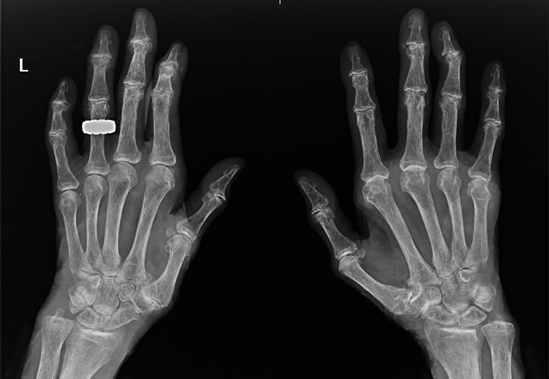
Investigations in primary care should focus on trying to establish the cause of the symptoms and ruling out differential diagnoses. They should include inflammatory markers, serum uric acid, full blood count, rheumatoid factor/anti-CCP antibodies, and X-rays of the affected joint as well as hands (see figure 1) and feet.
The possibility of malignancy should always be borne in mind and screening investigations guided by the history and examination.
Practical tip 2: Consider testing for rheumatoid factor and anti-CCP antibodies in older patients presenting with shoulder or hip girdle pain and inflammatory stiffness.
Practical tip 3: Consider PSA screening in older men with new onset inflammatory arthritis. Prostate cancer can sometimes cause an atypical inflammatory arthritis.
Referral
Referral to a rheumatologist should be considered if no alternative explanation can be found for the symptoms. This recommendation is based on the existing outcome data for patients with EORA. Although it was earlier thought that EORA had a better prognosis with a milder clinical course compared with YORA, evidence now suggests that this is not the case.5,6
The outcomes and disability from untreated disease are similar in EORA and YORA. Therefore, early treatment is imperative. Urgent referral of all suspected cases of RA has been endorsed by NICE guidance on the management of RA in adults.7,8
Management
Management is challenging for a variety of reasons, see table 3. In general, the pharmacokinetics of drugs differ in the elderly partly as a result of declining renal function and changes in body composition with aging.9
In addition, older patients may have multiple comorbidities and may be taking a wide range of medications.
All this translates to a higher risk of adverse reactions, drug interactions and complications caused by polypharmacy.
Further research into the management of this group of patients is ongoing and no specific treatment recommendations are currently available. In theory, if the disease outcome of EORA is similar to YORA, the treatment protocols should not be any different and this concept is supported by evidence.5,10 However, in a practical setting this will be challenging and older patients may be offered less aggressive treatment. It has been shown that as a consequence, patients with EORA run the risk of being undertreated resulting in poor disease control, see figure 2.6
The current recommendation would be to follow the treatment guidelines for RA but with more careful tailoring to the individual patient taking account of any comorbidities. Tailoring treatment should not mean withholding treatment purely based on age. The current NICE treatment recommendations for adult RA are summarised in table 4.7,8
Common misconceptions about the management of inflammatory arthritis are listed in table 5.
The backbone of treatment remains methotrexate which is a conventional synthetic disease modifying drug (DMARD). Other options in this category include leflunomide, sulphasalazine and hydroxychloroquine. Since the onset of action of these medications can take up to 12 weeks, glucocorticoids can be used as bridging therapy. However, the potential limitations of glucocorticoids in this age group, for example comorbidities such as diabetes and neuropsychiatric side effects such as agitation, confusion or psychosis need to be considered.
In cases of failure to achieve remission or low disease activity with conventional DMARDs, addition of biologic DMARDs is recommended, although generally not as monotherapy. Biologic medication classes approved for the treatment of RA include IL-6 inhibitors (tocilizumab, sarilumab), TNF inhibitors (etanercept, infliximab, adalimumab etc), anti-CD20 antibodies (rituximab) and T cell inhibitors (abatacept). Janus kinase (JAK) inhibitors (tofacitinib and baricitinib) have also been approved.
Monitoring
All adults with RA should be followed up regularly in secondary care. In the initial stages, monitoring should be more frequent to ensure the treatment target is achieved (remission or low disease activity). It can be extended to 12 monthly once the disease and treatment regimen have become stable.
Regular blood monitoring is necessary for patients on DMARD therapy (excluding hydroxychloroquine), this can be done in primary or secondary care according to local or national guidelines, or shared care arrangements.
An annual review is recommended for all patients to assess the following aspects: disease activity, functional ability, development of comorbidities (hypertension, ischaemic heart disease, osteoporosis, depression) or complications (vasculitis, disease of the cervical spine, lung or eyes) and the impact the disease is having on the patient’s life.
Conclusion
RA is a systemic disease which can present at any age. Although it primarily affects the small joints of the hands and feet, it can present with large joint synovitis. Constitutional symptoms and a systemic inflammatory response can be present, and these are more common in the EORA group.
Early diagnosis and treatment can improve long-term outcomes and reduce the development of comorbidities and complications.
While methotrexate remains first-line therapy, the development of numerous biologic and other new therapies over the past 15 years has contributed to better control of articular and extra-articular disease, and reduced disability.
REFERENCES
1 Yazici Y, Paget SA. Elderly-onset rheumatoid arthritis. Rheum Dis Clin North Am 2000;26(3):517-26
2 Entezami P, Fox DA, Clapham PJ et al. Historical perspective on the etiology of rheumatoid arthritis. Hand Clin 2011;27(1):1-10
3 Kobak S, Bes C. An autumn tale: geriatric rheumatoid arthritis. Ther Ad Musculoskel Dis 2018;10(1):3-11
4 Chen DY, Hsieh TY, Chen YM et al. Proinflammatory cytokine profiles of patients with elderly-onset rheumatoid arthritis: a comparison with younger-onset disease. Gerontology 2009;55(3):250-58
5 Sugihara T, Harigai M. Targeting low disease activity in elderly-onset rheumatoid arthritis: Current and future roles of biological disease-modifying antirheumatic drugs. Drugs Aging 2016;33:97-107
6 Tutuncu Z, Reed G, Kremer J, Kavanaugh A. Do patients with older onset rheumatoid arthritis receive less aggressive treatment than younger patients. Ann Rheum Dis 2006;65:1226-29
7 National Institute for Health and Care Excellence. NG100. Rheumatoid arthritis in adults: management. NICE. London. 2018
8 National Institute for Health and Care Excellence. QS33. Rheumatoid arthritis in over 16s. NICE. London. 2013 (Updated Jan 2020)
9 Klotz U. Pharmacokinetics and drug metabolism in the elderly. Drug Metab Rev 2009;41(2):67-76
10 Villa-Blanco JI, Calvo-Alén J. Elderly onset rheumatoid arthritis: differential diagnosis and choice of first-line and subsequent therapy. Drugs Aging 2009;26(9):739-50
ARTICLE IN PDF
 Download this article in PDF format
PRESET SEARCHES
PubMed
Elderly onset rheumatoid arthritis
Rheumatoid arthritis general practice
NICE Evidence