SEARCH

Taggart D. Tailor treatment to the patient in stable angina. Practitioner 2011; 255 (1744):25-28
Tailor treatment to the patient in stable angina
19 Oct 2011
AUTHORS
Professor David Taggart MD PhD FRCS, Professor of Cardiovascular Surgery, University of Oxford and Consultant Cardiac Surgeon, John Radcliffe Hospital, Oxford
Article
Stable angina is a chronic condition which may persist for years. It affects a significant proportion of the population, and is more common with advancing age. According to the 2006 Health Survey for England, angina affects 8% of men and 3% of women aged 55-64 increasing to 14% and 8% respectively for men and women aged 65-74.1
Symptoms of angina can be alarming and distressing and it is therefore important that patients understand the underlying problem and what therapies are available to improve or abolish their symptoms.
The management of stable angina in all patients should include appropriate lifestyle changes and optimal medical therapy - and in some patients revascularisation. It is important to reassure patients with clinically significant coronary artery disease, both symptomatic and asymptomatic, that for most a combination of lifestyle modification and optimal medical therapy will prove sufficient treatment. However, a minority of patients may also require intervention either by stents or surgery.
In discussions with patients, it is useful to involve appropriate friends or family and to adapt recommendations to the patient’s individual circumstances. For example, whereas some limitation of strenuous exercise in an elderly patient may be appropriate this might be less attractive to younger patients.
Two important evidence-based guidelines have recently been published in this area. In 2010, the European Society of Cardiology
and the European Association for Cardio-Thoracic Surgery (ESC/EACTS) published joint guidelines for myocardial revascularisation.2 In July 2011, NICE published guidelines on the management of stable angina.3
Lifestyle modification
It is vital that patients with obvious precipitating factors that may promote or aggravate underlying coronary artery disease address these with appropriate lifestyle changes.
Cigarette smoking should be stopped and a balanced diet and regular exercise should be encouraged. Weight loss should be strongly advised for those who are significantly overweight and its additional benefits of reducing the risk of developing diabetes (or improving its control) and musculoskeletal problems emphasised.
Patients should also be given general advice about factors that aggravate angina for example:
• cold weather
• heavy exercise
• emotional stress
Advice on appropriate physical exertion and sexual activity should also be included. Patients may have to adapt their expectations to the severity of their symptoms.
Optimal medical therapy
What defines optimal therapy in an individual patient will be dependent on the burden and severity of the underlying coronary artery disease.
A short-acting nitrate for angina prevention and treatment of episodes of angina is recommended. It should be used prophylactically in advance of any exertion.
In terms of secondary prevention, basic therapy includes aspirin and a statin and antihypertensive agents for those with higher blood pressure.
Optimal drug therapy consists of two anti-anginal drugs, such as a beta-blocker or calcium channel blocker as first-line treatment and in preference to other drug therapy unless there are side-effects or contraindications to these.
A third anti-anginal drug is not necessary in those patients whose angina is adequately controlled on dual therapy but should be considered if symptoms remain intrusive. In such situations advice from a cardiologist may be useful.
Investigations
Some consideration should be given to the need for further investigation in patients with angina even if symptoms are appropriately controlled by lifestyle changes and optimal medical therapy. This is because the severity of symptoms does not necessarily correlate with the severity of the underlying disease process.
It is of critical importance to understand that the prognosis of coronary artery disease is strongly linked to the volume of underlying myocardial ischaemia and this cannot be determined simply by the level of symptoms. This should be explained to patients who should be offered further investigation if they wish and should certainly be encouraged in younger patients. It is mandatory in those with obvious changes in their level of symptoms.
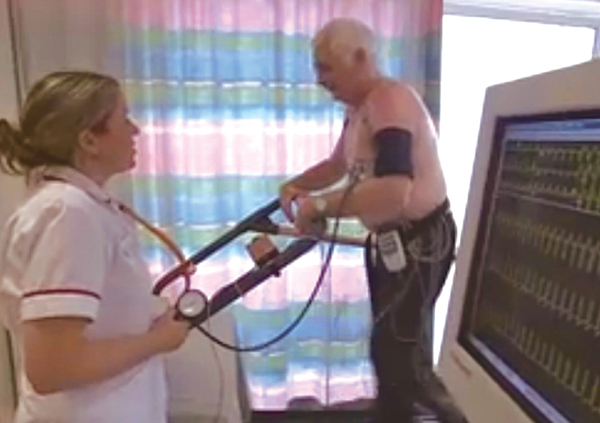
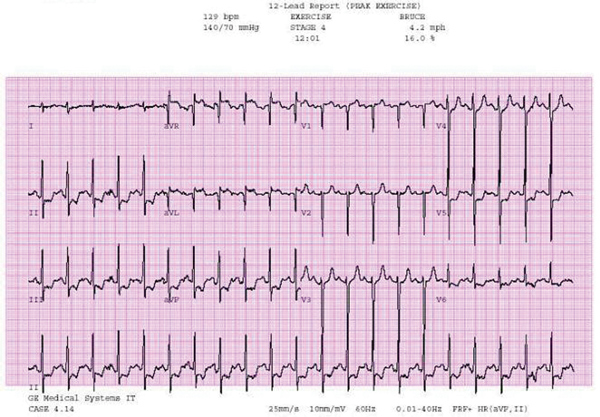
A relatively normal exercise test provides considerable reassurance that the patient is at low risk of subsequent adverse cardiac events. In patients who have positive exercise tests further investigation, usually by angiography, should be undertaken.
This can define the number of diseased coronary arteries and in association with simultaneous fractional flow reserve measurements can quantify the functional significance of any particular stenoses in causing ischaemia.
Unless a significant volume of myocardium (>10%) is at risk from ischaemia, there may be no prognostic benefit from revascularisation. However, even in patients in whom there is no significant burden of ischaemia, revascularisation can be justified on symptomatic grounds if the patient remains highly symptomatic despite optimal medical therapy or is intolerant of maximal medical therapy.
Revascularisation
The choice of revascularisation, whether by stents or surgery, has been the subject of much debate and recent guidelines produced jointly by the ESC and EACTS have helped clarify recommendations on when stents or coronary artery bypass grafting (CABG) should be carried out (see tables 1 and 2, opposite).
The guidelines emphasise that the recommendations apply where both therapies are potentially suitable and where the patient is at low risk for surgical intervention.
As the SYNTAX trial24 shows, for the majority of patients with three-vessel coronary artery disease (around 79%) and for almost two thirds of patients with left main stem disease, there is still a clear survival advantage associated with CABG rather than stents and in such patients stents are contraindicated unless the patient is unfit for, or refuses, surgery, see table 2 opposite.
However, for patients with less severe three-vessel coronary artery disease and less severe anatomical forms of left main disease there now appears to be equivalence in terms of survival between CABG and stents, although CABG still remains far more effective in reducing the need for further interventions.
Ongoing management
NICE emphasises the importance of the role of the multidisciplinary team. This should include a non-interventional cardiologist, a cardiac surgeon and an interventional cardiologist. It recommends the team meet regularly to discuss
the risks and benefits of continuing drug treatment or the revascularisation strategy.
Even after intervention, it is mandatory to ensure that the patient remains on optimal medical therapy, usually consisting of at least one antiplatelet agent, a beta-blocker and a statin. Additional therapy may be necessary depending on the severity of the coronary artery disease.
Conclusion
Most patients with chronic stable angina can be treated satisfactorily these days with a combination of lifestyle changes and optimal medical therapy. For a smaller cohort of patients with more severe disease, revascularisation may be appropriate. For patients with the most severe forms of coronary artery disease there is still a prognostic benefit from coronary artery bypass grafting while stents may be appropriate in less severe forms of disease.
REFERENCES
1 Health Survey for England 2006:CVD and risk factors adults, obesity and risk factors children. NHS Information Centre for Health and Social Care. 2008
2 The Task Force on Myocardial Revascularization of the European Society of Cardiology (ESC) and the European Association for Cardio-Thoracic Surgery (EACTS). Guidelines on myocardial revascularization. Euro Heart J 2010;31:2501-2555
3 National institute for Health and Clinical Excellence CG 126. Management of stable angina. NICE. London. 2011
4 Jeremias A, Kaul S, Rosengart TK et al. The impact of revascularization on mortality in patients with nonacute coronary artery disease. Am J Med 2009; 122:152-161
5 Yusuf S, Zucker D, Peduzzi P et al. Effect of coronary artery bypass graft surgery on survival: overview of
10-year results from randomised trials by the Coronary Artery Bypass Graft Surgery Trialists Collaboration. Lancet 1994; 344:563-570
6 Caracciolo EA, Davis KB, Sopko G et al. Comparison of surgical and medical group survival in patients with left main equivalent coronary artery disease. Long-term CASS experience. Circulation 1995; 91:2335-2344
7 Brener SJ, Lytle BW, Casserly I et al. Propensity analysis of long-term survival after surgical or percutaneous revascularization in patients with multivessel coronary artery disease and high-risk features. Circulation 2004; 109:2290-2295
8 Hannan EL, Racz MJ, Walford G et al. Long-term outcomes of coronary-artery bypass grafting versus stent implantation. N Engl J Med 2005; 352:2174-2183
9 Hannan EL, Wu C, Walford G et al. Drug-eluting stents vs. Coronary-artery bypass grafting in multivessel coronary disease. N Engl J Med 2008;358:331-341
10 Malenka DJ, Leavitt BJ, Hearne MI et al. Comparing long-term survival of patients with multivessel coronary disease after CABG or PCI: analysis of BARI-like patients in northen New England. Circulation 2005; 112: 1371-1376
11 Smith PK, Califf RM, Tuttle RH et al. Selection of surgical or percutaneous coronary intervention provides differential longevity benefit. Ann Thorac Surg 2006; 82: 1420-1428
12 Dzavik V, Ghali WA, Norris C et al. Long-term survival in 11,661 patients with multivessel coronary artery disease in the era of stenting: a report from the Alberta Provincial Project for outcome Assessment in Coronary Heart Disease (APPROACH) Investigators. Am Heart J 2001; 142:119-126
13 Davies RF, Goldberg AD, Forman S et al. Asymptomatic Cardiac Ischemia Pilot (ACIP) study two-year follow-up: outcomes of patients randomized to initial strategies of medical therapy versus revascularization. Circulation 1997; 95:2037-2043
14 Shaw LJ, Berman DS, Maron DJ et al. Optimal medical therapy with or without percutaneous coronary intervention to reduce ischemic burden: results from the Clinical Outcomes Utilizing Revascularization and Aggressive Drug Evaluation (COURAGE) trial nuclear substudy. Circulation 2008;117:1283-1291
15 Hachamovitch R, Hayes SW, Friedman JD et al. Comparison of the short-term survival benefit associated with revascularization compared with medical therapy in patients with no prior coronary artery disease undergoing stress myocardial perfusion single photon emission computed tomography Circulation 2003;107:2900-2907
16 Bucher HC, Hengstler P, Schindler C, Guyatt GH. Percutaneous transluminal coronary angioplasty versus medical treatment for non-acute coronary heart disease: meta-analysis of randomised controlled trials. BMJ 2000; 321:73-77
17 Katritsis DG, Ioannidis JP. Percutaneous coronary intervention versus conservative therapy in nonacute coronary artery disease: a meta-analysis. Circulation 2005;111:2906-2912
18 Hueb W, Lopes NH, Gersh B et al. Five-year follow-up of the Medicine, Angioplasty, or Surgery Study (MASS II): a randomized controlled clinical trial of 3 therapeutic strategies for multivessel coronary artery disease. Circulation 2007; 115:1082-1089
19 Schomig A, Mehilli J, de Waha A et al. A meta-analysis of 17 randomized trials of a percutaneous coronary intervention-based strategy in patients with stable coronary artery disease. J Am Coll Cardiol 2008; 52: 894-904
20 Trikalinos TA, Alsheikh-Ali AA, Tatsioni A et al. Percutaneous coronary interventions for non-acute coronary artery disease: a quantitative 20-year synopsis and a network meta-analysis. Lancet 2009; 373:911-918
21 Boden WE, O’Rourke RA, Teo KK et al. Optimal medical therapy with or without PCI for stable coronary disease. N Eng J Med 2007; 356:1503-1516
22 Aziz O, Rao C, Panesar SS et al. Meta-analysis of minimally invasive internal thoracic artery bypass versus percutaenous revascularisation for isolated lesions of the left anterior descending artery. BMJ 2007; 334:617
23 Kapoor JR, Gienger AL, Ardehali R et al. Isolated disease of the proximal left anterior descending artery comparing the effectiveness of percutaneous coronary interventions and coronary artery bypass surgery. JACC Cardiovasc Interv 2008; 1:483-491
24 Serruys PW, Morice MC, Kappetein AP et al. Percutaneous coronary intervention versus coronary–artery bypass grafting for severe coronary artery disease. N Eng J Med 2009; 360: 961-972
USEFUL INFORMATION
The British Heart Foundation
Accessible explanatory booklets for patients with coronary artery disease
NICE CG126. The management of stable angina
The full quideline, quick reference guide, and summary for patients are available from
 Download this article in PDF format