SEARCH

Basu J, Sharma S. Erectile dysfunction heralds onset of cardiovascular disease. Practitioner 2016;260(1794):21-23
Erectile dysfunction heralds onset of cardiovascular disease
23 Jun 2016
AUTHORS
Dr Joyee Basu BMBCh MA MRCP, Cardiology Registrar, Royal Berkshire Hospital, Reading, UK
Professor Sanjay Sharma MD FRCP (UK) FESC (UK), Professor of Clinical Cardiology, St George's University London, London, UK
Article
Erectile dysfunction (ED) relates to the inability to achieve or sustain an erection for the duration of sexual intercourse. Around 150 million men are estimated to have ED and this figure is predicted to increase to 320 million by 2025.1
ED is usually graded using the International Index of Erectile Dysfunction (ILEF-5)2 which has a high sensitivity (98%) and specificity (88%).3 ED was once assumed to be a psychological condition but has now been shown to share risk factors with cardiovascular disease including age, diabetes mellitus, smoking, hypertension and hypercholesterolaemia, suggesting an underlying vascular pathology.4
Evidence reveals that there is a potential link between ED and subsequent development of coronary artery disease.5-13 ED itself may also increase cardiovascular risk.14,15 Cardiovascular disease is a leading cause of mortality and morbidity worldwide. Current efforts are focused on primary prevention and early detection of coronary artery disease. Therefore, patients presenting with ED may provide an early opportunity to identify at-risk individuals.
This article explores the evidence for the link between ED and cardiovascular disease, proposed mechanisms and recommendations for the assessment of patients who present with ED in primary care.
Evidence from trials
Many studies have explored the association between ED and cardiovascular risk. These include sub-studies of large trials such as the Prostate Cancer Prevention Trial.5
Of the 9,457 men with ED at entry those who developed ED during follow-up had a significant risk of subsequent cardiovascular events compared with subjects without ED. Other trials have reported similar findings.6,7 These findings have been corroborated by meta-analyses of cohort studies,8 as well as systematic reviews.9 The relative risk of developing coronary artery disease within ten years, in patients with moderate to severe ED, has been calculated as 14% in men aged 30-39 years and may be as high as 27% in those aged 60-69.10
The association appears greater when younger men presenting with ED are considered. In a retrospective study comparing atherosclerotic events in a group of patients with ED versus an equivalent general male population with normal erectile function, the former group had a significantly higher rate of cardiovascular events, particularly those presenting at a young age.11 In another case control study of patients referred for coronary angiography,12 the severity of coronary artery disease was higher in patients with ED who were under 60.
Furthermore, in studies looking specifically at a younger cohort (20-60 years), 86% of the subjects who underwent coronary angiography were found to have co-existent ED.13
This highlights the importance of risk factor management and its consideration even at a young age.
The severity of ED has also been linked with the severity of coronary artery disease. A recent study6 compared SYNTAX scores in men undergoing coronary angiography with ILEF-5 scores. The SYNTAX score was developed for the SYNTAX trial and is an angiographic scoring system which separates patients into low, intermediate and high risk when undergoing percutaneous coronary intervention.
Men with moderate to severe ED had a significantly higher SYNTAX score compared with men with normal erectile function. The correlation between severity of coronary artery disease and ED has been duplicated in other studies using alternate measures of severity of coronary artery disease.16
ED as an independent predictor of CV risk
Although ED and cardiovascular disease share many risk factors there is evidence that ED may also be an independent predictor of cardiovascular risk and mortality. A meta-analysis of 12 prospective cohort studies including 36,744 subjects14 concluded that ED significantly increased the risk of cardiovascular disease, stroke and all cause mortality. This was corroborated in a subsequent meta-analysis of 14 longitudinal studies including 92,757 subjects, detecting the ability of ED to predict events.15
The effect on increased risk of mortality is largely due to the effect of ED on cardiovascular mortality and its hazard ratios are comparable with those obtained for conventional cardiovascular risk factors.
Mechanisms
In order to achieve and maintain an erection, there is active relaxation of the cavernosal arteries and passive restriction of venous outflow. This is mediated by the nitric oxide cyclic guanosine monophosphate (cGMP) pathway. Nitric oxide also has anti-atherogenic effects. Endothelial dysfunction is partly thought to be caused by impairment of the nitric oxide pathway and can occur throughout the arterial tree. Evidence in support of ED mediated by endothelial dysfunction comes from studies of patients with obstructive coronary artery disease undergoing endothelial function testing.17 In these patients levels of inhibitors of nitric oxide synthetase, which catalyses the production of nitric oxide, was noted to be higher in patients with severe ED.
A study comparing men with ED and vascular risk factors and men with ED and no vascular risk factors18 showed that biochemical markers of endothelial dysfunction were raised in those with ED and this was independent of vascular risk factors.
The presence therefore of endothelial dysfunction as assessed by the surrogate of ED may be a silent marker of the same disease process in the coronary tree. In fact, endothelial dysfunction itself has been associated with an increased risk of future cardiovascular events.19,20 Atherosclerosis is thought to be driven by inflammation secondary to endothelial damage of the intimal layer of an artery and therefore the same process giving rise to coronary artery disease is thought to occur in the cavernosal arteries.
The artery size hypothesis has been proposed to explain the link between the two, whereby a larger vessel is able to tolerate a higher plaque burden but a smaller artery cannot 21 and may explain why ED occurs before manifestation of coronary artery disease.
Cardiovascular risk assessment
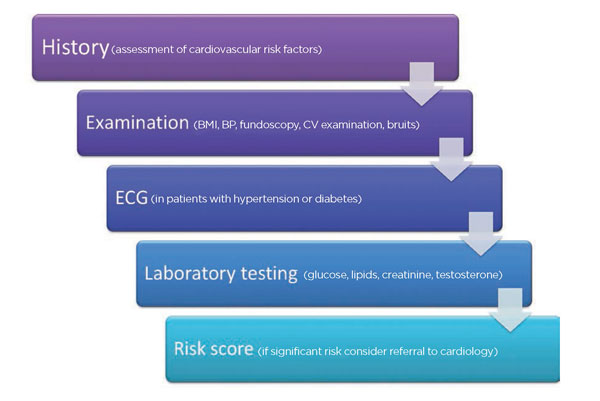
There is likely to be a delay between presentation with ED and clinical presentation with coronary artery disease. In one study, ED was found to present 39 months prior to coronary symptoms.6,7 This provides the clinician with an opportunity to modify risk. Recommendations from the Mayo Clinic22 and a recently published review23 regarding initial review of patients with ED include a full history, with assessment of cardiovascular risk factors (hypertension, prediabetes, diabetes, hypercholesterolaemia, smoking status and family history of premature cardiovascular disease), dietary and lifestyle assessment.
A thorough clinical examination assessing BMI, measurement of blood pressure, examination of fundi, cardiovascular examination, auscultation for carotid bruits and vascular examination should also be performed, see figure 1. An ECG is recommended in patients with hypertension or diabetes. Laboratory testing should include fasting glucose, lipid profile, creatinine and testosterone.
Risk stratification should also be performed using a conventional cardiovascular risk score. Those with a significant QRISK score or JBS3 risk score should be referred to a cardiologist. The consensus opinion22,24 is that intermediate- or high-risk patients should undergo exercise stress testing or CT coronary angiography (CTCA). Although exercise testing may be low yield in risk stratifying patients CTCA has shown more promise.25 Cardiology referral and tailored investigations may be a good compromise in equivocal cases. Nevertheless, in patients with identified cardiovascular risk factors aggressive primary prevention should be carried out including weight loss, exercise prescription, dietary modification to address hypercholesterolaemia and glucose handling, tight control of blood pressure, and smoking cessation advice.
Conclusion
The link between ED and coronary artery disease is well supported in the literature. Studies have shown that severity of ED predicts severity of coronary artery disease.
The proposed pathological mechanisms are based on a theory of endothelial dysfunction which eventually leads to atherosclerosis.
This occurs first in more vulnerable narrow diameter vessels such as the cavernosal arteries.
Furthermore, ED itself may be an independent risk factor for cardiovascular disease as well as cardiovascular related mortality.
As ED often predates the development of coronary artery disease this provides GPs with a valuable window of opportunity for risk assessment, subsequent primary prevention and early referral to a cardiologist.
REFERENCES
1 Aytaç A, Mckinlay J, Krane R. The likely worldwide increase in erectile dysfunction between 1995 and 2025 and some possible policy consequences. BJU Int 1999; 84(1):50-56
2 Rosen R, Cappelleri J, Smith M et al. Development and evaluation of an abridged, 5-item version of the International Index of Erectile Function (IIEF-5) as a diagnostic tool for erectile dysfunction. Int J Impot Res 2000;11(6):319-326
3 Rhoden E, Telöken C, Sogari P, Vargas Souto C. The use of the simplified International Index of Erectile Function (IIEF-5) as a diagnostic tool to study the prevalence of erectile dysfunction. Int J Impot Res 2002;14(4):245-250
4 Sullivan M, Keoghane S, Miller M. Vascular risk factors and erectile dysfunction. BJU Int 2002;87(9):838-845
5 Thompson I, Tangen C, Goodman P et al. Erectile dysfunction and subsequent cardiovascular disease. JAMA 2005;294(23):2996-3002
6 Andrade W, Oliveira P, Laydner H et al. Severity of erectile dysfunction is highly correlated with the syntax score in patients undergoing coronariography. Int Braz J Urol 2016;42(1):123-131
7 Montorsi F, Briganti A, Salonia A et al. Erectile dysfunction prevalence, time of onset and association with risk factors in 300 consecutive patients with acute chest pain and angiographically documented coronary artery disease. Eur Urol 2003;44(3):360-365
8 Guo W, Liao C, Zou Y et al. Erectile dysfunction and risk of clinical cardiovascular events: a meta-analysis of seven cohort studies. J Sex Med 2010;7(8):2805-2816
9 Gandaglia G, Briganti A, Jackson G et al. A systematic review of the association between erectile dysfunction and cardiovascular disease. Eur Urol 2014;65(5):968-978
10 Ponholzer A, Temml C, Obermayr R et al. Is erectile dysfunction an indicator for increased risk of coronary heart disease and stroke? Eur Urol 2005;48(3):512-518
11 Chew K, Finn J, Stuckey B et al. Erectile dysfunction as a predictor for subsequent atherosclerotic cardiovascular events: findings from a linked-data study. J Sex Med 2010;7(1):192-202
12 Riedner C, Rhoden E, Fuchs S et al. Erectile dysfunction and coronary artery disease: an association of higher risk in younger men. J Sex Med 2011;8(5):1445-1453
13 Dattatrya K, Vedpalsingh T, Gorakhnath W, Kiran P. Can erectile dysfunction in young patients serve as a surrogate marker for coronary artery disease? J Clin Diagn Res 2015; 9(11):PCO1-PCO3
14 Dong J, Zhang Y, Qin L. Erectile dysfunction and risk of cardiovascular disease. JACC 2011;58(13):1378-1385
15 Vlachopoulos C, Terentes-Printzios D, Ioakeimidis N et al. Prediction of cardiovascular events and all-cause mortality with erectile dysfunction: a systematic review and meta-analysis of cohort studies. Circ Cardiovasc Qual Outcomes 2013;6(1):99-109
16 Greenstein A, Chen J, Miller H et al. Does severity of ischaemic coronary disease correlate with erectile dysfunction? Int J Impot Res 1997;9(3):123-126
17 Elesber A, Solomon HM, Lennon R et al. Coronary endothelial dysfunction is associated with erectile dysfunction and elevated asymmetric dimethylarginine in patients with early atherosclerosis. Eur Heart J 2006;27(7): 824-831
18 Bocchio M, Desideri G, Scarpelli P et al. Endothelial cell activation in men with erectile dysfunction without cardiovascular risk factors and overt vascular damage. J Urol 2004;171(4):1601-1604
19 Halcox J, Schenke W, Zalos G et al. Prognostic value of coronary vascular endothelial dysfunction. Circulation 2002;106(6):653-658
20 Suwaidi J, Hamasaki S, Higano S et al. Long-term follow-up of patients with mild coronary artery disease and endothelial dysfunction. Circulation 2000;101(9): 948-954
21 Montorsi P, Ravagnani P, Galli S. The artery size hypothesis: a macrovascular link between erectile dysfunction and coronary artery disease. Am J Cardiol 2005;96(12):19-23
22 Nehra A, Jackson G, Miner M et al. The Princeton III consensus recommendations for the management of erectile dysfunction and cardiovascular disease. Mayo Clin Proc 2012;87(8):766-778
23 Shah N, Cainzos-Achirica M, Feldman D et al. Cardiovascular disease prevention in men with vascular erectile dysfunction: the view of the preventive cardiologist. Am J Med 2016;129(3):251-259
24 Miner M, Nehra A, Jackson G. All men with vasculogenic erectile dysfunction require a cardiovascular workup. Am J Med 2014;127(3):174-182
25 Jackson G, Padley S. Erectile dysfunction and silent coronary artery disease: abnormal computed tomography coronary angiogram in the presence of normal exercise ECGs. Int J Clin Pract 2008;62(6): 973-976
ARTICLE IN PDF
 Download this article in PDF format
PRESET SEARCHES
PubMed
Erectile dysfunction and cardiovascular disease
NICE evidence search
Erectile dysfunction cardiovascular risk
Immediate CPD prompts
These handy templates*, associated with all articles, prompt drafting of personal learning, reflection and planning.
Save your record straight into your personal development folder on your device or cloud storage system.
*Adobe fillable PDFs. Adobe reader needed for iPad
Comment or question
If you, or your peer group, would like to comment on an article or have a question for the authors, write to:
Editor