SEARCH

Ball SL, Tidman MJ. Managing patients with hidradenitis suppurativa. Practitioner 2016; 260(1793):25-29
Managing patients with hidradenitis suppurativa
23 May 2016
AUTHORS
Dr Stephanie L Ball BMBS MSc MRCP, Registrar
Dr Michael J Tidman MD FRCP(Ed) FRCP(Lond) Consultant Dermatologist, Department of Dermatology, Royal Infirmary of Edinburgh, Edinburgh, UK
Article
Hidradenitis suppurativa is a painful inflammatory condition affecting apocrine-bearing areas of the skin. It is primarily a disease of follicular occlusion, associated with an autosomal dominant mode of inheritance.
Epidemiological studies conducted in the USA, Denmark and France give an average prevalence of 1%. 1,2,3,4 Women appear to be more than twice as likely to be affected as men.3 Historically, hidradenitis suppurativa has been the subject of relatively little research, despite the fact that it is common and often significantly impacts on quality of life.5
Presentation
Hidradenitis suppurativa forms part of a tetrad of follicular occlusion, the other components are acne conglobata, pilonidal disease and dissecting cellulitis. The onset of hidradenitis suppurativa is variable but usually occurs in the second and third decades of life, coinciding with development of the apocrine glands. Hence it is rarely seen in pre-pubertal children.6
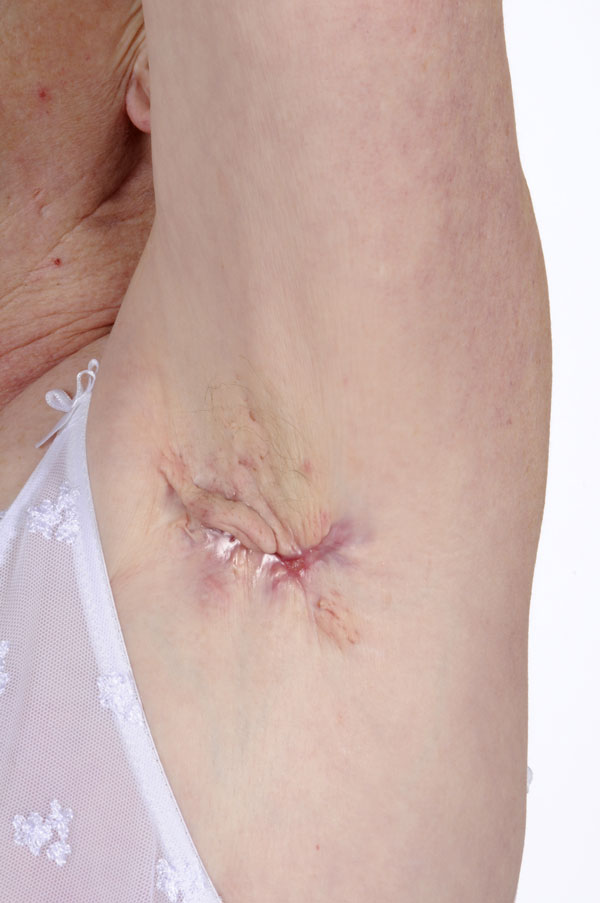
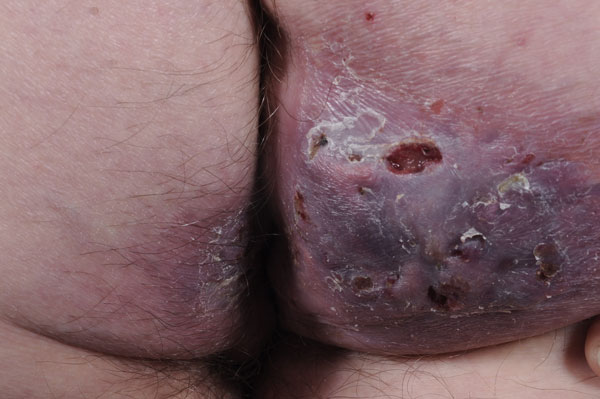
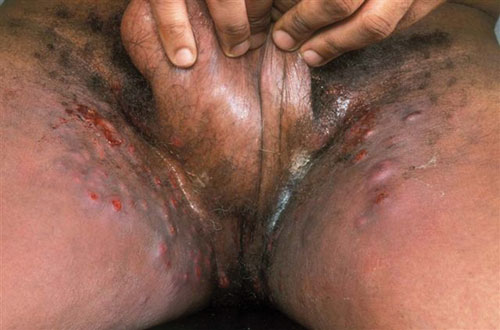
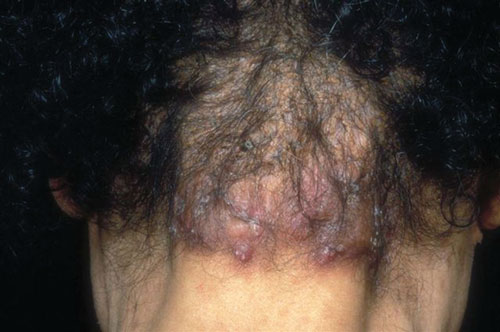
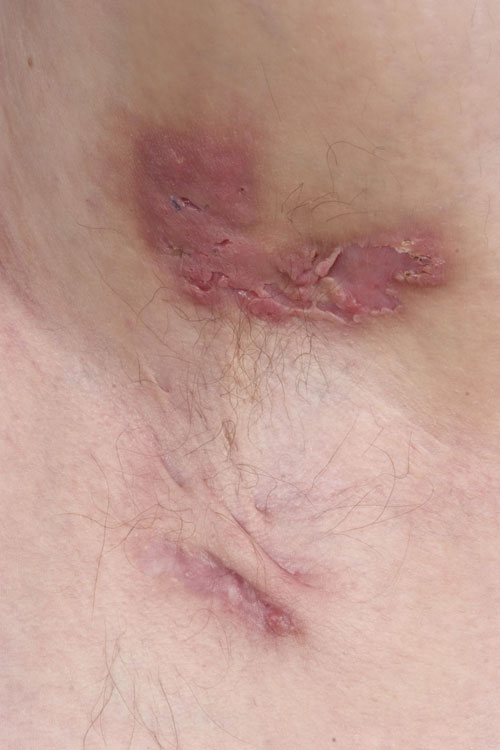
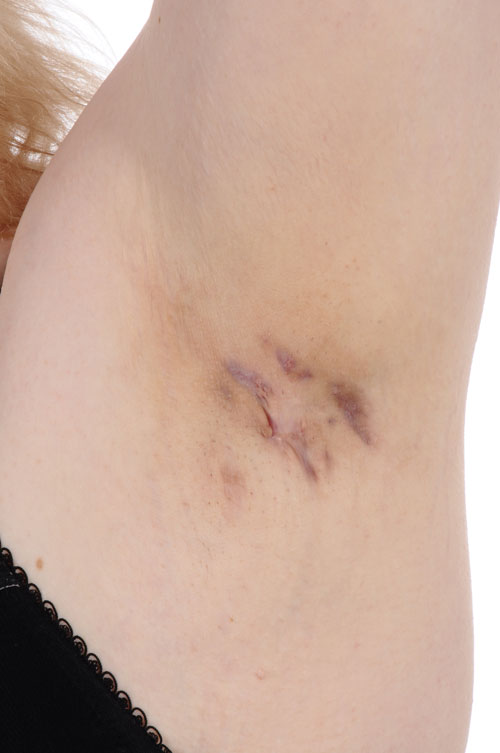
The most commonly involved anatomical sites are the intertriginous (inverse) areas of skin such as the axillae (see figure 1, and figures 5 &6), groin (see figure 3), and inframammary regions, although the buttocks (see figure 2), nuchal scalp (see figure 4) and retroauricular areas are notable atypical sites, more commonly seen in men.6,7
Hidradenitis suppurativa varies in clinical presentation and severity, and is often associated with significant pain and morbidity. The condition is characterised by painful, inflammatory papules and nodules which frequently progress to form abscesses, sinus tracts and hypertrophic scars. A useful physical sign is double-headed comedones. Pressure on inflammatory lesions may lead to serosanguinous or purulent discharge. Postinflammatory scarring is frequently hypertrophic or rope like, and multiple interconnected sinus tracts may lead to honeycomb patterning.6,8
The complications of hidradenitis suppurativa include lymphatic obstruction or contractures from scarring, sacral osteomyelitis, anaemia and formation of pyogenic granulomas. Squamous cell carcinoma is another well recognised but rare risk in these patients, and may present difficulties in diagnosis if mistaken for inflammatory lesions.8,9
Pain is a significant complication as is the psychosocial impact. Patients with hidradenitis suppurativa have a mean score on the Dermatology Quality of Life Index that is higher than other skin conditions associated with high morbidity including eczema, acne, psoriasis and even chronic urticaria.10
Pathogenesis
The primary event in the pathogenesis of hidradenitis suppurativa appears to be occlusion of the apocrine glands caused by epidermal hyperplasia. Subsequent follicular rupture leads to inflammation and abscess formation with consequent scarring.11 The ruptured follicles may reform to create the sinus tracts and fistulas seen in the disease.12
A number of different factors have been implicated in the aetiology of hidradenitis suppurativa, including genetics, obesity and smoking.
Recent studies have found mutations in the gamma-secretase genes, which could possibly contribute to the follicular occlusion pathway.13,14
Metabolic syndrome is significantly more common in hidradenitis suppurativa patients than those without the condition (P < 0.001), and obesity is also well recognised as an independent factor. Almost half of hidradenitis suppurativa patients are overweight.15,16
The effects of weight on pathogenesis could relate to increased frictional forces and a low-level pro-inflammatory effect.11 The prevalence of smokers within the hidradenitis suppurativa population is significantly higher than in the normal population. A recent Dutch study found that not only were 71% of hidradenitis suppurativa patients current smokers, but there appears to be a correlation between smoking and more severe disease.17
Another study reported a lower remission rate in those who were current smokers.18 The mechanism of smoking on the pathogenesis of hidradenitis suppurativa may be associated with nicotine causing epidermal hyperplasia and subsequent follicular occlusion.19
Bacteria are not felt to have a primary role in lesion formation, and abscesses are often sterile. No obvious relationship between hidradenitis suppurativa and hormonal factors has been established.20,21
Confirming diagnosis
A European guideline published in 2015 gives primary and secondary diagnostic criteria, see table 1.22
The Hurley staging system provides a classification of severity, see table 2.23
The diagnosis of hidradenitis suppurativa is clinically based, without a specific diagnostic test. In primary care it is prudent to take a bacterial swab from any discharging abscesses to exclude superadded infection or colonisation.24 Blood tests are helpful to screen for underlying disease such as metabolic syndrome or anaemia of chronic disease. Skin biopsy is not routinely required.
Risk factors and associated conditions
The most important non-genetic factors implicated in hidradenitis suppurativa are obesity and smoking.
There is also a possible link between hidradenitis suppurativa and inflammatory bowel disease, though cutaneous Crohn’s disease is also a common differential diagnosis. A Dutch study found that 17% of Crohn’s patients and 14% of patients with ulcerative colitis suffered with recurrent abscesses in the axillae or groin.25
Management
In 2015, the European Dermatology Forum published evidence-based guidelines to aid clinicians in the management of hidradenitis suppurativa patients.22 These are broadly categorised into either surgical or medical management.
In general, locally recurring lesions can be treated surgically and more widespread disease may be better managed with a combination of medical treatment and surgery, see box 1.
Although it is generally recommended that patients should try to attain an ideal weight and to stop smoking, these recommendations are largely based on anecdotal evidence. Psychological support is often paramount and signposting to groups such as the Hidradenitis Suppurativa Trust (www.hstrust.org) can provide valuable information and help. Pain control should also be addressed within the primary care setting.
Again, the use of topical antiseptics (such as 4% chlorhexidine lotion) is frequently advised, despite no evidence to support this. However, first-line treatment in the form of topical clindamycin 1% is advocated for mild disease, and has been shown to be helpful in a small randomised controlled trial.26
Should topical antibiotics not be effective, or if disease is more severe in the first instance, the next treatment option is oral antibiotics, initially, a tetracycline, such as lymecycline for four months.
More potent treatment options for recalcitrant disease include combination therapy of oral clindamycin (300 mg twice daily), and rifampicin (300 mg twice daily for three months), which leads to an improvement in about 80% of cases.27, 28 If this proves ineffective, retinoids are often used. The evidence shows that isotretinoin is less effective than acitretin. However, because of the ongoing teratogenic risk with acitretin (a woman should not conceive for two years after cessation of the drug), isotretinoin is often favoured in younger women.29
The advent of biological therapies has significantly improved the outcome for hidradenitis suppurativa patients.
A systematic review in 2012 found that 89% of hidradenitis suppurativa patients treated with infliximab had a moderate or significant response, as did 79% of patients treated with adalimumab.29
In May 2016 NICE published final draft guidance on the use of adalimumab with the recommendation that the drug is used for people with active moderate to severe hidradenitis whose disease has not responded to conventional systemic therapy. The drug is recommended only if the company provides it at the price agreed in the patient access scheme. Final guidance is expected to be published in June 2016.30
Surgical management ranges from simple incision and drainage of single abscesses to deroofing of sinus tracts with secondary intention healing, through to extensive operations such as radical wide excisions. The latter is thought to be the only definitive curative treatment and can involve removal of an entire anatomical area of apocrine-bearing skin, with repair via skin grafting or flaps. Ablative laser treatments are also sometimes used.
Referral
Patients with Hurley stage I disease can be effectively managed in primary care, with lifestyle advice, topical clindamycin, and oral lymecycline should lesions persist. Beyond this, referral to secondary care is appropriate.
Should the patient have more severe disease at first presentation, rapid referral and prescription of tetracycline antibiotics pending the dermatology appointment would be advocated.
Conclusion
Hidradenitis suppurativa is a painful, debilitating and under-researched condition that has a high psychological and physical burden on the people it affects. Its pathogenesis is complex and multifactorial and there is a comparative lack of evidence-based treatments available, particularly in the form of randomised placebo-controlled trials. However, the European guidelines have provided a helpful treatment pathway, with evaluation of all current available research.
Taking a holistic approach when assessing and treating these patients is vital, and referral to dermatology services is important should simple measures fail to be effective.
REFERENCES
1 Jemec GB. The symptomatology of hidradenitis suppurativa in women. Br J Dermatol 1988;119:345-350
2 Jemec GB, Heidenheim M, Nielsen NH. The prevalence of hidradenitis suppurativa and its potential precursor lesions. J Am Acad Dermatol 1996;35:191-4
3 Shahi V, Alikhan A, Vazquez BG et al. Prevalence of hidradenitis suppurativa: a population-based study in Olmsted County, Minnesota. Dermatology 2014;229(2):154-58
4 Revuz JE, Canoui-Poitrine F, Wolkenstein P et al. Prevalence and factors associated with hidradenitis suppurativa: results from two case-control studies. J Am Acad Dermatol 2008;59:596-601
5 Alavi A, Anooshervani N, Kim WB et al. Quality-of-life impairment in patients with hidradenitis suppurativa: a Canadian study. Am J Clin Dermatol 2015; 16(1):61-65
6 Micheletti RG. Hidradenitis suppurativa: current views on epidemiology, pathogenesis, and pathophysiology. Semin Cutan Med Surg 2014;33(Suppl 3)S48-50
7 Dufour DN, Emtestam L, Jemec GB. Hidradenitis suppurativa: a common and burdensome, yet under-recognised, inflammatory skin disease. Postgrad Med J 2014;90(1062):216-21
8 Poli F, Jemec GBE, Revuz J. Clinical presentation. In: Hidradenitis suppurativa, GBE Jemecs, J Revuz, JJ Leyden (Eds). Springer. Heidelberg. 2006: pp.12-15
9 Alikhan A, Lynch PJ, Eisen DB. Hidradenitis suppurativa: a comprehensive review. J Am Acad Dermatol 2009;60:539-61
10 Matusiak Ł, Bieniek A, Szepietowski JC. Hidradenitis suppurativa markedly decreases quality of life and professional activity. J Am Acad Dermatol 2010;62:706-08
11 Nazary M, der Zee HV, Prens E et al. Pathogenesis and pharmacotherapy of Hidradenitis suppurativa. Eur J Pharmacol 2011;672:1-8
12 Wollina U, Koch A, Heinig B et al. Acne inversa (Hidradenitis suppurativa): a review with a focus on pathogenesis and treatment. Indian Dermatol Online J 2013;4(1):2-11
13 Fitzsimmons JS, Guilbert PR. A family study of hidradenitis suppurativa. J Med Genet 1985;22:367-73
14 Pink AE, Simpson MA, Desai N et al. Mutations in the γ-secretase genes NCSTN, PSENEN, and PSEN1 underlie rare forms of hidradenitis suppurativa (acne inversa) J Invest Dermatol 2012;132:2459-61
15 Shalom G, Freud T, Harman-Boehm I et al. Hidradenitis suppurativa and metabolic syndrome: a comparative cross-sectional study of 3207 patients. Br J Dermatol 2015;173:464-70
16 Canoui-Poitrine F, Revuz JE, Wolkenstein P et al. Clinical characteristics of a series of 302 French patients with hidradenitis suppurativa, with an analysis of factors associated with disease severity. J Am Acad Dermatol 2009;61:51-7
17 Schrader AMR, Deckers IE, van der Zee HH et al. Hidradenitis suppurativa: A retrospective study of 846 Dutch patients to identify factors associated with disease severity. J Am Acad Dermatol 2014;71:460-67
18 Kromann CB, Deckers IE, Esmann S et al. Risk factors, clinical course and long-term prognosis in hidradenitis suppurativa: a cross-sectional study. Br J Dermatol 2014;171(4):819-24
19 Hana A, Booken D, Henrich C et al. Functional significance of non-neuronal acetylcholine in skin epithelia. Life Sci 2007;80(24-25):2214-20
20 Mortimer PS, Dawber RP, Gales MA, Moore RA. Mediation of hidradenitis suppurativa by androgens. Br Med J 1986;292(6515):245-48
21 Harrison BJ, Read GF, Hughes LE. Endocrine basis for the clinical presentation of hidradenitis suppurativa. Br J Surg 1988;75(10):972-75
22 Zouboulis CC, Desai N, Emtestam L et al. European S1 guideline for the treatment of hidradenitis suppurativa/acne inversa. J Eur Acad Dermatol Venereol 2015;29:619-44
23 Hurley H. Axillary hyperhidrosis, apocrine bromhidrosis, hidradenitis suppurativa, and familial benign pemphigus. In: RH Roenigk, HH Roenigk Jr. Eds. Dermatologic surgery: principles and practice. Marcel Dekker. New York, NY. 1989:729-39
24 Guet-Revillet H, Coignard-Biehler H, Jais JP et al. Bacterial pathogens associated with hidradenitis suppurativa, France. Emerg Infect Dis 2014; 20:1990-98
25 Van der Zee HH, van der Woude CJ, Florencia EF, Prens EP. Hidradenitis suppurativa and inflammatory bowel disease: are they associated? Results of a pilot study. Br J Dermatol 2010;162:195-7
26 Clemmensen OJ. Topical treatment of hidradenitis suppurativa with clindamycin. Int J Dermatol 1983;22(5):325-28
27 Gener G, Canoui-Poitrine F, Revuz JE et al. Combination therapy with clindamycin and rifampicin for hidradenitis suppurativa: a series of 116 consecutive patients. Dermatology 2009;219:148-54
28 van der Zee Hessel H, Boer J, Prens EP, Jemec Gregor BE. The effect of combined treatment with oral clindamycin and oral rifampicin in patients with hidradenitis suppurativa. Dermatology 2009;219:143-7
29 Blok JL, van Hattem S, Jonkman MF, Horváth B. Systemic therapy with immunosuppressive agents and retinoids in hidradenitis suppurativa: a systematic review. Br J Dermatol 2013;168:243-52
30 National Institute for Health and Care Excellence. GID-TAG520. Hidradenitis suppurativa (moderate, severe).[ID812]. NICE. London. 2016
ARTICLE IN PDF
 Download this article in PDF format
EXTERNAL WEBLINKS
British Association of Dermatologists
Hidradenitis Suppurativa Trust
We welcome your feedback
If you would like to comment on this article or have a question for the authors, write to: [email protected]