SEARCH

Larmour KE, Maxwell AP. Early intervention can improve outcomes in acute kidney injury. Practitioner 2015;259(1783):25-28
Early intervention can improve outcomes in acute kidney injury
22 Jun 2015
AUTHORS
Dr Kathryn E Larmour MB BCh MRCP, Specialist Trainee in Renal Medicine
Professor Alexander P Maxwell MD PhD FRCP, Consultant Nephrologist, Regional Nephrology Unit, Belfast City Hospital, Belfast, UK
Article
Acute kidney injury (AKI) is common, costly to manage and associated with high mortality.1-3 AKI can occur either in the community or in hospitalised patients and may be challenging to recognise because it is typically asymptomatic.1-4
Opportunities for prevention of AKI are frequently missed and in the absence of symptoms or signs there is often a delay in recognition of established AKI.1-4
Approximately two thirds of hospitalised patients admitted with AKI have developed AKI in the community.2,4 AKI in hospitalised patients is associated with a substantial mortality rate > 20%.2,4,5 AKI is a potentially reversible process so improvements in recognition and early interventions could have a major impact on patient outcomes.
The annual incidence of AKI is rising reflecting an increasingly elderly at-risk population,6,7 with multiple comorbidities, coupled with improved detection of AKI following introduction of clinical chemistry laboratory algorithms.5,8
Presentation
AKI occurs when there is a rapid decrease in glomerular filtration rate (GFR) within hours to days. The loss of kidney function results in the retention of urea and creatinine and subsequent dysregulation of electrolytes and fluid balance. AKI may occur in individuals with previously normal kidney function or in patients with pre-existing chronic kidney disease (CKD).
Within the community AKI is generally recognised incidentally in the setting of other illness when a U&E test has been ordered and a rise in serum creatinine from baseline is identified.
Although reduction in urine output is a sensitive indicator of renal dysfunction it is unlikely to be noted outside a hospital environment.
Most clinical chemistry laboratories now issue electronic alerts (e-alerts), which flag changes in serum creatinine indicative of AKI, helping to identify patients at an earlier stage.5,8
Various factors can increase an individual’s susceptibility to AKI and earlier recognition of those at higher risk of AKI is helpful (see box 1). Individuals in the community with pre-existing CKD and/or patients treated with an ACE inhibitor (ACEi) or angiotensin receptor blocker (ARB) are at increased risk of AKI if they develop an illness associated with hypovolaemia or hypotension.
The risk of community-acquired AKI is also higher in patients predisposed by other chronic conditions such as heart failure, diabetes or urinary tract obstruction.
Older people have a greater risk of AKI7 as they typically have a much lower baseline GFR (natural age-related nephron loss) and may in certain circumstances have limited access to oral fluids.
Common underlying causes
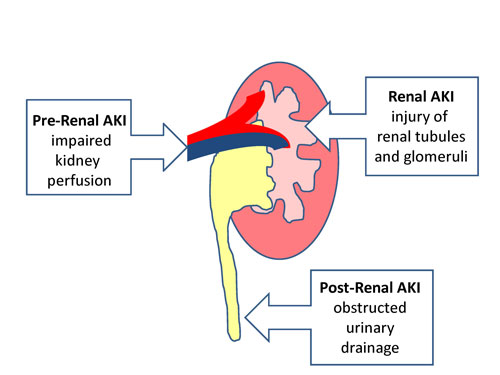
Normal kidney function depends on having sufficient arterial perfusion to intact nephrons with adequate urinary drainage. If there is a problem with any of these aspects of kidney function then AKI may occur, see figure 1. The common physiological classification of AKI reflects these three components, see box 2.
Pre-renal AKI is very common within the community and may be reversed with restoration of appropriate fluid volume status. Prolonged pre-renal AKI insults may result in acute tubular necrosis (ATN) which is not ‘fluid volume responsive’. Recovery from ATN may be prolonged and the patient’s kidney function may not recover to the previous baseline kidney function.
AKI caused by acute glomerular disease is much less common within the community.
Following consideration of obvious causes, a less common aetiology for AKI should be considered if clinical features such as fever, rash, joint pains or pulmonary infiltrates are present. Proteinuria and/or haematuria on urinalysis may also indicate a less common cause of AKI.
Thrombocytopenia and haemolytic anaemia with AKI is suggestive of haemolytic uraemic syndrome.
Confirming diagnosis
Once an unexplained raised serum creatinine is identified this should trigger a careful review of the patient’s history including the common AKI risk factors (see box 1), medication record, baseline renal function (where known), and clinical examination.
The severity of the AKI should be considered by evaluating the extent of rise of serum creatinine from baseline. Monitoring of GFR is less useful during episodes of AKI as renal function is not in a steady state i.e. the GFR will not be accurate. Patients who have advanced CKD will be more susceptible to complications of AKI since they already have limited renal function.
Potential clues in the history for AKI include reduced fluid intake and/or increased fluid losses, urinary tract symptoms and recent drug ingestion. AKI secondary to a systemic disease may be associated with other clinical features such as fever, rash, joint pains and non-specific malaise.
Clinical examination includes assessment of fluid volume status, which is guided by clinical signs including temperature, peripheral perfusion, heart rate, blood pressure and jugular venous pressure.
Onward referral to hospital should be arranged in the setting of severe hypotension associated with sepsis or fluid losses. Postural changes in pulse and blood pressure are more sensitive indicators of hypovolaemia than supine observations.
The abdomen can be examined carefully for the presence of a palpable bladder. If the history and examination are suggestive of urinary tract obstruction the patient should be referred for urgent ultrasound of renal tracts and discussed with urology services.
Reagent strip urinalysis should be performed, if possible, on any patient with suspected AKI. Positive protein and blood indicators of 2+ to 4+ on urinalysis suggest intrinsic glomerular disease and should trigger more urgent referral to hospital. A high specific gravity (> 1.020) suggests fluid volume depletion and increased oral fluid intake may be appropriate.
The laboratory investigations for AKI may include:
• U&E (with particular reference to concentrations of urea, creatinine, sodium, potassium and bicarbonate)
• Full blood count
• CRP
• Liver function tests
• Glucose
• Bone profile
• Immunological tests for rarer causes of AKI include:
— anti-neutrophil cytoplasmic antibodies (for vasculitis)
— anti-glomerular basement membrane antibody (for anti-GBM disease)
— autoantibody screen including anti-dsDNA titre and complement levels (for SLE and lupus nephritis)
— serum free light chains, serum immunoglobulins, plasma protein electrophoresis (for myeloma).
Management
There are no specific pharmacological treatments for AKI. The focus of AKI management is correcting the conditions causing or contributing to it.
Fluid balance
It is critical that the fluid volume status of patients with AKI is accurately assessed through careful history and examination. Increased oral intake should be encouraged in the setting of hypovolaemia or dehydration however inadvertent fluid overload should be avoided. The patient may be encouraged to monitor their weight to aid assessment of their volume status.
Drugs that affect AKI
Stop, at least temporarily, drugs that may induce, exacerbate or complicate AKI. Drugs such as diuretics, ACEi, ARBs, NSAIDs will exacerbate hypoperfusion of kidneys and should be withheld until the patient has recovered and AKI has resolved.
Blood pressure
It is important to restore an effective blood pressure. Septic patients should be referred to hospital for fluid resuscitation and antibiotics.
Infections that may be contributing to hypotension should be treated early.
Medication review
Medications commonly contribute to the development of AKI. In addition, because of a sudden reduction in kidney function associated with AKI, many drugs require dose reduction to avoid hazardous side effects. All regular medications should be reviewed, see table 1.
Careful monitoring of potassium is required if initiating medications that might aggravate hyperkalaemia in patients with advanced CKD who are already at risk.
Referral to nephrology
It is not necessary to refer all patients with AKI to hospital if they are responding to timely community management of their underlying medical condition.
Early contact with a nephrology team is advised for those patients who may require dialysis or for whom intrinsic renal disease is considered to be the most likely cause of their AKI.
Outpatient referral to a nephrologist can be considered for individuals who appear to have recovered from their AKI but have a persisting eGFR
< 30 ml/min/1.73m2 or significant proteinuria (urinary albumin/creatinine ratio > 50 mg/mmol). If a patient is already under review by a nephrology team it would be helpful to inform the nephrologist if AKI occurs in patients with CKD stage 4 or 5 or in renal transplant recipients.
It is also possible that AKI may be part of a terminal illness reflecting progression of an advanced untreatable comorbidity. In this setting the appropriateness of onward referral to hospital or a nephrology clinic can be reconsidered.
Improving outcomes
The majority of episodes of AKI occur within the community and GPs play a vital role in the early identification and management of individuals with AKI.9
Ideally, renal function should be monitored during any episodes of acute illness associated with sepsis, volume depletion or hypotension.
A careful review of prescribed medications is always appropriate with the aim of stopping any potentially nephrotoxic drugs.
Individuals at increased risk of AKI (and their main carers) can be educated about sick day rules i.e. temporary cessation of certain drugs (diuretics, ACEi, ARBs, metformin, NSAIDs) during episodes of acute illness. Advice cards with sick day rules and medications to be stopped can be given to patients, see box 3.10
Prescribing decisions can have a significant impact on the risk of community AKI. Co-prescription of NSAIDs with an ACEi or ARB is a potentially nephrotoxic combination. Temporarily withholding these medications in acute illness, e.g. vomiting and diarrhoea, can help to reduce the risk of AKI. The risk of ongoing prescription of potential nephrotoxic medications should be considered if the patient will be at continued risk of hypovolaemia.
Conclusion
AKI is a common, costly and potentially reversible condition, associated with high mortality.
Identifying and educating individuals at high risk of AKI, particularly about the potential harm of co-prescribed medications, may limit the severity of AKI. Careful prescribing within the community is a key component in reducing future risk of AKI. GPs play
a central role in the early identification and management of patients with AKI.
Timely liaison between primary and secondary care and ease of access to services is required to lesson the impact of AKI on patients in the community.
REFERENCES
1 Stewart J, Findlay G, Smith N et al. Adding insult to injury. A review of the care of patients who died in hospital with a primary diagnosis of acute kidney injury. National Confidential Enquiry into Patient Outcome and Death. NCEPOD. London. 2009 www.ncepod.org.uk/2009report1/Downloads/AKI_report.pdf
2 Kerr M, Bedford M, Matthews B, O'Donoghue D. The economic impact of acute kidney injury in England. Nephrol Dial Transplant 2014;29(7):1362-8
3 Chertow GM, Burdick E, Honour M et al. Acute kidney injury, mortality, length of stay, and costs in hospitalized patients. J Am Soc Nephrol 2005;16(11):3365-70
4 Wonnacott A, Meran S, Amphlett B et al. Epidemiology and outcomes in community-acquired versus hospital-acquired AKI. Clin J Am Soc Nephrol 2014;9(6):1007-14
5 Selby NM, Crowley L, Fluck RJ et al. Use of electronic results reporting to diagnose and monitor AKI in hospitalized patients. Clin J Am Soc Nephrol 2012;7(4):533-40
6 Susantitaphong P, Cruz DN, Cerda J et al. Acute Kidney Injury Advisory Group of the American Society of Nephrology. World incidence of AKI: a meta-analysis. Clin J Am Soc Nephrol 2013;8(9):1482-93
7 Coca SG. Acute kidney injury in elderly persons. Am J Kidney Dis 2010;56(1):122-31
8 Porter CJ, Juurlink I, Bisset LH et al. A real-time electronic alert to improve detection of acute kidney injury in a large teaching hospital. Nephrol Dial Transplant 2014;29(10):1888-93
9 Blakeman T, Harding S, O’Donoghue D. Acute kidney injury in the community: why primary care has an important role. Br J Gen Pract 2013;63(609):173-4
10 Morrison C, Wilson M. Medicine sick day rules cards – interim evaluation. NHS Highland http://margaretmccartney.com/wp-content/uploads/2014/10/NHSH-interim-evaluation-medicine-sick-day-rules.pdf
ARTICLE IN PDF
 Download this article in PDF format
PRESET SEARCHES
PubMed
Acute kidney injury primary care
NICE evidence search
Acute kidney injury primary care
Immediate CPD prompts and frameworks
These handy templates* prompt immediate drafting of personal learning, reflection and planning. Save your record straight into your personal development folder on your device or Cloud storage system.
*Adobe reader needed for iPad
EXTERNAL WEBLINKS
Think kidneys
NICE CG169
Acute kidney injury. Prevention, detection and management of acute kidney injury up to the point of renal replacement therapy
Guidelines and Audit Implementation Network. Northern Ireland guidelines for acute kidney injury