SEARCH

Narayanan RP, Samad S. Improving outcomes in diabetes in pregnancy. Practitioner 2015;259(1782):25-28
Improving outcomes in diabetes in pregnancy
21 May 2015
AUTHORS
Dr Ram Prakash Narayanan MBBS PhD MRCP(UK) FHEA, Clinical Lecturer, University of Liverpool, Specialty Registrar in Diabetes and Endocrinology
Dr Sabnam Samad MB BChir MA MRCP(UK), Consultant Physician, Diabetes and Endocrinology, Aintree University Hospital, Liverpool, UK
Article
One in 250 pregnancies in the UK involves diabetes.1 Pregnancy with uncontrolled glucose levels can have serious consequences for the mother and her baby.2 This is true of women with known diabetes before pregnancy as well as gestational diabetes mellitus (GDM).3 As a corollary, patient education, glycaemic control and specialist diabetes and obstetric input can ensure excellent outcomes in the majority of these women.
In women with pre-existing diabetes there is a critical role for pre-conception management and monitoring.4 Gestational diabetes rates would be expected to increase in the UK as a result of rising obesity, maternal age and ethnic diversity.
In February 2015, NICE published updated guidance on diabetes management in pregnancy, and there are many areas in which primary care plays a crucial role.5
Pre-existing diabetes
Diabetes in pregnancy is associated with a five-fold increase in the risk of stillbirth and a two-fold increased risk of congenital defects compared with the general maternity population.6 There are multiple ways in which diabetes can cause harm in pregnancy. 7-9
Fetal sensitivity to glucose
Fasting blood glucose levels above 5.3 mmol/L can directly affect organogenesis – particularly of the fetal heart and spine. As these structures start to develop before the third week of gestation, good control before conception is crucial.
Changes to maternal physiology Carbohydrate metabolism in pregnancy shifts towards ketogenesis making women with diabetes susceptible to diabetic ketoacidosis.
Furthermore, hypoglycaemia in the first trimester makes conditions such as morning sickness difficult to manage.
Changes caused by the placenta Hyperglycaemia can cause placental failure and stillbirth and for this reason early delivery is recommended (before 39 weeks’ gestation in pre-existing diabetes and no later than 40+6 weeks in GDM).
Placental hormones such as human placental lactogen also drive the maternal insulin resistance that occurs from 24 weeks onwards. If the mother cannot compensate for this and maintain euglycaemia the chances of fetal macrosomia and neonatal hypoglycaemia are greatly increased. Other hormones released by the placenta are thought to accelerate maternal retinopathy, nephropathy and hypertension.
Management
Pre-pregnancy counselling: Enabling good blood glucose control prior to conception (in addition to smoking and alcohol cessation advice) can minimise pregnancy risks towards levels approaching that of women without diabetes. This involves considerable efforts by patients and often radical changes to diabetes management.
Glycaemic targets: The recommended glycated haemoglobin (HbA1c) target in preparation for pregnancy is 48 mmol/mol (6.5%) if this can be safely achieved. Women with an HbA1c 86 mmol/mol should be strongly advised against pregnancy. Referral to a diabetes or obstetric specialist clinic at the pre-conception stage can help women make informed decisions based on their individual pregnancy risks, and help them improve glycaemic control and optimise medication.
While in many women the ideal HbA1c target is not achievable, any glycaemic improvement will help reduce risks in a future pregnancy.
In our own practice we enable glycaemic improvement through the use of insulin pumps, carbohydrate counting and changing insulin regimens. For women with type 2 diabetes, the only safe oral hypoglycaemic agents are metformin and glibenclamide, so their pre-pregnancy management may involve a switch to insulin or cessation of other agents.
During pregnancy, individualised target blood glucose levels are set based on the recent NICE guidelines.5 These are applicable to women with pre-existing as well as gestational diabetes, see table 1. Although the glycaemic control required is rather tight, it is achievable with frequent monitoring and support from the diabetes team.
Retinopathy and renal disease: Women should be screened and optimised before conception, as retinal and renal disease10 can worsen during pregnancy. Retinal and renal screening in pregnancy is undertaken once per trimester in women with pre-existing diabetes, and ophthalmology or renal specialist input sought when appropriate.
The presence of retinopathy on its own should not prevent glycaemic targets being achieved during pregnancy.
Medication management: Statins, ACE inhibitors and angiotensin 2 receptor antagonists, most oral hypoglycaemic agents and antihypertensive drugs are contraindicated in pregnancy, and usually stopped pre-conception.
Safer alternative antihypertensive drugs (for example amlodipine, labetalol and methyldopa) should be considered with diabetes/obstetric input where appropriate.
For women with type 1 or type 2 diabetes, high dose folic acid (5 mg) should be prescribed to prevent fetal spinal malformation if they are considering pregnancy within the next three months, to be continued throughout the first trimester.
Aspirin (75 mg) is recommended from 12 weeks onwards to reduce pre-eclampsia risk.
Monitoring during pregnancy
Women are reviewed frequently throughout pregnancy to review their glucose control and organise fetal growth scans at intervals. Many services aim to deliver these women before term, however the choice of delivery method depends on the mother and baby’s obstetric needs.
Glycaemic management during labour is usually guided by the patient’s individual circumstances and local protocols, with regular monitoring of the mother and baby after delivery.
The mother’s insulin requirements usually decrease significantly after the delivery of the placenta and appropriate glucose monitoring should be instituted.
Following discharge patients should be referred back to their usual diabetes care arrangements.
Contraception
A key role for primary care is to identify and refer women wishing to conceive for optimisation or education with regards to their diabetes. Equally important is ensuring that all women who are undecided, not wishing to get pregnant or who do want to get pregnant but require optimisation are on effective contraception. Some primary care teams have added this to their annual review assessments.
Gestational diabetes
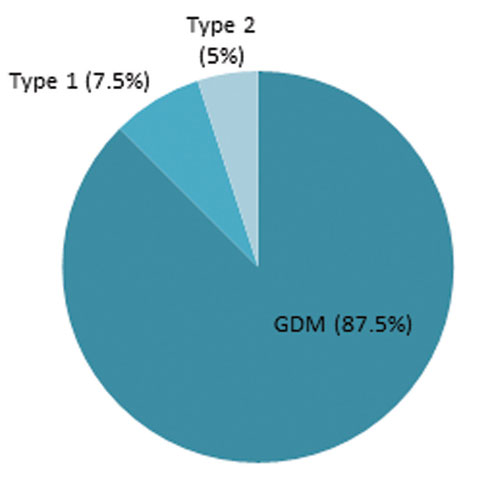
Gestational diabetes has generally been defined as glucose intolerance originating or first detected during pregnancy.11 It accounts for the majority of cases of diabetes in pregnancy, see figure 1.
In normal pregnancy, the increased insulin resistance mediated by placental hormone secretion is compensated by increased maternal insulin secretion to maintain euglycaemia.
Gestational diabetes arises from an inability to meet these increased insulin requirements adequately, especially after 24 weeks of gestation. Once the baby and placenta are delivered, most patients have normal glucose handling. True GDM is a transient condition.
As with pre-existing diabetes, gestational diabetes is associated with risks to the mother as well as the developing fetus. The Hyperglycaemia and Adverse Pregnancy Outcomes (HAPO) study, a seminal international study involving 25,505 pregnant women, suggested a continuum of increasing risk of adverse events in association with maternal glucose levels.12
Importantly, women with gestational diabetes are at significant risk of developing type 2 diabetes in the future.13
Diagnosis
NICE recommends that women with certain risk factors for gestational diabetes are identified at the booking appointment, see table 2.5
Women with a previous history of GDM may be offered either early self-monitoring of capillary glucose measurements at the booking visit or a 75 g oral glucose tolerance test (OGTT) early in pregnancy. Women with all other risk factors (as well as women with previous GDM who tested negative in the first OGTT) should be offered the 75 g OGTT between 24 and 28 weeks’ gestation.
The recent NICE guidelines5 set out the criteria for gestational diabetes diagnosis based on OGTT thresholds, see table 3.
Internationally, GDM diagnostic criteria published in 2010 by the International Association of the Diabetes and Pregnancy Study Groups (IADPSG)14 are used in many countries and some parts of the UK.
Management
Women with GDM should be offered a review in a joint diabetes and obstetric clinic within a week of diagnosis. They should be taught self-monitoring of capillary glucose measurements, and glycaemic targets are similar to that for pre-existing diabetes.
Lifestyle modification with input from a specialist diabetes dietician is key to GDM management. The importance of dietary management alongside blood glucose monitoring (and insulin where appropriate) was confirmed in the Australian Carbohydrate Intolerance Study (ACHOIS), an important randomised trial that established a link between improved glycaemic control in gestational diabetes and reduced adverse perinatal outcomes.15
If glycaemic improvement is inadequate within one to two weeks, addition of metformin and/or insulin therapy may be required. Glibenclamide is an alternative for women with metformin intolerance.
Women with GDM receive input from the specialist teams every one to two weeks and regular fetal growth scans. Modes of delivery are guided by the patient’s individual circumstances, with the majority of women undergoing vaginal deliveries. Babies of women with GDM have glucose levels monitored for 2-4 hours after delivery in addition to routine checks and may need specialist care if there are any complications.
Postnatal diabetes testing
All treatment for gestational diabetes is stopped at delivery. While many services repeat the OGTT at a six to eight week postnatal visit, the recent NICE guidelines merely advocate a single fasting blood glucose or HbA1c at three months instead, usually undertaken in primary care.
Longer-term diabetes screening
Women with GDM have a significant lifetime risk of developing type 2 diabetes, hence diabetes screening must be undertaken on an annual basis in primary care.
A lifelong healthy diet and lifestyle is recommended to mitigate the diabetes and cardiometabolic risk.
In our local region these women are placed on an Impaired Glucose Regulation (IGR) register to ensure annual diabetes screening.
Conclusion
Diabetes can have significant adverse implications in pregnancy but regular specialist input and good glycaemic control can ensure excellent outcomes for the majority of women.
Primary care practitioners have a vital role in helping women with gestational diabetes reduce their risk of developing type 2 diabetes in addition to ensuring that annual diabetes screening is carried out.
REFERENCES
1 Diabetes UK. Diabetes: Facts and Stats (version 3). Revised March 2014. www.diabetes.org.uk/Documents/About%20Us/Statistics/Diabetes-key-stats-guidelines-April2014.pdf
2 Inkster ME, Fahey TP, Donnan PT et al. Poor glycated haemoglobin control and adverse pregnancy outcomes in Type 1 and Type 2 diabetes mellitus: systematic review of observational studies. BMC Pregnancy and Childbirth 2006;6:30
3 Dornhorst A, Banerjee A. Diabetes in Pregnancy, in Holt RIG, Cockram CS, Flyvbjerg A et al (Ed.) Textbook of diabetes, 4th edition. Wiley-Blackwell. 2010
4 Taylor R, Davison JM. Type 1 diabetes and pregnancy. BMJ 2007;334(7956):742-45
5 National Institute for Health and Care Excellence. NG3. Diabetes in pregnancy: management of diabetes and its complications from preconception to the postnatal period. NICE. London. 2015
6 Confidential Enquiry into Maternal and Child Health (CEMACH) (2007). Diabetes in pregnancy: are we providing the best care? Findings of a national enquiry. www.hqip.org.uk/assets/NCAPOP-Library/CMACE-Reports/25.-February-2007-Diabetes-in-Pregnancy-are-we-providing-the-best-care-Findings-from-a-national-project-March-2002-February-2003.pdf
7 Catalano PM, Tyzbir ED, Wolfe RR et al. Carbohydrate metabolism during pregnancy in control subjects and women with gestational diabetes. Am J Physiol 1993;264:E60–E67
8 Homko CJ, Sivan E, Reece EA, Boden G. Fuel metabolism during pregnancy. Semin Reprod Endocrinol 1999;17:119-25
9 Handwerger S, Freemark M. The roles of placental growth hormone and placental lactogen in the regulation of human fetal growth and development. J Pediatr Endocrinol Metab 2000;13:343-56
10 Bell R, Glinianaia SV, Tennant PW et al. Peri-conception hyperglycaemia and nephropathy are associated with risk of congenital anomaly in women with pre-existing diabetes: a population-based cohort study. Diabetologia 2012;55(4):936-47
11 American Diabetes Association. Standards of Medical Care in Diabetes—2013. Diabetes Care 2013;36:S67-S74
12 Metzger BE, Lowe LP, Dyer AR et al. HAPO Study Cooperative Research Group. Hyperglycemia and adverse pregnancy outcomes. N Engl J Med 2008;358:1991-2002
13 Bellamy L, Casas JP, Hingorani AD et al. Type 2 diabetes mellitus after gestational diabetes: a systematic review and meta analysis. Lancet 2009;373(9677):1773-79
14 International Association of Diabetes and Pregnancy Study Groups Consensus Panel. International Association of Diabetes and Pregnancy Study Groups Recommendations on the Diagnosis and Classification of Hyperglycemia in Pregnancy. Diabetes Care 2010;33:676-682
15 Crowther CA, Hiller JE, Moss JR et al. Effect of treatment of gestational diabetes mellitus on pregnancy outcomes. N Engl J Med 2005;352(24):2477-86
ARTICLE IN PDF
 Download this article in PDF format
PRESET SEARCHES
PubMed
Management of diabetes in pregnancy
Management of type 1 diabetes in pregnancy
Management of type 2 diabetes in pregnancy
NICE evidence search
Immediate CPD prompts and frameworks
These handy templates* prompt immediate drafting of personal learning, reflection and planning. Save your record straight into your personal development folder on your device or Cloud storage system.
*Adobe reader needed for iPad