SEARCH

Unsworth DJ, Tsiougkos N. Improving detection and management of drug allergy. Practitioner 2015;259(1780)25-27
Improving detection and management of drug allergy
23 Mar 2015
Article
The term drug allergy is non-specific and widely misused. Often the diagnosis is assumed with little definitive evidence.
As well as the risk of overdiagnosis, underreporting is also a problem. Investigation is frustrated by limited availability of reliable confirmatory tests. The clinical guideline published by NICE, in September 2014, gives evidence-based recommendations on diagnosis, management, and advice on when to refer to specialist clinics.1
Suspected adverse drug reactions may be subdivided in a variety of ways. Classification may be on the basis of mechanism e.g. immunological (requiring sensitisation by previous exposure) versus non-immunological; timing (e.g. immediate or delayed), or whether the phenomenon is dose dependent or not.
In the recent NICE guideline1 the main approach adopted is to classify the adverse event according to whether it is immediate (within an hour of drug administration) or delayed (hours or days), and whether it affects a single system (e.g. only cutaneous such as urticaria) or multiple systems, and whether clinically severe/life threatening or not.
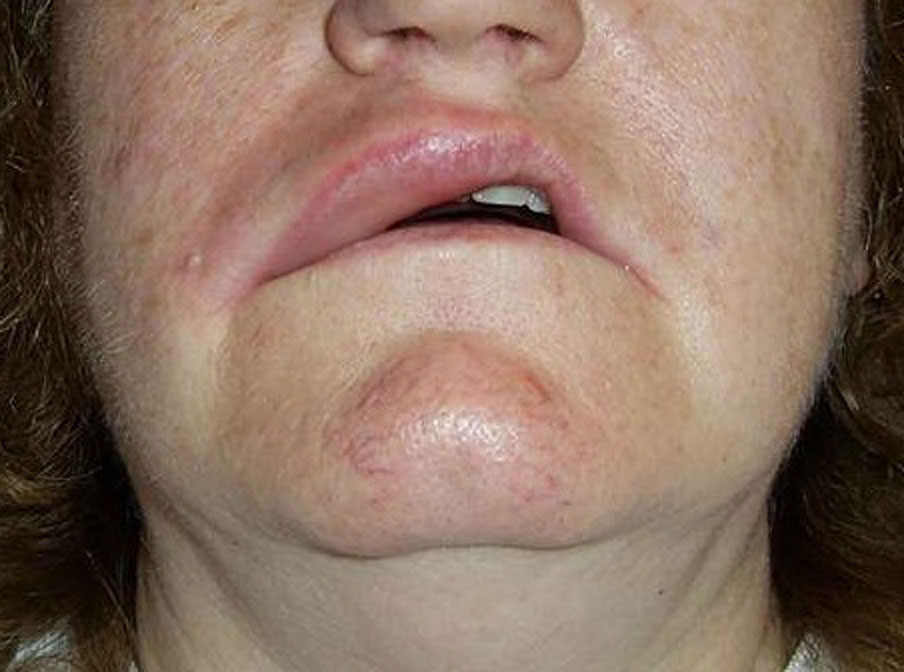
Rash and/or mucosal reactions are common adverse drug effects. Urticaria (caused by NSAIDs, for example), angioedema (e.g. aspirin, see figure 1; ACE inhibitors), maculopapular rash (e.g. antibiotics), photosensitivity (e.g. tetracycline), erythema multiforme (e.g. NSAIDs), and Stevens-Johnson syndrome (e.g. allopurinol) provide examples which reflect the wide range of different mechanisms (many non-immunological) and the range of clinical severity.
The point is made that gastrointestinal manifestations in isolation have a low specificity for true drug allergy, although GI disturbance after antibiotics is well recognised.
An immediate, immunologically mediated, multisystem, life-threatening reaction would for example include anaphylaxis (type 1 or typically IgE-mediated hypersensitivity), especially if the clinical features (e.g. bronchospasm, hypotension) are suggestive.
Investigations
Cross-reference is made to the 2011 NICE guideline on investigation and management of anaphylaxis2 with a reminder to test acutely (ideally within two hours and certainly before four hours post reaction) for serum mast cell tryptase, as previously reviewed in this journal.3 Total serum IgE testing is not useful and not recommended.
Detailed investigation of suspected cases in a specialist clinic is ideally delayed for 4-6 weeks after the event, and skin testing is the main test modality used.4,5 Blood testing is limited, and suffers from a very limited repertoire and low sensitivity.
For some, but not all, drugs implicated in an immediate possible anaphylactic reaction, skin prick testing which may be followed by more sensitive and more risky intradermal testing may be definitive (this is indicated for local and general anaesthetic or penicillin reactions, but is not useful for NSAID testing).
For delayed reactions, where an immunological mechanism (T-cell mediated) is suspected, patch testing (skin patches loaded with drug embedded in paraffin wax) may be useful (e.g. maculopapular rash following antibiotic use) but again sensitivity is low.
Patch testing is not recommended for high-risk cases where previous reactions have been life threatening including Stevens-Johnson syndrome.
Patients referred to a specialist clinic for skin testing should, if possible, suspend any medication that may potentially interfere with testing (antihistamines, prednisolone, and others). The two case reports below provide illustrative examples.
Recording drug reactions
A key recommendation in the NICE guideline1 is that adverse drug reactions need to be meticulously recorded, and that the patient and their family should be fully informed. This information also needs to be made available to other healthcare professionals in primary and secondary care.
One recommendation from NICE is that all GP referrals and all hospital discharge summaries include this information as a matter of routine including documentation of ‘no known drug allergy’ as appropriate.
Documentation should include:
• Date of reaction
• Drug name (chemical and generic)
• Route of administration
• Time interval between first dose
and event
• Nature and severity of symptoms
Written guidance should be provided on which other chemically related drugs also need to be avoided. It is important, for example, that a patient who has experienced urticaria following diclofenac is also aware that the drug’s brand name is Voltarol, and that it is a member of the NSAID family all of which may trigger similar (non-immunological) reactions.
Referral
Patients with mild reactions (e.g. isolated urticaria) following a non-selective NSAID who have an ongoing need for anti-inflammatory medication could be considered for a trial of a selective COX-2 inhibitor, which carries a lower risk of further urticaria, starting at a low dose without specialist referral.
However, this approach would not be recommended when the previous adverse NSAID reaction was more severe (e.g. an asthma episode requiring nebuliser treatment).
Specialist referral is indicated for the following:
• All cases of suspected anaphylaxis
• All severe/life-threatening episodes e.g. Stevens-Johnson syndrome
• Severe NSAID reactions with ongoing need for NSAID therapy
• Suspected penicillin allergy (but only where alternative antibiotics are not available)
• Problems related to general and local anaesthesia
Every referral is extremely time consuming in terms of skin testing which requires a day case slot. Each case of suspected penicillin allergy takes a specialist nurse an hour or so, and test-negative cases must still undergo penicillin challenge after written informed consent to confirm non-sensitivity which takes a further couple of hours.5,6 Hence where possible it is simpler just to flag such cases as possible allergy/intolerance and provide alternative antibiotics instead.
Conclusion
Drug allergy is a complex and potentially lethal problem. The recent NICE guidance1 focusses on the need for full and proper documentation and communication, not least to the patient and their family. Detailed management advice is available from specialist clinics.
REFERENCES
1 National Institute for Health and Care Excellence. CG183. Drug allergy: diagnosis and management of drug allergy in adults, children and young people. NICE. London. 2014 www.nice.org.uk/guidance/CG183
2 National Institute for Health and Care Excellence. CG134. Anaphylaxis: assessment to confirm an anaphylactic episode and the decision to refer after emergency treatment for a suspected anaphylactic episode. NICE. London. 2011 www.nice.org.uk/guidance/CG134
3 Unsworth DJ. Following up patients after treatment for anaphylaxis. Practitioner 2012;256(1749):21-24
4 Mirakian R, Ewan PW, Durham SR et al. BSACI guidelines for the management of drug allergy. Clin Exp Allergy 2009;39:43-61
5 Demoly P, Adkinson NF, Brockow K et al. International consensus on drug allergy. Allergy 2014;69(4):420-37
ARTICLE IN PDF
 Download this article in PDF format
PRESET SEARCHES
Immediate CPD prompts
These handy templates* prompt immediate drafting of personal learning, reflection and planning. Save your record straight into your personal development folder on your device or Cloud storage system.
*Adobe reader needed for iPad