SEARCH

Tidman MJ. Managing urticaria in primary care. Practitioner 2015;259(1779)25-28
Managing urticaria in primary care
23 Feb 2015
AUTHORS
Dr Michael J. Tidman MD FRCP (Ed) FRCP (Lond), Consultant Dermatologist, Department of Dermatology, Royal Infirmary of Edinburgh, Edinburgh, UK
Article
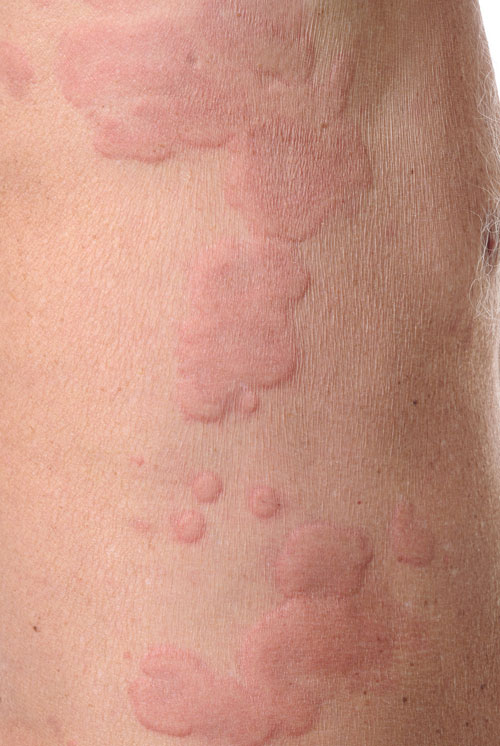
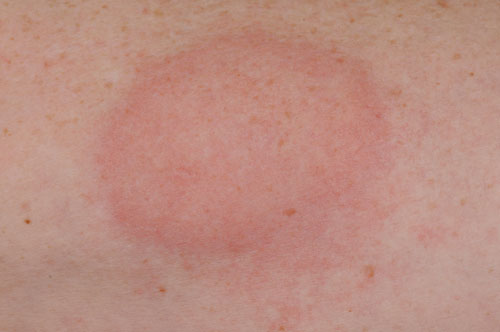
Urticaria (derived from urtica, Latin for nettle) is a common condition that can affect all age groups. It is often referred to as hives or nettle rash. Urticaria is characterised by transient wheals that consist of a swollen palpable centre often surrounded by an erythematous flare, see figure 1, and figure 2. The lesions are associated with itching or, less commonly, a burning sensation. Typically, individual wheals disappear rapidly (usually within 1 to 24 hours) leaving normal skin.
In 50% of cases, wheals may be accompanied by angioedema, a more deep-seated flesh-coloured or erythematous swelling of the skin or mucous membrane (particularly eyelids, lips, tongue and upper aerodigestive tract). This may last considerably longer than 24 hours. Angioedema is not usually itchy but may be painful, and may occasionally occur without wheals, for instance in C1 inhibitor deficiency or as an adverse effect of ACE inhibitor therapy. Urticaria is not usually accompanied by systemic symptoms.
A multinational guideline has been published recently covering the definition, classification and diagnosis of urticaria, and giving evidence-based therapeutic options, many of which are appropriate to primary care practitioners.1
Urticaria is classified as acute when it resolves within six weeks and as chronic when its duration exceeds six weeks. Chronic urticaria is now sub-classified into chronic spontaneous urticaria (CSU) and chronic inducible urticaria (CIU). The latter subtype includes variants that were known as the physical urticarias, see box 1.1 CSU and CIU may co-exist.
Urticarial vasculitis and urticaria pigmentosa are not classified as urticaria because of their distinctly different pathomechanisms.1 Autoinflammatory syndromes can present with urticaria, associated with systemic symptoms such as fever, malaise and joint pains.
The prognosis for eventual recovery from spontaneous and inducible urticaria is excellent. However, the time course for individual cases is unpredictable and may extend to years, often following a relapsing and remitting course. In CSU, 50% of cases resolve within three to five years, but 20% last for more than ten years.
Causes
Urticaria results from the release of inflammatory mediators (principally histamine, but also others such as platelet-activating factor, bradykinin, leukotrienes and cytokines) from dermal mast cells. This leads to vasodilatation, plasma extravasation, recruitment of immunologically active cells (neutrophils, eosinophils, macrophages, basophils and T-lymphocytes) and sensory nerve stimulation.1
The cause of urticaria cannot usually be precisely identified for most affected individuals, as the stimuli for mast cell activation in urticaria are heterogeneous, diverse and currently ill defined.1,2 They include:
• Histamine-releasing autoantibodies directed against either IgE or the high affinity mast cell receptor for IgE
• Possibly certain bacterial (such as Helicobacter pylori), viral, parasitic and fungal infections, although the role of infection in urticaria remains to be precisely clarified
• Drugs
• Various physical stimuli
Patients with urticaria frequently present to primary care in the belief that their rash is the result of allergy. However, IgE-mediated food allergy is rarely the cause of CSU in patients with the daily appearance of urticarial lesions, although it should be considered in CSU patients with intermittent symptoms.1
Pseudoallergy (non-IgE-mediated hypersensitivity reactions) to NSAIDs and food ingredients (such as salicylates, additives, preservatives, dyes and antioxidants) may both elicit and aggravate CSU and may be of relevance in CSU with daily symptoms.1,2
Potential complications
Chronic urticaria frequently has a significant detrimental effect on quality of life, associated with sleep disturbance, depression and embarrassment, and may also affect performance at work and school.1
Angioedema of the tongue and vocal cords can cause acute obstruction of the upper airway requiring emergency measures. Patients with urticaria should be warned about this, albeit unlikely, consequence.
Very occasionally, urticaria may progress to anaphylaxis, and conversely, urticaria may be a feature of anaphylactic reactions.2
Acute spontaneous urticaria is common in infants and young children, particularly in atopic individuals1 and, more frequently than in older children and adults, may be associated with a sensitisation to foods such as milk, eggs and peanuts. In this young age group, food-induced urticaria may be a harbinger of anaphylaxis.1
An individual with cold urticaria is at risk of massive histamine release into the circulation if immersed in cold water, sufficient to cause hypotension and fainting with potentially fatal consequences.
Diagnosis
A history from the patient of an itchy rash, the individual components of which last a matter of hours is enough to seal a diagnosis of urticaria, especially if complemented by the presence of wheals on examination or in a photograph taken by the patient.
The persistence of wheals for more than 24-36 hours should prompt consideration of a vasculitic aetiology (urticarial vasculitis), requiring a diagnostic skin biopsy and appropriate investigation.
CSU may co-exist with one of the physical urticarias. Patients should be asked if they are able to induce wheals to appear.
If the history is suggestive, appropriate testing (when no antihistamine is being taken by the patient) can be undertaken in the surgery:
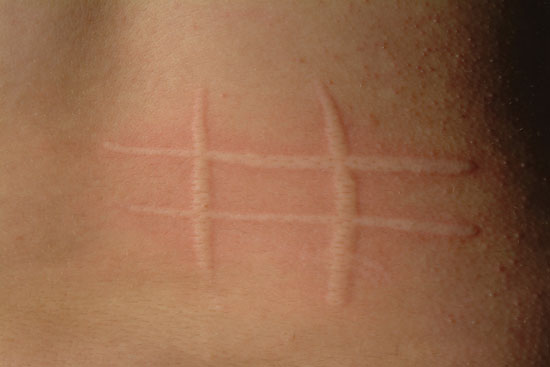
• Dermographism can be excluded by firm stroking of the skin with a blunt instrument, such as a ball pen, see figure 3
• Cholinergic urticaria may be precipitated by exercise appropriate to the patient’s general health
• Cold urticaria can be easily confirmed by the development of an urticated plaque at the site of application of an ice cube or freezer block on forearm skin for 10-15 minutes. The site should be examined 10-15 minutes after removal of the cold stimulus once the skin has warmed up (otherwise vasoconstriction will impair plasma extravasation).
Investigations
Routine investigations are not considered necessary in acute urticaria.1,2 For patients with CSU a differential full blood count and inflammatory markers (ESR or CRP) are all that are routinely recommended.1 However, it is also reasonable to test thyroid function and check for circulating thyroid autoantibodies as there is an association between CSU and thyroid autoimmunity.2
Routine screening for malignancies, in the absence of relevant symptoms and signs, is not recommended.1,2
If angioedema occurs without urticaria, undertaking a complement profile and C1 inhibitor level is appropriate to exclude hereditary angioedema.1
For older patients with intermittent chronic urticaria and young children with acute urticaria, a food diary, investigation for circulating specific IgE to suspect foodstuffs and latex, and skin prick testing may be considered.1
Management
General measures
An information leaflet, such as that produced by the British Association of Dermatologists (www.bad.org.uk), should be given to patients or their carers. It is important to stress that the cause of the urticaria may not be found.2 Consideration should be given to possible trigger factors such as drugs, physical stimuli, inflammation, infection and infestation.
If possible, NSAIDs and opiates should be avoided as they may exacerbate a tendency to urticaria through a non-allergic mechanism. IgE-mediated food allergy is rarely the underlying trigger for CSU, but in those cases where sensitisation to a food has been demonstrated (by the presence of a specific IgE or positive skin prick testing) and shown to be clinically relevant, strict avoidance should be advised. A trial of a low pseudoallergen diet is now recommended (for a minimum of three weeks to establish its effectiveness, and thereafter for at least three to six months) in cases of CSU with daily or virtually daily symptoms (www.ecarf.org/).1,3
Topical therapy (1% menthol in aqueous cream and calamine lotion) can be soothing for the pruritus of urticaria, and although the short-term use of topical corticosteroids can be helpful their routine use is not recommended.2 Topical antihistamines may result in sensitisation and contact dermatitis, and thus should be avoided in urticaria.
Various self-help measures are listed in table 1.
Pharmacological treatment
The symptoms of urticaria are predominantly mediated by the interaction of histamine, released by mast cells, and H1 receptors located on endothelial cells and sensory nerves. Thus H1 antihistamine therapy is recommended as first-line symptomatic treatment for urticaria. The modern second-generation H1 antihistamines are preferred over first-generation H1 antihistamines as they are relatively non-sedating and have a good safety profile.1
However, only cetirizine, levocetirizine, loratadine, desloratadine, fexofenadine, rupatadine and bilastine have been adequately studied in CSU.
In CSU they should be taken continuously rather than on demand, in the lowest effective dose. The timing of the antihistamine treatment should be adjusted to ensure maximum blood levels of the drug when urticaria is anticipated to be at its worst.2
Trials of at least two non-sedating H1 antihistamines should be offered as response and tolerance varies between individuals.2
Lack of response after two weeks to a second-generation H1 antihistamine in standard licensed dosage should prompt consideration of increasing the dose up to four-fold higher than the recommended dose, as second-line treatment, in otherwise healthy individuals.1 This is preferable to using several different H1 antihistamines over the course of a day.1
It is reasonable to consider (in addition to a second-generation antihistamine) a sedating H1 anti-histamine such as chlorphenamine or hydroxyzine at night if sleep is disturbed.2 The addition of an H2 antihistamine, such as cimetidine, off licence may provide better control of urticaria in refractory cases.2
Urticaria remaining poorly controlled after a further one to four weeks may be explained by a relatively greater involvement of mast cell mediators other than histamine. A trial of the leukotriene antagonist montelukast can be added, off licence, to the high-dose H1 antihistamine regimen, as third-line therapy.1,2
Although the long-term use of oral glucocorticoids in urticaria is not recommended, a short course of prednisolone (up to seven days) for the treatment of acute exacerbations or to cover important events such as exams or a wedding, may be given.1
In individuals with a history of severe potentially life-threatening angioedema, an epinephrine autoinjector should be supplied for self-administration in an emergency, and the patient or carer carefully instructed in its use.2
Once urticaria is controlled, periodic monitoring, perhaps every three to six months, is advised in order to evaluate the necessity for continued or alternative therapy.1
Referral
Patients with urticaria that is refractory to antihistamine and antileukotriene therapy and whose quality of life is significantly impaired by their urticaria should be referred to secondary care for consideration of adding immuno-modulating therapies, such as ciclosporin or omalizumab, to second-generation H1 antihistamine therapy. Omalizumab is a monoclonal antibody that selectively binds to human IgE, thereby lowering free IgE levels.
Other immunosuppressant options (such as dapsone, sulfasalazine, methotrexate, mycophenolate mofetil, phototherapy, plasmapheresis, intravenous immunoglobulin and anti-TNF-alpha agents) have only a very low evidence base in urticaria, but may be useful in certain circumstances.
Referral to a dietician should be considered for patients embarking on a low pseudoallergen diet.
Conclusion
Many of the recommendations relating to the basic treatment of urticaria involve the use of drugs off licence.2 The treatment aim in urticaria should be for complete symptom control as safely as possible1 in view of the potential for this condition to have a very significant adverse impact on quality of life.
REFERENCES
1 Zuberbier T, Aberer W, Asero R et al. The EAACI/GA(2) LEN/EDF/WAO Guideline for the definition, classification, diagnosis, and management of urticaria: the 2013 revision and update. Allergy 2014;69(7):868-87
2 Grattan CE, Humphreys F. British Association of Dermatologists Therapy Guidelines and Audit Subcommittee. Guidelines for evaluation and management of urticaria in adults and children. Br J Dermatol 2007;157(6):1116-23
3 Akoglu G, Atakan N, Cakır B et al. Effects of low pseudoallergen diet on urticarial activity and leukotriene levels in chronic urticaria. Arch Dermatol Res 2012;304(4):257-62
ARTICLE IN PDF
 Download this article in PDF format
PRESET SEARCHES
PubMed
NICE Evidence
Immediate CPD prompts
These handy templates* prompt immediate drafting of personal learning, reflection and planning. Save your record straight into your personal development folder on your device or Cloud storage system.
*Adobe reader needed for iPad
EXTERNAL WEBLINKS
British Association of Dermatologists
LETTERS TO THE EDITOR
If you would like to comment on this article for publication or have a question for the authors, write to: