SEARCH

Wilding J. Managing patients with type 2 diabetes and obesity. Practitioner 2015;259(1778):25-28
Managing patients with type 2 diabetes and obesity
22 Jan 2015
AUTHORS
Professor John Wilding DM FRCP, Professor of Medicine and Honorary Consultant Physician, Head of Department of Obesity and Endocrinology, Institute of Ageing and Chronic Disease, Clinical Sciences Centre, University Hospital Aintree, Liverpool, UK
Article
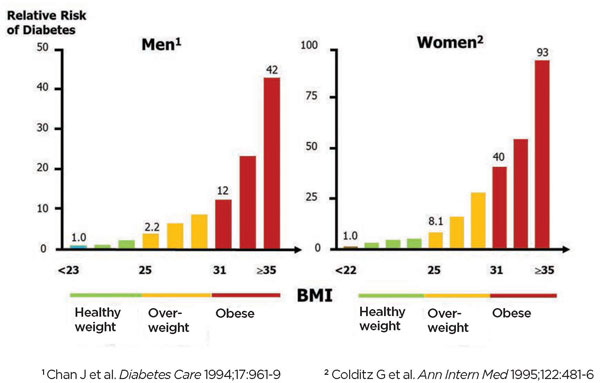
Type 2 diabetes is fundamentally an obesity-related disease. Risk increases exponentially with increasing body mass index (BMI),1,2 (see figure 1) particularly if fat accumulates centrally, in the abdominal region, and/or in the skeletal muscle, liver and other organs such as the pancreas.3
Some individuals are susceptible to developing diabetes at a lower BMI and this may be partly genetic. People of Asian ethnicity are particularly prone to developing diabetes at a lower BMI than Caucasians.
Those with diabetes and co-existing obesity, particularly if it is severe, are also at risk of other obesity-related conditions, such as cardiovascular disease, obstructive sleep apnoea, joint pain, many cancers and depression, see figure 2.
The best approach from a public health perspective is of course prevention, and there is no doubt that diabetes can be prevented with lifestyle intervention.
Clinical trials from the USA, Europe, India and China have all shown that in people with impaired glucose tolerance, modest weight loss (just 4% of initial starting weight) can reduce the development of overt diabetes by 50% or more over four years.
Once diabetes has developed weight loss can also be of benefit, and support for this should be a fundamental aspect of management for all patients who are overweight or obese with type 2 diabetes.4
Management should always involve lifestyle advice but consideration should also be given to the choice of glucose-lowering agent, the use of obesity pharmacotherapy, and in some patients the option of bariatric surgery.
Initial management
Lifestyle advice
Supporting patients to lose weight should be considered a key goal of diabetes care for all overweight and obese patients with type 2 diabetes. The UKPDS study showed the effectiveness of dietary advice in the early stages after diagnosis, with patients losing on average 2 BMI units and improving fasting glucose by about 3 mmol/L during the first three months, before pharmacotherapy was introduced.5 Proof of principle of the effectiveness of weight loss has been shown in small-scale studies using very low energy diets (< 800 kcal/day), which can result in dramatic improvements in blood glucose control, at least in the short-term.6
This approach is not currently recommended routinely, but is being tested in ongoing clinical trials.
Increased physical activity improves insulin sensitivity and can help weight loss maintenance – again this should be recommended for all patients with type 2 diabetes.
Although the Look AHEAD study of lifestyle weight management in type 2 diabetes did not show a reduction in cardiovascular disease events with modest weight loss, patients did gain many other benefits including improvements in glucose control, lipids and blood pressure and quality of life. Healthcare costs were also reduced.7, 8
Glucose lowering therapy
Pharmacotherapy for type 2 diabetes is becoming increasingly complex. Metformin is the first-line therapy and is generally considered weight neutral, although some patients may lose 1-2 kg.
In patients who are obese or overweight NICE guidelines for the management of type 2 diabetes recommend consideration of body weight when making subsequent treatment choices.9
Of the oral therapies available second line, DPP-IV inhibitors are weight neutral and the newer SGLT2 inhibitors (which induce glycosuria) can produce 2-3 kg of weight loss on average. In contrast sulfonylureas may cause weight gain and increase hypoglycaemia risk.
The injectable GLP-1 analogues may also result in some weight loss, but NICE recommends that they are only offered to those with the highest weight (BMI > 35 kg/m2), as cost effectiveness is not clear at lower BMIs.
Insulin is an essential treatment for some patients but often causes weight gain and patients should be counselled about this.
Adjunctive treatment with metformin, SGLT2 inhibitors, DPP-IV inhibitors and GLP-1 analogues can help keep insulin doses lower and limit weight gain.4
Obesity pharmacotherapy
Currently, obesity pharmacotherapy in type 2 diabetes is limited to orlistat, which has been shown to improve glucose control, and is worth considering if weight loss is a priority; however GI side effects limit its usefulness for many.
A combination drug of naltrexone and bupropion has recently been approved in the EU for weight management – clinical trial data has shown benefit in diabetes.
A high dose (3 mg, compared with 1.8 mg maximum dose for glucose control in diabetes) of the GLP-1 analogue liraglutide has also shown promise in clinical trials for weight loss. It has recently been approved in the USA and is under regulatory review in Europe. This is a rapidly evolving area that may change practice in the near future.10
Bariatric surgery
NICE guidance recommends bariatric, or weight loss, surgery as a clinically and cost effective treatment option for obese patients with type 2 diabetes, particularly those with severe obesity (BMI > 35 kg/m2).11
The most common surgical procedures in current use are the Roux-en-Y gastric bypass, adjustable gastric banding and sleeve gastrectomy; these are usually done laparoscopically in modern surgical practice.
These procedures typically result in 20-30% of body weight loss which takes about 18 months to two years to achieve.12 The higher figure being more likely with the gastric bypass.
Improvement in blood glucose control in those with diabetes is often rapid (within days), particularly with the gastric bypass, where there is evidence that changes in incretin hormones, such as GLP-1 might contribute to the improvement in glucose control. The profound energy restriction in the perioperative period is also likely to make a major contribution.
Observational studies and randomised controlled trials in patients with type 2 diabetes suggest that more than 50% of patients are likely to achieve long-term ‘remission’ of their diabetes (i.e. normalisation of HbA1c while off all pharmacotherapy).12 This is more likely in those with recent onset diabetes, and those who do not require insulin therapy.13 Other related conditions such as sleep apnoea and joint pain common in the severely obese are also likely to improve.
Some recent trials of up to three years’ duration have also included less severely obese patients (BMI > 30 kg/m2) and these patients also show benefit in terms of blood glucose control and other risk factors compared with conventional approaches to diabetes management.14, 15
Bariatric surgery carries risks and should only be undertaken after careful assessment by a multidisciplinary team with expertise in the medical and surgical treatment of obesity, after lifestyle options to achieve weight loss have been shown to be unsuccessful. The patient must fully understand the implications and possible adverse consequences and commit to lifelong follow-up.
In practice, the full assessment process including support for lifestyle change, medical and psychological assessment and patient education usually takes 12-24 months. This process has been summarised in the recently updated NICE obesity guideline.11 It also highlights the benefits of surgical intervention in those with more recently diagnosed diabetes (< 10 years) and, for the first time, recommends consideration
of bariatric surgery in people with type 2 diabetes with a BMI > 30 and < 35 kg/m2, where other interventions are failing to achieve adequate glucose control, see figure 3.
Long-term follow-up
NICE guidance recommends that a follow-up care package is provided within the bariatric service for a minimum of two years. This should include the following:
• Monitoring and treatment for complications of surgery: this might include early surgical complications such as wound infections or anastomosis failure; later complications such as strictures, internal hernias and marginal ulcers; and medical complications of surgery such as dumping syndrome and hypoglycaemia
• Ongoing support for dietary changes, including regular vitamin and mineral supplementation (all patients should be prescribed
a vitamin and mineral supplement; some will need additional vitamin D, calcium, iron, zinc and copper) and encouragement of physical activity
• Monitoring comorbidities (such as blood pressure and lipid profile, and specifically HbA1C for type 2 diabetes, continuous positive airway pressure for obstructive sleep apnoea, and pain and mobility for osteoarthritis)
• Measurement of blood levels of vitamin B12, folic acid and vitamin D and the minerals calcium, copper, iron and zinc at least annually
• Provision of psychological support, where necessary, and information about patient support groups
After discharge from the bariatric surgery service, it would be usual for primary care to take on ongoing follow-up with at least annual monitoring of nutritional status
(as above) and appropriate lifelong supplementation according to need, as part of a shared care model of chronic disease management.
Some patients will have significant excess skin. Patients are counselled before surgery that plastic surgery to remove excess skin is not routinely funded on the NHS but where this is causing significant problems (such as recurrent infections or major restriction of movement), then funding might be available, but will usually require an exceptional funding request.
Conclusions
Type 2 diabetes is strongly related to obesity and can be prevented by modest weight loss in high-risk patients. Weight loss should be a priority for all people who are overweight or obese with type 2 diabetes and this should be embedded in treatment plans.
Bariatric surgery is emerging as an effective treatment. Not all patients will be suitable for surgery or will wish to consider surgery, but it can be a very effective treatment for type 2 diabetes, particularly if carried out early in the course of the disease. Those who do have surgery require lifelong follow-up.
REFERENCES
1 Colditz GA, Willett WC, Rotnitzky A, Manson JE. Weight-gain as a risk factor for clinical diabetes mellitus in women. Ann Intern Med 1995;122:481-6
2 Chan JM, Stampfer MJ, Ribb EB et al. Obesity, fat distribution and weight gain as risk factors for clinical diabetes in man. Diabetes Care 1994;17:961-9
3 Carey VJ, Walters EE, Colditz GA et al. Body fat distribution and risk of non-insulin-dependent diabetes mellitus in women - The Nurses' Health Study. Am J Epidemiol 1997;145(7):614-9
4 Wilding JPH. The importance of weight management in type 2 diabetes mellitus. Internat J Clin Pract 2014;68(6):682-91
5 UKPDS Group. UK Prospective Diabetes Study 7: response of fasting plasma glucose to diet therapy in newly presenting type II diabetic patients. Metabolism 1990;39(9):905-12
6 Lim EL, Hollingsworth KG, Aribisala BS et al. Reversal of type 2 diabetes: normalisation of beta cell function in association with decreased pancreas and liver triacylglycerol. Diabetologia 2011;54(10):2506-14
7 Wing R, Bolin P, Brancati FL et al. Cardiovascular effects of intensive lifestyle intervention in type 2 diabetes. N Engl J Med 2013;369(2):145-54
8 Espeland MA, Glick HA, Bertoni A et al. Impact of an intensive lifestyle intervention on use and cost of medical services among overweight and obese adults with type 2 diabetes: The Action for Health in Diabetes. Diabetes Care 2014;37(9):2548-56
9 National Institute for Health and Clinical Excellence. CG87. Type 2 diabetes: The management of type 2 diabetes. NICE. London. 2009
10 Rodgers RJ, Tschoep MH, Wilding JPH. Anti-obesity drugs: past, present and future. Dis Model Mech 2012;5(5):621-6
11 National Institute for Health and Care Excellence. CG189. Identification, assessment and management of overweight and obesity in children, young people and adults. NICE. London. 2014 www.nice.org.uk/guidance/cg189
12 Buchwald H, Avidor Y, Braunwald E et al. Bariatric surgery: A systematic review and meta-analysis. JAMA 2004;292(14):1724-37
13 Boza C, Valderas P, Daroch DA et al. Metabolic surgery: Roux-en-Y gastric bypass and variables associated with diabetes remission in patients with BMI < 35. Obes Surg 2014;24(8):1391-7
14 Schauer PR, Bhatt DL, Kirwan JP et al. Bariatric surgery versus intensive medical therapy for diabetes-3-year outcomes. N Engl J Med 2014;370(21):2002-13
15 Wentworth JM, Playfair J, Laurie C et al. Multidisciplinary diabetes care with and without bariatric surgery in overweight people: a randomised controlled trial. Lancet Diabetes Endocrinol 2014;2(7):545-52
ARTICLE IN PDF
 Download this article in PDF format
PRESET SEARCHES
PubMed
Management of diabetes and obesity
Management of diabetes in pregnancy
Management of type 1 diabetes in pregnancy
Management of type 2 diabetes in pregnancy
NICE evidence search
Immediate CPD prompts
These handy templates* prompt immediate drafting of personal learning, reflection and planning. Save your record straight into your personal development folder on your device or Cloud storage system.
*Adobe reader needed for iPad