SEARCH

Oliver A, Overton C. Diagnosis and management of miscarriage. Practitioner 2014;258 (1771)25-28
Diagnosis and management of miscarriage
22 May 2014
AUTHORS
Dr Abigail Oliver MBBS BSc MRCOG, Senior Registrar in Obstetrics and Gynaecology
Mrs Caroline Overton, MBBS MD FRCOG FHEA, Consultant Gynaecologist, Subspecialist in Reproductive Medicine & Laparoscopic Surgery
St Michael's University Hospital, Bristol, UK
Article
Miscarriage is the most common complication of pregnancy. It is defined as a pregnancy failure occurring before the completion of 24 weeks of gestation. It has been estimated that 10 to 15% of all pregnancies end in early spontaneous first trimester miscarriage i.e. before the end of the completed twelfth week of pregnancy.1
The risk of miscarriage decreases with increasing gestational age, and late miscarriages, from 12 to 24 weeks’ gestation, occur in only 1-4% of cases.2 While miscarriage is rarely associated with significant health problems, it can cause significant psychological distress to the woman and her partner.
Advancing maternal age is well known to be associated with increasing chance of miscarriage, with the rate reaching 45% in women over the age of 40.3 Advanced paternal age is also associated with an increased miscarriage rate.4
Environmental risk factors include being underweight or overweight, smoking and high alcohol consumption. Recent studies suggest that heavy lifting (more than 20 kg) and night shift work are also associated with an increased rate of spontaneous miscarriage although this effect is small and any change to working patterns in isolation is very unlikely to be of any benefit in achieving a successful pregnancy.
The majority of early miscarriages are related to sporadic chromosomal abnormalities predominantly trisomies. Maternal medical conditions such as diabetes and thyroid disease, or the presence of uterine abnormalities are additional aetiological factors.1
Presentation
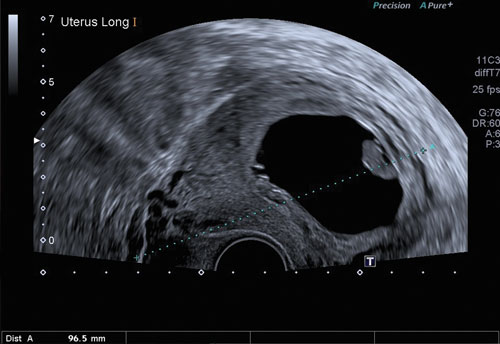
Women who are miscarrying may present with vaginal bleeding which can be associated with lower abdominal or pelvic pain. Some women seek advice regarding loss of pregnancy symptoms such as nausea and breast tenderness, while others have no symptoms or concerns and miscarriage is only diagnosed at the routine first trimester screening ultrasound scan, see figure 1.
Vaginal bleeding can range from scanty pink discharge to active heavy blood loss with passage of large clots. Women may describe passing tissue or a sac-like structure per vagina, and occasionally some may see a small embryo.
Pelvic pain is usually described as a period-like cramping which can be severe. There may be nausea or vomiting. Unilateral pain, with or without vaginal bleeding, should raise suspicion of ectopic pregnancy, which is difficult to distinguish clinically from a miscarriage and should always be considered in any woman with a positive pregnancy test and symptoms of pain and bleeding.
Where bleeding has been very heavy or prolonged there may be haemodynamic instability and maternal collapse. Pregnancy tissue passing through the cervix may cause a vasovagal response referred to as cervical shock, which manifests as bradycardia and collapse. In these circumstances, vaginal speculum examination is essential to facilitate removal of the tissue from the cervix, simply grasp the products with sponge holding forceps and gently tease the tissue out.
If intrauterine infection develops, historically referred to as septic miscarriage, then initial presentation may be with lower abdominal pain, pyrexia and an offensive vaginal discharge. In the most recent triennial confidential enquiry into maternal death Saving Mothers’ Lives 2006-2008 septic miscarriage was responsible for two deaths.6 This report highlighted that once established, genital tract sepsis can be fulminating with rapid deterioration into septic shock and multi-organ failure. Prompt recognition, investigation and treatment are essential to prevent serious morbidity and mortality, see table 1.6
In an emergency situation, call 999 and administer penicillin V if the patient is not allergic. The ambulance will carry ergometrine which in the event of heavy bleeding can be given intramuscularly to encourage uterine contraction and reduce blood loss.
Assessment
While the diagnosis of miscarriage based on history taking and physical examination alone is inaccurate,7 clinical assessment does allow effective triage to be undertaken and appropriate follow-up arranged. Traditional practice classified miscarriage according to the history and findings on speculum examination: threatened, inevitable or complete. However, transvaginal ultrasound scan has become readily available and should be considered the standard test to assess viability of the pregnancy.1
An estimation of the gestation of the pregnancy should be attempted based on the woman’s recollection of her last menstrual period, and the pregnancy should be confirmed with a urine test. Pregnancy tests should be classified as positive or negative, and not as faintly positive based on the clarity of the second line.
Commercial quantitative tests are available, estimating the gestation of the pregnancy, but these do not have a clinical application.
Risk factors for ectopic pregnancy should be identified, see table 2, bearing in mind that a third of women will have no known risk factors.8
Basic observations of pulse, blood pressure, temperature and respiratory rate identify those women who are unstable. Assessment of the amount of vaginal bleeding experienced is best made in the context of time taken to saturate a sanitary pad. Changing a pad soaked with blood and clots more than once an hour is an indication of heavy bleeding that requires immediate referral.
Abdominal, pelvic and vaginal examinations should be carried out to look for tenderness and the presence of cervical motion tenderness.
The presence of pregnancy tissue in the cervix on speculum examination confirms a miscarriage in progress.
Referral
Figure 2 shows which patients should be referred and where. Women can be advised that the early pregnancy service assessment will routinely use transvaginal ultrasound scanning in the initial assessment of the pregnancy. If this method of imaging is not acceptable to the woman, a transabdominal scan can be performed but this is less accurate and may result in a delayed diagnosis of pregnancy complications.
Following confirmation of a viable intrauterine pregnancy, symptoms may resolve. However, if the symptoms worsen, or persist beyond 14 days, a repeat referral should be made to the early pregnancy unit for further assessment.9
If a pregnancy is at 12 weeks’ gestation or beyond and the woman is rhesus negative, she will require anti-D prophylaxis if there are symptoms of bleeding.
Management
Where a miscarriage has been confirmed, there are three management options available.
Expectant management
Expectant management is the first-line approach, and is encouraged for 7-14 days after diagnosis of miscarriage. Most women will miscarry spontaneously during this time and will need no further treatment.
The early pregnancy unit will provide information on what to expect during the process and how to seek help and advice if there are any concerns or if an emergency arises. The patient should have immediate access to a telephone and the ability to explain their symptoms and access hospital treatment if necessary.
Symptoms of bleeding may persist for 2-3 weeks but should decrease with time. A urine pregnancy test taken after three weeks should be negative if the miscarriage has completed, and the woman will be advised to contact the early pregnancy unit if the test remains positive.
Expectant management is not appropriate if there are risk factors for haemorrhage, or if the woman is at increased risk from the effects of haemorrhage e.g. pregnancy at the end of the first trimester, twin pregnancy miscarriage, molar pregnancy, history of anaemia or coagulopathies, or refusal of blood transfusion.9 While there is no increased risk of infection with expectant management, there is no place for conservative management if symptoms of infection are present.
Medical management
Medical management of miscarriage can be offered on either an inpatient or outpatient basis depending on local protocols. Misoprostol is given vaginally or orally, and will usually provoke the onset of miscarriage within 24 hours of administration.
Women will experience vaginal bleeding and pain similar to that of a spontaneous miscarriage, but may also have diarrhoea and vomiting which are common side effects of prostaglandin administration.
Research shows that expectant and active treatment of miscarriage are similar in terms of severity of symptoms experienced, anxiety, women’s satisfaction with care, number of days in pain and the incidence of infection.
Expectant treatment of miscarriage is associated with fewer gastrointestinal side effects, but women undergoing expectant management have more days of bleeding and a significantly greater chance of needing a blood transfusion. Unplanned intervention is significantly greater in the expectant management group.9
Surgical management
Surgical management may be chosen by a woman if she has had a previous adverse or traumatic experience associated with pregnancy. It is recommended if there are risk factors for haemorrhage, in the presence of infection or heavy bleeding, or where gestational trophoblastic disease is suspected. Suction curettage under general anaesthesia is most commonly performed. Manual vacuum aspiration using local anaesthetic is used in some centres, although this practice is more widespread in the USA than the UK.10
Surgical intervention is the most reliable method of achieving complete uterine evacuation, and is least likely to be associated with the need for further intervention.11 The disadvantages are exposure to surgical risks, including uterine perforation and cervical lacerations/damage, although these complications are uncommon.
Anti-D (250 IU) should be offered to all non-sensitised rhesus-negative women who have surgical management of miscarriage. It is not required for women under 12 weeks’ gestation who are following expectant or medical management of miscarriage, but should be given to those women with a viable pregnancy who have ongoing bleeding at 12 weeks and beyond.
GP follow-up and support
If a woman miscarries at home, often the pregnancy tissue will be passed along with blood clots into the toilet.
If she wishes to keep these remains, she may legally do so.
If remains or tissue are brought into the GP practice for inspection, and the woman does not want to dispose of them herself, then each local hospital will have its own procedure for dealing sensitively with the tissue.
The hospital chaplin is an excellent source of information in these circumstances, and will be able to facilitate the necessary arrangements.
Miscarriage is often, but not always, associated with emotional distress which can be prolonged and pervasive. The grieving process can be followed by persistent symptoms of anxiety or depression which can deteriorate and lead to significant psychosocial morbidity if not identified and addressed.12 GPs are ideally positioned to recognise the emotional impact of miscarriage, and refer for psychological support or treatment where needed.
Couples affected by miscarriage may require repeated reassurance that they did nothing to cause the miscarriage, and a successful pregnancy in the future is achievable.
There is no evidence to suggest that delaying a further attempt at pregnancy is associated with an increased chance of successful pregnancy, although often a woman may require time to recover emotionally and physically from her experience.
REFERENCES
1 Swer M and Jurkovic D. Diagnosis of miscarriage. Acute Gynaecology and Early Pregnancy. Advanced Skills Series. RCOG Press. 2011
2 Regan L, Rai R. Epidemiology and the medical causes of miscarriage. Ballieres Best Pract Res Clin Obstet Gynaecol 2000;14:839-54
3 Nybo Andersen AM, Wohlfahrt J, Christens P et al. Maternal age and fetal loss: population based register linkage study. BMJ 2000;320:1708-12
4 Belloc S, Cohen-Bacrie P, Benkheilfa M et al. Effect of maternal and paternal age on pregnancy and miscarriage rates after intrauterine insemination. Reprod Biomed Online 2008;17:392-397
5 Feodor Nilsson S, Andersen PK, Strandberg-Larsen K, Nybo Andersen A-M. Risk factors for miscarriage from a prevention perspective: a nationwide follow-up study. BJOG 2014; DOI: 10.1111/1471-0528.12694
6 Saving Mothers’ Lives: Reviewing maternal deaths to make motherhood safer: 2006–2008. BJOG 2011:118:1-203
7 Wieringa-de Waard M, Bonsel GJ et al. Threatened miscarriage in general practice: diagnostic value of history taking and physical examination. Br J Gen Pract 2002;52:825-9
8 Bottomley C. Epidemiology and aetiology of miscarriage and ectopic pregnancy. Acute Gynaecology and Early Pregnancy. Advanced Skills Series. RCOG Press. 2011
9 National Institute for Health and Clinical Excellence. CG154. Ectopic pregnancy and miscarriage: diagnosis and initial management in early pregnancy. NICE. London. 2012
10 Swer M. Conservative and surgical management of miscarriage. Acute Gynaecology and Early Pregnancy. Advanced Skills Series. RCOG Press. 2011
11 Sotiriadis A, Makrydimas G, Papatheodorou S, Ioannidis JP. Expectant, medical or surgical management of first trimester miscarriages: a meta-analysis. Obstet Gynaecol 2005;105:1104-13
12 Cumming G, Klein S, Bolsover D et al. The emotional burden of miscarriage for women and their partners: trajectories of anxiety and depression over 13 months. BJOG 2007;114:1138-1145
ARTICLE IN PDF
 Download this article in PDF format
EXTERNAL WEBLINKS
The Miscarriage Association
The charity has a website, and phone helpline, with comprehensive information on all aspects of miscarriage, including a list of publications that women, and their partners, may find helpful
NICE Evidence
PubMed