SEARCH

Wade DT. Managing prolonged disorders of consciousness. Practitioner 2014;258 (1769):25-30
Managing prolonged disorders of consciousness
20 Mar 2014
AUTHORS
Professor Derick T Wade MA MB BChir MD FRCP, Consultant and Professor in Neurological Rehabilitation, Oxford Centre for Enablement, Oxford, UK
Article
Most GPs will know a patient who has sustained a severe brain injury sufficient to leave them unconscious for more than four weeks. Although the GP will not be responsible for the initial clinical care, he or she will see the relatives, who are often not adequately supported by the acute hospital team. GPs may well find the guidance published by the Royal College of Physicians in December 2013 of great help as they try to support the family through a very difficult time.
Vegetative state
In 1972, Professor Brian Jennet published a paper1 coining the term the vegetative state in which he described a clinical state of being awake but unaware. In 1992, the High Court decided that someone who was in this state permanently did not have an interest in continuing to be treated medically, and that medical treatment could be (not should be) withdrawn. The medical treatment was clinically assisted nutrition and hydration, and the patient Tony Bland died.
In 1996, the Royal College of Physicians published its first guidance on the diagnosis of the vegetative state to help clinicians and also the courts. This was revised in 2003.
Since then there has been more research into the nature of the vegetative state, including a recognition that there are people at the borders who are in a minimally conscious state.2 There have also been advances in the diagnosis both clinically and using technological investigations.
Several new guidelines relating to the overall management of people with severe neurological losses have since been published.3,4
Therefore, it was timely for the Royal College of Physicians to develop a new set of guidelines.5 The primary aim was to increase awareness of how to manage people who had a prolonged disorder of consciousness, whether or not they eventually entered the permanent vegetative state and this article will focus on that aspect.
Recovery from brain insult
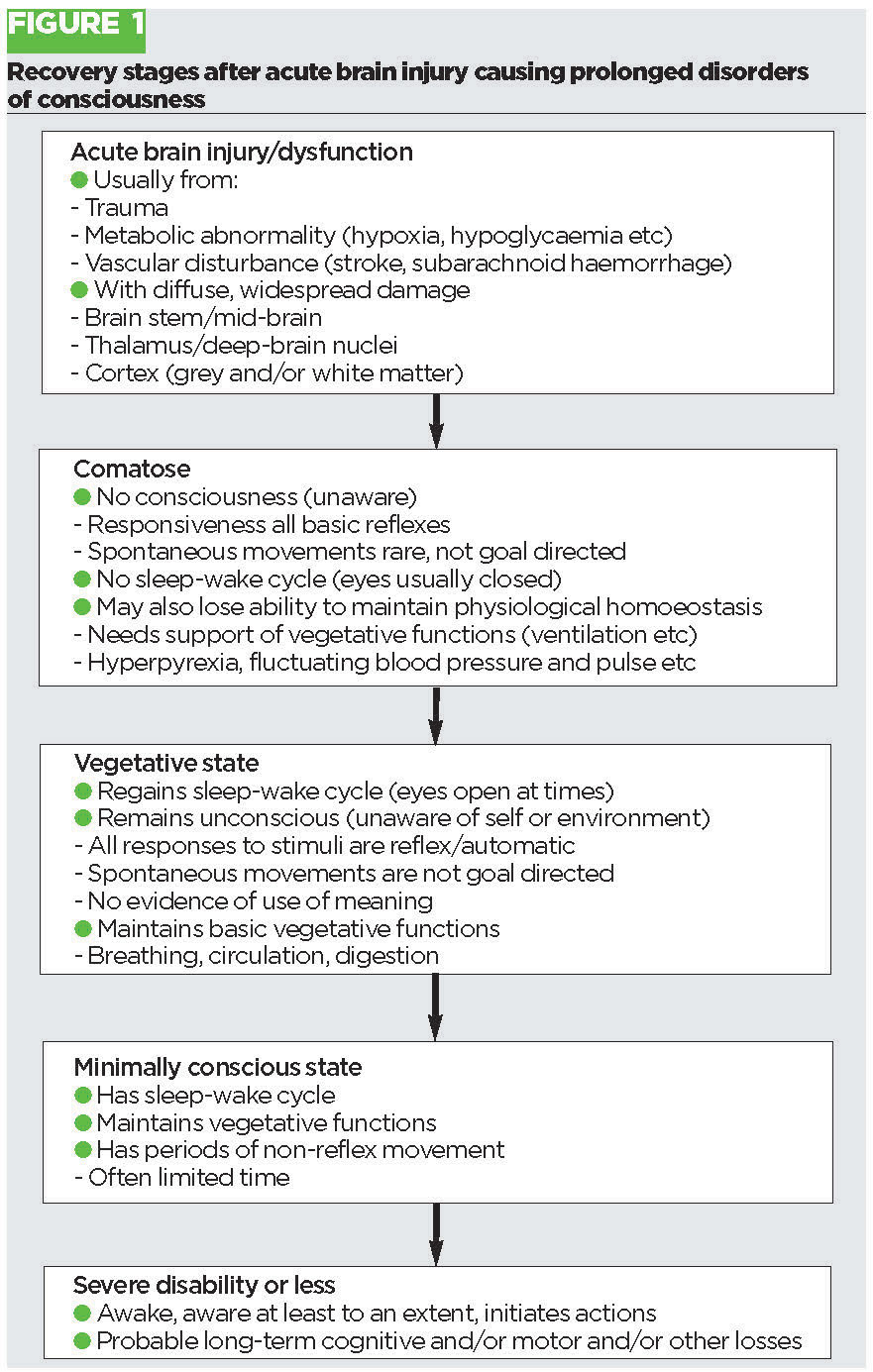
After acute severe brain damage, many people are rendered unconscious or comatose for more than 24 hours, see figure 1. Although a number can still recover fully, some will not and a significant minority remain unconscious for days, weeks or longer. These patients have a prolonged disorder of consciousness. The different types of condition that may arise are shown and contrasted in table 1, above. This also lists the locked-in syndrome, because it is commonly considered a differential diagnosis. However it is not, arising as it does from focal pontine infarction which leaves an individual fully, and obviously aware.
Recovery from initial unconsciousness usually passes through the phases shown in figure 1. For most patients the recovery is too fast to notice the different phases but they are easily seen in people who recover slowly.
In coma, a person is not only unaware, but also does not have a sleep-wake cycle. As the person recovers, one of the first physiological functions to return is a normal sleep-wake cycle. If a person remains otherwise unconscious, the patient is described as being in a vegetative state – awake but unaware, maintaining circulation and respiration but not showing spontaneous or responsive goal-directed actions. Even in people with a prolonged recovery, the vegetative state is usually reached within the first four weeks.
Minimally conscious state
If recovery continues, as it does in most cases, the patient may well then pass through a stage when they are aware for short periods at a relatively low level, possibly just aware of the presence of another person. This state is usually referred to as the minimally conscious state.
At a later stage, the patient will emerge into a higher level of awareness, being aware most of the time that they are awake. The patient will usually still have quite severe losses and disabilities.
The time course of recovery is very variable, and not easily predicted in the early phases. As a very broad and general rule, failure to see any change in level of responsiveness over the first 4-8 weeks usually presages very limited further recovery. This rule is insufficiently sound to use for irreversible decisions but can be used to help prepare families for the probable future.
Permanent vegetative state
If recovery of awareness has not occurred by six months after hypoxic or hypoglycaemic brain damage and 12 months after most other causes of brain damage, then the patient is very unlikely to recover any awareness and is described as being in a permanent vegetative state.
If someone enters a minimally conscious state, recovery may continue towards full awareness over the next three to five years, although this is much less well researched. Again giving a prognosis in an individual case is impossible, and some people remain in a permanent minimally conscious state.
Assessing awareness
GPs may well be asked about awareness by relatives. Table 2, above, lists key points that will help GPs to inform and support the family.
Assessment of level of awareness is not straightforward, and requires a team with suitable experience and expertise. It is vital to establish the underlying neurological damage, and whether or not there is an intact primary sensory input and motor output, and if there are reversible causes such as a high level of a sedating drug, or a subdural haematoma.
Determining the level of awareness is primarily a clinical matter, and does not depend upon imaging or other technologically based investigations. Although, investigations do have a role in diagnosing the cause, they have no role in determining the level of (un)awareness. Full assessment will usually involve admission to a specialist neurological rehabilitation service. Assessment is funded nationally and should not be an obstacle.
Structured observation protocols should be used in order to establish the level of awareness. At least six different published structured assessments exist, but the recent guidance suggests using one or more of the following:
• Coma Recovery Scale - Revised
• Wessex Head Injury Matrix
• Sensory Modality Assessment and Rehabilitation Technique (SMART)
The first two can be used easily, the third only by people who have undergone specialised training. Whichever scale is used, it is important that:
• The person has sufficient experience and knowledge
• Repeated observations are made over two or three weeks at different times of day and potentially in different settings
• All ancillary information is reviewed which will involve going through the notes, and asking clinical staff involved and, importantly, the family
It is important to recognise that a patient may be responsive without being aware, and that spontaneous movements can occur in somebody who is unaware. When measuring a level of awareness there will always
be patients who are on the border between states and therefore difficult to categorise. However, in reality it is usually uncontentious as to whether or not someone is unaware.
Active management
The recommended general pathway for active management is shown in figure 2, p28. The GP should be aware of this in order to help relatives in setting expectations and making plans, and also in asking for the appropriate management if this is not being organised properly. Three points are particularly important:
• A specialist multidisciplinary team should be closely involved in the management of every patient from the outset. This must include not only a consultant in neurological rehabilitation or other doctor with appropriate expertise, but also the full range of specialists in physiotherapy, nursing, occupational therapy, speech and language therapy, clinical psychology and ideally social work.
Furthermore, the team should have access to other specialist expertise, for example in eating and dietetics.
Full assessment usually requires, at some point, admission to a specialist neurological rehabilitation service and, as admissions are now funded nationally (in England) there should be no obstacle
• In every case the family must be closely and fully involved from the outset. Families legally cannot, and should not, be asked to make decisions concerning healthcare, the only exception being if a family member is a legally appointed deputy or has been given power of attorney in relation to healthcare matters. Nevertheless family members can, and should, be asked to give information about the person’s wishes, life choices etc as part of the best interests decision-making process, and they should be involved in best interests meetings
• Family members need support – information, practical help, and emotional support – and this need may continue for many months or years
• Given that these patients do not have the mental capacity to participate in decision making, it is essential to use the best interests decision-making process outlined in the Mental Capacity Act 2005.
There is good evidence that currently this process is used rarely, and that it is not followed even when attempts are made to consider best interests.6
The Act and its associated guidance7 appears to be based on the assumption that only one specific decision needs to be made at a time.
In reality decisions are being made constantly. Many are too trivial to warrant discussion (e.g. to turn the patient in bed or to clean the patient’s face) but there are also more significant decisions currently usually made without discussion, such as initiating nasogastric feeding, undertaking a tracheostomy and inserting a percutaneous endoscopic gastrostomy tube.
Moreover, decisions are made about acute treatments such as treating hydrocephalus or infections late after the injury also often without formal consideration of the patient’s best interests – would the patient have wanted the intervention?
The GP has two vital roles in the best interests process. Often the GP may have information about the patient’s views on healthcare, medical treatments and what he or she might want in the situation. Second, the GP can inform and support families to ensure that best interests meetings are held and that family members are involved properly in the process.
It must be stressed that families cannot make the decisions, but they must be consulted about what the patient’s views would have been.
They should not be asked what their own views are, as these are not relevant.
To save time and effort any best interests meeting should consider:
• Any specific decision needed at the time
• Policies for likely or potential situations requiring
— Immediate decisions - e.g. cardiac arrest, other collapses
— Urgent decisions – e.g. transfer to ITU, further operations
— Less urgent decisions – e.g. insertion of a feeding tube
• In the later stages, policies on
life-prolonging treatment
A suggested format for documenting a best interests meeting is shown in table 3, and the GP could give this to a relative to use when asking for a formal meeting.
Finally, it is important to note the guideline draws attention to one particular situation, the patient who remains unaware or minimally aware with no realistic prospect of further recovery. It recommends not only that a best interests meeting must be held for all patients when they enter the permanent vegetative state but also that the default, usual conclusion should be that it is not in the person’s best interests to continue clinically assisted nutrition and hydration.
The reasoning is that on every occasion that this question has been considered by the High Court, it has come to that conclusion.
Conclusion
GPs will recognise that these guidelines simply recommend good patient-centred, family-friendly care and will help clinicians to:
• Involve the appropriate specialist service from the outset
• Make all decisions in the best interests of the patient (who by definition cannot be involved)
• Keep the family informed from the outset
• Involve the family in helping in the best interests decision-making process and helping in the assessment of the patient, if they so wish.
REFERENCES
1 Jennett B, Plum F. Persistent vegetative state after brain damage: A syndrome in search of a name. Lancet 1972;299:734–737
2 Giacino IT, Ashwal S, Childs N et al. The minimally conscious state: definition and diagnostic criteria. Neurology 2002;58:349-353
3 The National Service Framework for Long Term Conditions. Department of Health. London. 2005 https://www.gov.uk/government/publications/quality-standards-for-supporting-people-with-long-term-conditions
4 Royal College of Physicians and British Society of Rehabilitation Medicine. Rehabilitation following acquired brain injury. National clinical guidelines. RCP, BSRM. London. 2003
5 Prolonged disorders of consciousness. National clinical guidelines. Report of a working party 2013. Royal College of Physicians. London. 2013. www.rcplondon.ac.uk/sites/default/file/prolonged_disorders_of_consciousness_national_clinical_guidelines_0.pdf
6 Kitzinger J, Kitzinger C. The ‘window of opportunity’ for death after severe brain injury: family experiences. Sociology of Health & Illness 2013;35:1095–1112 doi: 10.1111/1467-9566.12020
7 Making decisions. A guide for people who work in health and social care. Office of the Public Guardian. OPG603. 4th Edition. London. 2009 www.justice.gov.uk/downloads/protecting-the-vulnerable/mca/opg-603-0409.pdf
ARTICLE IN PDF
 Download this article in PDF format
EXTERNAL WEBLINKS
An online resource for families and clinicians will soon be available on www.healthtalkonline.org
Contact Professor Celia Kitzinger
for more information: [email protected]