SEARCH

Thomas M, Pal R. Be vigilant for acute kidney injury in primary care. Practitioner 2013; 257 (1765): 23-26
Be vigilant for acute kidney injury in primary care
23 Oct 2013
AUTHORS
Dr Mark Thomas BSc MB BS MD FRCP, Consultant Nephrologist, Heart of England Foundation NHS Trust, Birmingham, UK
Dr Rajib Pal MBChB MRCP(UK) MRCGP DCH DRCOG PGCert (Med Ed) GP, Hall Green Health, Birmingham, UK
Article
Acute kidney injury (AKI) has been the Cinderella of acute organ injuries.
Large studies have found that about 20% of all adult emergency admissions are affected by AKI.1-5 The mortality rate for AKI is almost 25%.5,6 As this condition is both frequent and devastating it has a major impact on patient health and NHS costs.7 One conservative estimate from an NHS Kidney Care study is that AKI, excluding AKI in the community, causes more than 10,000 preventable deaths a year in England alone.3
AKI was previously called acute renal failure.8 It was regarded as uncommon, with patients typically managed by nephrologists. However, it is now accepted that AKI represents a wide spectrum of injury to the kidneys, not just kidney failure. It is a common problem among the increasingly elderly patients who are admitted to hospital.
A report published by the National Confidential Enquiry into Patient Outcome and Death (NCEPOD)9 described systemic deficiencies in the care of adult patients dying from AKI. It became clear that clinicians needed to improve their recognition and management of this condition.
It is not a problem confined to acute hospitals, the vast majority of AKI cases start with an illness in the community. In our study, 67% of AKI cases were identified on blood samples from the A&E department, admission areas or the community.10 The NCEPOD report led to the commissioning of the NICE clinical guideline on AKI published in August this year.11
Pathophysiology
In AKI, loss of kidney function contributes to morbidity and mortality. Patients die from AKI rather than with AKI as a complication of an underlying illness. Even when comorbidities are taken into account, AKI has an independent effect on mortality.10 This may be because AKI is a pro-inflammatory state that induces distant organ dysfunction: so-called organ crosstalk.12
The metabolic work of the kidney tubule imposes major energy demands, especially on the proximal tubule and medullary thick ascending limb. At the same time the tubule normally operates under conditions of borderline oxygen supply, especially in the outer medulla.13 If the blood supply to the kidney is compromised, this part of the kidney can fall off a ‘hypoxic cliff.’ In our ageing, hypertensive society, the kidney is used to a blood pressure in a certain, relatively higher range.14 In the development of AKI, the typical patient will suffer a surprisingly modest fall in blood pressure of about 15-20 mmHg.15 It is this relative or absolute hypotension that can lead to a range of tubular injury.
Traditionally tubular injury has been divided simplistically into either pre-renal AKI (reversible ischaemia of tubules) or frank acute tubular necrosis. However, the kidney shows various pathologies in AKI, including tubular injury, tubular obstruction, tubular cell necrosis, apoptosis, and inflammation.16,17 Thus acute tubular necrosis is no longer a useful term. The pre-renal – tubular cell injury spectrum is best viewed as just that, a complex spectrum with a wide range of injury. This view has been reinforced by the finding that even small rises in creatinine, indicating AKI, are independently associated with increased mortality.7,18,19
Causes
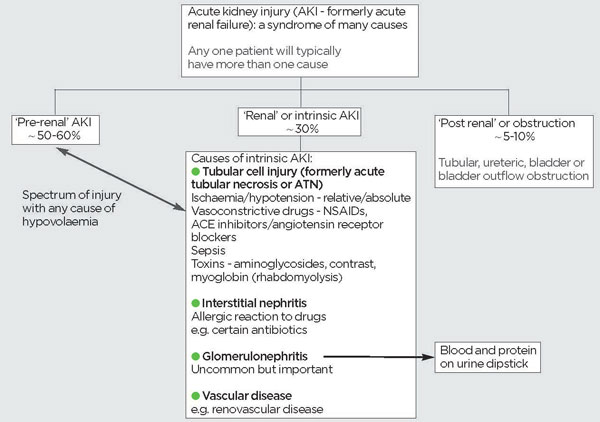
The causes of AKI have traditionally been divided into pre-renal, intrinsic renal, and post-renal or obstructive see figure 1.
Any cause of hypovolaemia or reduced effective circulating volume can inflict ischaemic tubular injury. These include fluid loss (diarrhoea, vomiting, etc), and blood loss, and other causes of hypotension (relative or absolute, including pump or cardiac failure). Intrinsic renal causes of AKI can be thought of as conditions manifested as direct injury to the glomerulus, the tubule, the interstitium, or the vasculature, see figure 1.
Post-renal AKI refers to any obstruction within the tubule itself, ureters, bladder or the bladder outflow/urethra. Prostatic hyperplasia is a common cause of the latter form of obstruction,20 so AKI in any older man should raise the suspicion of this condition.
The clinician should be aware of the risk factors and conditions that predispose to the development of AKI, see box 1. Thus a patient with chronic kidney disease (CKD) may be stable and appropriately treated with an ACE inhibitor for hypertension, until an episode of diarrhoea, vomiting, hypotension and AKI occurs.
AKI syndromes
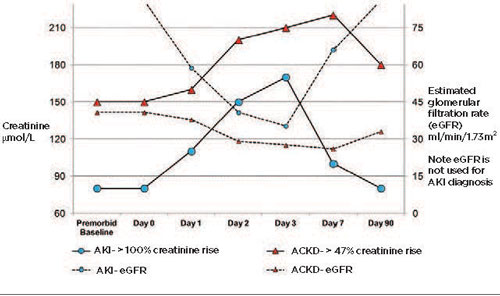
The diagnosis of AKI is currently based on a rise in creatinine, and/or reduced urine output. Oliguria is detectable occasionally on history taking, but AKI in the community is most often diagnosed on the basis of a rise in creatinine, see box 2. Estimated glomerular filtration rate (eGFR) is not used in the diagnosis of AKI,21 and is shown in figure 2, for information only.
During AKI, after a single defined insult to the kidneys, creatinine may rise over a few days before reaching a plateau, see figure 2.22 Creatinine is a by-product of muscle energy metabolism. In patients with low muscle mass, AKI may only be seen as a small rise in creatinine. The rise in creatinine needs to be on a short, acute timescale to distinguish it from the slower steady rise of progressive CKD.
Clinicians should be aware of certain AKI subgroups, shown in schematic form in figure 2. The graph shows one patient with AKI and >100% rise in creatinine over three days and another patient with pre-existing CKD, who has a superimposed episode of AKI, called acute on chronic kidney disease (ACKD).
It is increasingly recognised that episodes of AKI can fail to recover fully, particularly in patients with more severe AKI or with prior CKD. Each episode of AKI is another blow to the kidneys, potentially leading to cumulative damage.23,24 An episode of AKI is often the final straw for a patient with CKD resulting in end stage renal disease and the need for dialysis.
The recognised international guidance for the detection and staging of AKI is shown in box 2, in simplified form. It has recently been recognised that subtle degrees of AKI with small rises in creatinine ≥ 26 µmol/L independently affect mortality.7,18,19 These small rises have therefore been incorporated into the definition of AKI. In the near future it should be standard for all UK laboratory urea, creatinine and electrolyte (U&E) results to include an alert warning for any possible AKI.25
Initial assessment
A key step in the initial assessment is to identify the likely cause(s) of kidney injury, as AKI is a syndrome and not a diagnosis, see box 3, left. In most cases there will be multiple causes.
Not all patients need immediate referral to hospital, see box 4. Other factors such as age, the number and severity of comorbidities, and availability of carers will impact on any decision regarding referral.
For example, the following patient could potentially be managed at home.
A 30-year-old man with no associated comorbidities who is generally fit and well develops diarrhoea, after a night out, with no red flag symptoms. Blood tests showed a significant rise in creatinine suggestive of stage 1 AKI. He remains clinically well and is able to keep up his fluid intake. He continues to pass urine as normal. His condition and kidney function should be monitored within 48 to 72 hours of the original detection of AKI, and the latter followed up every 48 to 72 hours over the next two weeks to ensure full recovery.
There has been little research on the assessment of sick patients in the community to determine whether hospital admission is needed. It has been advocated that the National Early Warning Score (NEWS) should be used for this purpose.26
When possible all the major causes of AKI should be rapidly treated.
This may include using antibiotics for tackling infection (where sepsis is not a concern) and cessation/suspension of all nephrotoxic medications.
Follow-up
At discharge following an episode of AKI, the focus of care should switch to monitoring and prevention of further episodes. Patients and carers should be given information about the cause(s) of the AKI, treatment, monitoring and prognosis.11
It is important to arrange to recheck the kidney function, for example at 1-2 weeks after discharge. In patients with known CKD, further insults to the kidneys should be avoided if at all possible (see risk factors for AKI, box 1). In particular the use of NSAIDs or iodinated contrast should be avoided. When prescribed potentially nephrotoxic drugs, patients should be educated about the AKI risk associated with dehydration and infection.
Although evidence in this area is limited, patients should be advised to suspend ACE inhibitors and angiotensin receptor blockers temporarily. 11
In particular, these drugs should be suspended immediately during an episode of vomiting and/or diarrhoea until the patient is clearly improving. This may be done without reference to a doctor at the time, but we advise that the drugs should be restarted in a timely fashion, as they offer cardiovascular and renal protection.
Conclusion
AKI is common and has a serious impact on outcomes across the spectrum of affected patients. It is important to be vigilant for AKI, and act promptly if you find it. The failings identified in the NCEPOD report should be consigned to history.
Disclaimer
Both authors contributed to the NICE guideline development group for AKI. The views expressed are the opinions of the authors and do not necessarily represent the opinions of NICE.
REFERENCES
1 Uchino S, Bellomo R, Goldsmith D et al. An assessment of the RIFLE criteria for acute renal failure in hospitalized patients. Crit Care Med 2006;34(7):913-1917
2 Pannu N, James M, Hemmelgarn BR et al. Modification of outcomes after acute kidney injury by the presence of CKD. Am J Kidney Dis 2011;58(2):206-213
3 Kerr M. Insight Health Economics, NHS Kidney Care. Economics of acute kidney injury. Royal College of Physicians of Edinburgh Consensus Conference on AKI. 2012
4 Wang HE, Muntner P, Chertow GM, Warnock DG. Acute kidney injury and mortality in hospitalized patients. Am J Nephrol 2012;35(4):349-355
5 Susantitaphong P, Cruz DN, Cerda J et al. World incidence of AKI: A meta-analysis. Clin J Am Soc Nephrol 2013;8(8):1421-8
6 Selby NM, Crowley L, Fluck R J et al. Use of electronic results reporting to diagnose and monitor AKI in hospitalized patients. Clin J Am Soc Nephrol 2012;7(4) 533-540
7 Chertow GM, Burdick E, Honour M et al. Acute kidney injury, mortality, length of stay, and costs in hospitalized patients. J Am Soc Nephrol 2005;16:3365-3370
8 Swann RC, Merrill JP. The clinical course of acute renal failure. Medicine 1953;32(2):215-292
9 Stewart J, Findlay G, Smith N et al. Adding Insult to Injury. A review of the care of patients who died in hospital with a primary diagnosis of acute kidney injury (acute renal failure). National Confidential Enquiry into Patient Outcome and Death. NCEPOD. London. 2009
10 Thomas ME, Sitch AJ, Dowswell G. The initial development and assessment of an automatic alert warning of acute kidney injury. Nephrol Dial Transplant 2011;26(7):2161-2168
11 National Institute for Health and Care Excellence. CG169. Acute kidney injury: Prevention, detection and management of acute kidney injury up to the point of renal replacement therapy. NICE. London. 2013
12 Grams ME, Rabb H. The distant organ effects of acute kidney injury. Kidney Int 2012; 81(10):942-948
13 Molitoris BA, Sharfuddin A. Chapter 76 - Pathophysiology of Acute Kidney Injury. 2527-2575. Seldin and Giebisch's The Kidney (5th edition). Academic Press. 2013
14 Abuelo JG. Normotensive ischemic acute renal failure. N Engl J Med 2007;357:797-805
15 Liu YL, Prowle J, Licari E et al. Changes in blood pressure before the development of nosocomial acute kidney injury. Nephrol Dial Transplant 2009;24:504-511
16 Devarajan P. Update on mechanisms of ischemic acute kidney injury. J Am Soc Nephrol 2006;17(6):1503-1520
17 Bellomo R, Kellum JA, Ronco C. Acute kidney injury. Lancet 2012;380(9843):756-766
18 Lassnigg A, Schmidlin D, Mouhieddine M et al. Minimal changes of serum creatinine predict prognosis in patients after cardiothoracic surgery: a prospective cohort study. J Am Soc Nephrol 2004;15(6):1597-1605
19 Lassnigg A, Schmid ER, Hiesmayr M et al. Impact of minimal increases in serum creatinine on outcome in patients after cardiothoracic surgery: do we have to revise current definitions of acute renal failure? Crit Care Med 2008;36(4):1129-1137
20 Feest TG, Round A, Hamad S. Incidence of severe acute renal failure in adults: results of a community based study. Br Med J 1993;306(6876):481-483
21 Nguyen MT, Maynard SE, Kimmel PL. Misapplications of Commonly Used Kidney Equations: Renal Physiology in Practice. Clin J Am Soc Nephrol 2009;4(3):528-534
22 Star RA. Treatment of acute renal failure. Kidney Int 1998;54(6):1817-1831
23 Thakar CV, Christianson A, Himmelfarb J, Leonard AC. Acute kidney injury episodes and chronic kidney disease risk in diabetes mellitus. Clin J Am Soc Nephrol 2011;6(11):2567-2572
24 Coca SG, Singanamala S, Parikh CR. Chronic kidney disease after acute kidney injury: a systematic review and meta-analysis. Kidney Int 2012;81(5):442-448
25 Association for Clinical Biochemistry & Laboratory Medicine. e-alerts for AKI. Statement of the Derby meeting, July 2013. http://www.acb.org.uk/docs/ default-source/guidelines/e-alerts-for-aki-meeting-statement.pdf
26 Royal College of Physicians. National Early Warning Score (NEWS). Standardising the assessment of acute-illness severity in the NHS. Report of a working party. www.rcplondon.ac.uk/sites/default/files/documents/
national-early-warning-score-standardising-assessment - acute-illness-severity-nhs.pdf
27 Hsu CY, Ordonez JD, Chertow GM et al. The risk of acute renal failure in patients with chronic kidney disease. Kidney Int 2008;74:101-107
28 Kidney Disease: Improving Global Outcomes (KDIGO) Acute Kidney Injury Work Group. KDIGO Clinical practice guideline for acute kidney injury. Kidney Int Suppl 2012;(2):1-138
29 McGee S. Evidence-based physical diagnosis. (2nd edition). Saunders Elsevier. St Louis, Missouri. 2007
30 Chassagne P, Druesne L, Capet C et al. Clinical presentation of hypernatremia in elderly patients: a case control study. J Am Geriatr Soc 2006;54:1225-1230
ARTICLE IN PDF
 Download this article in PDF format
EXTERNAL WEBLINKS
NICE CG169
Acute kidney injury. Different versions of the guideline are available including Information for the public
Patients.co.uk
Acute kidney injury