SEARCH

Tidman ASM, Tidman MJ. Intense nocturnal itching should raise suspicion of scabies. Practitioner 2013;257 (1761):23-27
Intense nocturnal itching should raise suspicion of scabies
23 May 2013
AUTHORS
Dr Alice S M Tidman BSc MBChB, Foundation Year 1 Doctor
Dr Michael J Tidman MD FRCP (Ed) FRCP (Lond), Consultant Dermatologist, Department of Dermatology, Royal Infirmary of Edinburgh, Edinburgh, UK
Article
Scabies (from the Latin scabere, to scratch) is a common, contagious, intensely pruritic condition, rooted in antiquity, caused by infestation with a parasitic mite, Sarcoptes scabiei var hominis. This is a small, eight-legged organism, barely visible to the naked eye. The female mite tunnels within the stratum corneum of the epidermis, forming the burrows that typify the condition, laying eggs as she goes that hatch into larvae which develop into adults via a nymphal form.
The immunological consequences of scabies are still incompletely understood, although the itch and rash appear to be largely the result of a delayed (type IV) allergic reaction to the mite, its eggs and excreta.
There is typically a lag of two to six weeks from the time of initial infestation until symptoms develop, but re-infection may result in rapid recurrence of symptoms.
In classical scabies, there are, on average, approximately a dozen female mites scattered over the body surface, but, occasionally, extremely large numbers of mites, often many thousands, infest the skin, causing relatively little pruritus. This highly contagious form is known as crusted, or Norwegian, scabies, and is particularly likely in elderly, immunocompromised, bedridden or institutionalised individuals, or in those with impaired perception of itch or an inability to scratch.
Spread
Scabies is spread by a mite transferring to the skin surface of an unaffected person, usually by skin to skin contact with an infested person, but occasionally via contaminated bed linen, clothes or towels. However, it is quite often the case that the source of the infestation in a particular individual cannot be identified. A mite lodged beneath a fingernail as the result of scratching a burrow may be spread to a different part of the body or to another person.
In crusted scabies, mites are also dispersed within shed scales, enabling the condition to be contracted from contaminated surfaces. Normally, the scabies mite can survive away from the human host for only up to three days, but it is likely to be longer in the case of crusted scabies as the scale provides a source of food.
Risk factors
The scabies mite is no respecter of age, gender, race or socioeconomic status. Undoubtedly, scabies remains a stigma-laden condition because of a misconception that it is always associated with sexual contact and poor personal hygiene, whereas in most cases it is acquired innocently by hygienic individuals.
Crowded living conditions facilitate spread of the mite, and epidemics frequently occur in institutional settings such as prisons and residential or nursing homes. Healthcare professionals are also at particular risk through physical contact with patients.
Presentation
Patients with classical scabies usually present with an itchy non-specific rash. Often, the history alone can be virtually diagnostic. An intense itch, affecting all body regions except the head, typically worse at night, appearing to be out of proportion to the physical evidence, with a close contact also itching, should prompt serious consideration of scabies.
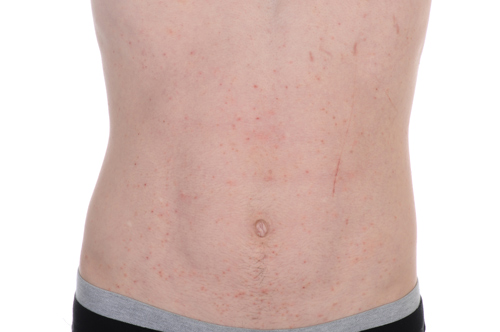
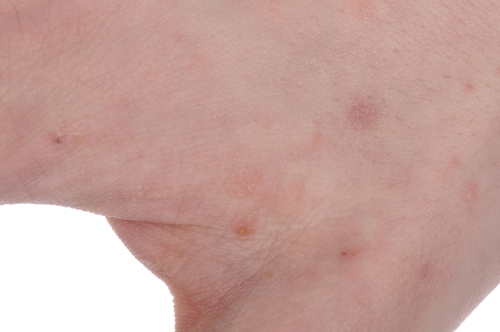
The generalised hypersensitivity rash consists of erythematous macules and papules with excoriation, see figure 1, p23, and close inspection (with gloved hands) will reveal serpiginous burrows, usually up to around 1 cm in length, see figure 2, opposite.
In adults, the characteristic sites for burrows are the:
• Finger webs
• Sides of the fingers
• Palms and flexural aspects of the wrists
• Elbows and anterior axillary folds
• Insteps
• Around the areolae in women
• Genital skin in men. Itchy inflamed scabetic nodules on the penile and scrotal skin are typical
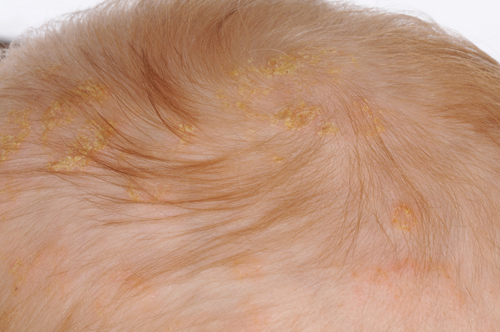
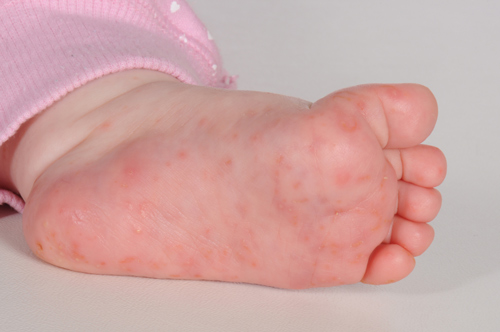
In infants, scabies can involve the face and scalp resembling seborrhoeic dermatitis, see figure 3, and a pustular eruption on the palms and soles is common, see figure 4.
Scabies can be easy to miss when it is superimposed on other dermatoses, such as eczema and psoriasis, and it is the unusual intensity of the itch, particularly at night, that provides the clue (see case 1).
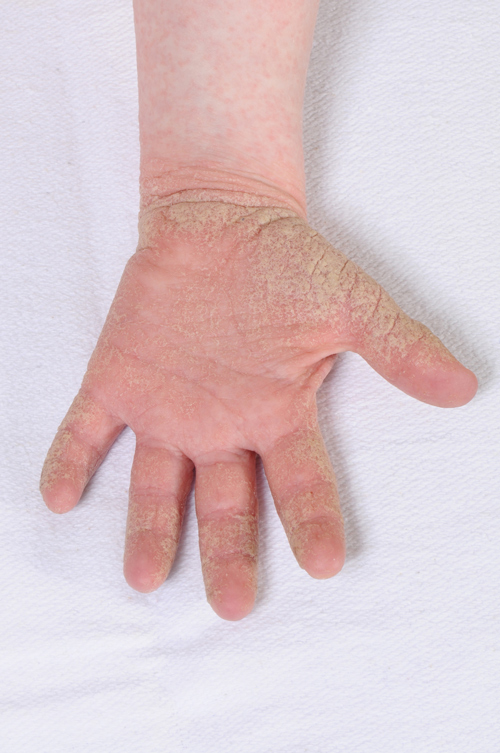
In contrast, the crusted variant of scabies may not be itchy, and is characterised by areas of dry, scaly, hyperkeratotic and crusted skin, particularly on the extremities, see figure 5 containing so many burrows that it is easy to overlook them (see case 2). Thickened nails may be a feature.
Scabies may occasionally present in unusual forms such as:
• Blistering eruption resembling pemphigoid
• Purpuric rash mimicking vasculitis
• Erythematous cutaneous nodules in small children1
• Unexplained eosinophilia
The normal clinical features of scabies may be masked by topical or systemic corticosteroid therapy, and result in very large numbers of mites. This is referred to as scabies incognito.
Confirming diagnosis
The pathognomic sign of scabies is the presence of burrows. In secondary care, extraction of mite, eggs or faecal material, by means of scrapings, curettage or with a cutting needle, is confirmatory.
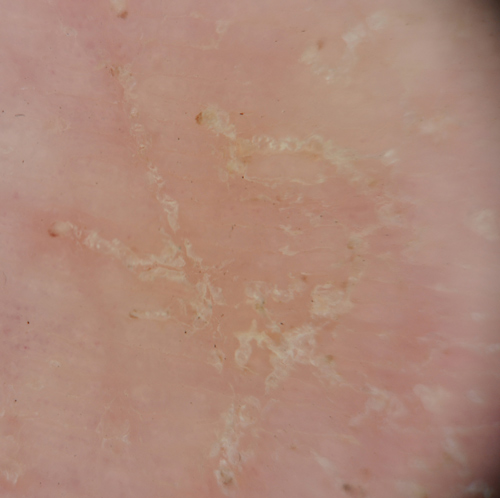
Nothing ensures 100% compliance with treatment more than the patient seeing a mite under the microscope. Dermatoscopic examination is also a quick and easy way of confirming the diagnosis, see figure 6.
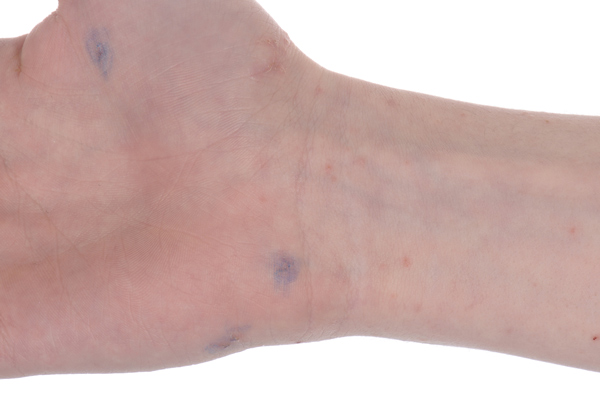
In primary care, the burrow ink test can be used to confirm the presence of burrows if there is doubt.2 This involves applying ink to the suspected burrow with the back of a fountain pen nib, and wiping off the excess with a cotton ball moistened with water or an alcohol swab. A burrow will absorb the ink and show up as a dark line, see figure 7.
Management
Typical scabies is a readily curable condition with topical measures, but certain basic principles must be adhered to:
• To reduce the risk of re-infection, all close contacts, including family members, require simultaneous treatment, even if asymptomatic, as asymptomatic infestation appears to be not uncommon.
• Two overnight (8-12 hours) applications of 5% permethrin cream, or 24 hour applications of 0.5% malathion lotion, should be given one week apart, to all areas of the skin (which should be cool and dry) from the chin down to the feet. Particular attention should be paid to the sites of burrows and beneath the free edge of nails.
Properly applied, the first treatment will usually destroy all the adult and developing mites, but not necessarily the eggs. The second treatment one week later will destroy any larval and nymphal forms that have hatched in the interim.
Patients with classical scabies may return to school or work 24 hours after the first treatment.
• In small children, the mite may also infest the scalp and face, which should be treated too.
• The treatment should be reapplied to the hands or nappy area if they are washed. Young children should wear mittens to prevent the acaricide being licked off.
• Clothing, towels and bedding should be left for a few days, in a plastic bag, and then put through a standard wash cycle. For classical scabies, general cleaning of accommodation is not necessary, but thorough cleansing of rooms used by patients with crusted scabies is advisable.
• It can take a number of weeks (longer for nodular lesions) for symptoms to subside after adequate treatment.
It is important to explain this to patients. The itch and rash can be ameliorated by topical corticosteroids, crotamiton (itself a mild acaricide), calamine, menthol cream and a nocturnal dose of sedating antihistamine.
• It is prudent to provide the patient or carers with detailed written or verbal instructions.3
• Persistent symptoms usually imply inadequate treatment, re-infestation or, rarely, drug resistance.
Permethrin 5% cream (an ectoparasitic neurotoxin) is the first-line treatment for scabies, although its use should be avoided in individuals with chrysanthemum allergy. Malathion 0.5% lotion is also an effective acaricide.
Benzyl benzoate 25% emulsion is an irritant and is not recommended for children. If used for adults, it should be left on for 24 hours and applied on two or three consecutive days, without bathing.
Traditional treatments such as gamma benzene hexachloride (which can be neurotoxic) and sulphur ointment are now rarely used in the UK and are not recommended.
Crusted scabies can be more difficult to treat. Gentle attempts should be made to soak off the crusts, and the topical acaricide should be applied two or three times on consecutive days.
Oral ivermectin can be considered if there is difficulty in eradicating crusted scabies. It is available on a named patient basis, and usually instigated on specialist advice.
Referral
Referral to secondary care should be considered in the following cases:
• Diagnostic doubt
• Patient under two months of age
• Lack of response to two courses of different insecticides
• Crusted scabies
• History suggests a risk of sexually transmitted infection
Outbreaks of scabies in institutions should be referred to the local health protection services.
Potential complications
Serious complications in typical scabies are rare. Scratch-induced secondary bacterial infection with Staphylococcus and Streptococcus species can cause impetigo, boils and cellulitis, and infection may be particularly dangerous in crusted scabies. Exacerbation of pre-existing skin conditions, particularly eczema and psoriasis, may occur. Misdiagnosis can result in unnecessary investigation for more sinister conditions such as vasculitis, blistering disorders or histiocytosis.1
Even after successful treatment, persistent itchy nodules, particularly on adult male genital skin, nodular scabies, may persist for a number of months.
Conclusion
Scabies is common and debilitating, and a potentially challenging disorder in primary care, as delay in its diagnosis and treatment causes not only difficulties for individual patients but also enables spread of the condition.
The key to making the diagnosis is always to consider the possibility in any patient complaining of itch, and deliberately and patiently look for the telltale burrows.
REFERENCES
1 Tidman MJ, Adamson B, Allan S, Wallace WH. Childhood scabies mistaken for Langerhans cell histiocytosis. Clin Exp Dermatol 2003;28(1):111-2
2 Woodley D, Saurat JH. The burrow ink test and the scabies mite. J Am Acad Dermatol 1981;4(6):715-22
3 The British Association of Dermatologists. Scabies. Information leaflet for patients http://www.bad.org.uk/ site/871/Default.aspx
ARTICLE IN PDF
 Download this article in PDF format
CLICK ON IMAGES
EXTERNAL WEBLINKS
For healthcare professionals
Clinical knowledge summaries: scabies
For patients
The British Association of Dermatologists
Primary Care Dermatology Society
PubMed reviews
NICE- evidence search