SEARCH

Hoigné P, Gibbs SRG. Can my patient with CVD travel to high altitude? Practitioner 2013;257 (1760):27-30
Can my patient with CVD travel to high altitude?
25 Apr 2013
AUTHORS
Dr J Simon R Gibbs MD FRCP, Senior Lecturer in Cardiology, Imperial College, London, Honorary Consultant Cardiologist, Department of Cardiology, Hammersmith Hospital, London, UK
Article
Package holidays are enabling an increasing number of people who live at sea level to travel rapidly to high altitude in the Alps, Andes, Rockies and Himalayas. Those with borderline health should consult a physician before travelling to altitude.
The aim of this article is to help GPs to provide practical advice for patients with cardiovascular disease who are planning a trip to high altitude (2,000–3,500 m). There is no data beyond anecdotes about safety above 3,500 m.
Altitude tolerance depends on the severity of the underlying cardiovascular disease. To provide appropriate advice the physician will need to know:
• The duration of the trip
• Ascent profile
• How much exercise the patient plans to undertake
The presence of comorbid diseases which reduce oxygenation and ventilation should also be taken into account since these may interact with cardiovascular disease. There is very limited evidence on which to provide advice and there are no clinical investigations which reliably predict outcome at altitude. Every patient must be assessed on an individual basis and the advice provided below may not be appropriate for every patient. Complex cases may require advice from the patient’s cardiologist.
Specific high altitude illnesses (acute mountain sickness, high altitude pulmonary oedema and high altitude cerebral oedema) may have additional adverse effects on patients with cardiovascular disease. General precautions from slow ascent to drug prophylaxis are important but may need modification in these patients. Guidelines for healthy people are readily available.1
Physiological changes
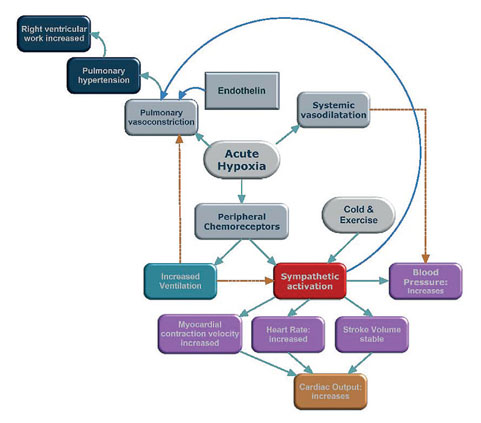
Travelling from sea level to an altitude of 2,500 m causes a 20% reduction in the partial pressure of inspired oxygen. Acclimatisation to chronic hypoxia is progressive over several weeks but the changes in the first few days are most relevant to holiday visitors. These physiological changes after arrival at altitude are shown in figure 1.
After an initial net increase in myocardial oxygen consumption during the first 3–5 days this then falls as cardiac output on exercise is reduced. This has been covered in more detail in previous reviews.2
Each cardiovascular disease is described in isolation below, however it is important to remember that many patients will have a combination of these diseases and this should be taken into account when providing advice. Contraindications to ascent to high altitude are listed in table 1.
Acute coronary syndrome
Case 1
A 55-year-old gardener is planning a trip to Vail, Colorado, at 2,484 m, to go hiking at moderate intensity. The patient has a history of an acute coronary syndrome with single vessel coronary disease treated with a stent one year ago. Left ventricular function is normal. He has no other comorbidities. After successful cardiac rehabilitation he returned to work and had no chest pain or shortness of breath.
Six months ago he had a normal exercise test to an intensity of 7 metabolic equivalents. He is on regular post-myocardial infarction medication.
His GP considered this trip to be a minimal risk for the patient and advised him to continue with his usual medication. The patient was warned to reduce his exercise if he noticed any angina, and in case of progressive worsening angina or pain at rest to seek emergency medical help.
He followed this advice, remained symptom-free and enjoyed his trip.
Comment
Acute altitude exposure can potentially trigger an acute coronary syndrome, especially in the first three days after arrival. During this time patients with angina pectoris may become symptomatic at a lower level of exercise than at sea level and should be advised to reduce activity. After five days at 2,500 m, the exertion threshold to precipitate myocardial ischaemia returns to sea level values.3
In a survey of hikers in the Austrian Alps, sudden death during hiking between 1,100 m and 2,100 m was no more frequent than sudden death during vigorous exercise at lower altitude.4
Patients who have suffered from an acute coronary syndrome are often able to travel to high altitude but not immediately after the event.
If revascularisation is indicated then this should be performed first. The patient should undergo a cardiac rehabilitation course, have a negative exercise test or an ischaemic threshold > 6 metabolic equivalents, and have no heart failure. After a reasonable time (3-6 months) to recover from the acute event, the patient can then be considered to be at low risk.
We know that patients at low risk for cardiovascular disease do well on a day trip with submaximal exercise up to an altitude of 3,454 m.5 For a more prolonged stay above 2,500–3,000 m, the ascent should be made gradually in stages to allow the patient to acclimatise.
Stable angina pectoris
Most patients with stable coronary artery disease that allows a sufficiently high exercise capacity at sea level can go as high as 3,000–3,500 m with only
a minimally increased risk, see table 2, opposite. Patients should be advised about planning their ascent according to the recommendations in table 3.
Patients with symptomatic angina on exertion should be advised against undertaking high altitude trekking holidays.
Heart failure
Case 2
A 75-year-old retired engineer asks his GP for advice about a trip to the Jungfraujoch, at 3,471 m, during his holiday in Switzerland. He plans to take the rack railway from the valley (920 m), go for a gentle walk at the summit station and return to the valley the same day.
The patient has a history of heart failure due to ischaemic heart disease. Left ventricular function is moderately impaired. At sea level he experiences shortness of breath with mild limitation of physical activity, New York Heart Association (NYHA) functional class II. On his last cardiopulmonary exercise test he reached 60% of his predicted oxygen consumption.
His GP advised him that he may undertake the excursion as he was only mildly symptomatic on moderate exercise and intended to exercise at low intensity at altitude. He was warned that his exercise capacity would be reduced at altitude and that he must descend by the next train if his breathlessness was noticeable at rest or on minor exertion and if necessary seek medical advice on return to the valley.
The patient followed this advice.
At 3,471 m he experienced increased shortness of breath on exertion but managed to take a gentle walk comfortably. He remained otherwise well and had a thoroughly enjoyable holiday.
Comment
Patients with heart failure experience a greater reduction in exercise performance than healthy people at high altitude, and the severity
of worsening is related to the severity of left ventricular dysfunction.6 This means that a heart failure patient at high altitude becomes more breathless, the more so the worse his left ventricular function.
Patients with mild to moderately impaired systolic left ventricular function and mild symptoms (NYHA functional classes I and II) may travel up to 3,000–3,500 m for a day trip. Regular medication should be continued. Care needs to be taken with diuretics since the dry air can result in dehydration. Serum potassium should be in the normal range since hyperventilation could theoretically reduce potassium further and cause hypokalaemia.
A patient with severely impaired systolic left ventricular function and symptoms on moderate exercise at sea level (NYHA functional classes III and IV) should not travel to high altitude.
Patients with unstable heart failure or fluid retention should be stabilised before travel. A significant proportion of patients with heart failure may develop pulmonary hypertension and when present this is a contraindication to altitude exposure.
Patients with heart failure caused by valve disease should not ascend to altitude if a surgical or medical intervention is planned or if they have pulmonary hypertension.
Hypertension
While on acute exposure to altitude blood pressure falls, it starts to rise again within a few hours and this may continue over several weeks. There is a dearth of data about what happens to hypertension and on first principles patients with poorly controlled hypertension at sea level should not travel to high altitude.
Patients planning a sojourn at high altitude should be advised to consider taking their own blood pressure during their stay and should know how to adjust their medication and when to seek local medical advice.
For a stay of a few weeks additional medication may be required. Calcium channel blockers are a good option as add-on medication if needed.
Arrhythmias
Sympathetic activation may increase premature supraventricular and ventricular beats in proportion to altitude but there is no increase in complex forms up to 2,500 m.3
There are no studies of paroxysmal atrial fibrillation but in our clinical experience whether it becomes more or less troublesome is unpredictable.
Patients with arrhythmias with a poorly controlled heart rate or complex arrhythmias should not travel to high altitude.
In patients on oral anticoagulants the INR should be checked more frequently than at sea level because of reports of the INR going out of range.
Permanent pacemakers and their leads are not affected by altitudes up to 4,000 m.
Pulmonary vascular disease
Patients with pulmonary hypertension diagnosed at cardiac catheterisation should not ascend to an altitude beyond 1,500–2,000 m. Hypoxic pulmonary vasoconstriction increases right ventricular afterload and places a further burden on this ventricle in addition to the disease itself.
Patients with a previous pulmonary embolism and occlusion of a right or left pulmonary artery even in the absence
of pulmonary hypertension, or congenital absence of a pulmonary artery are at high risk of developing high altitude pulmonary oedema and should not go to altitude.
Congenital heart disease
Advice should be sought from a specialist in congenital heart disease about the safety of travel. Particular care should be taken advising any patient with cyanotic congenital heart disease, atrial or ventricular septal defects, patent ductus arteriosus, or pulmonary atresia because of the risk of pulmonary hypertension, and coarctation of the aorta because of systemic hypertension.
Conclusion
Patients with severe or unstable cardiovascular disease or pulmonary vascular disease should avoid high altitude exposure.
Conversely, there is no evidence to restrict trips to high altitude in patients with stable disease who do well at sea level and have only mild symptoms.
In Europe most mountain resorts are located below 2,000 m and a direct ascent for these patients should not pose a problem. Day trips with uphill transport up to 3,500 m are also well tolerated in low-risk patients.
REFERENCES
1 Luks AM, McIntosh SE, Grissom CK et al. Wilderness Medical Society Consensus Guidelines for the Prevention and Treatment of Acute Altitude Illness. Wilderness & Environmental Medicine 2010;21:146–155
2 Bartsch P, Gibbs JSR. Effect of altitude on the heart and the lungs. Circulation 2007;116:2191-2202
3 Levine BD, Zuckerman JH, deFilippi CR. Effect of high-altitude exposure in the elderly. The Tenth Mountain Division study. Circulation 1997;96:1224-1232
4 Burtscher M, Philadelphy M, Likar R. Sudden cardiac death during mountain hiking and downhill skiing. N Engl J Med 1993;329:1738-1739
5 Schmid JP, Noveanu M, Gaillet R et al. Safety and exercise tolerance of acute high altitude exposure (3,454 m) among patients with coronary artery disease. Heart 2006;92:921-925
6 Agostoni P, Cattadori G, Guazzi M et al. Effects of simulated altitude-induced hypoxia on exercise capacity in patients with chronic heart failure. Am J Med 2000;109:450-455
ARTICLE IN PDF
 Download this article in PDF format
EXTERNAL WEBLINKS
The International Society for Mountain Medicine
www.ismmed.org
The High Altitude Medicine Guide
www.high-altitude-medicine.com
The Institute for Altitude Medicine
www.altitudemedicine.org