SEARCH

Brown J, Taupach T. GPs have key role in helping patients to stop smoking. Practitioner 2012; 256 (1751):23-25
GPs have key role in helping patients to stop smoking
23 May 2012
AUTHORS
Dr Jamie Brown PhD, Research Associate, Cancer Research UK Health Behaviour Research Centre, Department of Epidemiology and Public Health, UCL, London, UK
Dr Tobias Raupach MD, Cardiologist and Research Associate, Department of Cardiology and Pneumology, University Hospital Göttingen, Göttingen, Germany
Professor Robert West PhD, Professor of Health Psychology and Director of Tobacco Studies, National Centre for Smoking Cessation and Training, London.
Cancer Research UK Health Behaviour Research Centre, Department of Epidemiology and Public Health, UCL, London, UK
Article
Fifty years ago the Royal College of Physicians published its report Smoking and Health1 that firmly established the impact of smoking on health in the public consciousness. This was the trigger for a sustained decline in smoking prevalence in the UK and a catalyst for many subsequent activities that have successfully reduced morbidity and mortality from smoking.2
However, 18% of all deaths in adults aged 35 or over in England are still attributable to smoking.3 Almost all these premature deaths could be avoided if smokers stopped before their mid-thirties but only a quarter of people who have ever smoked regularly manage to quit by this age.
The pivotal role of GPs in smoking cessation is reflected by the inclusion of smoking indicators in the QOF, see box 1. It has long been known that advice from the patient’s GP is one of the most important triggers to a smoker making an attempt to quit.4, 5 Recent research has shown that this can be done more easily, quicker and more effectively than previously thought.6, 7
Smoking cessation advice
All patients attending a surgery for any reason who have smoked within the past three years should be offered advice on stopping smoking.
Studies have shown that many GPs prefer to limit advice to current smokers with smoking-related conditions,8, 9 and feel that quite a large proportion of consultations are inappropriate for raising the topic of smoking.10
However, the evidence is clear: smokers without smoking-related diseases are just as likely to respond to advice as those with them.11
Every opportunity to raise the topic of smoking is a potential opportunity to save a patient’s life. Every day that a person aged 35 or older continues to smoke costs him or her six hours of life expectancy.12
It is also important to re-assess the status of former smokers who were recorded as having stopped within the past three years. They may well have relapsed. Half of those who stopped six months ago will relapse at some point as will 40% of those who stopped a year ago.13
New evidence points to a change in the way smoking advice should be given. Rather than going through a litany of advising smokers to stop, asking whether smokers are interested in stopping and only if they are interested offering support, a better approach is simply to offer help with stopping to all smokers.6, 7 This puts the interaction on a positive supportive footing with minimal risk of causing upset.14
Online training module
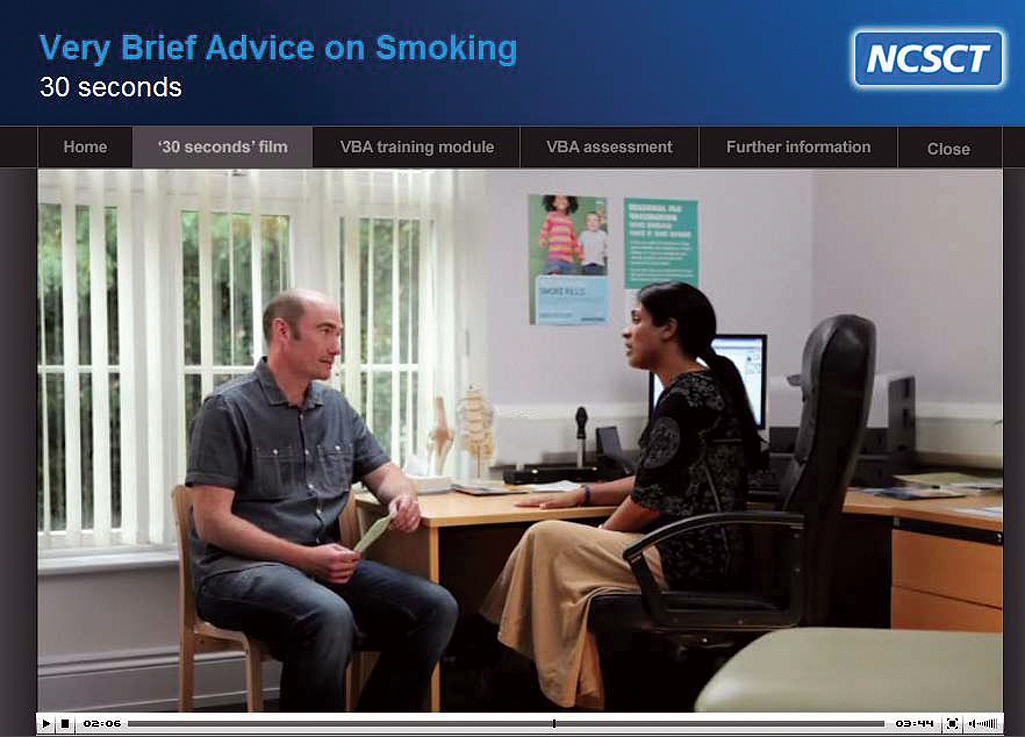
In response to this new evidence, the National Centre for Smoking Cessation and Training (NCSCT) has launched a new online training module on how GPs can best deliver smoking cessation support to their patients (www.ncsct.co.uk/vba).
The module is called Very Brief Advice and is designed to be used opportunistically in less than 30 seconds in almost any consultation with a smoker, see box 2.
Smoking cessation therapy
Smokers who attend stop smoking services should receive treatment for what is an addiction and not simply a lifestyle choice.15-17 Smoking cigarettes leads to a rapid increase in nicotine concentration in the brain.18 Nicotine then acts on nicotinic cholinergic receptors to release dopamine and other neurotransmitters.19, 20 This action results in several mechanisms that sustain addiction. These include powerful urges to smoke in the presence of particular cues and a nicotine hunger – a drive to smoke when CNS nicotine levels become depleted.21-24
Optimum treatment involves behavioural support plus one of the smoking cessation medications now available.25, 26 Behavioural support includes a number of specific behaviour change techniques that have been found to enhance the smoker’s chances of remaining abstinent.27, 28 These techniques include:
• measurement of carbon monoxide in expired air to bring home the risks of smoking and show the immediate benefit of stopping
• advice on best use of medication
• helping smokers to put in place a very clear ‘not a puff’ rule to counter the tendency to think they can ‘just have one’.
The three pharmacotherapies currently licensed and widely used in the UK are nicotine replacement therapy (NRT), varenicline and bupropion.
The most effective medication option is either varenicline or combination NRT (i.e. the patch and one of the faster acting products such as gum or an inhalator).26, 29, 30
A large RCT has recently found that cytisine, a very low cost drug that acts in a similar way to varenicline, is effective but this is unlikely to be available on the NHS until the finding has been confirmed by further trial evidence.31
Although the popular press occasionally carries reports and opinion pieces arguing that treatment to aid smoking cessation is not effective in the real world32 there is a wealth of evidence to refute this.25, 26, 29, 30
GP advice is one of the most important triggers to a smoker making an attempt to quit. This offers GPs the opportunity to play a critical role in reducing the huge number of premature deaths attributable to smoking. Evidence shows that offering help to all smokers is easier, quicker and likely to be more effective than just advising smokers to stop or asking whether they are interested in quitting.
REFERENCES
1 Royal College of Physicians. Smoking and Health.
A report on smoking in relation to lung cancer and other diseases. RCP. London. 1962
2 Royal College of Physicians. Fifty years since Smoking and Health. Progress, lessons and priorities for a smoke-free UK. Report of conference proceedings. RCP. London. 2012
3 The NHS Information Centre for Health and Social Care. Statistics on Smoking: England 2009 www.ic.nhs.uk/pubs/smoking09
4 Stead LF, Bergson G, Lancaster T. Physician advice for smoking cessation. Cochrane Database Syst Rev 2008 (2):CD000165
5 National Institute for Health and Clinical Excellence. PHI001. Brief interventions and referral for smoking cessation in primary care and other settings. NICE. London. 2006
6 Aveyard P, Begh R, Parsons A, West R. Brief opportunistic smoking cessation interventions: a systematic review and meta-analysis to compare advice to quit and offer of assistance. Addiction 2011;Dec 16. doi: 10.1111/j.1360-0443.2011.03770.x.
7 West R, Brown J. Smoking and Smoking Cessation in England 2011. London. 2012. www.smokinginengland.info
8 Coleman T, Murphy E, Cheater F. Factors influencing discussion of smoking between general practitioners and patients who smoke: a qualitative study. Br J Gen Pract 2000;50(452):207-10
9 Coleman T, Wilson A. Anti-smoking advice in general practice consultations: general practitioners’ attitudes, reported practice and perceived problems. Br J Gen Pract 1996;46:87–91
10 Vogt F, McEwen A, Michie S. What general practitioners can do to deliver more brief stop-smoking interventions: An exploratory study. J Smoking Cessation 2008;3(2):110–6
11 Senore C, Battista RN, Shapiro SH et al. Predictors of smoking cessation following physicians’ counseling. Prev Med 1998;27:412–21
12 Doll R, Peto R, Boreham J, Sutherland I. Mortality in relation to smoking: 50 years' observations on male British doctors. BMJ 2004;328(7455):1519
13 West R, Stapleton J. Clinical and public health significance of treatments to aid smoking cessation. Eur Resp Rev 2008;17(110):199-204
14 Conroy MB, Majchrzak NE, Regan S et al. The association between patient-reported receipt of tobacco intervention at a primary care visit and smokers' satisfaction with their health care. Nicotine Tob Res 2005;7: Suppl 1:S29-34
15 Aveyard P, West R. Managing smoking cessation. BMJ 2007;335(7609):37-41
16 Aveyard P, Raw M. Improving smoking cessation approaches at the individual level. Tob Control 2012; 21(2):252-7
17 Moxham J. Nicotine addiction. BMJ 2000;320(7232):391-2
18 Russell MAH, Feyerabend C. Cigarette Smoking:
A dependence on high-nicotine boli. Drug Metab Rev 1978;8(1):29-57
19 Benowitz NL. Nicotine addiction. N Engl J Med 2010;362(24):2295-303
20 Balfour DJK. Neural mechanisms underlying nicotine dependence. Addiction 1994;89(11):1419-23
21 Balfour DJ. The neurobiology of tobacco dependence: a preclinical perspective on the role of the dopamine projections to the nucleus accumbens [corrected]. Nicotine Tob Res 2004;6(6):899-912
22 Ferguson SG, Shiffman S. The relevance and treatment of cue-induced cravings in tobacco dependence. J Subst Abuse Treat 2009;36(3):235-43
23 Foulds J. The neurobiological basis for partial agonist treatment of nicotine dependence: varenicline. Int J Clin Pract 2006;60(5):571-6
24 West R. The multiple facets of cigarette addiction and what they mean for encouraging and helping smokers to stop. COPD 2009;6(4):277-83
25 Department of Health. NHS Stop Smoking Services - Service and Monitoring Guidance. London. 2010 www.dh.gov.uk/en/Publicationsandstatistics/Publications/PublicationsPolicyAndGuidance/DH_109696
26 Brose LS, West R, McDermott MS et al. What makes for an effective stop-smoking service? Thorax 2011;66(10):924-6
27 West R, Walia A, Hyder N et al. Behavior change techniques used by the English Stop Smoking Services and their associations with short-term quit outcomes. Nicotine Tob Res 2010;12(7):742-7
28 West R, Evans A, Michie S. Behavior change techniques used in group-based behavioral support by the English stop-smoking services and preliminary assessment of association with short-term quit outcomes. Nicotine Tob Res 2011;13(12):1316-20
29 Cahill K, Stead LF, Lancaster T. Nicotine receptor partial agonists for smoking cessation. Cochrane Database Syst Rev 2011;(2): Art. No.CD006103
30 Stead LF, Perera R, Bullen C et al. Nicotine replacement therapy for smoking cessation. Cochrane Database Syst Rev 2008;(1): Art. No.CD000146
31 West R, Zatonski W, Cedzynska M et al. Placebo-controlled trial of cytisine for smoking cessation. N Engl J Med 2011;365(13):1193-200
32 Alpert HR, Connolly GN, Biener L. A prospective cohort study challenging the effectiveness of population-based medical intervention for smoking cessation. Tob Control 2012;Epub ahead of print
USEFUL INFORMATION
NCSCT
Smokefree
QUIT
ASH
Smoking in England
ARTICLE IN PDF
 Download this article in PDF format