SEARCH

Unsworth D J. Following up patients after treatment for anaphylaxis. Practitioner 2012;256 (1749):21-24
Following up patients after treatment for anaphylaxis
21 Mar 2012
AUTHORS
Dr David J Unsworth PhD FRCP FRCPath, Consultant in Immunology & Allergy Southmead Hospital, Bristol
Article
NICE has recently published guidelines on the care and follow-up of patients who have received emergency treatment for anaphylaxis.1 The definition of anaphylaxis used by the guidelines as a severe, life-threatening, generalised or systemic hypersensitivity reaction is widely accepted.2 Diagnosis is based on the presenting symptoms and clinical signs which classically develop rapidly, typically evolving over minutes but in some cases hours. Various combinations of airway and/or breathing and/or circulatory problems are possible as illustrated in case 1 (severe bronchospasm, urticaria, and hypotension i.e. anaphylactic shock).
Skin and/or mucosal changes (typically urticaria and/or angioedema) are seen in around 75% of cases, but importantly, these features alone are insufficient for a diagnosis of anaphylaxis. This point was illustrated by the case history in a previous article in this journal.3
Full details of how to resuscitate a patient presenting acutely as a medical emergency with anaphylaxis have been covered previously.3, 4
Key recommendations
NICE recommends that as soon as possible after successful emergency treatment, timed (labelled) blood samples should be taken for the mast cell tryptase (MCT) test.3
MCT is normally stored in mast cells but is released in large amounts in anaphylaxis. Because MCT has a very short half life, diagnostic serum samples need to be taken within 1–2 hours but no later than 4 hours from the onset of symptoms. If possible a second paired and timed sample within the same time frame is useful. Routine clotted blood bottles are required, and blood samples are stable overnight at room temperature.
MCT test results may strongly support anaphylaxis, but normal test results do not confidently exclude the diagnosis.
It is important to document the acute clinical features (record blood pressure, respiratory rate etc) and in particular, the time course of the onset of symptoms/signs and their resolution.
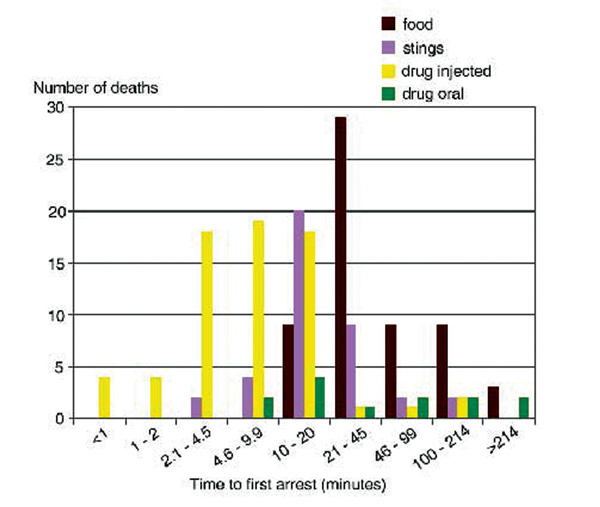
The circumstances immediately before the onset of symptoms should also be recorded to try to identify possible triggers. A study of fatal anaphylaxis5 showed that the majority of triggers provoke symptoms within one hour of exposure (see figure 1). Injected agents including medical drugs or bee/wasp venom act most rapidly, with some reactions following foods and oral medicines producing delayed reactions after a couple of hours. Food typically triggers symptoms within a few minutes, and is more likely in a child whereas new onset food allergy is far less likely in adults.
Because of the risk of relapse i.e. biphasic reactions, see case 2, opposite, the guidelines recommend that patients should be observed for 6-12 hours after the onset of symptoms especially for under 16 year olds. Possible confusion will be avoided if monitoring is advised for all cases who have been resuscitated following life-threatening anaphylaxis. Children younger than 16 years should be admitted and supervised by a hospital paediatrician.
An adrenaline injector device for intra-muscular use only, should be prescribed appropriately for body weight3, 4 as an interim measure before referral to a specialist allergy clinic. The adrenaline prescription must be accompanied by on-the-spot practical training in when, why, and how to use these devices before discharge.
Information packs should include details on how to recognise and manage future reactions, including the direction to ‘use the adrenaline injector and call emergency services’. Interim advice should be given about avoidance of triggers (if known). Contact details for patient support groups should also be provided.
Referral to a specialist allergy service (or specialist paediatric service), is strongly recommended. The BSACI website (www.bsaci.org) lists many suitable clinics with contact details. Diagnosis can be confirmed, and further investigations organised not least with a view to identifying or confirming triggers (though many cases remain idiopathic). Advice on ongoing management, and further patient education can also be provided.
Each hospital trust providing emergency treatment for suspected anaphylaxis should have separate referral pathways for suspected anaphylaxis in adults (and young people) and children.
Uniphasic and biphasic reactions
Uniphasic reactions are the norm (see case 1) with clinical features (urticaria and/or bronchospasm and/or hypotention etc) peaking at around 30 minutes after the trigger event, and full recovery (either spontaneously or as a result of treatment) within the next 30-60 minutes.
By contrast biphasic responses (see case 2, above) are reported when an apparently fully resolved uniphasic response is followed by relapse without further exposure to the trigger substance. These biphasic reactions are thought to be uncommon but are hard to predict.
Biphasic reactions are managed as for new onset anaphylaxis, often requiring further intramuscular adrenaline injections as appropriate. Biphasic reactions have been documented in children following supervised hospital-based food challenges, and in adults following immunotherapy injections of pollen extract or other allergens.
How common is anaphylaxis?
Some estimates suggest that as many as 1 in 1,333 of the UK population have experienced anaphylaxis at some point in their lives.6 But fatal anaphylaxis in the community setting is, fortunately, extremely rare with only 1 fatal case per 5 million of the UK population per annum.7 Note that half of all the fatal cases are related to medicines or other agents within a hospital rather than a community setting.
The question therefore arises, how to reconcile these two numerical estimates. It may be that the former is an overestimate and the latter an underestimate. In part it depends on the definition of anaphylaxis used.
Confirming diagnosis
Referral to a specialist clinic should take place as soon as possible, ideally within a few weeks of the acute episode.
Earlier referral (within the first two weeks) may be counterproductive as MCT tests may not have been processed, and though evidence is lacking, there are concerns that IgE-specific blood tests may be less accurate at this time.
Important background referral details should include details and timings of clinical features (peak expiratory flow, oximetry, blood pressure) both at presentation and after resuscitation.
The diagnosis of anaphylaxis rests largely on presentation with the expected clinical features, rapid onset, and in many, but not all, cases elevated acute MCT levels. Identifying the trigger agent can be difficult.
The only available tests aimed at identifying trigger agents assume an IgE-based mechanism, and therefore are more likely to be helpful when symptom onset is rapid (minutes) rather than delayed (hours). Selection and interpretation of IgE-specific blood testing and/or skin prick testing, is best left to the clinic specialists.
Patients should stop taking antihistamines and/or prednisolone (if possible) several days before clinic attendance to avoid interference with skin prick testing.
Adrenaline injector device training
It is vital that patients who need to carry an adrenaline injector lifelong, have their training reviewed. Indeed some referred cases may prove not to have had anaphylaxis3 and the correct recommendation may be withdrawal of the autoinjector and reassurance. Failure to train patients properly can lead to misuse including unintentional self-injection which is surprisingly common.8
At the risk of oversimplification, simple antihistamines, and oral prednisolone tablets should be provided in addition to an adrenaline autoinjector, for mild, moderate, and severe (life-threatening) reactions respectively.
Long-term follow-up in primary care
Once patients have been assessed in a specialist clinic, and provided with a tailored management plan, regular review will be necessary in primary care. Important aspects include ensuring that:
• adrenaline devices are in date
• injection technique refresher sessions are available
• background asthma is well controlled
• any dietary restrictions have not led to an unhealthy diet (e.g. lack of adequate calcium source in patients avoiding dairy products).
Conclusion
We know that many anaphylaxis cases are currently not referred to a specialist clinic for review. This specific aspect, and many others, can now be audited against the guidelines. Collection and documentation of presenting features, MCT test results, and clinical outcomes will facilitate research including more accurate data on the frequency of fatal and biphasic reactions.
REFERENCES
1 National Institute for Health and Clinical Excellence. CG134. Anaphylaxis: Assessment to confirm an anaphylactic episode and the decision to refer after emergency treatment for a suspected anaphylactic episode. NICE. London. 2011
2 Johansson SG, Bieber T, Dahl R et al. Revised nomenclature for allergy for global use: Report of the Nomenclature Review Committee of the World Allergy Organization. J Allergy Clin Immunol 2004;113 (5):832-6
3 Soar J, Unsworth DJ. Suspected anaphylaxis requires prompt treatment. Practitioner 2009;253 (1719):32-37
4 Resuscitation Council (UK). Emergency treatment of anaphylactic reactions. Guidelines for healthcare providers 2008. www.resus.org.uk
5 Pumphrey RS. Fatal anaphylaxis in the UK, 1992-2001. Novartis Found Symp 2004; 257:116-28
6 Stewart AG, Ewan PW. The incidence, aetiology, and management of anaphylaxis presenting to an accident and emergency department. QJM 1996;(11):859–64
7 Pumphrey RS. Lessons for management of anaphylaxis from a study of fatal reactions. Clin Exp Allergy 2000;30(8):1144-50
8 Simons FE, Edwards ES, Read EJ Jr et al. Voluntary reported unintentional injections of epinephrine from auto-injectors. J Allergy Clin Immunol 2010;125:419
USEFUL INFORMATION
UK Resuscitation Council [email protected]
www.resus.org.uk
Allergy UK
Helpline: 01322 619898
http://www.allergyuk.org/
The Anaphylaxis Campaign
Helpline: 01252 542029
http://www.anaphylaxis.org.uk/
NICE
Copies of the NICE guideline on anaphylaxis (CG134) and the version for patients can be downloaded free from: www.nice.org.uk
BSACI
Lists specialist allergy services
http://www.bsaci.org/
ARTICLE IN PDF
 Download this article in PDF format