SEARCH

Lewis S, Liddle J. Diagnosing non-parkinson’s movement disorders. Practitioner 2012;256 (1748):21-24
Diagnosing non-parkinson’s movement disorders
24 Feb 2012
AUTHORS
Dr Siobhan Lewis BSc MB ChB MRCP
StR General and Geriatric Medicine
Dr Jane Liddle MB BS FRCP
Consultant Geriatrician, Sheffield Teaching Hospitals NHS Foundation Trust
Article
Movement disorders are a common cause of neurological disability in older people, and the risk of developing such a disorder increases with age.1 Movement disorders can range from mild symptoms to severe disability and can have a significant impact on quality of life. Idiopathic Parkinson’s disease (IPD), caused by degradation of dopaminergic neurones in the nigrostriatal pathways of the brain leading to a triad of tremor, rigidity and bradykinesia, is probably the most well known. This article will focus on the most common non-parkinson’s movement disorders seen in older people and give guidance on their management. The clinical features and treatment of common movement disorders are summarised in table 1.
Essential tremor
Essential tremor is the most common movement disorder affecting older people. It was previously known as benign essential tremor as it was not thought to be associated with significant morbidity, although many sufferers can have very disabling symptoms.
However, essential tremor can be a very mild illness in some patients, with many sufferers not seeking medical attention, making if difficult to establish the true incidence and prevalence rates.2 A study from Spain found prevalence rates of 4.8%.3
Around three quarters of sufferers report significant functional disability due to the tremor.4 This can also result in problems with employment and even lead to early retirement.5
Clinical presentation
Patients present with a symmetrical tremor of the upper limbs in 95% of cases, although tremor of the head, voice, face and legs can occur. The tremor is present on posture i.e. when the body part is held against gravity and on voluntary movement – such as holding a cup or writing. It is less evident at rest, unlike the tremor of IPD, and there will be no rigidity or bradykinesia.
The tremor is classically a fine tremor of 4-12Hz, although it may be coarser in older people as tremor frequency decreases with age. Tremor improves with alcohol in up to 75% of patients and a positive family history has been reported in 17-100% of patients.6 Variations in the assessment and diagnostic criteria used are thought to account for the wide variation in reported prevalances.
Diagnosis
Essential tremor is a mainly clinical diagnosis. Functional tests such as drawing of spirals or measuring the amount of water spilled from a cup can be done, although they may miss mild cases.6
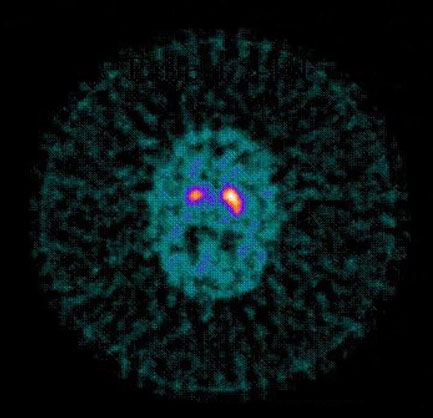
There may be some difficulty differentiating essential tremor from early IPD. A watchful waiting period may be tried. A dopamine transporter scan (DaTSCAN) can be helpful as the results will be normal in patients with essential tremor and abnormal in those with IPD (see figure 1). There is evidence that starting treatment early rather than later in IPD patients with significant symptoms is preferable for patients in the long term,7 so differentiation in the early stage could be beneficial.
The differential diagnosis also includes dystonic tremor (usually more jerky, irregular movements) and exaggerated physiological tremor (e.g. secondary to hyperthyroidism, smoking and high caffeine intake).
Treatment
Essential tremor can be difficult to treat, with many patients achieving only limited benefit from the therapies currently available. A large number of patients do, however, gain some reduction in tremor and disability.
Beta blockers: Propranolol has been shown to be effective for the treatment of essential tremor, with 40-50% of patients reporting an improvement in symptoms.6 In older people a starting dose of 40mg three times a day up to a maximum of 320mg may be beneficial in reducing tremor amplitude. Propranolol use may, however, be limited by the side effects of systemic beta blockade.
Primidone: Primidone, an anticonvulsant, has been shown to decrease the amplitude of tremor.6 It is started at low doses to prevent side effects such as dizziness, tiredness and nausea, which are usually self limiting. Dose increases from 25mg up to 50-250mg a day may be effective.
Neurosurgery: Good results have been obtained by neurosurgical interventions in patients with severely disabling symptoms uncontrolled by medical therapy. Deep brain stimulation of the thalamus can bring about a significant reduction in tremor and disability and has a relatively low complication rate, although patients must be selected carefully.6
Vascular parkinsonism
Vascular parkinsonism accounts for 4.4-12% of all cases of parkinsonism, although it is likely that many cases remain undiagnosed.8 It can present in a similar manner to IPD but is caused by cerebrovascular disease in the substantia nigra rather than Lewy bodies. It can be difficult to differentiate from IPD, and diagnosis is clinical, although brain imaging can be helpful.
Clinical features
The features of vascular parkinsonism are usually bilateral and symmetrical, in contrast with IPD where they are characteristically asymmetrical. They often affect the lower more than the upper limbs (lower body parkinsonism). Rest tremor is uncommon and tends not to be a pill rolling type when present. Tone is usually increased but without cogwheeling. Bradykinesia may be present. Gait disorders are a predominant feature, usually with a broad-based gait but with an upright posture.8
There may be other features of cerebrovascular disease, such as incontinence and cognitive impairment, and pyramidal (upper motor neurone) motor signs.
Diagnosis
A history of previous stroke is common, as are the presence of cardiovascular risk factors such as hypertension and diabetes. The incidence of vascular parkinsonism increases with age and it is more common in men. The presence of vascular disease on CT or MRI supports a diagnosis of vascular parkinsonism. DaTSCAN is usually normal.
Treatment
Managing cardiovascular risk factors is important in vascular parkinsonism. Controlling hypertension and diabetes mellitus, stopping smoking, use of antiplatelet drugs and treatment of hyperlipidaemia are recommended, although no trial data exist to confirm the efficacy of these approaches.
There is generally a poor response to dopaminergic therapy, although a subset of patients will gain some benefit with L-dopa. For this reason some patients with suspected vascular parkinsonism may receive a trial of L-dopa for three or more months.
Gait disorders can be helped greatly by rehabilitation therapy, and involvement of physiotherapists and occupational therapists may help patients maintain physical independence and quality of life.
Drug-induced parkinsonism
Drug-induced parkinsonism is the second most common cause of parkinsonism behind IPD.9
Older people are more susceptible to the extrapyramidal effects of neuroleptic (antipsychotic) medication, and their symptoms are often misdiagnosed as IPD. Many drugs have been implicated, the most well known being antipsychotic agents, however, other medications commonly prescribed for older people can be responsible (see table 2).
Antipsychotics
Extrapyramidal symptoms including parkinsonism, dystonias, akathisia and tardive dyskinesias occur in 80% of patients taking antipsychotic medication, with nearly a quarter of these exhibiting signs of parkinsonism.10 The risk is much higher with typical antipsychotics, such as chlorpromazine and haloperidol, but still occurs to a lesser extent with newer atypical antipsychotics.
Clozapine is the antipsychotic with the lowest risk of developing extrapyramidal symptoms, although this carries a 2% risk of agranulocytosis. The drug with the next lowest risk is quetiapine, with olanzapine carrying a greater risk, and an even greater risk with risperidone at high doses (> 8mg/day), the risk is less at lower doses.11
Switching to a drug with a lower risk profile can improve antipsychotic-induced extrapyramidal symptoms.12
Antiemetics
Prochlorperazine and metoclopramide, both of which are commonly prescribed in primary care, can cause drug-induced parkinsonism. These drugs should be avoided in older people because of the risk of developing extrapyramidal symptoms, and chronic prescriptions should be reviewed. Domperidone is a preferable antiemetic with no central nervous effects.
Calcium channel blockers
Long-term use of cinnarizine and flunarizine, commonly used for vertigo, may cause drug-induced parkinsonism in up to a third of patients treated with these drugs.9 Other calcium channel blockers such as diltiazem, amlodipine and verapamil are rarely implicated.
Clinical features and diagnosis
Older people are more susceptible to drug-induced parkinsonism, and it occurs more commonly in women.9 Higher drug doses are associated with greater risk. Onset can occur within days or weeks, or up to 12 months, of starting therapy.
Symptoms are bilateral and symmetrical. Tremor is more commonly postural than at rest. The presence of other extrapyramidal symptoms can help diagnose drug-induced parkinsonism, but the clinical picture may be very similar to IPD.
A DaTSCAN will be normal in drug-induced parkinsonism, which may be useful if the diagnosis is unclear.
Management
Withdrawal of the offending drug, or switching to a drug with the lowest risk profile, is the mainstay of managing drug-induced parkinsonism. In most cases an improvement in symptoms can be seen in 4-18 months, but in 15% of patients with neuroleptic-induced parkinsonism the features will persist despite stopping the drug.9
Anticholinergic drugs are sometimes used to control extrapyramidal symptoms in patients who require long-term antipsychotic treatment, but these should be avoided in older people because of their side-effect profile e.g. worsening of cognitive impairment and urinary retention.
Referral
All patients thought to have a diagnosis of possible IPD should be referred to secondary care so that treatment by a movement disorder specialist can be started, once diagnosis has been confirmed, as recommended in the NICE guidelines on Parkinson’s disease.13
It would also be prudent to refer any patients whose diagnosis is unclear and where advice would be helpful on future management.
REFERENCES
1 Wenning GK, Kiechl S, Seppi K et al. Prevalence of movement disorders in men and women aged 50-89 years. Lancet Neurol 2005;4:815-20
2 Benito-Leon J, Bermejo-Pareja F, Louis ED. Neurological Disorders in Central Spain (NEDICES) study group. Incidence of essential tremor in three elderly populations of central Spain. Neurology 2005;64:1721-5
3 Benito-Leon J, Bermejo-Pareja F, Morales JM et al. Prevalence of essential tremor in three elderly populations of central Spain. Mov Disord 2003;18:389-94
4 Louis ED, Barnes L, Albert SM et al. Correlates of functional disability in essential tremor. Mov Disord 2001;16:914-20
5 Bain PG, Findley LJ, Thompson PD et al. A study of hereditary essential tremor. Brain 1994; 117:805-24
6 Thanvi B, Lo N, Robinson T. Essential tremor - the most common movement disorder in older people. Age Ageing 2006;35:344-349
7 Hauser RA, Lew MF, Hurtig HI et al. Long-term outcome of early versus delayed rasagiline treatment in early Parkinson's disease. Mov Disord 2009;24(4):564-73
8 Thanvi B, Lo N, Robinson T. Vascular parkinsonism - an important cause of parkinsonism in older people. Age Ageing 2005;34:114-119
9 Thanvi B, Treadwell S. Drug induced parkinsonism: a common cause of parkinsonism in older people. Postgrad Med J 2009; 85:322-326
10 Janno S, Holi M, Tuisku K et al. Prevalence of neuroleptic induced movement disorders in chronic schizophrenia patients. Am J Psychiatry 2004;161:160-3
11 Tarsy D, Baldessarini RJ, Tarazi FI. Effects of newer antipsychotics on extrapyramidal function. CNS Drugs 2002;16:23-45
12 Cortese L, Caliguiri MP, Williams R et al. Reduction in neuroleptic induced movement disorders after a switch to quetiapine in patients with schizophrenia. J Clin Psychopharmacol 2008;28:69-73
13 National Institute for Health and Clinical Excellence. CG35.Parkinson’s disease diagnosis and management in primary and secondary care. NICE. London. 2006
USEFUL INFORMATION
National Tremor Foundation
Tel: 01708 386399
Parkinson’s UK
Provides information and support for patients with idiopathic Parkinson’s disease, vascular and drug-induced parkinsonism
Tel: 020 7931 8080
Helpline: 0808 800 0303 (confidential)
Email: [email protected]
 Download this article in PDF format