SEARCH

Practitioner 2011; 255 (1743):29-33
Prevention and management of hip fracture in older patients
20 Sep 2011
Article
Hip fracture is not only one of the greatest challenges for today’s and tomorrow’s health services, but its prevention and management are a salutary paradigm of the entire spectrum of healthcare provision for an ageing population.
The average age at hip fracture is 83 for women and 84 for men,1 with around 80% of cases in women. The reported 30% mortality and 20% new institutionalisation rates at 12 months2 reflect the high prevalence of comorbidity and to some extent suboptimal management at the time of the fracture.
The current annual UK incidence of around 75,000 cases3 is predicted to reach 100,000 by the end of the decade. Yet with timely intervention and better clinical management many fractures can be prevented and even when they do occur their human and economic costs can be greatly reduced.
Prevention
Hip fracture is by far the most serious of the fragility fractures. Defined as fractures caused by a fall from standing height or less, fragility fractures occur in those with demonstrable osteoporosis or osteopaenia and/or a range of factors placing them at risk. The efficacy of a range of drugs in the prevention of fragility fractures, by decreasing bone turnover or enhancing bone formation, is well established though not proven in every case specifically for hip fracture. The goal of prevention is to identify and treat those at risk.
Assessing and managing fracture risk: Bone health measures: The WHO definition of osteoporosis stipulates a bone mineral density (BMD) T-score, measured by dual absorption x-ray absorptiometry (DXA), of >2.5 standard deviations (SD) below normal. However, it is clear that many fragility fractures occur not only with osteoporosis but also with osteopaenia (a T-score below normal but by < 2.5 SD).
Additional risk factors are commonly identifiable, see table 1, above, so BMD alone is not a watertight predictor. The risk factor evidence has been assimilated from the worldwide literature into an open access WHO-linked on-line multiple risk assessment algorithm, FRAX®.4 This computes the 10-year major fracture (and specific hip fracture) risk for any one individual, either with or without, the benefit of a T-score, allowing clinicians and guideline developers to propose appropriate risk-based thresholds for intervention.
NICE has developed technology appraisals (TAs 160, 161 and 204) 5,6,7 using an in-house algorithm for risk assessment and an intervention threshold based on its own parameter of cost-effectiveness – cost per QALY. These TAs are exclusive to osteoporosis (WHO definition) in women i.e. they do not cover osteopaenia or men, although a not unreasonable assumption is made that the recommendations may be extrapolated to men. Their rationale has also raised major concerns among clinicians on the grounds that if the cheapest primary drug intervention (alendronate) is not tolerated, patients at risk have to wait (on cost-effectiveness criteria) until their osteoporosis worsens before progressing to more expensive second-line agents, a strategy widely considered unacceptable and unworkable in clinical practice. There is as yet no full NICE clinical guideline for fracture prevention that resolves these problems.
The National Osteoporosis Guideline Group (NOGG) has produced guidance based on FRAX® (with a direct link on its website) and a threshold for intervention defined as a 10-year fracture risk equivalent to that of prior fracture.8 However, there is a counterintuitive rising threshold for intervention with age resulting from the amalgamation of the FRAX® life-expectancy based (lifetime threshold) approach to 10-year risk prediction with the exclusion from both of the list of evidence-based risk factors of key age-associated risk determinants (with the exception of age), such as comorbidity, multiple medication and risk of falling.
Thus, using the NOGG algorithm, a 5ft 6in (167.64 cm), underweight (40.8 kg) postmenopausal woman aged 45-65 with moderately severe osteoporosis
(T = -3.5), no prior fracture and no other FRAX®-designated risk factors (see table 1, above) is recommended for treatment of the osteoporosis. The same woman aged ≥75 is recommended for lifestyle advice and reassurance. Given that age is the single most important risk factor for fragility fracture, such reassurance might seem a little hollow, if not discriminatory. If an actual prior (e.g. vertebral) fracture is added to the risk list, the result is similar, although the NOGG adds a logical rider that any actual prior fragility fracture should be regarded as justifying intervention.
The rising age threshold, however, contrasts with National Osteoporosis Foundation guidance in the United States recommending treatment for all over 50 with a given absolute fracture risk.9 Critics point to cost, and to the alleged medicalisation of older age, with a quite high percentage of older women likely to receive treatment.10
The contrary stance is that intervention should be driven solely by the capacity to benefit (which is not in question) and that established treatments are becoming available at greatly reduced cost. The analogy of cardiovascular risk springs to mind, whereby a substantial percentage of the UK male population are already receiving treatment for primary hypertension, with generally acknowledged cardiovascular risk benefit at population and public health level.
As yet UK clinicians lack a single universally endorsed, decision support resource such as those available to assess cardiovascular risk. The limitations of FRAX® with respect to falls risk in older people have recently been acknowledged in an important position development paper.11 At the same time, the public health imperative to reduce fragility fractures, especially, but not only, hip fractures, is immense. It is crucial to ensure that this drive is not dissipated away from today’s high-risk cohort of very elderly people by flawed or insensitive decision models. This imperative has not yet evolved into a QOF standard, but it seems only a matter of time before it does.
Pending a NICE clinical guideline and/or quality standard, the prudent strategy for clinicians is to become familiar with all three available risk measures, introduce fracture risk assessment into routine practice, and allow clinical judgement to prevail in cases of doubt – perhaps, especially in the case of very elderly people, more often in the direction of intervention than non-intervention.
It has been suggested that for those with a history of falls, 30% per fall in the past year should be added to FRAX®-calculated 10-year fracture risk.11
For hip fracture specifically, identifying the existence of any previous signal fragility fractures (e.g. incidentally reported on spinal or peripheral x-rays or lost in old records) is especially important.
Medications covered by NICE TAs for the prevention of osteoporotic fractures include:
• alendronate
• etidronate
• risedronate
• raloxifene
• strontium ranelate
• teriparatide
• denosumab5,6,7
In accordance with the trial evidence, these all assume that recipients are vitamin D replete or will have any concurrent deficiency corrected.
Some oral bisphosphonates are inconvenient to take and have unwanted effects, such as gastro-oesophageal reflux. In large-scale trial follow-up cohorts, compliance has often been found to be very poor.12 Enhanced fracture protection may not be achieved until 6-12 months. These aspects need to be evaluated at the start of any course of medication and in deciding the most appropriate agent.
Falls prevention measures: Recognising falls risk and implementing effective, realistic and evidence-based prevention is intuitively rational, even though the proportion of all falls that cause hip fracture is comparatively low. Preventing falls in older people has been the subject of a previous article in this journal13 reflecting NICE guidance.14 International consensus guidelines have been updated15 and the scale of research activity has been considerable. To date, no major findings have emerged that question the general direction or appropriateness of the existing UK or international guidelines. The evidence is clear that many falls, up to 60% annually in some studies, can be prevented in this way. The problem internationally has been one of implementation, and this aspect has been recently reviewed.16
The challenge to primary care is to ensure that primary risk assessment (the simple acquisition of any history of falls, together with gait observation) takes place routinely at any clinical encounter with an older person, and that those identified as at risk are referred for detailed assessment and intervention.
The key elements of an effective falls prevention service for older people comprise a network co-ordinated from departments of medical gerontology. It should have strong operational linkages to: opportunistic or population-based screening and home exercise programmes (predominantly in the community); its own acute inpatient, day patient and outpatient services (specifically to A&E, trauma and orthopaedics, and bone health); and other medical and surgical specialties (including cardiology). The basis and need for this co-ordinated, centralised focus have recently been reviewed by the author.16
Prevention after hip fracture
Measures to ensure that those who suffer fractures are automatically tracked into assessment and management of bone health factors and falls risk are being adopted in most centres in the UK. There is general consensus that a fragility hip fracture in a person over 75 constitutes in itself an a priori indication for osteoporosis medication irrespective of any further assessment.
There is a strong cost-effectiveness evidence base underpinning the role of the fracture liaison nurse model.17 Historically, this has been substantially focused on ensuring that bone health assessment, including DXA, takes place in hospitals for all who suffer any fragility fracture, followed by introduction of appropriate osteoporosis therapy as indicated.
A high rate of recurrent fracture within the first three months after hip fracture before useful pharmacologically driven increases in BMD are realised has more recently broadened the focus, and the need for co-ordination, to encompass falls prevention programmes as well.18 In one or two centres, fracture liaison has become substantially driven from within primary care, and it is possible that this model will grow in parallel with Directed Enhanced Services, or their equivalents, and/or the advent of a QOF standard. Access to sophisticated techniques, e.g. cardiovascular tilt-table testing, will remain fundamental to competent falls risk assessment.
A recent study has confirmed that with appropriate measures, recurrent falling can be effectively prevented in populations of patients who have already suffered a hip fracture.19
The comprehensive Hip Fracture Programme (HFP) management model, see below, constitutes another effective track into secondary prevention, ensuring continuity of access to bone health and falls prevention measures.
Management of hip fracture
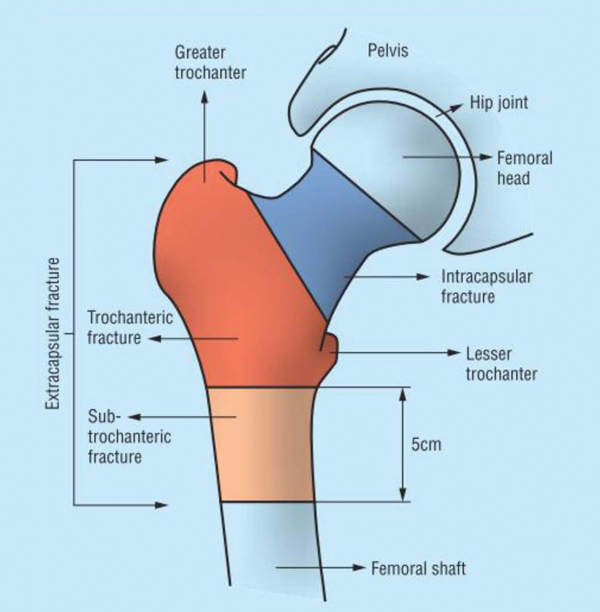
Hip fractures can be subclassified into intracapsular (displaced or undisplaced), trochanteric or sub-trochanteric, see figure 1, p 29.2
A clinical guideline has recently been produced by NICE on fragility hip fracture management in adults (CG124).20,21 Although a major emphasis is on recommendations to deal with variation in standards of management in hospitals, effective care undoubtedly hinges on the best possible collaborative partnership between primary and secondary care.
There is a historical backdrop of unsatisfactory management of pain, delayed or missed diagnosis, delays in surgery and reliance on junior staff carrying out operations on emergency lists, fragmented management of medical comorbidity, inconsistencies in surgical technique, disjointed and delayed rehabilitation management and premature or poorly planned discharge to free up acute beds. These deficiencies have been counterproductive both in terms of poor outcomes for patients and costly inefficiency in the system of care.
The evidence is that prompt and appropriate surgery by experienced surgeons results in fewer complications and better functional results, and reduces duration of hospital stay. The same is true of an HFP approach to care in the acute hospital, bringing together orthogeriatricians, surgeons, anaesthetists and the multidisciplinary team from the onset of the hospital course, minimising transfers between care settings, ensuring continuity of clinical and managerial accountability across the hospital-community divide, and collaborating closely with community professionals providing early supported discharge or intermediate care.
Diagnosis and initial management
Diagnosis and pre-hospital management are addressed in the SIGN guideline on hip fracture.22 The classical signs after a fall by an older person, of severe pain, shortening and external rotation of the affected limb, and loss of mobility, are well known and should result in immediate and rapid transfer to hospital, with adequate pain relief by ambulance personnel en route. But these signs may not be present. It is not rare in the case of intracapsular fractures for mobility to be deceptively maintained on a moderately or minimally painful hip, thus rationalising diagnostic delay but at the risk of irretrievable damage to the blood supply of the femoral head.
The index of suspicion should always be high, with prompt referral for radiography if there is any doubt. In a small proportion of cases (3-5%), plain radiographs may not show the fracture, in which case magnetic resonance or CT imaging should be promptly undertaken if there is still uncertainty. A proportion of such occult fractures may show on a repeat plain radiograph 48 hours or more later, but this is less reliable and causes delay. No older person with a history of falling and consequent, continued unexplained pain in the hip should be reassured or clinically signed off until hip fracture has been excluded with absolute certainty.
Surgery and anaesthesia
Surgery is the norm for hip fracture and is the ideal form of pain relief. It may even be a key element of management when the clinical context is one of palliative care. Before and after surgery, prompt, effective analgesia is essential. Immediate paracetamol (there is now an effective intravenous formulation) can be surprisingly effective in hip fracture, and regular six-hourly administration, when not contraindicated, may be all that is required.
Opioid use is not without risk, and in older people sensitive to these drugs may impede postoperative recovery; but opioids may obviously be given alongside paracetamol, which can help to limit opioid dosage requirement 23 when necessary. In centres with appropriately skilled staff, nerve blocks may be used alongside, or instead of, opioids. Partly because of known risks in the prevalent age group, non-steroidals are avoided.
Studies looking at the effect of time intervals before operating (for ethical reasons mainly cohort studies) have found there is no time threshold (up to 24 hours) below which some clinical outcome benefit is not demonstrable. Avoiding delay has also been shown to be cost effective not least because patients get home sooner. Based on this evidence together with a humanitarian perception that to spend more than one night in hospital in some pain without surgical intervention is unacceptable, NICE stipulates that surgery should occur on the day of, or the day after, admission on a planned trauma list with adequate senior supervision of surgical, anaesthesia and theatre teams.
A DH best practice tariff initiative24 providing additional resources when trusts achieve the tariff’s 36-hour threshold adds additional impetus, and there is growing evidence from the National Hip Fracture Database (NHFD) that this is already being achieved by many trusts.
Modern surgical techniques promote immediate postoperative unrestricted weightbearing. Non-displaced intracapsular fractures are fixed internally. For many displaced intracapsular fractures a hemiarthroplasty is carried out, but for those who were previously mobile and cognitively unimpaired a total hip replacement gives better results and is preferred, provided they are fit enough for the more intensive surgical procedure. For trochanteric fractures extramedullary implants, such as sliding hip screws, give greater fracture stability and a better outcome than intramedullary nails, but for subtrochanteric fractures the latter are preferable.
For those who are fit for either general or spinal anaesthesia there is no compelling evidence for better clinical outcome either way. A choice based on preference (awake or asleep) can be offered by the anaesthetist after careful explanation. Adjunctive nerve blocks can reduce the need for intraoperative opioids and other analgesics.
Multidisciplinary management
As already stated, hip fracture is partly a signal of comorbidity within its prevalent age group. The advantages of highly organised, prompt and close collaboration between surgeons and orthogeriatricians have been recognised, including faster and better preoperative assessment and clinical decision making, reduced lengths of stay, and better functional outcomes up to 12 months. There will inevitably be a subset of patients for whom delay to operation is clinically appropriate.
Conversely, problems often historically associated with unnecessary delays on poor clinical criteria because of the lack of prompt, experienced medical input have included anaemia, management of anticoagulant therapy, volume depletion, electrolyte imbalance, diabetic control, poorly compensated heart disease, correctable arrhythmia or ischaemia, and acute or acute-on-chronic respiratory conditions.
Orthogeriatricians also specialise in joint working both with hospital-based multidisciplinary teams and community-based health and social care professionals, enabling comprehensive assessment and planning to run seamlessly from admission through to discharge and final recovery.
There is significant research literature on different models of collaboration, most focusing on postoperative transfer to a variety of rehabilitation units. The dominant model to emerge as cost-effective, however, both in terms of efficiency and clinical outcome is the comprehensive HFP model.25 This is based in the acute hospital either on the trauma unit or a designated acute orthogeriatric ward. It minimises transfers and maximises continuity across the clinical course, but also entails clear communication lines between professionals across the hospital-community divide and key options for collaboration in the provision of early supported discharge26 and intermediate care services for patients eligible on strict clinical criteria.
An important stipulation of guidance is that those admitted from long-term care settings should not, as has often been the case, be sidelined from comprehensive assessment and rehabilitation and prematurely sent back to care homes to free up acute beds. Instead, these patients should be given every opportunity to improve their functional and health status with the full range of HFP options, including where appropriate early supported discharge.
Although much of the guidance is predominantly applicable to the representative older age group of those with hip fracture, the evidence and expertise gained within orthogeriatric collaboration is directly applicable across the full adult age range.
Conclusion
The challenge of hip fracture is substantial, growing, and urgent, but by no means insurmountable. It approximates to a test case of whether or not we will achieve the pattern of healthcare required to deal with demographic change over the coming decades, since its prevention and management span a full spectrum of typical need from primary prevention through acute and rehabilitative management to secondary prevention and long-term and palliative care. Changing what happens in acute hospitals is fundamental to this challenge, but the achievement of seamless clinical continuity across primary, secondary and social care is equally important. A NICE quality standard is undergoing development.
Author statement
The author chaired the NICE Guideline Development Group for CG124 and is currently chair of the Topic Expert Group for the NICE Quality Standard on Hip Fracture. The views expressed are entirely those of the author and not representative of NICE or any other organisation. The author declares no other potential or actual conflicts of interest.
REFERENCES
1 National Hip Fracture Database. The National Hip Fracture Database National Report 2010 - extended version. 2010. www.nhfd.co.uk/003/hipfractureR.nsf/NHFD_National_Report_Extended_2010.pdf
2 Parker M, Johansen A. Hip fracture. BMJ 2006;333(7557):27-30
3 British Orthopaedic Association. The care of patients with fragility fractures. 2007. www.boa.ac.uk/en/publications/fragility_fractures
4 World Health Organization (2008). FRAX® WHO Fracture Risk Assessment Tool. www.shef.ac.uk/FRAX/
5 National Institute for Health and Clinical Excellence. TA160 (amended). Alendronate, etidronate, risedronate, raloxifene and strontium ranelate for the primary prevention of osteoporotic fragility fractures in postmenopausal women. NICE. London. 2011
6 National Institute for Health and Clinical Excellence. TA161 (amended). Alendronate, etidronate, risedronate, raloxifene, strontium ranelate and teriparatide for the secondary prevention of osteoporotic fragility fractures in postmenopausal women. NICE. London. 2010
7 National Institute for Health and Clinical Excellence. TA204. Denosumab for the prevention of osteoporotic fractures in postmenopausal women. NICE. London. 2010
8 National Osteoporosis Guideline Development Group (2008) www.shef.ac.uk/NOGG/index.html
9 National Osteoporosis Foundation (2008). NOF’s Clinician’s Guide to Prevention and Treatment of Osteoporosis. www.nof.org/sites/default/files/pdfs/ClinGuide_Overview.pdf
ARTICLE IN PDF
 Download this article in PDF format