SEARCH

Practitioner 2011; 255 (1740): 27-31
Identifying the culprit allergen in seasonal allergic rhinitis
30 May 2011
AUTHORS
Dr Prashantha M Vaitla MBBS MRCP
Specialty Registrar Immunology
Dr Elizabeth Drewe MBBS PhD MRCP FRCPath
Consultant Clinical Immunologist
Nottingham University Hospitals NHS Trust
Article
Seasonal allergic rhinitis (SAR) is a global health problem and affects 20% of the UK population. It is the main form of rhinitis in children whereas in adults it accounts for about a third of cases. SAR can have a significant impact on patients' quality of life. It can lead to non-attendance and underperformance at school and work and results in substantial NHS costs. In children, it may affect GCSE results as the grass pollen season coincides with exams.
SAR is a risk factor for the development of asthma1 and chronic rhinosinusitis which may be difficult to treat. As the major burden of allergic rhinitis is on primary care, GPs play a key role in the management of these patients.
Diagnosis
The common presenting symptoms of SAR are a runny or blocked, itchy nose and sneezing. Itchy red, watery eyes, itchy ears and throat and chest wheeze may also occur. A history of atopy and family history of rhinitis are important risk factors. Firstborn children and immigrants are also at increased risk.
The most common allergic triggers are grass and tree pollens. Allergy to fungi (moulds) and weeds is less common. Identifying the months of the year when an individual is symptomatic will help define the culprit allergen, see figure 1.
SAR needs to be differentiated from non-allergic rhinitis (NAR). The latter is a heterogeneous group of conditions which includes eosinophilic, autonomic/vasomotor, drug-induced, hormonal and food-related rhinitis as well as that related to systemic disease e.g. immunodeficiency or Wegener's granulomatosis. Nasal obstruction may be a key feature of NAR.
Investigations
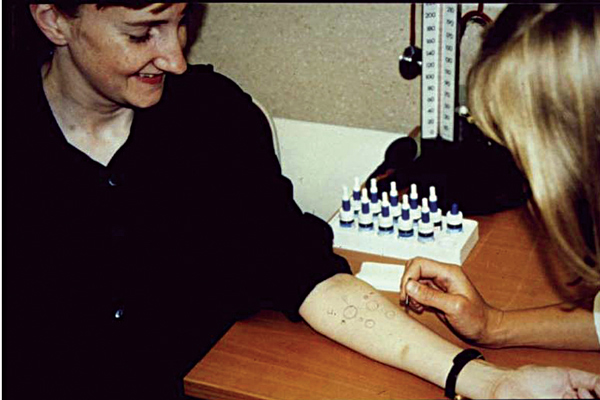
If there is a clear recurring seasonal history the diagnosis may be made on the strength of the history. Skin prick testing is an extremely useful tool in differentiating SAR from NAR and defining the culprit allergen(s). It is particularly helpful if multiple allergens with overlapping seasons are suspected and in identifying patients for allergen immunotherapy.
Skin prick tests are available in specialist allergy, immunology and ENT clinics, and in some instances in primary care. Skin prick tests need to be interpreted in the context of the patient's history as they may produce false-positive results. Around 15% of patients will not have symptoms on exposure to the identified allergen. Skin prick tests may also be uninterpretable if the patient is on antihistamines and they should therefore be withdrawn at least 48 hours before skin prick testing. Topical steroids and tricyclic antidepressants also affect results.
Specific IgE tests for suspected allergens can be performed if skin tests are not available. A positive IgE test to an allergen does not necessarily mean that clinical allergy is present, it may reflect sensitisation of the immune system. Although, in general, specific IgE tests have a high negative predictive value they are less sensitive than skin prick tests for grass pollen and moulds.2 It is therefore advisable to refer cases where there is a strong clinical suspicion, but a negative IgE result to a specific allergen, to an allergy clinic for evaluation.
Non-conventional allergy tests e.g. Vega testing, hair analysis, kinesiology and specific IgG testing are not recommended as there is insufficient scientific evidence of efficacy, and lack of standardisation and reproducibility. Similarly, allergy testing by untrained individuals is not recommended as results need to be interpreted in the light of the clinical history.
Sensitisation to multiple allergens has become increasingly common so individuals may be symptomatic across seasons. ARIA (Allergic Rhinitis and its Impact on Asthma) has published a new classification for rhinitis based on the severity of symptoms, see figure 2, below.3 It is a useful guide to assessing severity of rhinitis and tailoring treatment to the patient.
Treatment
Allergen avoidance
This is the first step in the management of any allergic rhinitis. Although it is often not possible to avoid allergen exposure completely, the allergen load may be reduced by taking appropriate measures, see table 1.
Antihistamines
Oral non-sedating antihistamines are recommended as first-line treatment for mild SAR and will help alleviate itching, sneezing and eye symptoms. A meta-analysis showed that antihistamines improved total nasal symptom score (TNSS) by a mean of 7% more than placebo.4 A recent randomised, double blind placebo-controlled trial in adults with SAR showed improvement in
Total-5 Symptom Score (sum of rhinorrhoea, sneezing, nasal congestion and nasal and ocular pruritus) with levocetirizine 5 mg OD for 2 weeks (P<0.01; n=577).5 Higher doses e.g. cetirizine 20 to 30 mg per day may be necessary in moderate to severe SAR. Topical nasal antihistamines and/or antihistamine eye drops may also be used but their effects are obviously confined to the area of application and they are usually less well tolerated than oral treatment.
Intranasal corticosteroids
Intranasal corticosteroids should be used in moderate to severe forms of SAR and also in mild forms where treatment with antihistamines has failed. They have been shown to reduce symptoms of rhinitis by about 17% more than placebo.4 Clinical improvement may not be apparent for a few days, and maximal effect occurs after two weeks. Hence treatment should be started two weeks before the allergen season begins.6 Lack of response to intranasal corticosteroids is often the result of poor technique. It is important to give appropriate training in the use of nasal sprays, see table 2, below. The principle is to target the turbinates and avoid the nasal septum.
There are no major differences in terms of efficacy between different corticosteroid preparations (beclometasone, budesonide, fluticasone and mometasone) but the systemic absorption is modest with budesonide and high with beclometasone.
A meta-analysis of randomised double blind placebo controlled trials evaluating efficacy of mometasone furoate nasal spray (MFNS) in allergic rhinitis showed significant reduction in TNSS with MFNS compared with placebo (p <0.00001; n=2,998).7
Long-term growth studies in children using fluticasone, mometasone and budesonide (but not beclometasone) have been reassuring.8, 9, 10 Systemic steroid absorption could increase with use at multiple sites. Hence, it is advisable to monitor growth in children treated with topical steroid preparations at different sites such as the nose, skin and lungs.11
Other treatments
Nasal douching: Nasal douching with saline reduces rhinitis and can be used as an additional therapy. It is a safe and inexpensive treatment. An isotonic solution (1 teaspoon of salt and a pinch of sodium bicarbonate in 500 ml of cooled boiled water) should be used. The simplest way is to sniff up the solution from cupped hands. Alternatively, a syringe or other nasal douching devices can be used.
Topical anticholinergics: Ipratropium bromide nasal spray is effective in patients whose main symptom is a runny nose but has no effect on other nasal symptoms. It can be used as an additional treatment alongside intranasal steroids.
Systemic corticosteroids: These are not usually required in SAR but a short course may be used in severe cases when conventional treatment has failed or relief is needed for a specific occasion e.g. an exam or wedding. In adults, prednisolone at a dose of 0.5 mg/kg for 5 days may be used. Injectable corticosteroids are not recommended because of their poor risk/ benefit profile.
Chromones: Sodium cromoglycate and nedocromil have weak benefits for allergic rhinitis. They are generally safe and well tolerated and may be useful in children and adults with mild and intermittent symptoms. Chromone eye drops are useful in conjunctivitis as topical therapy.
Leukotriene receptor antagonists: Montelukast is safe and well tolerated but has limited efficacy for allergic rhinitis. It may be used to treat SAR in children and adults who cannot tolerate oral antihistamines. In children with SAR and asthma, it may be used to treat asthma in those where use of inhaled corticosteroids is not feasible.
Nasal decongestants: These drugs may be used in patients with nasal congestion but should only be used briefly for
Referral to specialist care
Patients should be referred to an allergy clinic if:
- diagnosis is unclear
- there is failure to respond to optimal symptomatic treatment
- frequent prescription of oral corticosteroids is needed
- the impact of the condition on daily activities warrants consideration of allergen immunotherapy
Allergen immunotherapy
Allergen immunotherapy involves repeated oral or subcutaneous administration of an allergen over a period of three to five years with the aim of inducing tolerance to the allergen. It can change the natural course of the disease and potentially induce long- term remission. It is highly effective in patients who are allergic to a single allergen and should be considered in people in whom optimal symptomatic treatment has failed. Selection criteria are listed in table 3. Allergen immunotherapy has not been evaluated by NICE and both availability and funding arrangements may vary across the UK.
Subcutaneous immunotherapy (SCIT): SCIT has been used in the UK since the beginning of the last century but its use was curtailed in the 1980s because deaths from anaphylaxis, mainly in patients with asthma, were reported.
In the past decade immunotherapy has resurfaced as a safer option with more standardised allergen preparations and more stringent selection criteria. Cochrane meta-analysis of double blind randomised placebo controlled trials has shown significant reduction in symptom scores in the immunotherapy group (p<0.00001) with relatively low risk of severe adverse events.12
Two forms of SCIT are available for grass and tree pollen, a preseasonal form and an all-year-round form. The former is licensed in the UK and involves administration of six doses, one to two weeks apart, preseason for three years. The latter is available to registered hospitals and a typical regimen comprises subcutaneous injections of incremental doses of allergenic extract on a weekly basis for the first 16 weeks followed by maintenance injections six weekly for a total period of three years. Clearly, considerable commitment is required from patients.
Adverse effects from SCIT include local injection site reactions. There is also a risk of systemic reactions and anaphylaxis. Hence administration in a hospital setting with resuscitation facilities is recommended. Patients need to be observed for an hour after injection.13
Sublingual immunotherapy (SLIT): This also has benefits for SAR with a systematic review showing significant improvements in symptom score and use of rescue medication, compared with placebo (p<0.00001).14 A sublingual tablet form for grass pollen is licensed in the UK. The Scottish Medicines Consortium did not, however, recommend its use within Scotland because of a lack of sufficiently robust economic analysis. Funding constraints may therefore apply and if prescribed, treatment is normally initiated by hospital physicians. The allergen extract is taken daily with the first dose under medical supervision. It is debated whether it should be used continuously or preseasonally. Local oral reactions are common with SLIT but systemic reactions are rare. Compliance may also be an issue. There are very few clinical trials analysing immunotherapy with fungal extracts and this is not routinely used in the UK.
Conclusion
The prevalence of allergic rhinitis is increasing and in addition patients may have a wider range of allergies than in the past. The burden of SAR should not be underestimated and in the UK patients suffering with allergic rhinitis perceive their symptoms as being more severe than their doctors grade them.15 Appropriate patient education, management and referral to an allergy clinic could help address this issue.
Further reading
Scadding GK, Durham SR, Mirakian R et al. BSACI guidelines for the management of allergic and non-allergic rhinitis. Clin Exp Allergy 2008; 38:19-42
Brozek JL, BousquetJ, Baena-Cagnani CE et al. Allergic Rhinitis and its Impact on Asthma (ARIA) guidelines: 2010 revision. J Allergy Clin Immunol 2010;126:466-76
REFERENCES
1 Guerra S, Sherrill DL, Martinez FD et al. Rhinitis as an independent risk factor for adult onset asthma. J Allergy Clin Immunol 2002;109 (3):419-25
2 Gleeson M, Cripps AW, Hensley MJ et al. A clinical evaluation in children of the Pharmacia ImmunoCAP system for inhalant allergens. Clin Exp Allergy 1996;26(6):697-702
3 Bousquet J, Van Cauwenberge P, Khaltaev N et al. Allergic rhinitis and its impact on asthma. J Allergy Clin Immunol 2001;108(5 Suppl):S147-33
4 Wilson AM, O'Byrne PM, Parameswaran K. Leukotriene receptor antagonists for allergic rhinitis: a systematic review and meta-analysis. Am J Med 2004; 116:338-44
5 Segall N, Gawchik S, George G et al. Efficacy and safety of levocetirizine in improving symptoms and health-related quality of life in US adults with seasonal allergic rhinitis: a randomized, placebo-controlled study. Ann Allergy Asthma Immunol 2010;104:259-67
6 Graft D, Aaronson D, Chervinsky P et al. A placebo- and active-controlled randomized trial of prophylactic treatment of seasonal allergic rhinitis with mometasone furoate aqueous nasal spray. J Allergy Clin Immunol 1996;98(4):724-31
7 Penagos M, Compalati E, Tarantini F et al. Efficacy of mometasone furoate nasal spray in the treatment of allergic rhinitis. Meta-analysis of randomized, double-blind, placebo-controlled, clinical trials. Allergy 2008;63: 1280-91
8 Salib RJ, Howarth PH. Safety and tolerability profiles of intranasal antihistamines and intranasal corticosteroids in the treatment of allergic rhinitis. Drug Saf 2003; 26(12): 863-93
9 Skoner DP, Rachelefsky GS, Meltzer EO et al. Detection of growth suppression in children during treatment with intranasal beclomethasone dipropionate. Pediatrics 2000;105(2):E23
10 Allen DB. Systemic effects of intranasal steroids: an endocrinologist's perspective. J Allergy Clin Immunol 2000; 106:S179-90
11 Allen DB, Meltzer EO, Lemanske RF Jr et al. No growth suppression in children treated with the maximum recommended dose of fluticasone propionate aqueous nasal spray for one year. Allergy Asthma Proc 2002;23(6):407-1
12 Calderon MA, Alves B, Jacobson M. Allergen injection immunotherapy for seasonal allergic rhinitis. Cochrane Database Syst Rev 2007 Jan 24;(1):CD001936
13 healthguides.mapofmedicine.com/choices/map/
seasonal_allergic_rhinitis3.html
14 Radulovic S, Wilson D, Calderon M et al. Systematic reviews of sublingual immunotherapy (SLIT). Allergy 2011 Mar 28. doi: 10.1111/j.1398-9995. 2011.02583.x. [Epub ahead of print]
15 Scadding GK, Williams A. The burden of allergic rhinitis as reported by UK patients compared with their doctors. Rhinology 2008;46(2):99-106
FURTHER READING
Scadding GK, Durham SR, Mirakian R et al. BSACI guidelines for the management of allergic and non-allergic rhinitis. Clin Exp Allergy 2008; 38:19-42
Brozek JL, BousquetJ, Baena-Cagnani CE et al. Allergic Rhinitis and its Impact on Asthma (ARIA) guidelines: 2010 revision. J Allergy Clin Immunol 2010;126:466-76
USEFUL INFORMATION
BSACI
For patients
Allergy UK
NHS choices
www.nhs.uk/livewell/Allergies/Pages/Allergieshome.aspx
Patient UK
 Download this article in PDF format