SEARCH

Practitioner 2011; 255 (1738):25-28
Improving recognition of generalised anxiety disorder
23 Mar 2011
AUTHORS
Dr Phillip Bland BA BM BCh MRCGP DRCOG
GP with an interest in mental health
Dalton-in-Furness
Article
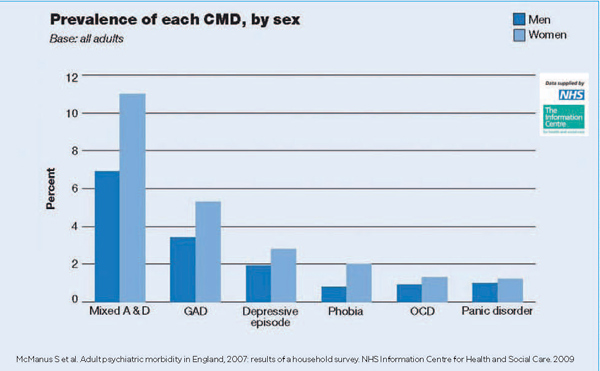
Generalised anxiety disorder (GAD) is a common condition, with a point prevalence of 4.4% among the adult population in England.1 It is characterised by a persistent, unfocused sense of threat, associated with symptoms of tension, autonomic hyperactivity and vigilance.
Patients repeatedly overestimate the danger of physical or social harm, and at the same time underestimate their ability to cope.2 As a result, they worry excessively about a wide range of activities and life events, such as work, family issues, financial difficulties and health problems.
GAD is a chronic relapsing condition, with a remission rate of only 38% after five years.3 It is associated with even greater impairment of occupational and social functioning than that associated with major depression, and has a significant impact on quality of life.4
However, most patients (around two-thirds) are not recognised in primary care5 and only a third of those identified by the 2007 household survey in England were receiving any form of treatment.1
There are several possible reasons for this. Patients often present with somatic symptoms. GAD is frequently comorbid with other mental health conditions, and it is often difficult to establish a reliable diagnosis. There have been doubts as to the validity of GAD as a distinct clinical entity 6 and not all primary care physicians regard it as a genuine disorder.5
NICE has recently updated its guidance on the management of adults with GAD,7 and it is hoped that this will increase the recognition and effective treatment of this debilitating disorder.
Recognition
Patients with GAD seldom complain of feeling overanxious and worrying excessively. NICE recommends that we should be alert to the possibility of GAD when patients express frequent concerns about their health or other matters, and be vigilant among the following high-risk groups:
- Patients with chronic physical health problems
- Frequent attenders with multiple functional somatic symptoms
- Patients with other anxiety and depressive disorders
- Patients with alcohol misuse
Diagnosis and assessment
NICE has adopted the DSM IV diagnostic criteria, see table 1. Diagnosis of GAD is not easy, for a number of reasons:
- It requires a subjective judgement that the worry is excessive
- The six-months' duration criterion is arbitrary 8 and difficult to establish
- None of the six associated symptoms are specific to GAD
- Most patients also have another anxiety or depressive disorder
NICE cautions that our assessment should not simply rely on a symptom count, but should also consider the degree of distress and functional impairment.
Comorbid conditions
GAD is commonly associated with other anxiety disorders, particularly panic disorder and social phobia.9 The hallmark feature of GAD is generalised worry as distinct from the specific worries associated with the other anxiety disorders e.g. the fear of public embarrassment in social phobia.
It can be difficult to differentiate GAD from major depression: four of the six associated symptoms also constitute criteria for a diagnosis of depression, and the two conditions often occur together. According to the DSM criterion F (see table 1), we should not diagnose GAD if it is experienced only during the course of a depressive illness. Hence, GAD can be diagnosed when a patient has depression, providing it does not occur exclusively during the course of the depression. However, comorbid GAD, regardless of this exclusion criterion, is an important marker of depression severity and is associated with increased suicidal ideation and social dysfunction.10
In its 2004 guidance, NICE recommended that depression should be given priority over comorbid GAD and treated first. This guidance has now been superseded by the recommendation that we should give precedence to whichever disorder is more severe, in the expectation that treatment of this disorder is most likely to improve overall functioning.
However, for patients with harmful or dependent substance misuse, the substance misuse should be treated first as this may result in a substantial improvement in the symptoms of GAD.
Treatment
NICE recommends the following stepped care model:
Step 1: Education and active monitoring
We should explain the nature of GAD, discuss the available treatment options and provide a copy of the version of the guideline designed for patients (see Useful information box, p28). We should arrange follow-up and monitor the patient's symptoms and functioning. If there is no improvement, we should progress to:
Step 2: Low-intensity interventions
We should offer one of the following:
- Non-facilitated self-help (bibliotherapy or computer-delivered therapy)
- Guided self-help
- Psychoeducation group participation
Non-facilitated self-help materials should be based on the principles of CBT and patients should work through the material independently and systematically over at least six weeks.
NICE considered the evidence to be of low to moderate quality.
The most effective intervention was a programme of guided computerised cognitive behaviour therapy (CCBT), but unfortunately this is not available in the UK. Bibliotherapy is most likely to be beneficial if patients are well educated and highly motivated.11
Step 3: High-intensity interventions or drug therapy
If patients have marked functional impairment or if low-intensity interventions have proved ineffective, we should offer a choice of:
Individual CBT or applied relaxation
OR
Drug treatment (SSRIs)
CBT involves teaching patients to recognise the automatic thoughts which generate anxiety. There are two characteristic cognitive distortions in GAD: patients overestimate the likelihood that a feared event will occur, and believe that the event will have catastrophic consequences.
The patient works in collaboration with the therapist to reappraise probability and explore alternative less catastrophic outcomes.12 Applied relaxation involves teaching relaxation skills and applying them in anxiety-provoking situations.
Tricyclic, SSRI and SNRI antidepressants have similar overall efficacy in GAD.6 NICE recommends that patients should be offered an SSRI, preferably sertraline, as this is the best tolerated drug with the lowest discontinuation rate. If treatment is effective, it should be continued for at least 12 months.
Benzodiazepines should not be prescribed, except as a short-term measure during crises. Antipsychotics should not be prescribed in primary care. NICE does not consider the use of beta-blockers in GAD. According to a review in the Lancet6 beta-blockers have unproven efficacy in GAD but may be useful for patients with marked autonomic hyperactivity.
Step 4: Referral to secondary care
Patients should be referred if there is:
- An inadequate response to Step 3 treatments
- Severe anxiety with marked functional impairment
- A high risk of self-harm or suicide
Implications for the QOF indicators
DEP 1: Case finding
Depression is more common among patients with chronic physical health problems and is associated with increased morbidity and mortality. Since 2006, there have been QOF incentive payments for depression case finding among patients with diabetes and CHD (see box 1, left), although the number needed to screen is large.
Anxiety disorders have been less well studied, but there is now increasing evidence that they are of equal importance. GAD is commonly associated with chronic conditions (14% of diabetes patients have GAD)13 and anxiety disorders are associated with poor quality of life, disability and cardiovascular mortality.14 It is suggested, therefore, that we should not look for depression without also searching for anxiety.15
If we decide to screen for anxiety, I suggest a three-step procedure. Patients who respond positively to either of the two screening questions (see box 2, left) are asked to complete a HADS questionnaire, and those with a score ≥ 8 are then interviewed by the practice nurse.
The HADS anxiety scale (HADS-A) consists of seven questions which are scored on a scale of 0 to 3. The anxiety score is the sum of the seven individual scores, with a range of 0 to 21. The score is categorised as normal (0-7), mild (8-10), moderate (11-14) or severe (15-21).
With a cut-off HADS-A score of ≥ 8, GAD is detected with a sensitivity of 80% and a specificity of 88%.16 Among diabetes patients, the positive predictive value (PPV) will be 0.52 which compares favourably with the PPV of 0.22 for those who screen positive for depression.17
An alternative case-finding strategy is to identify and screen persistent frequent attenders, among whom there is a high prevalence of both anxiety and functional somatic symptoms.18
DEP 2: Diagnosis
It is no longer sufficient simply to assess whether the diagnostic criteria for DSM IV major depression are met. We must also consider whether the patient fulfils the diagnostic criteria for a comorbid anxiety disorder, and if so, we need to decide which is the primary disorder.
When assessing severity, there is a case for using the HADS as this allows simultaneous assessment of both anxiety and depression. If using the PHQ-9, I think we should also ask the patient to complete the GAD-7 (see box 3, p27).
It is important to remember that both the HADS and GAD-7 are screening tools which ask about recent symptoms. To make a diagnosis of GAD, the symptoms must have been present for at least six months and should not be restricted to the duration of the depressive illness. However, even if patients do not fulfil these criteria, a high HADS-A or
GAD-7 score is significant as it is an independent marker of depression severity.
DEP 3: Follow-up
Sertraline has been recommended as the drug of first choice for both major depression19 and GAD. It is both effective and well tolerated, and has the lowest drop-out rate. As a result, patients are more likely to adhere to treatment and return for follow-up. Case management can facilitate active monitoring, improve adherence to treatment and increase recognition of non-responders. However, only one of the two published trials of collaborative care in GAD found a small benefit and NICE does not feel able to make a recommendation at this stage.
Conclusion
Both in research and in clinical practice, there has been an excessive focus on depression to the detriment of the anxiety disorders.15 This is unfortunate in view of the high prevalence of GAD, its substantial impact on functioning and its association with chronic physical health problems. It is to be welcomed that this imbalance is now being addressed.
REFERENCES
1 McManus S, Meltzer H, Brugha T et al. Adult psychiatric morbidity in England, 2007: results of a household survey. NHS Information Centre for Health and Social Care. 2009. www.ic.nhs.uk/pubs/psychiatricmorbidity07
2 Salkovskis PM. The cognitive approach to anxiety: threat beliefs, safety-seeking behaviour, and the special case of health anxiety and obsessions. In Frontiers of Cognitive Therapy. Ed Salkovskis PM. Guilford Press. New York. 1996
3 Yonkers KA, Dyck IR, Warshaw M et al. Factors predicting the clinical course of generalised anxiety disorder. Br J Psychiatry 2000;176:544-9
4 Wittchen HU, Carter RM, Pfister H et al. Disabilities and quality of life in pure and comorbid generalised anxiety disorder and major depression in a national survey. Int Clin Psychopharmacology 2000;15:319-28
5 Wittchen HU, Kessler RC, Beesdo K et al. Generalised anxiety and depression in primary care: prevalence, recognition and management. J Clin Psychiatry 2002;63(suppl 8):24-34
6 Tyrer P, Baldwin DS. Generalised anxiety disorder. Lancet 2006;368:2155-66
7 National Institute for Health and Clinical Excellence. CG113. Generalised anxiety disorder and panic disorder (with or without agoraphobia) in adults: management in primary, secondary and community care. NICE. London. 2011
8 Andrews G, Hobbs, MJ, Borkovec TD et al. Generalised worry disorder: a review of DSM-IV generalised anxiety disorder and options for DSM-V. Depression and Anxiety 2010;10:1-4
9 Kessler RC, Wai Tat Chu AM, Demler O et al. Prevalence, severity and comorbidity of 12-month DSM IV disorders in the National Comorbidity Survey Replication. Arch Gen Psychiatry 2005;62:617-27
10 Zimmerman M, Chelminski I. Generalised anxiety in patients with major depression: is DSM-IV's hierarchy correct? Am J Psychiatry 2003;160:504-12
11 Anderson L, Lewis G, Araya R et al. Self-help books for depression: how can practitioners and patients make the right choice? Br J Gen Pract 2005:55:387-92
12 Brown TA, O'Leary TA, Barlow DH. Generalised anxiety disorder. In: Clinical Handbook of Psychological Disorders: A Step-by-Step Treatment Manual. Ed Barlow DH. Guilford Publications. New York. 2001
13 Gigsby AB, Anderson RJ, Freedland KE et al. Prevalence of anxiety in adults with diabetes: a systematic review. J Psychosom Res 2002;53:1053-60
14 Roy-Byrne PP, Davidson KW, Kessler RC et al. Anxiety disorders and comorbid medical illness. Gen Hosp Psychiatry 2008;30:208-25
15 Kroenke K, Spitzer RL, Williams JBW et al. Anxiety disorders in primary care: prevalence, impairment, comorbidity and detection. Ann Intern Med 2007:146:317-25
16 Olsson I, Mykletun A, Dahl AA. The hospital anxiety and depression rating scale: a cross-sectional study of psychometrics and case-finding abilities in general practice. BMC Psychiatry 2005;5:46 doi:10.1186
17 Bland PM. Diagnosing depression in primary care. Practitioner 2009;253 (1718):24-7
18 Smits FTM, Brouwer HJ, ter Riet G, van Weert JCP. Epidemiology of frequent attenders: a 3-year historic cohort study comparing attendance, morbidity and prescriptions of one-year and persistent frequent attenders. BMC Public Health 2009;9:36 doi:10.1186
19 Cipriani A, Furukawa TA, Salanti G et al. Comparative efficacy and acceptability of 12 new-generation antidepressants: a multiple-treatments meta-analysis. Lancet 2009;373:746-58
FURTHER READING
Healthcare professionals and patients
Copies of NICE clinical guideline CG113 together with guidance for patients CG113. Anxiety: understanding NICE guidance can be downloaded from: www.nice.org.uk
Self-help materials
Anxiety UK recommends Overcoming Worry by Kevin Meares and Mark Freeston
The RCPsych has an information leaflet on anxiety, panic and phobias.
It also recommends Overcoming Anxiety, Stress and Panic: A Five Areas Approach by Chris Williams, and has a link to a review of self-help books
www.rcpsych.ac.uk/mentalhealthinfoforall/problems/anxietyphobias.aspx
ARTICLE IN PDF
 Download this article in PDF format