SEARCH

Practitioner 2009;253(1715):27-31
EECP: A non-invasive therapy for refractory angina
01 Feb 2009
AUTHORS
Dr Youssef Beaini MB ChB
fellow in cardiology
Dr Chris Morley MA BM BCh FRCP DM
consultant cardiologist, Bradford Teaching Hospitals NHS Trust
Article
Refractory angina is a chronic and often disabling condition, which may be demoralising for both patients and their carers.1 Those affected may have endured complex pharmacological treatment, recurrent hospital admissions, repeated investigations and multiple interventions. Patients with refractory angina have by definition exhausted conventional pharmacological and interventional treatments.
Initial symptom relief in chronic stable angina is often successful, but for a significant minority, symptoms may not be alleviated or will recur in time. Intervention is increasing both in the management of acute coronary syndromes and chronic stable angina and so too is the need for repeated intervention, where the complexity and procedural risk may be increased as well as the psychological and traumatic burden to patients of increasing age and morbidity.
Furthermore multiple coronary stenting may diminish the possibility of surgical intervention by metallising arteries. Increasing longevity and the resulting demographic shift in age and the uncertainty of long-term results of intervention may also exacerbate these problems in the future.
The incidence of refractory angina has been estimated at around 25,000-75,000 new cases per annum in the USA2 where there are more than two million interventions each year, with a half-life to re-intervention of seven years. These numbers are likely to increase as intervention increases and the survival of vascular patients improves. Many strategies are available, some exemplified by the treatment offered by the National Refractory Angina Centre in Liverpool, the only specialist centre in the UK. These include support, education and psychological approaches to diminish the counterproductive effects of fear and anxiety on pain. Analgesia is seldom effective and potent analgesia may be inappropriate except in the small number of patients who may be approaching the end of life.
Alternative means of managing coronary disease, especially for patients who develop angina refractory to conventional treatments, or those who are unable to tolerate or choose not to proceed with such treatments, are urgently needed.
Enhanced external counter pulsation
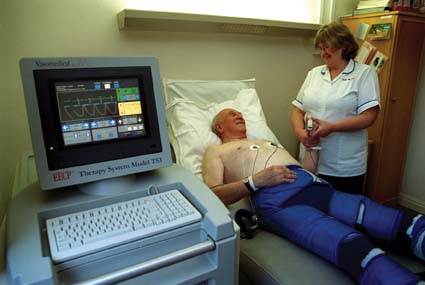
Counter pulsation is a therapy developed from sound physiological principles,3 widely used in cardiothoracic and interventional centres in the form of intra-aortic balloon pumping (IABP). It has now been developed externally as enhanced external counter pulsation (EECP), see box 1.EECP is a non-invasive, safe and well tolerated therapy, with very few contraindications. It was approved by the FDA in 1995 for the treatment of stable angina, unstable angina, cardiogenic shock and MI and, in 2002, heart failure.6 The American Heart Association recommends it as a class 11b intervention for treating refractory angina. EECP is also included in the SIGN guidelines on managing refractory angina. Currently, EECP is used predominantly in patients with severe angina, who are at high risk and are not suitable for revascularisation. It provides a therapeutic and supportive approach to managing such patients regardless of age7 and co-morbidity including those with stable heart failure.8
The treatment is most often undertaken in an outpatient setting. In the USA, where currently 20,000 patients are treated annually in around 1,000 centres, it is most commonly directed by cardiac interventionists.
The recommended duration of treatment of 35 hours (one to two hours daily for three to seven weeks) is based on the results of pilot studies indicating increasing symptomatic benefit up to this time and little further benefit beyond. Researchers are currently looking at different 'dosages' of treatment, especially in heart failure, including top up regimens. Optimisation of treatment may depend on the degree of diastolic augmentation achieved.9
Benefits
EECP is undoubtedly therapeutic, in the sense that myocardial perfusion has been shown to increase both acutely and in the longer term following treatment. This has been demonstrated by radio-nuclear scanning,10 PET scanning,11 time to onset of ischaemia on exercise testing,12 stress echo13 and most recently by cardiovascular MR.14
EECP unlike interventional treatments can be shammed and therefore subjected to randomised controlled trials (RCTs). The first RCT, MUST EECP12 reported improved symptoms and exercise time to onset of ischaemia and a sub-study reported improved quality of life scores one year after treatment.15 We have recorded improvements in quality of life at two years and have submitted our findings for publication.
Patients with refractory angina frequently have impaired LV function, both systolic and diastolic, as well as poor physical conditioning through lack of exercise. They may find their breathlessness on exertion and fatigue even more distressing than their angina, especially once the fear of this symptom is overcome. EECP may be effective in improving these symptoms as well as reducing angina. Furthermore, psychosocial benefits e.g. feeling of wellbeing and reduction in depression, are significantly improved in subjects with and without objective measures of improved ischaemia.16
Patients with refractory angina often have very advanced ischaemic heart disease and the majority will have significantly impaired LV function.1 EECP increases venous return but is well tolerated and safe in these patients provided treatment is commenced at high pressure, which provides maximal after-load reduction on cuff deflation, when the vascular beds in the lower limbs are relatively empty.17
The international EECP patient registry has published follow-up data at two years18 and three years,19 showing sustained symptomatic benefit in the first cohort of 5,056 patients. Immediately following treatment the numbers in Canadian Cardiovascular Society (CCS) class III and IV had declined from 89% to 25%, 78% had improved by at least one CCS class and 38% by two classes. These benefits were sustained in 74% of patients at three years with 35% of patients reported to be free of angina. Improvement in quality of life scores at one year and exercise tolerance and myocardial perfusion over five years20 have also been documented.
Favourable long-term outcome defined as sustaining CCS class II or less and without major adverse cardiac events (MACE) was achieved in 36%. These results are similar to those for PCI documented in the NHBI registry for patients with comparably severe symptoms (CCS III and IV), where the combined endpoint for recurrent angina plus MACE at one year was 47%.21
EECP is as effective in women,22 patients with diabetes,23 the obese24 and the elderly (>80 years)7 and although much of the data originates from the USA encouraging results have recently been published from the UK.25
Rehabilitation is likely to be important, especially in reinforcing the benefit of treatments that can improve exercise tolerance, such as EECP, but as yet there are no specific guidelines for rehabilitation in refractory angina.1
There are of course palliative treatments which have a role in diminishing pain, e.g. TENS, but others e.g. nerve blocks and spinal cord stimulation, are invasive and perhaps not ideal for patients who have undergone many procedures and being palliative are neither likely to benefit circulatory function directly and diminish the fatigue and dyspnoea which are prominent symptoms in refractory angina, nor to have a vasoprotective effect. Surgical and percutaneous transmyocardial revascularisation are now seldom recommended owing to the operative risks and uncertainty of benefit.
EECP however, provides not only a safe, well tolerated and therapeutic treatment for these patients, but also facilitates a supportive approach through 35 hours of therapy. It improves fitness through passive lower body exercise and often an improvement in wellbeing which may relate to an effect of therapy delivered to the entire circulation. Other benefits include the potential to reduce erectile dysfunction,26 which is so prevalent and disabling in patients with vascular disease.
The exact mechanism by which EECP exerts its clinical benefits is not fully understood but is likely to be complex and multifactorial, see box 2, attached.
Prognosis
Prognostic benefit from EECP has not yet been evaluated in long-term, randomised outcome studies. However, a preliminary report at one year from an RCT of EECP added to optimal medical therapy, has shown reduced mortality and MI rates.36 A protective effect over five years, has been suggested in a non-randomised consecutive study of EECP compared with standard pharmacological treatment.37 Data from the IEPR,18 indicate a three-year mortality rate (15%) comparable to that for high-risk patients with non-prognostic lesions treated by CABG.
Non-responders to EECP are identified as a particularly high-risk group, whereas responders, despite their high-risk profile, appear to have a better than expected prognosis.38 A comparison of those completing EECP treatment with the 14% failing to complete treatment, but surviving beyond 60 days, has shown a significantly lower mortality and MACE.39 A comparison of radionuclide responders to EECP versus non-responders, has also shown a significantly lower MACE rate at five years.20
Outcome following either EECP (IEPR) or PCI (NHIBI dynamic registry) has been compared using two cohorts of PCI candidates treated for stable angina.40 Although symptom relief was greater with PCI, one-year survival and re-intervention rates were comparable, despite the EECP group being slightly older and having significantly higher risk with more CCF, diabetes, prior intervention and lower ejection fraction.
These findings indicate that it would be worthwhile undertaking comparative outcome studies in stable angina, either versus intervention or with adjunctive use of EECP. A three-pronged study comparing outcomes of treatment by EECP, medical treatment and PCI in chronic stable angina is planned in China.
Limitations
41223603EECP is not suitable for every patient although there are few absolute contraindications. See table 2, left.41
EECP is equally effective in reducing angina in patients with and without left main stem disease.42 However, early revascularisation should be advised on prognostic grounds for patients with left main stem disease.
Few patients fail to tolerate the treatment, but some have discomfort from the pressure, initial fatigue from the exercise and occasionally aggravation of low back pain.
The treatment is more easily tolerated with a stable cardiac rhythm, ideally 50 - 80 bpm. Patients with atrial fibrillation and pacing can be treated effectively, as long as the rate and irregularity are well controlled, but anticoagulation must be meticulously controlled (INR <3).
Response to treatment is disappointing in about 10% of patients. To be effective the forces of counter pulsation need to reach the myocardium, hence the need for at least one patent coronary arterial conduit,43 a reasonably compliant peripheral circulation and the absence of peripheral oedema and for the clinician to optimise diastolic augmentation during treatment.17
Retreatment may be necessary in 9% of patients successfully completing therapy at one year39 and around 22% at three years.19 Failure to complete the full course occurs in around 15% of patients, half of these through choice and the other half through clinical events. Retreatment results for both these categories are comparable to initial treatment results.39
The goals of treatment should be realistic and individualised, and psychological assessment and support available. Patients should always have optimised secondary preventive treatment and angina medication with particular attention to controlling BP and heart rate, both at rest and during exertion.
Much of the supportive evidence for EECP comes from the IEPR and although this is an uncontrolled observational study it does represent a diverse group of patients from an actual clinical setting.
Cost efficacy
The NHS health technology assessment programme is currently undertaking a review of cost efficacy of EECP within the UK.
Patients who are ineligible for revascularisation have a high rehospitalisation rate (1.3/patient/year), which is even higher for those with angina and LV dysfunction (2.1/patient/year).2 EECP has been shown to reduce both emergency department visits and hospitalisation significantly44 and to reduce the need for angina medication, including short- and long-acting nitrates and calcium channel blockers.19
Improving angina services
There is clearly a need in refractory angina, to explore and research alternative therapeutic options, as recommended in the NSF for CHD.
Provision of EECP should be considered as part of a dedicated service for patients with refractory angina. This service should ideally offer a careful diagnostic assessment and a multidisciplinary approach, including psychological support and rehabilitation and in those with a continuing burden of symptoms the freedom to choose between a psychological approach with CBT, a therapeutic approach with EECP and palliative treatments that can be offered by pain specialists.
There is an increasing understanding of the role of vascular endothelium in repair and maintenance of vascular health and regulation of vasomotor tone and a growing interest in how chemical and biomechanical forces, especially shear stress may regulate both biochemically and through gene expression these vital circulatory functions.45 Physical treatments, which act by increasing and modulating shear stress, not only in the coronary circulation but throughout the circulation may have a beneficial role in patients with diseased circulation, especially those that are unable to undertake adequate exercise as exemplified by those with both refractory angina and left ventricular impairment.
It remains to be seen whether such treatment should be considered preventively at an early stage, rather than as a last resort towards the end stage of coronary disease.
REFERENCES
1 Mannheimer C, Camici P, Chester MR et al. The problem of chronic refractory angina report from the ESC Joint Study Group on the treatment of refractory angina. Eur Heart J 2008; 23:355-370
2 Mukerjee D, Bhatt D, Roe MT et al. Direct myocardial revascularisation and angiogenesis: how many patients might be eligible? Am J Cardiol 1999;84:598-600
3. Kantrowitz A and Kantrowitz A. Experimental augmentation of coronary flow by retardation of arterial pressure pulse. Surgery 1953;34:678-687
4 Michaels AD, Accad M, Ports TA, et al. Left ventricular systolic unloading and augmentation of intracoronary pressure and Doppler flow during enhanced external counterpulsation. Circulation 2002;106:1237-1242.
5 Taguchi F, Ogawa K, Oida A et al. Comparison of haemodynamic effects of enhanced external counterpulsation and intra-aortic balloon pumping in patients with acute myocardial infarction. Am J Cardiol 2000;86:1139-1141
6 Manchanda A, Soran O. Enhanced external counterpulsation and future directions - Step beyond medical management for patients with angina and heart failure. JACC 2007;50:1523-1531
7 Linnemeier G, Lawson Q, Kennard ED et al. Enhanced external counterpulsation for the treatment of angina in the elderly; safety, response and durability of treatment. Eur Heart J 2001;22:3514
8 Abbottsmith CW, Chung ES, Varicchione T et al. Enhanced external counterpulsation improves exercise duration at peak oxygen consumption in older patients with heart failure: a sub-group analysis of the PEECH trial. Congest Heart Fail 2006;12 (6):307-311.
9 Michaels AD, Kennard ED, Kelsey SF et al. Does higher diastolic augmentation predict clinical benefit from enhanced external counterpulsation? Data from the International EECP Patient Registry. Clin Cardiol. 2001;24:453-458
10 Stys TP, Lawson WE, Hui JCK et al. Effects of enhanced external counterpulsation on stress radionuclide coronary perfusion and exercise capacity in chronic angina pectoris. Am J Cardiol. 2002; 89: 822-824.
11 Masuda D, Nohara R, Hirai T et al. Enhanced external counterpulsation improves myocardial perfusion in coronary flows in patients with chronic stable angina. European Heart J 2001;22:1451-1458
12 Aurora RR, Chou TM, Jain D et al. The multi-centre study of enhanced external counterpulsation (MUST - EECP): Effect of EECP on exercise-induced myocardial ischaemia and anginal episodes. J Am Coll Cardiol 1999;33:1833-1840.
13 Bagger JP, Hall RJC, Koutroulis G et al. Effect of enhanced external counterpulsation on Dobutamine induced left ventricular wall motion abnormalities in severe chronic angina pectoris. Am J Cardiol. 2004;93:465-467.
14 Pennell DJ. Perfusion abnormality, normal coronaries and chest pain. J Am Coll Cardiol 2008;51(4):473-475.
15 Aurora RR, Chou TM, Diwakar J et al. Effects of enhanced external counterpulsation on health-related quality of life continued 12 months after treatment: a sub-study of the multi-centre study of enhanced external counterpulsation. J Invest Med. 2002;50(2):25-32.
16 Springer S, Fyfe A, Lawson W et al. Psychosocial effects of enhanced external counterpulsation in the angina patient: a second study. Psychosomatics 2001:42(2):124-132
17 Silver MA. Mechanism and evidence for the role of enhanced external counterpulsation in heart failure management. Current Heart Failure Reports 2006;3:25-32.
18 Lawson WE, Hui JCK, Kennard ED et al. Two year outcomes in patients with mild refractory angina treated with enhanced external counterpulsation. Clin Cardiol 2006;29:69-73.
19 Loh PH, Cleland JG, Louis AA et al. Enhanced external counterpulsation in the treatment of chronic refractory angina: a long-term follow up outcome from the international enhanced external counterpulsation patient registry. Clin Cardiol 2008;31 (4):159-164
20 Lawson WE, Hui JCK, Cohn PF. Long-term prognosis of patients with angina treated with enhanced external counterpulsation: 5-year follow-up study. Clin Cardiol 2000;23:254-258
21 Houlubkov R, Laskey WK, Haviland A et al. Angina one year after percutaneous coronary intervention: A report from the NHLBI Dynamic Registry. Am Heart J 2002;144:826-833.
22 Lawson WE, Kennard ED, Linnemeier G et al. Do women with refractory angina respond as well as men to treatment with external counterpulsation? JACC 2002;154A:808-2
23 Linnemeier G, Rutter MK, Barsness G et al. Enhanced external counterpulsation for the relief of angina in patients with diabetes: safety, efficacy in one year clinical outcomes. Am Heart J 2003;146 (3):453-458.
24 McCullough PA, Silver MA, Kennard ED et al. Impact of body mass index on outcomes of EECP therapy. Am Heart J 2006;151(1):139 E9-E13.
25 Loh PH, Louis AA, Windram J et al. The immediate and long-term outcome of EECP in treatment of chronic stable refractory angina. J Int Med 2006;259:276-284.
26 Lawson WE, Hui JCK, Kennard ED et al. Effect of enhanced external counterpulsation on medically refractory angina patients with erectile dysfunction. Int J Clin Pract 2007;61(5):757-762
27 Bonetti PO, Gadasalli SN, Lerman A et al. Successful treatment of symptomatic coronary endothelial dysfunction with enhanced external counterpulsation. Mayo Clin Proc 2004;79:690-692
28 Schechter M, Matetsky S, Feinberg et al. External counterpulsation therapy improves endothelial function in patients with refractory angina pectoris. J Am Coll Cardiol 2003;42:2090-2095
29 Nichols WW, Estrada JC, Braith RW et al. Enhanced external counterpulsation treatment improves arterial wall properties and wave reflection characteristics in patients with refractory angina. J Am Coll Cardiol 2006;48(6):1209-1214
30 Urano H, Ikeda H, Euno T et al. Enhanced external counterpulsation improves exercise tolerance, reduces exercise induced myocardial ischaemia and improves left ventricular diastolic filling in patients with coronary artery disease. JACC 2001;37(1):93-99.
31 Taguchi Y, Ogawa K, Kanaya T et al. Effects of enhanced external counterpulsation on haemodynamics and its mechanism and relation to neurohumeral factors. Circulation 2004;68(11):1030-1034
32 Masuda D, Fujita M, Nohara R et al. Improvement of oxygen metabolism in ischaemic myocardium as a result of EECP with Heparin pre-treatment for patients with stable angina. Heart Vessels 2004;19(2):59-62.
33 Lawson WE, Hui JCK, Zheng ZS et al. Improved exercise tolerance following EECP: cardiac or peripheral effect? Cardiology 1996;87(4):271-275.
34 Akhtar M, Wu GF, Du ZM et al. Effective external counterpulsation on plasma nitric oxide and endothelin-1 levels. Am J Cardiol 2006 98:28-30
35 Casey DP, Conti CR, Nichols WW et al. Effect of enhanced external counterpulsation on inflammatory cytokines and adhesion molecules in patients with angina pectoris and angiographic coronary artery disease. Am J Cardiol 2008;101:300-302.
36 Ma H, Zheng ZA, Zhang MQ et al. The multi-centre research of enhanced external counterpulsation (EECP) : One year follow up in patients with coronary heart disease. The study was presented at the first international external counterpulsation symposium Guang Zhon, China. May 2006.
37 Karim S, Kasim M, Sumita R et al. EECP protects coronary artery disease patients from future cardiac events. J Heart Dis 1999;1(1):223:889
38 McCullough PA, Henry TD, Kennard ED et al. Residual high grade angina after enhanced external counterpulsation. Cardiovasc Revasc Med 2007;8:161-165
39 Lawson EW, Barsness G, Michaels AD et al. Effectiveness of repeat enhanced external counterpulsation for refractory angina in patients failing to complete an initial course of therapy. Cardiology 2007;108:170-175
40 Holubkov R, Kennard ED, Faris JM, et al. Comparison of patients undergoing enhanced external counterpulsation and percutaneous coronary intervention for stable angina pectoris. Am J Cardiol 2002;89:1182-1186.
41 Michaels AD, McCullough PA, Soran OZ et al. Primer: Practical Approach to the selection of patients and application of EECP. Nat Clin Pract Cardiovasc Med 2006; 3(11):623-632
42 Lawson WE, Hui JCK, Barsness GW et al. Effectiveness of EECP in patients with left main stem disease and angina. Clin Cardiol 2004;27:459-463
43 Lawson WE, Hui JCK, Zheng SZ et al. Can angiographic findings predict which coronary patients will benefit from enhanced external counterpulsation? Am J Cardiol 1996;77:1107-1109
44 Soran O, Kennard ED, Bart BA et al. Impact of EECP on emergency department visits and hospitalisations in refractory angina patients with left ventricular dysfunction. Congest Heart Failure 2007;13:36-40
45 Resnik N, Yahav H, Shay-Solit A et al. Fluid shear stress and vascular endothelium for better and for worse. Prog Biophys and Mol Biol 2003;81:177-199
FURTHER READING
The patient had refractory angina. His symptoms were so unstable that he was unable to leave hospital. After undergoing treatment with EECP he was soon discharged home where he was able to look after his disabled wife for the next 18 months. She would otherwise have had to have gone into care. At the time of treatment the patient was the oldest person to be treated by the authors in Bradford.
They are planning to develop a refractory angina service in Bradford based around EECP. They have managed around 125 patients in the past four years and plan to extend EECP as a community-based service. EECP has reduced readmission rates and days spent in hospital by more than threefold.
 Download this article in PDF format