SEARCH

Practitioner 2010; 254 (1729):27-30
Passive smoking damages children’s health
29 May 2010
AUTHORS
Professor John Britton MD MSc MRCS FRCP FFPH
Chair of the RCP Tobacco Advisory Group and Director of the UK Centre for Tobacco Control Studies
Honorary consultant physician, Nottingham City Hospital
Article
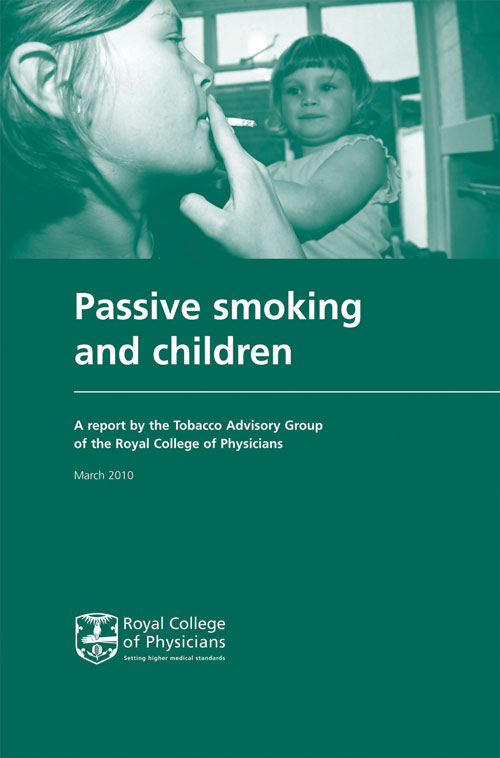
A recent report from the Royal College of Physicians Passive Smoking and Children 1 reveals the burden placed on the NHS from the diseases caused, and exacerbated, by passive smoking - a burden that falls heavily on primary care and which is entirely avoidable. Passive smoking in children accounts for an estimated 300,000 general practice consultations in the UK each year, the majority of which are consultations for middle ear disease (see table 1). However, asthma also emerges as a cause of repeated contacts with GPs, with more than 100,000 consultations for asthma in children each year attributable to passive smoking.
New research for the report, funded by Cancer Research UK and carried out by the UK Centre for Tobacco Control Studies, used a combination of data from a range of sources including ONS and The Health Improvement Network (THIN) database to estimate numbers of cases of disease and consequent morbidity in children caused by passive smoking in the UK.
The estimates are limited mainly to the more common diseases caused by passive smoking and are therefore likely to be an underestimate of the true numbers. These figures (see table 2, below) relate to annual numbers of cases in children in the UK and include:
- around 20,500 new cases of lower respiratory tract infection in children under the age of 3 years
- 121,400 new cases of middle ear disease in children of all ages
- 22,600 new cases of wheeze and asthma in children
- at least 200 cases of bacterial meningitis in children
- around 40 sudden infant deaths
It is likely that passive smoke exposure is a significant contributor to the socio-economic gradient of incidence of most of the childhood illnesses studied.
Fetal and reproductive health
It has been recognised for many years that maternal smoking during pregnancy has substantial adverse effects on the fetus. There is extensive evidence from human and animal studies on the biological mechanisms of how tobacco smoke affects the female reproductive system and fetal development. Many of the 4,000 chemicals in tobacco smoke, including nicotine and carbon monoxide, can cross the placental barrier and have a direct toxic effect on the fetus, as well as on the mother. Maternal smoking in pregnancy is clearly a potential cause of major morbidity and mortality to the fetus and newborn baby.
Most research on the adverse effects of smoking on the fetus has been carried out in relation to active maternal smoking, but fetal exposure also occurs as a result of maternal exposure to passive smoke, and the report used systematic reviews and larger studies to estimate the overall effects.
Active maternal smoking (and hence passive exposure of the fetus) causes up to about 5,000 miscarriages, 300 perinatal deaths, and 2,200 premature singleton births in the UK each year. Passive exposure of the fetus to active maternal smoking impairs fetal growth and development, increasing the risk of being small for gestational age and reducing birthweight by around 250 g, and probably increases the risk of congenital abnormalities of the heart, limbs, and face though the available evidence is not yet conclusive. Passive exposure of the fetus to active maternal smoking causes around 19,000 babies to be born with low birthweight in the UK each year.
Maternal passive smoking is likely to have similar adverse effects on fetal and reproductive health, but of smaller magnitude - it reduces birthweight by around 30-40 g, and may also have modest effects on the risk of prematurity and being small for gestational age. It may also reduce fertility, increase fetal and perinatal mortality, and increase the risk of some congenital abnormalities (particularly of the face and genitourinary system), though the available evidence is not yet conclusive.
Relative risks from passive smoking
New meta-analyses and systematic reviews provided contemporary best estimates of the magnitude of the impact of passive smoking on child health in the major disease areas covered above.
Living in a household in which one or more people smoke more than doubles the risk of sudden infant death. Smoking by the mother increases the risk of lower respiratory infections by about 60%, and smoking by any household member by more than 50%. Most of this increase is due to an effect on bronchiolitis, which is about 2.5 times more likely to occur in children whose mothers smoke.
Passive smoking increases the risk of wheezing at all ages. Again, the effect is strongest for smoking by the mother, with increases in risk of 65% to 77% according to the age of the child. It also increases the risk of asthma, and although effects were generally less strong than for wheeze or infection, in school-aged children the risk is increased by household smoking by around 50%. For middle ear disease, the risk is increased by about 35% for household smoking and around 46% for smoking by the mother, and it appears to more than double the risk of bacterial meningitis.
Since most mothers who smoke through pregnancy also smoke after the child is born, it is difficult to determine the relative importance of maternal smoking before and after birth on these outcomes. However, the stronger effects of postnatal than prenatal maternal smoking, and the presence of effects from other household smokers, suggest that postnatal smoking is the more important.
Costs to the NHS and society
The effects of passive smoking in the home on children have a far-reaching economic impact over and above the more often reported effects on child health. A conservative estimate is made of £9.7 million per annum in UK primary care visits and asthma treatment costs, and £12.1 million
per annum in hospital admissions in England, or approximately £13.6 million for the UK. The discounted cost of providing asthma drugs for children who develop asthma each year as a result of passive smoking up until the age of 16 in the UK is approximately
£4 million. The future treatment costs of smokers who take up smoking as a consequence of exposure to parental smoking could be as high as
£5.7 million per annum, or £48 million over 60 years, when discounted at 3.5% per annum.
GPs and the primary healthcare team
The simplest way to prevent passive exposure of children to tobacco smoke is to encourage and support their parents to quit smoking. For parents and other family members who will not or cannot quit smoking, the next best course of action is to make the home environment in which children live completely smoke-free. Primary care health professionals, in common with all health professionals, therefore need to engage with smoking prevention and cessation initiatives at all levels, but particularly in all contacts with individual patients who smoke, or family members who smoke.
Smoking interventions thus need, where possible, to become even more prominent and systematic. QOF points are available for recording smoking status and helping smokers who want to quit (see box 1), and GPs are used to well timed interventions at appropriate points such as:
- starting contraception
- pregnancy
- fertility treatment
- before major surgery.
Other opportunities include patients:
- becoming grandparents
- beginning childminding as a career or as informal carers for children in the family.
Ideally, healthcare providers should build smoking cessation interventions for all smokers into routine service provision.
The primary care team can also act as advocates for supporting and developing local smoking cessation services, either those attached to the practice or elsewhere. In the future drive for efficiency savings, non-frontline services without instant outcomes may look like an easy option for cuts, yet the cost-effectiveness of cessation services outstrips nearly all other health interventions, and can reduce future GP attendances many years later.
Primary care teams can become involved in developing new service models to support smoking cessation, and taking part in research studies, particularly on cessation interventions in pregnant women, and methods of relapse prevention after the birth of the child, when many mothers start to smoke again.
As educators, GPs and practice nurses can explore with GP and nursing trainees the importance of smoking cessation in preventing disease and improving health, an element that is barely covered in the traditional organ-based medical school curricula. In addition, direct experience of the effects of smoking and passive smoking at practice level will reinforce the message that both are major contributors to inequalities in health, and need to be addressed urgently at every level, from individual GPs to government ministers.
Acknowledgement
I would like to thank Linda Cuthbertson for her help in the preparation of this article.
REFERENCES
1 Royal College of Physicians. Passive smoking and children. A report by the Tobacco Advisory Group of the Royal College of Physicians. RCP. London. 2010
USEFUL INFORMATION
Patients can obtain expert advice and support from the NHS website.
 Download this article in PDF format