SEARCH

Day A, Hollamby S, Girling J. Early recognition of hyperemesis gravidarum can prevent complications. Practitioner July/August 2021;265(1850):21-25
Early recognition of hyperemesis gravidarum can prevent complications
26 Jul 2021
AUTHORS
Ms Andrea Day MBBS MRCOG, Locum Consultant Obstetrician and Gynaecologist
Ms Suzanne Hollamby MBBS FRCOG, Consultant Gynaecologist
Ms Joanna Girling MA MRCP FRCOG, Consultant Obstetrician and Gynaecologist
West Middlesex University Hospital, Chelsea and Westminster NHS Foundation Trust, London, UK
Competing interests: None
Acknowledgements
We would like to thank our colleagues in ambulatory emergency care, obstetrics and gynaecology, and the early pregnancy unit at Chelsea and Westminster Hospital NHS Foundation Trust for their hard work in developing the hyperemesis gravidarum ambulatory emergency care pathway.
Article
Nausea and vomiting in pregnancy is very common and affects up to 80% of women. It is usually mild and resolves during the first half of pregnancy. However, in a small proportion of women (0.3–3.6%), symptoms are so severe that they lead to dehydration, electrolyte imbalance and weight loss. This is known as hyperemesis gravidarum. A history of hyperemesis gravidarum in a previous pregnancy is the strongest independent risk factor with a recurrence rate of 26%. Increased pregnancy hormone levels caused by a multiple or molar pregnancy and preexisting medical conditions such as diabetes, hyperthyroidism, gastrointestinal disorders (specifically being seropositive for H. pylori) and psychiatric illness also increase risk. Symptoms typically start between the 4th and 7th weeks of gestation, peak around the 9th week and resolve by the 20th week. If the onset of symptoms occurs after 10 weeks’ gestation, the symptoms are unremitting or the presentation is atypical, the possibility of a different clinical condition needs to be considered. Urgent referral to secondary care, for intravenous fluids, electrolyte and vitamin replacement, should be considered for those women with: persistent severe symptoms despite oral antiemetic treatment; a PUQE score > 7; weight loss > 5% of the prepregnancy weight; medical comorbidities requiring oral treatment and/or any clinical concerns needing specialist input. Hyperemesis scores 3 points on the maternity VTE assessment tool, so any further risk factor is an indication to consider thromboprophylaxis. Women who have persistent symptoms into the second trimester of pregnancy should have consultant-led antenatal care and serial fetal growth ultrasound.
Nausea and vomiting in pregnancy is very common and affects up to 80% of women. It is usually mild and resolves during the first half of pregnancy. However, in a small proportion of women (0.3-3.6%) symptoms are so severe that they lead to dehydration, electrolyte imbalance and weight loss.1 This condition is known as hyperemesis gravidarum. As well as affecting the woman’s physical and mental health it can also cause fetal morbidity.
Traditionally, women with severe symptoms were referred to the emergency department and often required admission to hospital for parenteral treatment. As part of the Urgent and Emergency Care transformation programme within the NHS Long Term Plan, most women with hyperemesis gravidarum can now bypass the emergency department and receive immediate treatment in an ambulatory care setting without the need to stay in hospital overnight.
Early recognition in primary care and appropriate escalation to secondary care can prevent complications and improve quality of life.
The aetiology and pathogenesis of hyperemesis gravidarum remain unknown. However, it is well recognised that the following factors and medical disorders are associated with the condition:
• A history of hyperemesis gravidarum in a previous pregnancy. This is the strongest independent risk factor with a recurrence rate of 26%2
• Increased pregnancy hormone levels present in a multiple pregnancy or molar pregnancy3
• Preexisting medical conditions such as diabetes, hyperthyroidism, gastrointestinal disorders (specifically being seropositive for Helicobacter pylori) and psychiatric illness3,6
Young maternal age, Asian or Black ethnicity, nulliparity and carrying a female fetus may also be associated with an increased likelihood of hyperemesis gravidarum.2,4,5
Assessment
Most women usually complain of nausea, inability to swallow saliva, gagging, retching, dry heaving, vomiting, and odour and/or food aversion. These symptoms typically start between the fourth and seventh weeks of gestation, peak around the ninth week and resolve by the 20th week in 90% of women.
Hyperemesis gravidarum is a diagnosis of exclusion. If the onset of symptoms occurs after ten weeks’ gestation, the symptoms are unremitting or the presentation is atypical with or without other symptoms, a different clinical condition needs to be considered.
Table 1 outlines the most common differential diagnoses.
A full history, examination and targeted investigations are essential to exclude other diagnoses and also
to establish severity of hyperemesis gravidarum. It is always important to:
• Enquire about the onset, duration and frequency of symptoms, dehydration symptoms (urine volume and colour) as well as response to any antiemetic treatment if used.
• Exclude other causes, especially if women present with vaginal bleeding, symptoms of systemic infection, severe abdominal pain, haematemesis, urinary or bowel symptoms, late onset of vomiting or significant headache or confusion.
• Assess the woman for any coexisting conditions in which the efficacy of oral medications can be reduced (i.e. epilepsy) or where dehydration could cause complications (i.e. sickle cell disease, diabetes).
• Measure vital signs (consider using maternity specific warning scores) including lying and standing blood pressure.
• Look for signs of significant dehydration and/or muscle wasting, sepsis, hypokalaemia (muscle weakness), hypocalcaemia, thyrotoxicosis or abdominal pathology. Perform a symptom guided examination if required (i.e. neurological examination if headache is present).
• Classify the severity and quantify the ability to tolerate food/fluids using objective and validated measures (see table 2 and table 3).
• Evaluate mental health status and the effects on quality of life. This can be done using the Edinburgh Postnatal Depression Scale.7
• Monitor weight at initial presentation and then weekly and escalate care if weight loss > 5% when compared with prepregnancy weight.
• Test the urine, for evidence of infection (± MSU) and ketonuria. The presence of ketones does not always correlate with severity of symptoms and more commonly reflects a state of starvation rather than dehydration, and therefore should not be used as a sole marker of severity of symptoms.8,9
• Calculate venous thromboembolism (VTE) risk using the maternity VTE assessment tool (note hyperemesis already scores 3 points) and prescribe antiembolism stockings or low molecular weight heparin as indicated.10
• Organise an ultrasound in the early pregnancy unit to exclude multiple pregnancy and trophoblastic disease and confirm viability.
• Prescribe antiemetics (see details under Management).
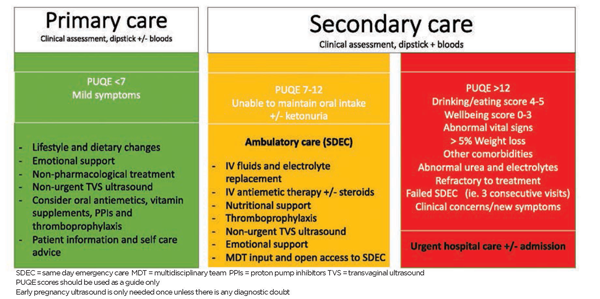
• Consider the need for outpatient parenteral treatment and/or hospitalisation (see figure 1).
• Signpost to self-help resources and support groups (see External websites)
• Monitor progress and arrange
follow-up to prevent hospital admission and complications.
In primary care, laboratory investigations are generally not required and are usually reserved for cases where intravenous hydration is needed. However, if an alternative diagnosis is considered these may be indicated.
Potential complications
Persistent vomiting can cause serious complications, both for the woman and the baby,11 see table 4.
Referral
Figure 1 outlines the recommended criteria and place of treatment for women with nausea and vomiting in pregnancy and hyperemesis gravidarum. Urgent referral to secondary care should be considered for those women with:
• Persistent severe symptoms despite oral antiemetic treatment (with or without ketonuria), PUQE score > 7
• Weight loss > 5% of prepregnancy weight
• Medical comorbidities needing oral treatment (such as disease modifying drugs in rheumatic or inflammatory bowel disorders, blood pressure control, antibiotics, antiepilepsy drugs) and/or any clinical concerns needing specialist input.
Hospital assessment and treatment is currently provided in two settings: ambulatory care, i.e. at an ambulatory emergency care unit, where women receive prompt intravenous replacement treatment and usually can be discharged after 2-4 hours with open access to reattend as needed, or the emergency department (usually out of hours), where women may need brief admission to an observation unit to receive similar treatment. Both settings have provision for multidisciplinary team (MDT) care (pharmacists, endocrinologists, dietitians, medical and surgical specialists and mental health professionals) with the option of relocation for inpatient care if indicated, a typical length of stay is 2-3 days.
Nausea and vomiting in pregnancy or hyperemesis gravidarum has a substantial emotional impact and can significantly affect a woman’s ability to carry out daily tasks. Signposting to support groups, self-help resources or a referral to the mental health team should be considered.
A non-urgent early pregnancy unit referral should be made for all women with hyperemesis gravidarum to rule out a molar or multiple pregnancy and confirm viability.
Management
Most women with mild nausea and vomiting in pregnancy should be advised to avoid foods, odours and activities that exacerbate symptoms, discontinue iron supplements, drink adequate amounts of fluids, eat small meals frequently and snack on carbohydrate-rich foods.12,13
Pharmacological treatment and psychological support (psychotherapy and possible involvement of the mental health team) may need to be considered in certain patients.
Choosing the best antiemetic drug presents challenges as there is a lack of evidence from controlled trials and a concern about potential teratogenesis in the first trimester.14 Regimens recommended are usually guided by the approach for treatment of nausea and vomiting secondary to chemotherapy or postoperative care with consideration of safety data in pregnancy and the side effect profile.
Women should be given the necessary information to make an informed decision, weighing the potential harm from pharmacological interventions against the harm of the complications resulting from dehydration, weight loss, nutritional deficiencies, metabolic imbalance, and the potential impact on mental health.
Figure 2 reflects the Royal College of Obstetricians and Gynaecologists’ (RCOG) advice illustrated in a stepwise approach. Previous efficacy, adverse reactions and route of administration should be considered in the decision making. If a woman does not respond to a single antiemetic, an incremental approach adding a second agent that has a different mode of action is advocated. Prescribing ‘as needed’ may be required together with appropriate counselling.
The RCOG recommends using antihistamines (cyclizine, promethazine) and phenothiazines (prochlorperazine and chlorpromazine) as first-line treatment. These agents are thought to be effective, have few and mild side effects, and are not known to be associated with any fetal malformations. A delayed release tablet containing doxylamine succinate (an antihistamine) and pyridoxine hydrochloride (vitamin B6) was licensed in the UK in 2018 for use in pregnancy and has been recommended in a NICE evidence summary document published in 2019.15 It is recommended only after conservative measures have failed.
Second-line medications include the dopamine antagonists (metoclopramide and domperidone) and a serotonin 5-HT3 antagonist (ondansetron). The safety profile of metoclopramide is well established16 but the risk of short-term extrapyramidal disorders and tardive dyskinesia limits its use to a maximum dose of 30 mg in 24 hours and a maximum recommended duration of treatment of five days.
Ondansetron is very commonly used and usually well tolerated. However, an American observational study17 reported in 2018 that its use was associated with an additional 3 cases of oral clefts per 10,000 births (14 cases vs 11 per 10,000 births in the unexposed population). The European Medicines Agency Pharmacovigilance Risk Assessment Committee then responded by banning ondansetron in the first trimester of pregnancy. However, the UK Teratology Information Service in collaboration with the European Network of Teratology Information Service reviewed all available evidence and issued a joint statement in September 2019 advocating that ondansetron can be used (with adequate counselling) as a second-line agent for the treatment of nausea and vomiting in pregnancy (as currently recommended by the RCOG Green-top Guideline).1
If polytherapy with second-line agents is not effective and symptoms are severe, steroids can be considered, usually prednisolone or hydrocortisone which do not cross the placenta. However, yet again, evidence for efficacy is weak. The side effects include hyperglycaemia and hypertension, and steroids are only recommended when other treatment combinations have been exhausted.18
Hyperemesis gravidarum is a recognised risk factor for VTE as dehydration and reduced mobility aggravate the prothrombotic risk already imposed by pregnancy.10 Any further risk factor increases the threat considerably which in early pregnancy includes any of the following: age ≥ 35 years, BMI ≥ 30, smoking, parity ≥ 3, gross varicose veins, personal or family history of VTE, thrombophilia or medical comorbidity, multiple pregnancy, conception by assisted reproductive technology, ovarian hyperstimulation syndrome, infection, hospitalisation and reduced mobility.
All women with hyperemesis gravidarum should have a documented risk assessment which should be repeated in any change of circumstances, such as an admission. Once hyperemesis resolves the risk should be reassessed and thromboprophylaxis stopped if appropriate.
Follow-up
Priority appointments should be given to women suffering from nausea and vomiting in pregnancy and hyperemesis gravidarum as they can deteriorate quickly if treatment is not started promptly. This should include patient information leaflets, advice on tracking food, fluid and medication intake at home, the option of providing a fit note and clear guidance on how to stop medication using a pragmatic approach is vital.
Women who have persistent symptoms into the second trimester of pregnancy should have consultant-led antenatal care and serial fetal growth ultrasound.
Conclusion
Assessment of women with nausea and vomiting in pregnancy and hyperemesis gravidarum should be holistic, recognising that no one measure can reliably indicate severity or guide management.
Early intervention with a stepwise approach allowing patients to make an informed decision is essential to avoid maternal and fetal complications.
Women with severe symptoms should have a prompt and appropriate referral (ideally before 5pm) for same day emergency care which expedites treatment and allows patients to self-refer for ongoing treatment. Primary care has a vital role including supporting emotional wellbeing.
REFERENCES
1 Royal College of Obstetricians and Gynaecologists. The management of nausea and vomiting of pregnancy and hyperemesis gravidarum. Green-top Guideline No. 69. RCOG. London. 2016
2 Fiaschi L, Nelson-Piercy C, Tata LJ. Hospital admission for hyperemesis gravidarum: A nationwide study of occurrence, reoccurrence and risk factors among 8.2 million pregnancies. Hum Reprod 2016;31(8):1675-84
3 Verberg MFG, Gillott DJ, Al-Fardan N, Grudzinskas JG. Hyperemesis gravidarum, a literature review. Hum Reprod Update 2005;11(5):527-39
4 Roseboom TJ, Ravelli ACJ, van der Post JA, Painter RC. Maternal characteristics largely explain poor pregnancy outcome after hyperemesis gravidarum. Eur J Obstet Gynecol Reprod Biol 2011;156(1):56-9
5 Fell DB, Dodds L, Joseph KS et al. Risk factors for hyperemesis gravidarum requiring hospital admission during pregnancy. Obstet Gynecol 2006;107(2):277-84
6 Jarvis S, Nelson-Piercy C. Management of nausea and vomiting in pregnancy. BMJ 2011;342(7812):1-8
7 Cox JL, Holden JM, Sagovsky R. Detection of postnatal depression: development of the 10-item Edinburgh Postnatal Depression Scale. Br J Psychiatry 1987;150(6):782-86
8 Dean CR, Shemar M, Ostrowski GAU, Painter RC. Management of severe pregnancy sickness and hyperemesis gravidarum. BMJ 2018;363:1-8
9 Niemeijer MN, Grooten IJ, Vos N et al. Diagnostic markers for hyperemesis gravidarum: a systematic review and metaanalysis. Am J Obstet Gynecol 2014;211(2):150.e1-150.e15
10 Royal College of Obstetricians and Gynaecologists. Reducing the risk of venous thromboembolism during pregnancy and the puerperium. Green-top Guideline No. 37a. RCOG. London. 2015
11 Fiaschi L, Nelson-Piercy C, Gibson J et al. Adverse maternal and birth outcomes in women admitted to hospital for hyperemesis gravidarum: a population-based cohort study. Paediatr Perinat Epidemiol 2018;32(1):40-51
12 Abramowitz A, Miller ES, Wisner KL. Treatment options for hyperemesis gravidarum. Arch Wom Ment Health 2017;20(3):363-72
13 Tsakiridis I, Mamopoulos A, Athanasiadis A, Dagklis T. The management of nausea and vomiting of pregnancy: synthesis of national guidelines. Obstet Gynecol Surv 2019;74(3):161-69
14 Boelig RC, Barton SJ, Saccone G et al. Interventions for treating hyperemesis gravidarum: a Cochrane systematic review and meta-analysis. J Matern Neonatal Med 2017;31(18):2492-2505
15 National Institute for Health and Care Excellence. Evidence review: doxylamine/pyridoxine (Xonvea) for treating nausea and vomiting of pregnancy. NICE. London. 2019 www.nice.org.uk/evidence
16 Matok I, Gorodischer R, Koren G et al. The safety of metoclopramide use in the first trimester of pregnancy. N Engl J Med 2009;360(24):2528-35
17 Huybrechts KF, Hernández-Díaz S, Straub L et al. Association of maternal first-trimester ondansetron use with cardiac malformations and oral clefts in offspring. JAMA 2018;320(23):2429-37
18 Kemp MW, Newnham JP, Challis JG et al. The clinical use of corticosteroids in pregnancy. Hum Reprod Update 2016;22(2):240-59
19 Ebrahimi N, Maltepe C, Bournissen FG, Koren G. Nausea and vomiting of pregnancy: using the 24-hour Pregnancy-Unique Quantification of Emesis (PUQE-24) Scale. J Obstet Gynaecol Can 2009;31(9):803-07
20 Kuşcu NK, Koyuncu F. Hyperemesis gravidarum: current concepts and management. Postgrad Med J 2002;78(916):76-79
21 Mitchell-Jones N, Gallos I, Farren J. Psychological morbidity associated with hyperemesis gravidarum: a systematic review and meta-analysis. BJOG 2017;124(1):20-30
22 Mitchell-Jones N, Lawson K, Bobdiwala S et al. Association between hyperemesis gravidarum and psychological symptoms, psychosocial outcomes and infant bonding: a two-point prospective case-control multicentre survey study in an inner city setting. BMJ Open 2020;10(10):1-12
23 Van Oppenraaij RHF, Jauniaux E, Christiansen OB et al. Predicting adverse obstetric outcome after early pregnancy events and complications: a review. Hum Reprod Update 2009;15(4):409-21
ARTICLE IN PDF
 Download this article in PDF format
EXTERNAL WEBLINKS
For healthcare professionals
Advice on medicines in pregnancy
UK Teratology Information Service (UKTIS)
UKTIS helpline: 0344 892 0909
Mon-Fri 9am to 5pm
NICE Clinical knowledge summaries
Nausea and vomiting in pregnancy
For patients
RCOG patient information leaflets
Chelsea and Westminster NHS Foundation Trust