SEARCH

Ayuk J, Hassan-Smith Z, Gittoes N. Diagnosis and management of primary hyperparathyroidism. Practitioner May 2021;265(1848):21-24
Diagnosis and management of primary hyperparathyroidism
25 May 2021
AUTHORS
Dr John Ayuk MD FRCP, Consultant Endocrinologist
Dr Zaki Hassan-Smith PhD FRCP, Honorary Consultant Endocrinologist
Dr Neil Gittoes PhD FRCP, Honorary Professor of Endocrinology and Consultant
Department of Endocrinology, Queen Elizabeth Hospital, University Hospitals Birmingham NHS Foundation Trust, Birmingham, UK
Competing interests: Dr Neil Gittoes was chair of the NICE primary hyperparathyroidism guideline development group. The other authors have no competing interests.
Article
Primary hyperparathyroidism (PHPT) has an estimated prevalence of 1-4 cases per 1,000 adults. It most commonly occurs sporadically, typically caused by a parathyroid adenoma. Such cases are more common in women and with increasing age. Other risk factors include neck irradiation and lithium use. Inherited cases can occur in relation to genetic conditions including MEN1. Parathyroid carcinoma is vanishingly rare. PHPT may present with symptoms of hypercalcaemia (such as thirst, excessive urination or constipation), or evidence of potential end organ effects. However, the most common presentation is an incidental finding of a raised albumin-adjusted serum calcium. End organ effects may be skeletal (fragility fractures and osteoporosis) or renal (renal stones/calcification), while observational studies demonstrate an association with cardiometabolic disease. Patients should be advised to keep well hydrated. Where possible, medication that can exacerbate hypercalcaemia should be stopped. Patients with a likely diagnosis of PHPT should have their vitamin D status assessed and vitamin D supplementation commenced as required. Once PHPT is confirmed, patients will undergo assessment for potential end organ effects with a DXA scan of the lumbar spine, hip and distal radius, and an ultrasound scan of the renal tract. Parathyroidectomy is the only curative treatment for PHPT.
Primary hyperpara-thyroidism is a common endocrine disorder with prevalence estimates in the range of 1 to 4 per 1,000 in the general population.1
It tends to occur sporadically and is typically caused by parathyroid adenoma. Such cases are more common in women and with increasing age. Other risk factors include neck irradiation and lithium use. NICE (CG185) recommends that patients taking lithium should have their calcium levels checked every 6 months.2 Some cases occur as a result of genetic disorders such as MEN1.3 Parathyroid carcinoma is vanishingly rare.
Presentation
NICE published guidelines on the diagnosis, assessment and initial management of primary hyperparathyroidism in May 2019.1
The diagnosis should be considered in the context of suggestive symptoms of hypercalcaemia, evidence of potential end organ effects or most commonly, an incidental finding of raised albumin-adjusted serum calcium.
Patients should be asked about potential symptoms (see table 1), many of which may be non-specific and mild.4
Common endocrine conditions including primary hyperparathyroidism should be excluded when assessing older patients with depression. There has been speculation that MAOI-A activation by calcium is a potential mechanism involved in the link between depression and primary hyperparathyroidism, but this is contentious.
At referral, the condition has shifted from a symptomatic condition once described by the now outdated ‘stones, bones, abdominal moans and psychic groans’ mnemonic to a largely mild or asymptomatic condition that is often picked up incidentally on routine testing.
End organ effects may be skeletal (fragility fractures and osteoporosis) and renal (renal stones/calcification) while observational studies demonstrate associations with cardiometabolic disease.4
The entity of normocalcaemic primary hyperparathyroidism has also been identified, characterised by an albumin-adjusted serum calcium in the upper part of the reference range alongside an otherwise unexplained elevation in parathyroid hormone (PTH). Data are emerging on long-term outcomes and the impact of definitive therapy in this condition.5
Patients should be advised to keep well hydrated. Medications should be reviewed to identify and, where possible, omit those that can exacerbate hypercalcaemia such as calcium supplements, thiazide diuretics, lithium and vitamin A.
Assessment and investigation
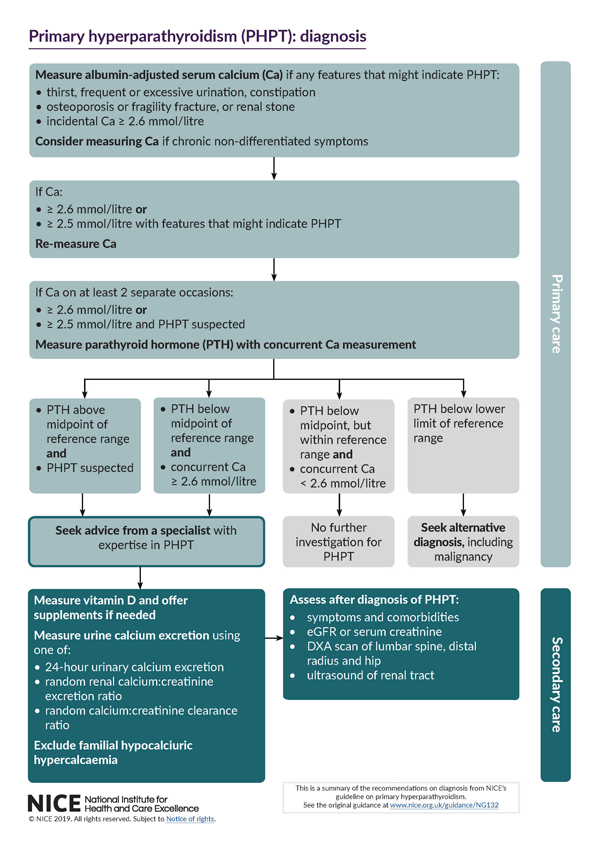
NICE guidelines advise that patients presenting with symptoms suggestive of hypercalcaemia, such as increased thirst, increased urination or constipation should have their albumin-adjusted serum calcium measured.
Those with potential end organ effects of primary hyperparathyroidism, including osteoporosis or fragility fractures and renal stones should also be tested.1
Testing should be considered in those with chronic non-differentiated symptoms such as fatigue, bone/muscle pains and mood disturbances.
Those with a baseline albumin-adjusted serum calcium ≥ 2.6 mmol/L in the absence of symptoms and those with measurements ≥ 2.5 mmol/L in the presence of symptoms should have a follow-up calcium test.
Confirming diagnosis
PTH testing is critical at this stage in distinguishing between primary hyperparathyroidism and so-called ‘PTH independent’ causes of hypercalcaemia. PTH should be measured in those with albumin-adjusted serum calcium measurements on two separate occasions that are ≥ 2.6 mmol/L in the absence of other clinical features or ≥ 2.5 mmol/L in those with other clinical features of primary hyperparathyroidism.1
NICE recommends referral to a primary hyperparathyroidism specialist if PTH is above the midpoint of the normal range and primary hyperparathyroidism is suspected (i.e. is likely). Referral is also recommended if PTH is below the midpoint of the normal range but the albumin-adjusted serum calcium is ≥ 2.6 mmol/L (i.e. primary hyperparathyroidism cannot be ruled out), see figure 1. An albumin-adjusted serum calcium test should be requested at the same time as a PTH test.
Further testing is not required in patients with PTH in the lower half of the reference range and with albumin-adjusted serum calcium in the reference range below 2.6 mmol/L.
It is critical that the patient is investigated for alternative diagnoses, including malignancy, if the PTH is below the lower limit of the reference range (see table 2); these conditions are best managed by the relevant (non-endocrine) specialty to treat the underlying condition.
Secondary hyperparathyroidism is a condition characterised by increased PTH secretion in response to hypocalcaemia. This is commonly seen in chronic kidney disease and vitamin D deficiency. This is an important differential diagnosis, and while NICE guidelines advise this is part of screening in secondary care this can also form part of the initial assessment.6
Patients with a likely diagnosis of primary hyperparathyroidism should have their vitamin D status assessed and vitamin D supplementation should be commenced as required.
Assessment of renal function with documentation of U&Es and eGFR is also important.1
Patients with suspected primary hyperparathyroidism who are referred to secondary care require measurement of urinary calcium excretion, by 24 hr urine collection or a spot urine test for calcium: creatinine clearance ratio to exclude familial hypocalciuric hypercalcaemia. This inherited condition is characterised by altered function of the calcium sensing receptor where the biochemistry may mimic primary hyperparathyroidism.7 It is a largely benign condition and patients do not require parathyroidectomy.
In secondary care, patients with confirmed primary hyperparathyroidism, will undergo assessment for potential end organ effects with bone densitometry DXA scanning of lumbar spine, hip and distal radius, and ultrasound scanning of the renal tract.
Surgical management
In patients with biochemically confirmed primary hyperparathyroidism who are referred for surgery imaging can be useful to confirm the presence of a parathyroid adenoma or gland hyperplasia that would represent a surgical target.8 The choice of imaging modality varies between centres, with ultrasound and radionucleotide imaging common first-line options. This can guide the surgical approach, with the benefit of focused surgery to remove the abnormal gland where an adenoma is apparent vs bilateral neck exploration where imaging is inconclusive or if four-gland hyperplasia is suspected.
Parathyroidectomy is the only curative treatment for primary hyperparathyroidism and referral to an experienced parathyroid surgeon will occur in secondary care for patients with symptomatic disease.9
Parathyroidectomy results in significant improvements in bone mineral density (BMD), and there is some evidence suggesting a trend towards lower rates of vertebral fracture following parathyroidectomy.10,11
The risk of renal stone disease has also been shown to decrease after curative parathyroidectomy, although the risk remains increased compared with the background population.12
Parathyroidectomy is also recommended in a subgroup of patients with asymptomatic disease.5,12
NICE guidelines recommend that parathyroidectomy should be considered in patients who fulfil the criteria set out in table 3.1
For patients who do not undergo parathyroidectomy, monitoring focused on detecting changes in serum calcium concentration, reductions in BMD, occurrence of fragility fractures, or changes in renal endpoints is indicated (see table 4).1,13 Indications for parathyroidectomy during monitoring are similar to those listed in table 3.
Although evidence-based recommendations are lacking in normocalcaemic primary hyperparathyroidism, surgery is suggested if patients become hypercalcaemic and have other indications for parathyroidectomy.4,13
Pregnancy
Primary hyperparathyroidism can be associated with adverse pregnancy outcomes, including those related to hypertensive disease. Women with primary hyperparathyroidism who are considering pregnancy should be offered parathyroidectomy prior to conception.
Women with the condition who are pregnant require referral to a specialist centre, with the capacity for multidisciplinary team (MDT) review and management. Many centres have specialist endocrine antenatal services. The MDT should include specialist input from an obstetrician, midwife, parathyroid surgeon, anaesthetist and physician with expertise in primary hyperparathyroidism.
Patients are carefully considered for potential parathyroidectomy in pregnancy although further studies of outcomes of intervention and consensus in this area are required.14
Medical management
Although surgery is the only curative treatment for primary hyperparathyroidism, medical treatments can be considered for patients who do not fulfil criteria for surgery or those who are unsuitable for or decline surgery. There is no currently available single drug that can normalise serum calcium, PTH levels and urinary calcium excretion, while at the same time increasing BMD, lowering fracture risk and reducing the risk of kidney stones.
Vitamin D deficiency and insufficiency occur in many patients with primary hyperparathyroidism and appear to be associated with more severe bone disease.10 It is therefore recommended that all patients who do not undergo surgery should be prescribed vitamin D, starting at a dose of 800 to 1,000 IU daily.13 Vitamin D replacement does not result in a significant increase in serum calcium.
Oestrogen, bisphosphonates and denosumab have all been shown to increase BMD in patients with primary hyperparathyroidism. However, data regarding fracture risk reduction are lacking.4
Cinacalcet is a calcimimetic agent that lowers serum calcium and PTH by increasing the sensitivity of the calcium-sensing receptor to extracellular calcium. It normalises serum calcium in the order of 70-80% of patients with primary hyperparathyroidism, but has no impact on BMD, renal stones or quality of life.10,15,16 Cinacalet should not be regarded as an equivalent alternative to parathyroidectomy.
Adjunctive measures such as cinacalcet can be considered where patients have significantly raised albumin-adjusted serum calcium, symptoms and where surgery is not possible. Furthermore, patients with osteoporosis can be considered for bisphosphonate therapy in the absence of cautions and contraindications.
It is important that patients have a good understanding of symptoms of severe hypercalcaemia including increased thirst, polyuria, nocturia, confusion, constipation, nausea, vomiting and abdominal pain.17 Patients should ensure that they keep well hydrated. Patient information is available from the Society for Endocrinology and Parathyroid UK, see External weblinks.
Conclusion
Primary hyperparathyroidism is a common condition that can be associated with adverse long-term health outcomes, including renal stone disease and osteoporosis. Patients often present with mild or asymptomatic disease.
Indications for surgery include symptoms of hypercalcaemia, markedly raised albumin-adjusted serum calcium and evidence of end organ effects.
Patients with suspected primary hyperparathyroidism or initially raised serum calcium should have repeat testing of albumin-adjusted serum calcium in primary care, with follow-up testing of PTH for those with persistently elevated levels ( ≥ 2.6 mmol/L) or high normal ( ≥ 2.5 mmol/L) with symptoms/clinical features.
Those with tests consistent with primary hyperparathyroidism should be referred for specialist review in a metabolic bone/calcium or endocrine service. The only curative therapy at present is parathyroidectomy, however many patients are managed conservatively or with medical therapies.
REFERENCES
1 National Institute for Health and Care Excellence. NG132. Hyperparathyroidism (primary): diagnosis, assessment and initial management. NICE. London. 2019
2 National Institute for Health and Care Excellence. CG185. Bipolar disorder: assessment and management. NICE. London. 2014 Updated 2020
3 Cardoso L, Stevenson M, Thakker RV. Molecular genetics of syndromic and non-syndromic forms of parathyroid carcinoma. Hum Mutat 2017;38;1621-48 [Last accessed 13 April 2021]
4 Bilezikian JP, Cusano NE, Khan AA et al. Primary hyperparathyroidism. Nat Rev Dis Prim 2016;2:1–16 [Last accessed 13 April 2021]
5 Aojula N, Khan S, Gittoes N, Hassan-Smith Z. Normocalcaemic primary hyperparathyroidism: what is the role of parathyroid surgery? Ther Adv Endocrinol Metab 2021:12 [Last accessed 13 April 2021]
6 Vallumsetla N, Mundi MS, Kennel KA. Secondary hyperparathyroidism. In: Hyperparathyroidism: a clinical casebook. pp 169-78. Springer International Publishing. 2016 [Last accessed 13 April 2021] www.ncbi.nlm.nih.gov/books/NBK557822/
7 Hannan FM, Babinsky VN, Thakker RV. Disorders of the calcium-sensing receptor and partner proteins: insights into the molecular basis of calcium homeostasis. J Mol Endocrinology 2016;57(3):R127-42
8 Bunch PM, Kelly HR. Preoperative imaging techniques in primary hyperparathyroidism: a review. JAMA Otolaryngol Head Neck Surg 2018;144:929-37
9 Wilhelm SM, Wang TS, Ruan DT et al. The American Association of Endocrine Surgeons guidelines for definitive management of primary hyperparathyroidism. JAMA Surg 2016;151(10):959-68 [Last accessed 13 April 2021]
10 Khan AA, Hanley DA, Rizzoli R et al. Primary hyperparathyroidism: review and recommendations on evaluation, diagnosis, and management. A Canadian and international consensus. Osteoporosis Int 2017;28:1 [Last accessed 13 April 2021]
11 Lundstam K, Heck A, Godang K et al. Effect of surgery versus observation: skeletal 5-year outcomes in a randomized trial of patients with primary HPT (the SIPH Study). J Bone Miner Res 2017;32(9):1907-14 [Last accessed 13 April 2021]
12 Rejnmark L, Vestergaard P, Mosekilde L. Nephrolithiasis and renal calcifications in primary hyperparathyroidism. J Clin Endocrinol Metab 2011 96(8):2377-85 [Last accessed 13 April 2021]
13 Bilezikian JP, Brandi ML, Eastell R et al. Guidelines for the management of asymptomatic primary hyperparathyroidism: Summary statement from the fourth international workshop. J Clin Endocrinol Metab 2014;99(10):3561-69 [Last accessed 13 April 2021]
14 DiMarco AN, Meeran K, Christakis I et al. Seventeen cases of primary hyperparathyroidism in pregnancy: a call for management guidelines. J Endocr Soc 2019;3(5):1009-21
15 Khan A, Bilezikian J, Bone H et al. Cinacalcet normalizes serum calcium in a double blind randomized, placebo-controlled study in patients with primary hyperparathyroidism with contraindications to surgery. Eur J Endocrinol 2015;172(5):527-35 [Last accessed 13 April 2021]
16 Peacock M, Bilezikian JP, Bolognese MA et al. Cinacalcet HCl reduces hypercalcemia in primary hyperparathyroidism across a wide spectrum of disease severity. J Clin Endocrinol Metab 2011;96(1):E9 [Last accessed 13 April 2021]
17 Gittoes NJ, Criseno S, Appelman-Dijkstra NM et al. Management of calcium metabolic disorders and osteoporosis. Eur J Endocrinol 2020;183:G57-65 [Last accessed 13 April 2021]
 Download this article in PDF format