SEARCH

Moghaddas F. Improving early recognition and treatment of anaphylaxis. Practitioner April 2021;265(1847):21-24
Improving early recognition and treatment of anaphylaxis
22 Apr 2021
AUTHORS
Dr Fiona Moghaddas MBBS (Hons) PhD FRACP, Clinical Immunology and Allergy Fellow, Department of Immunology and Allergy, North Bristol Trust, Bristol, UK
Competing interests: None
Article
Anaphylaxis is a serious potentially life-threatening systemic hypersensitivity characterised by airway, breathing and/or circulation compromise. Hospital admissions due to anaphylaxis result from exposure to food such as peanuts, tree nuts and cow’s milk, medication and venom, with the likely culprit varying with the age of the patient. However, one third of cases have no clear trigger. Where feasible, any trigger should be removed. Patients should be maintained in a comfortable yet safe position. Hypotensive patients should be placed in a supine position with or without leg elevation but those with airway or breathing compromise may prefer to sit up. A standard dose of 500 micrograms (0.5 ml of 1:1,000 adrenaline) is recommended in adults, whereas dosage varies in children depending on age/weight. Doses should be given at 5 minute intervals, along with intravenous fluid boluses to manage third spacing that occurs in anaphylaxis. Antihistamines and corticosteroids no longer feature in the initial management of anaphylaxis. Adults who have received treatment for suspected anaphylaxis should be observed for 6-12 hours after symptom onset and children under 16 should be admitted to hospital. Individuals with a past history of anaphylaxis are at increased risk of another episode so should be offered an action plan and provision of an adrenaline autoinjector should be considered. All patients who have had an episode of anaphylaxis should be referred to an age appropriate allergy service.
Anaphylaxis is a serious potentially life-threatening systemic hypersensitivity characterised by airway, breathing and/or circulation compromise.1 Anaphylaxis is a clinical diagnosis.
A European study has estimated that around 1 in 300 people experience an episode of anaphylaxis in their lifetime.2
Anaphylaxis has long been considered an immediate IgE-mediated hypersensitivity, caused by interaction between allergen and IgE pre-bound to high affinity receptors on the surface of mast cells leading to degranulation.
There is increasing recognition that a number of other pathophysiological mechanisms exist such as complement, IgG and direct mast cell activation.3,4
The unified end pathway, however, is the release of vasoactive and proinflammatory mediators that result in increased vascular permeability, hypotension and bronchospasm.
Epidemiology
There has been an increase in the incidence of anaphylaxis over time, with a seven-fold increase in hospitalisations across the UK between 1992 and 2012.5 However, no increase in fatalities was seen over the same time period. This was reflected in UK Fatal Anaphylaxis Registry trigger specific data, with doubling of hospitalisations for food related anaphylaxis from 1998 to 2012 but similar numbers of fatalities.6
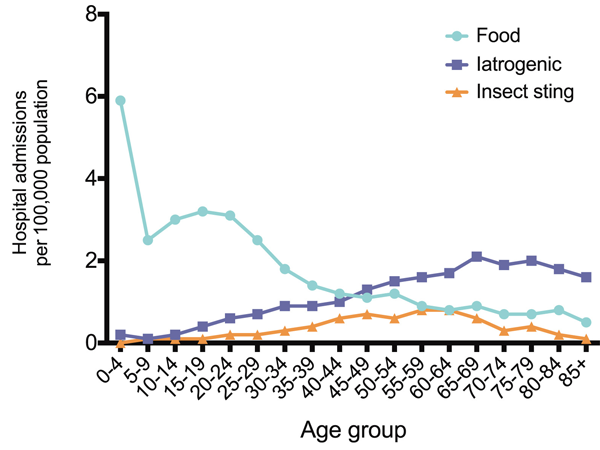
Hospital admissions due to anaphylaxis result from exposure to food such as peanuts, tree nuts and cow’s milk (35%), medication (17%) and venom (6.5%) with the likely culprit varying with the age of the patient.6,7 Approximately one third of anaphylaxis cases do not have a clear trigger and are classified as idiopathic.
Data on deaths from anaphylaxis has a different distribution, with culprits noted to be medication (39%), food (19%) and venom (14%).6,7
A number of factors may account for the disparity between incidence and fatality rates including age, comorbidities and route of exposure. In a review of anaphylaxis related arrests, most of those caused by food occurred within 30 minutes of exposure and almost all by 2-4 hours, compared with 10-15 minutes following insect stings and 5 minutes following intravenous medication.8
Presentation
The past year has seen new guidance on anaphylaxis from the World Allergy Organization,9 updated NICE clinical guidelines10 and a request for consultation on a proposed revision of management by the Resuscitation Council UK.11
The updated World Allergy Organization criteria highlight that the diagnosis of anaphylaxis remains clinical, and that classic skin features may not be present, see table 1.9
While cutaneous features such as urticaria and angioedema are present in 80% of cases, their presence in isolation is insufficient to be considered anaphylaxis.12
Without understating the importance of timely adrenaline administration in the acute management of anaphylaxis, the diagnosis should still be considered in patients who, in retrospect, fulfilled the clinical criteria but recovered without adrenaline.13
Assessment and management
As with any medical emergency, the priority is management based on an ABCDE approach with initial recognition of an unwell patient and an early request for assistance. Where evident and feasible, a trigger should be removed (for example, ceasing intravenous infusion, removing a stinger).
Proposed changes to the Resuscitation Council UK guidelines highlight the importance of patient positioning during anaphylaxis.11 Postural changes have been associated with cardiovascular collapse and fatal outcomes.14,15
Patients should be maintained in a comfortable yet safe position. Hypotensive patients should be placed in a supine position with or without leg elevation. Patients with airway or breathing compromise may prefer to sit up.
The accepted first-line treatment for anaphylaxis is intramuscular adrenaline. While there are no robust trials supporting its use, the physiological effects of adrenaline counter those seen in anaphylaxis.16
A standard dose of 500 micrograms (0.5 ml of 1:1,000 adrenaline) is recommended in adults, whereas dosage varies in children depending on age/weight.11 Doses should be administered at five-minute intervals, along with intravenous fluid boluses to manage third spacing that occurs in anaphylaxis.11
If a patient remains unwell after two intramuscular doses, an adrenaline infusion may be required for what would be considered ‘refractory’ anaphylaxis and expert advice should be sought.11
An important change in recommendations is that antihistamines and corticosteroids no longer feature in the initial management of anaphylaxis. Corticosteroids were thought to prevent biphasic reactions, but there is no good quality evidence to support this practice and harm may be caused by their administration.17
Corticosteroids may be considered in patients in whom an element of asthma exacerbation is considered to be contributing to the severity of the reaction, but should not be used to replace, or in preference to, adrenaline.
Non-sedating antihistamines such as cetirizine may provide symptomatic relief of urticaria and angioedema, and can be considered once the patient is stable.10,11
Investigations and follow-up
Once the acute episode has been managed, efforts should focus on gathering evidence to support or counter the diagnosis of anaphylaxis. Documentation of historical factors such as activities and exposures in the hours leading up to symptom onset will assist with identification of possible triggers as well as cofactors implicated in the episode.
The initial assessment of airway, breathing and circulation should be recorded with specific reference to abnormalities that may allow differentiation of anaphylaxis from more benign conditions such as acute urticaria. Examples of important findings include the presence of stridor, wheeze on auscultation and/or hypotension.
An acutely raised mast cell tryptase supports the diagnosis of anaphylaxis as it suggests mast cell degranulation. Blood mast cell tryptase concentrations peak within 1-2 hours after symptom onset and due to a short half-life, may return to normal within 6-8 hours.18,19
This physiology is reflected in the current NICE guidelines, with recommendation for mast cell tryptase sampling as soon as possible after emergency treatment has started and again within 1-2 hours.10 Although serial sampling improves sensitivity and specificity, it is acknowledged that mast cell tryptase has a poor negative predictive value particularly in the setting of food related anaphylaxis in children. Therefore, a normal mast cell tryptase does not exclude the diagnosis.
NICE guidelines continue to recommend that adults who have received treatment for suspected anaphylaxis should be observed for 6-12 hours after symptom onset whereas children under 16 should be admitted to hospital.10
An extended observation period may be considered for patients who have had delayed adrenaline administration or the initial requirement of more than one dose of adrenaline. The NICE expert panel acknowledged that up to 40% of biphasic reactions occur beyond the recommended observation time frame, but evidence that biphasic reactions are very rarely fatal may have been considered in their consensus opinion.20
Individuals with a past history of anaphylaxis are at an increased risk of another episode, with one study recording 26.5-54% of people experiencing a recurrence over a follow-up period of up to 25 years.21 Thus the observation period should be used to engage in patient education including providing information about the diagnosis and a written action plan.
If a trigger has been identified, the patient should be educated about appropriate avoidance strategies.
The provision of an adrenaline autoinjector should be considered, and where uncertainty about the diagnosis exists, can be provided as an interim measure until an appointment with an appropriate specialist is attended.
An autoinjector allows for prompt administration of adrenaline. This may improve patient outcomes, as evidence suggests community administration of adrenaline is associated with fewer hospitalisations for anaphylaxis.22
Those who have delayed adrenaline administration are at an increased risk of anaphylaxis related death.23,24
There are a number of factors to consider in the decision to prescribe an adrenaline autoinjector such as the ubiquity of, and ability to avoid, the suspected allergen (for example, venom or nuts compared with prescription medication), comorbidities such as asthma and demographic concerns such as distance from emergency care.
Any patient prescribed an adrenaline autoinjector must be educated on how and when to administer it.
Improving outcomes
All patients who experience anaphylaxis should be referred to an age appropriate allergy service. This has been projected to reduce the recurrence rates and mortality associated with food or medication related anaphylaxis compared with standard care, irrespective of whether an adrenaline autoinjector is prescribed as part of the management plan.25
Referral should be made with adequate documentation of the event as the patient may not fully recall every detail. Efforts should be made to forward ambulance assessment and emergency department notes where possible. An allergy specialist may consider further evaluation of possible triggers through skin prick or specific IgE tests that are targeted and based on the clinical history. Such testing is usually deferred for at least four weeks post anaphylaxis to optimise sensitivity.
Although a tailored plan is likely to be provided by an allergy specialist, GPs have an important role in the ongoing management of patients with anaphylaxis. Patients with asthma are likely to benefit from improved asthma control, although the specific role of asthma on severity of anaphylaxis is still debated.26,27 Furthermore, GPs are well placed to ensure appropriate allergen avoidance practices, access to in date adrenaline autoinjectors and demonstrate correct administration technique.
Conclusion
Guidelines continue to highlight the importance of early recognition of anaphylaxis and prompt management following ABCDE alongside adrenaline administration. Notable changes include an awareness of patient positioning during management, and the relegation of antihistamines and steroids to second- or third-line management only. Post event care involves referral to an allergy specialist, provision of an interim action plan and avoidance strategies, and consideration of adrenaline autoinjector prescription.
REFERENCES
1 Resuscitation Council (UK). Emergency treatment of anaphylactic reactions: Guidelines for healthcare providers. Resuscitation Council (UK). London. 2008
2 Panesar SS, Javad S, de Silva D et al. The epidemiology of anaphylaxis in Europe: a systematic review. Allergy 2013;68(11):1353-61
3 Jönsson F, de Chaisemartin L, Granger V et al. An IgG-induced neutrophil activation pathway contributes to human drug-induced anaphylaxis. Sci Transl Med 2019;11(500)
4 McNeil BD, Pundir P, Meeker S et al. Identification of a mast-cell-specific receptor crucial for pseudo-allergic drug reactions. Nature 2015;519(7542):237-41
5 Turner PJ, Campbell DE. Epidemiology of severe anaphylaxis: can we use population-based data to understand anaphylaxis? Curr Opin Allergy Clin Immunol 2016;16(5):441-50
6 Turner PJ, Gowland MH, Sharma V et al. Increase in anaphylaxis-related hospitalizations but no increase in fatalities: an analysis of United Kingdom national anaphylaxis data, 1992-2012. J Allergy Clin Immunol 2015;135(4):956-63.e1
7 Baseggio Conrado A, Ierodiakonou D, Gowland MH et al. Food anaphylaxis in the United Kingdom: analysis of national data, 1998-2018. BMJ 2021;372:n251
8 Pumphrey RS. Lessons for management of anaphylaxis from a study of fatal reactions. Clin Exp Allergy 2000;30(8):1144-50
9 Cardona V, Ansotegui IJ, Ebisawa M et al. World Allergy Organization anaphylaxis guidance 2020. World Allergy Organ J 2020;13(10):100472
10 National Institute for Health and Care Excellence. CG134. Anaphylaxis: assessment and referral after emergency treatment. NICE. London. 2011 Updated 2020 www.nice.og.uk/guidance/cg134
11 Resuscitation Council (UK) draft for consultation. Emergency treatment of anaphylaxis: guidelines for healthcare providers. Resuscitation Council (UK). London. 2020
12 Johnston SL, Unsworth J, Gompels MM. Adrenaline given outside the context of life threatening allergic reactions. BMJ 2003;326(7389):589-90
13 Pouessel G, Antoine M, Lejeune S et al. The time course of anaphylaxis manifestations in children is diverse and unpredictable. Clin Exp Allergy 2020;50(1):117-20
14 Mullins RJ, Wainstein BK, Barnes EH et al. Increases in anaphylaxis fatalities in Australia from 1997 to 2013. Clin Exp Allergy 2016;46(8):1099-1100
15 Pumphrey RS. Fatal posture in anaphylactic shock. J Allergy Clin Immunol 2003;112(2):451-52
16 de Silva D, Singh C, Muraro A et al. Diagnosing, managing and preventing anaphylaxis: systematic review. Allergy 2020:00:1–14 Online ahead of print
17 Campbell DE. Anaphylaxis management: time to re-evaluate the role of corticosteroids. J Allergy Clin Immunol Pract 2019;7(7):2239-40
18 Brown SG, Blackman KE, Heddle RJ. Can serum mast cell tryptase help diagnose anaphylaxis? Emerg Med Australas 2004;16(2):120-24
19 Schwartz LB. Diagnostic value of tryptase in anaphylaxis and mastocytosis. Immunol Allergy Clin North Am 2006;26(3):451-63
20 Pourmand A, Robinson C, Syed W, Mazer-Amirshahi M. Biphasic anaphylaxis: a review of the literature and implications for emergency management. Am J Emerg Med 2018;36(8):1480-85
21 Tejedor Alonso MA, Moro Moro M, Múgica García MV. Epidemiology of anaphylaxis. Clin Exp Allergy 2015;45(6):1027-39
22 Fleming JT, Clark S, Camargo CA Jr, Rudders SA. Early treatment of food-induced anaphylaxis with epinephrine is associated with a lower risk of hospitalization. J Allergy Clin Immunol Pract 2015;3(1):57-62
23 Sampson HA, Mendelson L, Rosen JP. Fatal and near-fatal anaphylactic reactions to food in children and adolescents. N Engl J Med 1992;327(6):380-84
24 Turner PJ, Jerschow E, Umasunthar T et al. Fatal anaphylaxis: mortality rate and risk factors. J Allergy Clin Immunol Pract 2017;5(5):1169-78
25 Armstrong N, Wolff R, van Mastrigt G et al. A systematic review and cost-effectiveness analysis of specialist services and adrenaline auto-injectors in anaphylaxis. Health Technol Assess 2013;17(17):1-117, v-vi
26 Pumphrey R. Anaphylaxis: can we tell who is at risk of a fatal reaction? Curr Opin Allergy Clin Immunol 2004;4(4):285-90
27 Tanno LK, Gonzalez-Estrada A, Olivieri B, Caminati M. Asthma and anaphylaxis. Curr Opin Allergy Clin Immunol 2019;19(5):447-55
ARTICLE IN PDF
 Download this article in PDF format