SEARCH

McGuinness J, Serpell M. Holistic approach needed to tackle chronic primary pain. Practitioner. February 2021;265(1845):23-25
Holistic approach needed to tackle chronic primary pain
21 Feb 2021
AUTHORS
Dr James McGuinness MBChB MRCP FRCA, ST5 Anaesthetics and Pain Medicine, Department of Anaesthesia, University Hospital Hairmyres, Glasgow, UK
Dr Mick Serpell MBChB FCPodS ECFMG FRCA FFPMRCA, Consultant in Anaesthesia and Pain Medicine for Greater Glasgow & Clyde NHS, and Senior Lecturer in Anaesthesia and Pain Medicine, University of Glasgow, Glasgow, UK
Competing interests
Dr James McGuinness has no competing interests. Dr Mick Serpell is an examiner for the FFPMRCA for the Royal College of Anaesthetists. He has received honoraria from Astellas, Grünenthal, NAPP and Pfizer for speaking at meetings. His institution has received research support in the past five years from Health Technology Assessment (HTA) and Chief Scientist Office (CSO) sponsored studies and commercial sponsored studies (Pfizer, Grünenthal, Lateral Pharma Pty Ltd)
Article
The International Association for the Study of Pain has developed a new classification system for chronic pain. A fundamental distinction is made between chronic primary pain and chronic secondary pain. Chronic primary pain is defined as pain in one or more anatomical regions that persists for longer than three months, is associated with disability or emotional distress, not better accounted for by another diagnosis of chronic pain. Chronic primary pain is subdivided into five categories: chronic widespread pain (e.g. fibromyalgia); complex regional pain syndromes; chronic primary headache (e.g. chronic migraine) or orofacial pain; chronic primary visceral pain (e.g. irritable bowel syndrome); and chronic primary musculoskeletal pain (e.g. chronic primary low back pain). Chronic secondary pain is pain secondary to an underlying disease. Patients may be labelled as having chronic primary pain while ongoing assessment is being carried out. They may ultimately be classified as having a chronic secondary pain syndrome. Assessment of chronic pain should include a comprehensive pain history, medical history and examination to identify any potential underlying cause or possible red flags.
It is important to ask about effects on lifestyle and day to day activities, including work and sleep disturbance; physical and emotional wellbeing;social interactions and relationships. The presence of disability and emotional distress in the context of negative history, examination and investigations allows the diagnosis of chronic primary pain to be made.
Chronic pain is a leading source of suffering and disability.1 It is defined as pain that lasts longer than three months and has been estimated to affect between one third and one half of the UK population.2
New diagnostic classification
In May 2019, the World Health Organization (WHO) adopted the International Classification of Diseases 11th Revision (ICD-11). ICD-11 is the first version of the coding manual to include a classification system for chronic pain.3
Prior to this, the lack of appropriate diagnostic codes rendered accurate epidemiological investigation of chronic pain difficult, potentially impeding health policy decisions such as financing access to multimodal pain management. ICD-11 was developed by a working group from the International Association for the Study of Pain (IASP) and is based on current scientific evidence and the biopsychosocial model.4
Chronic primary pain represents chronic pain as a disease in itself.5
It is defined as pain in one or more anatomical regions that persists for longer than three months and is associated with disability or emotional distress not better accounted for by another diagnosis of chronic pain.6
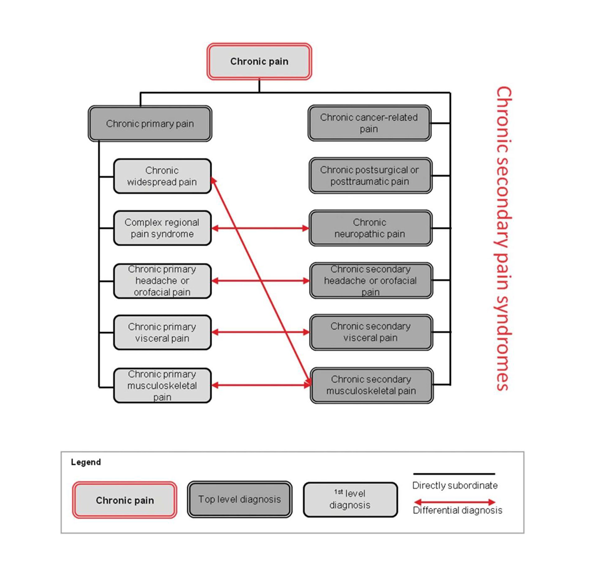
The IASP recommended that the diagnostic entities are subdivided into five groups (see figure 1):
• Chronic widespread pain
(e.g. fibromyalgia)
• Complex regional pain syndrome
• Chronic primary headache
(e.g. chronic migraine) or orofacial pain
• Chronic primary visceral pain
(e.g. irritable bowel)
• Chronic primary musculoskeletal pain (e.g. chronic primary low back pain).4
Another six subgroups of pain were also identified and can be characterised as secondary to an underlying disease.4
It is hoped that the development of a more robust coding system will lead to greater recognition of chronic pain as a public health problem, and ultimately improve access to adequate pain treatment for patients worldwide.
Assessment
The assessment of chronic primary pain, and pain in general, involves a comprehensive biopsychosocial approach.
Chronic primary pain is a diagnosis that requires thorough medical assessment before being confidently made. Patients may be labelled as having chronic primary pain while ongoing assessment is being carried out. They may ultimately be classified as having a chronic secondary pain syndrome as illustrated in figure 1. It is possible for a secondary chronic pain to coexist with a primary chronic pain. For example, a patient may be under investigation for fibromyalgia because their proven osteoarthritis or rheumatoid arthritis does not fully explain their widespread pain. This allows coding for, and thus recording of, the workload created by pain patients in primary care, and epidemiological data to be gathered which will inform future service provision.
Individual assessment
Central to the assessment of a patient presenting with chronic pain should be an attempt to get to know the patient as an individual. Active participation and shared decision making fosters a collaborative relationship which can be vital in managing what is ultimately a chronic condition.
A comprehensive pain and medical history should always be obtained to elucidate any potential underlying cause or possible red flags that may be present. The combination of suggestive history and normal or negative examination points towards a diagnosis of chronic primary pain.
To fulfil the second half of the definition, assessment must take into consideration any disability or emotional distress. It is important to ask the patient how the pain affects their life, and how their life may affect the pain. This may include their lifestyle and day to day activities, including work and sleep disturbance.
Attention should also be paid to both physical and emotional wellbeing, social interactions and relationships. Identifying any disability and emotional distress in the context of negative history, examination and investigation allows the diagnosis of chronic primary pain to be made. Investigations are guided by the individual presentation, and appropriateness deemed by the assessing clinician.
It is important to get an idea of not only the patient’s understanding (and acceptance) of their condition, but also that of their family, carers and significant others. It is important to discuss their ideas concerning what causes the pain, what might happen in the future and outcomes of any treatment in terms of pain control and quality of life. This will often lead to the healthcare professional acknowledging the fact that pain may not improve, despite best medical care.
Ultimately a care plan should be developed where the possible benefits, risks and uncertainties of all management options are discussed. It is especially important to be sensitive when communicating normal or negative test results in order to avoid invalidating the patient’s experience of pain.
Most importantly, the patient should be ready to engage actively in supported self-management.
Management
NICE draft guidance on chronic pain, published in 2020, has made several recommendations for the management of chronic primary pain.7 NICE suggests using these recommendations alongside their existing guidelines for headache, low back pain and irritable bowel.8,9,10
The draft NICE guidance has resulted in much discussion within the pain community.11,12 The Faculty of Pain Medicine has raised concerns surrounding the confusing terminology in the document and the possible overemphasis of evidence for acupuncture in the management of chronic primary pain. The confusion surrounding terminology relates to the failure to distinguish clearly between chronic pain and chronic primary pain. Even the title of the draft guidance references chronic pain as the subject, while the majority of the document relates to the management of chronic primary pain.11
Crucially, it does not include the flowchart (see figure 1) which more clearly illustrates that chronic primary pain can be used as part of a differential diagnosis while ongoing assessment is being carried out. It is imperative that all patients with chronic primary pain are thoroughly assessed to avoid the risk of misdiagnosis.
Giving patients a final diagnosis of chronic primary pain, without adequate investigation, could result in the mismanagement of specific pain syndromes. This diagnostic term is new and so is not included in the established pain research literature. Consequently, much of the treatment evidence base is excluded with the conclusion that few treatments for this condition are useful. This risks the blanket withdrawal of effective treatments, which are already established.
In terms of non-pharmacological interventions, the principal recommendation is to encourage patients to exercise either in the form of a supervised group programme or by carrying on with their usual exercise.
There is evidence that exercise both reduces pain and improves quality of life.13 Most of this evidence is derived from studies involving fibromyalgia and chronic neck pain and is consistent with the European League Against Rheumatism recommendations for the management of fibromyalgia.14
Other draft recommendations
include consideration of psychological interventions such as cognitive behaviour therapy (CBT) or acceptance and commitment therapy (ACT).
ACT has been found to improve quality of life and sleep, and reduce pain and psychological distress.15 Evidence for CBT pertains to improvement in quality of life only, but there is not enough evidence to support a preference for either CBT or ACT.7
Acupuncture delivered in a community setting has also been proposed. Acupuncture has been found to reduce pain and improve quality of life in the short term (3 months) when compared with usual care or sham intervention.16
Non-pharmacological measures which NICE could not find evidence to recommend include, transcutaneous electrical nerve stimulation (TENS) or inferential therapy, ultrasound, biofeedback or manual therapy.
NICE has made research recommendations for mindfulness and psychotherapy where there appears to be a signal of benefit, but a substantial enough evidence base has yet to be established.
Pharmacological options also have very limited recommendations in the draft NICE guidance. It specifies that
off-label prescribing of antidepressants should be considered; specifically, either duloxetine, fluoxetine, paroxetine, citalopram, sertraline or amitriptyline. Evidence indicates that they can lead to improvements in quality of life, pain and psychological distress when compared with placebo.7
The draft NICE guidance recommends avoiding opioids, benzodiazepines, NSAIDs, gabapentinoids (unless in a clinical trial or for complex regional pain syndrome), local anaesthetics by any route, corticosteroids, paracetamol, ketamine and antipsychotics.
The recommendation regarding gabapentinoids, specifically pregabalin, contradicts that of the SIGN guideline on chronic plain (SIGN 136) where pregabalin is specifically recommended in the treatment of fibromyalgia.17 SIGN 136 supports the assertion in the draft NICE guidance for the use of antidepressants in chronic primary pain in the form of fibromyalgia.
The draft guidance also recommends that if a patient with chronic primary pain is already prescribed any of the above listed medications, the risks of continuing should be discussed. If the shared decision is to stop the medication, withdrawal effects must be considered especially with opioids, antidepressants, benzodiazepines and gabapentinoids.
Referral
Referral to the pain management service should be considered when pain or function have not improved following appropriate primary care management, there is significant distress and where specialist assessment may be useful.17
It has been reported that longer delays between specialist referral and specialist consultation result in poorer health and pain management. This deterioration starts as early as five weeks from referral and there is consensus that a delay of longer than six months is clinically unacceptable.18 Depending on local arrangements, it may be that this is the only way of accessing specialist pain psychology for the provision of ACT or CBT.
Conclusion
It is hoped that the implementation of the new classification system will allow pain to be recognised as a centrally important condition in primary care and allow for the capacity to measure incidence, prevalence and impact of pain locally, nationally and internationally.
It should provide the opportunity to match evidenced based treatment to chronic pain subtypes.
At the time of writing the NICE guideline remains in draft form, and the recommendations have not been finalised for adoption in day to day practice. While some of the preliminary recommendations are controversial it is hoped that the final published guideline will provide GPs with support to emphasise the limited effectiveness of medication in chronic primary pain, and the importance of self-management.
REFERENCES
1 Goldberg DS, McGee SJ. Pain as a global public health priority. BMC Public Health 2011;11(1):770
2 Fayaz A, Croft P, Langford RM et al. Prevalence of chronic pain in the UK: a systematic review and meta-analysis of population studies. BMJ Open 2016;6(6):e010364
3 World Health Organization. International Classification of Diseases 11th Revision. 2019 https://icd.who.int/browse11/l-m/en [Last accessed 11 Jan 2021]
4 Treede R, Rief W, Barke A et al. Chronic pain as a symptom or a disease: the IASP Classification of Chronic Pain for the International Classification of Diseases (ICD-11). Pain 2019;160(1):19-27
5 Raffaeli W, Arnaudo E. Pain as a disease: an overview. J Pain Res 2017;10:2003-08
6 Nicholas M, Vlaeyen JWS, Rief W et al. The IASP classification of chronic pain for ICD-11: chronic primary pain. Pain 2019;160(1):28-37
7 National Institute for Health and Care Excellence. Draft for consultation. Chronic pain in over 16s: assessment and management. 2020. www.nice.org.uk/guidance/gid-ng10069/documents/draft-guideline [Last accessed 12 Jan 2021]
8 National Institute for Health and Care Excellence. CG61. Irritable bowel syndrome in adults: diagnosis and management. NICE. London. 2017 www.nice.org.uk/guidance/cg61 [Last accessed 12 Jan 2021]
9 National Institute for Health and Care Excellence. CG150. Headaches in over 12s: diagnosis and management. NICE. London. 2012 www.nice.org.uk/guidance/cg150/ [Last accessed 12 Jan 2021]
10 National Institute for Health and Care Excellence. NG59. Low back pain and sciatica in over 16s: assessment and management. NICE. London. 2020 www.nice.org.uk/ guidance/ng59 [Last accessed 12 Jan 2021]
11 Faculty of Pain Medicine. Response to draft NICE guidelines on chronic pain: assessment and management. 2020 https://fpm.ac.uk/sites/fpm/files/documents/2020-09/NICE-chronic-pain-comments-FPM-FINAL-website.pdf [Last accessed 11 Jan 2021]
12 Cochrane Pain, Palliative & Supportive Care. PaPas Response to NICE draft guidance on chronic pain: assessement and management. 2020; https://papas.cochrane.org/news/papas-response-nice-draft-guidance-chronic-pain-assessment-and-management. [Last accessed 11 Jan 2021]
13 Sosa-Reina M, Nunez-Nagy S, Gallego-Izquierdo T. Effectiveness of therapeutic exercise in fibromyalgia syndrome: a systematic review and meta-analysis of randomized clinical trials. Biomed Res Int 2017;2017:2356346
14 Macfarlane GJ, Kronisch C, Atzeni F et al. EULAR recommendations for management of fibromyalgia. Ann Rheum Dis 2017;76(12):e5
15 Hughes LS, Clark J, Colclough JA et al. Acceptance and commitment therapy (ACT) for chronic pain: a systematic review and meta-analyses. Clin J Pain 2017;33(6):552-68
16 Vickers AJ, Linde K. Acupuncture for chronic pain. JAMA 2014;311(9):955-56
17 Scottish Intercollegiate Guidelines Network. SIGN 136. Management of chronic pain. SIGN. Edinburgh. 2013 Revised 2019 www.sign.ac.uk/our-guidelines/ management-of-chronic-pain [Last accessed 12 Jan 2021]
18 Lynch ME, Campbell F, Clark AJ et al. A systematic review of the effect of waiting for treatment for chronic pain. Pain 2008;136(1):97-116
 Download this article in PDF format