SEARCH

Samad S, Cockerill R. Improving outcomes in obese pregnant women. Practitioner April 2019;263(1825):21-24
Improving outcomes in obese pregnant women
24 Apr 2019
AUTHORS
Dr Sabnam Samad MB BChir MA FRCP (UK), Consultant Physician, Diabetes and Endocrinology, Aintree University Hospital, Liverpool, UK
Dr Ruth Cockerill MB BCh, Consultant in Obstetrics and Gynaecology, Liverpool Women’s Hospital, Liverpool, UK
Competing interests: None
Article
For obese women the risks of adverse outcomes during pregnancy, for both the mother and her child, are significantly higher than for the general population. In 2016, 21% of all women attending antenatal services in the UK were reported to have a BMI ≥ 30 kg/m2. In 2003-2005, 27% of all maternal deaths occurred in women with a BMI ≥ 30 kg/m2. Obesity increases the risk of venous thromboembolism, gestational diabetes, pre-eclampsia and hypertension. There is an increased likelihood of induction of labour, instrumental delivery and postpartum haemorrhage. The greatest effect on risk reduction is weight loss prior to conception. It is worthwhile finding out what weight management services are available locally and also how your local obstetric service manages obese patients. Some women may benefit from being signposted to online NHS resources. Referral to a specialist weight management service for women with a high BMI may be of great benefit. Many obstetric services offer pre-pregnancy counseling for high-risk women. Around 20% of women with a BMI ≥ 35 kg/m2 have macrosomic babies, double the rate of women with a lower BMI. The stillbirth rate increases with BMI. All women with a BMI ≥ 30 kg/m2 should be screened for gestational diabetes. In addition, given the much higher risks of congenital abnormality in type 2 diabetes, it may be prudent to test HbA1c at booking.
In 2016, 21% of all women attending antenatal clinics in the UK were reported to have a BMI ≥ 30 kg/m2.1
In obese women the risks of adverse outcomes during pregnancy, for both mother and child, are significantly higher than for the general population.
There is also accumulating evidence that the babies born to obese women have considerable lifelong risks to their health related to their mother’s weight during gestation, in particular excess cardiovascular risk.
In this article, we will detail some of these risks but also summarise how the RCOG Green-top guideline, published in November 2018, aims to help healthcare professionals manage these patients.2
Weight loss prior to conception
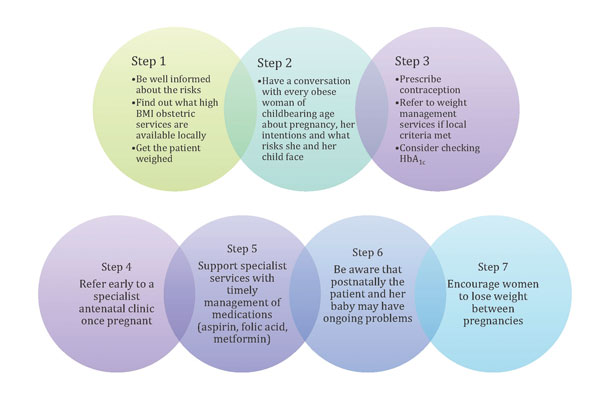
The greatest effect on risk reduction is weight loss prior to conception, hence putting primary care in a key position to help these women early on, see figure 1, and box 1.
It is worthwhile finding out what weight management services are available locally and also how your local obstetric service manages these patients, so you are prepared to give the patient well informed answers when discussing these issues with her.
The provision of weight management services varies across the country.
It would be advisable to recommend a service with in-built support that women can continue to use during their pregnancy. Some women may benefit from being signposted to online NHS resources.3 Further details can be found in the NICE guideline on the management of obesity.4 Referral to a specialist weight management service for women with a high BMI may be of great benefit.
Although bariatric surgery can reduce some of the risks prior to conception, as it should lead to weight loss, referral will be complicated by the fact that most tier 3 services will only refer for surgery after 6-18 months of patient engagement in a specialist weight management service. Furthermore, pregnancy is not advised until 12-18 months post surgery as there is an increased risk of low weight for gestational age babies, odds ratio (OR) 2.16, preterm delivery and admission to neonatal intensive care.
All pregnant women with any history of bariatric surgery should be referred early in their pregnancy to a consultant led obstetric service.
Obese women requiring IVF
Many women requiring IVF find the weight loss targets challenging, however IVF medication and techniques mean higher BMI makes this process significantly less successful. Although fertility teams will investigate the patient, they may only offer her treatment when her BMI is < 30 kg/m2.5 It is worth mentioning this to the patient as you make your referral to fertility services and consider simultaneously referring her to local weight loss services as well as giving her a target weight.
Increased obstetric risks
The increased risks due to obesity for the mother and her child are listed in table 1, left. Nearly every risk associated with pregnancy is increased in obese women. In 2010, the Centre for Maternal and Child Enquiries (CMACE)6 published a detailed document following a three-year study where they examined 1,103 deliveries to try to quantify the effect of obesity on pregnancy. This study was commissioned following the Confidential Enquiry into Maternal and Child Health (CEMACH ) report for 2003-2005, Saving Mothers’ Lives,7 which found that 27% of all maternal deaths were in women with a BMI ≥ 30 kg/m2.
The 2010 CMACE report calculated that 4.9% of pregnant women would have a BMI ≥ 35 kg/m2 and that 21.8% of this group would have a preexisting comorbid condition prior to pregnancy with a further 23.3% being diagnosed with one during pregnancy.
As well as having comorbidity, this group also had higher risks of pregnancy related problems such as gestational diabetes, pre-eclampsia, hypertension and venous thromboembolism, see box 2.
There was also a higher risk of problems during delivery such as the need for induction or instrumental delivery, postpartum haemorrhage (PPH) and increased use of general anaesthetic. The incidence of PPH in the higher BMI range was four times the rate of women with BMI < 35 kg/m2.
Risks for the babies of obese mothers were also shown to be higher than for babies of mothers with a lower BMI, with higher rates of macrosomia, stillbirth, intrapartum loss and increased length of stay in hospital. Around 20% of the women with a BMI ≥ 35 kg/m2 had macrosomic babies, double the rate of women with a lower BMI.
Compared with women with a BMI < 35 kg/m2, the odds ratio to require induction is OR 1.7; for emergency caesarean section OR 1.5; and shoulder dystocia OR 2.9.
The stillbirth rate increases with BMI. For women with a BMI 35-39.9 kg/m2 the stillbirth rate is 7.9 per 1,000 deliveries this figure rises to 15.8 per 1,000 for those with a BMI ≥ 50 kg/m2. These respective rates are double and quadruple the rate for the general population.
It is perhaps not surprising that these women and their children have a lower discharge rate at 24 hours than the general population, see table 3.
There is also increasing evidence of long-term effects for the resultant offspring. A large Scottish study,8 following up the offspring of obese mothers found that as adults they had an increased risk of hospitalisation for a cardiovascular event and an increased risk of premature death. However, there were many confounding factors in this study, and research is ongoing into whether this risk in the offspring can be reduced by a reduction in maternal obesity.
Causes of excess risk
The increased risk is multifactorial; combining increased maternal medical morbidity, poor maternal health (especially nutritional status), reduced ability to monitor mother and child due to high BMI and maternal habitus directly affecting the use of delivery interventions such as epidurals and general anaesthetic.
An obese expectant mother is more likely to start pregnancy with a comorbidity that will adversely effect pregnancy and more likely to develop further problems during the pregnancy. These problems will be harder to monitor in the woman and her baby and more difficult to treat.
The RCOG guidance discusses these problems in detail and also suggests strategies to mitigate them.
Managing risk
Practical problems such as difficulty finding appropriately sized blood pressure cuffs mean that pre-eclampsia may not be effectively diagnosed.
The RCOG guideline details managing equipment for these patients, manual handling and making sure the midwifery and medical teams have appropriate knowledge.
If the patient is low risk and has a BMI 30-34.9 kg/m2, she can be managed in a midwife led service, but patients with higher BMI or additional risks will be managed by a consultant led service, see box 3, and hence these women will have limited options for their birth plans.
These problems will be screened for in the initial booking visit in the antenatal clinic, where the midwives will arrange screening for gestational diabetes, referral to a dietitian, additional support for breastfeeding and mental health as well as initiating risk assessments.
Monitoring
Obesity poses a significant challenge to ultrasound scanning, as the increased adiposity makes scanning signals weaker and more difficult to interpret. This leads to problems with chromosomal risk scoring for the baby, anomaly scanning for congenital abnormalities and in the last trimester, difficulties in viewing the baby’s positioning for delivery. This is further compounded by the fact that palpation and measuring fundal height of the gravid uterus are still a very accurate way to assess the positioning and growth of the baby. This is technically much more difficult in obese women, hence these patients will have more third trimester ultrasound scans.
In addition, the babies of obese mothers are at higher risk of most congenital abnormalities with the risk of spina bifida 2.24 and neural tube defects 1.8 times that of women with normal range BMI.
Diet and weight loss
As mentioned previously, all of these risks can be reduced with weight loss, enabling the patient to have a less medicalised pregnancy. Weight loss in pregnancy is a controversial issue, historically linked to small for dates babies and a poor obstetric outcome. While there is emerging evidence that it is not dangerous for obese women, weight loss targets have not been advised in this group of patients. What is advised is a healthy balanced diet, this inevitably causes weight loss in patients with an excessive intake.
Obese women have been shown frequently to have poor nutrient uptake in their diet. Their below average folic acid intake may impact on the spinal development of their child. The RCOG therefore advises 5 mg folic acid use for all women with a BMI ≥ 30 kg/m2, ideally from one month prior to conception or from when the pregnancy is confirmed and continuing throughout the first trimester. There is also thought to be a vitamin D deficiency in this group, however replacement depends on how large the deficit is. The obstetric team will also refer all these women to a dietitian in the first trimester.
Diabetes
Given the much higher risks of congenital abnormality in type 2 diabetes, it may be prudent to test HbA1c at booking of obese women, as they may have preexisting type 2 diabetes that they are unaware of. Some services already do this. The risk of gestational diabetes in obese women is increased three fold. All obese women should be screened for gestational diabetes between 24 and 30 weeks, when this condition usually arises, see box 2.
Anaesthesia and analgesia
As well as managing anaesthesia for caesarean section, the anaesthetists also manage epidurals and much of the pain relief in delivery. Around 25% of maternal arrests are due to anaesthesia, and 75% of these events are in the obese population. Factors such as difficulty in manually ventilating patients, intubation, intravenous access and siting epidurals all contribute to this. The need to re-site epidurals in this group is 17% versus 3% in the non-obese population.
The guidelines recommend early consultant anaesthetist review for obese women in the first trimester, delivery in doctor led units, anaesthetists above ST6 level only to attend these patients, and siting two cannulae prophylactically at the beginning of labour among other specific recommendations.
Pre-eclampsia
Women with a BMI 30-35 kg/m2 are at 1.7 times greater risk of pre-eclampsia than those with a lower BMI. This risk rises to a 5.5-fold increased risk for women with a BMI ≥ 40 kg/m2. This risk is lowered by the use of 150 mg aspirin from week 12 to delivery.
GP support
The primary care team are ideally placed to make a huge positive effect on reducing risks in pregnancy in the obese population, see figure 1.
Many obstetric services offer pre-pregnancy counseling for high-risk women, so it is worth finding out if this is available for your patient if you feel she needs more detailed explanations and assessments. The RCOG also has a very good patient advice leaflet about BMI and pregnancy, see Useful information box.
REFERENCES
1 NHS Digital (HSCIC). Maternity services monthly statistics, England: November 2016. https://digital.nhs.uk/data-and-information/publications/ statistical/maternity-services-monthly-statistics/june-2016
2 Royal College of Obstetricians and Gynaecologists. Care of women with obesity in pregnancy (Green-top guideline No. 72). RCOG. London. 2018 www.rcog.org.uk/en/guidelines-research-services/guidelines/gtg72/
3 NHS. Healthy weight. www.nhs.uk/live-well/healthy-weight/start-the-nhs-weight-loss-plan/
4 National Institute for Health and Care Excellence. CG189. Obesity: identification, assessment and management. NICE. London. 2014 https://www.nice.org.uk/guidance/cg189
5 National Institute for Health and Care Excellence. CG156. Fertility problems and treatment. NICE. London. 2017 https://www.nice.org.uk/guidance/cg156
6 Centre for Maternal and Child Enquiries (CMACE). Maternal obesity in the UK: Findings from a national project. CMACE. London. 2010
7 Lewis G (ed). The confidential enquiry into maternal and child health (CEMACH). Saving mothers’ lives: reviewing maternal deaths to make motherhood safer 2003-2005. The seventh report on confidential enquiries into maternal deaths in the United Kingdom. CEMACH. London. 2007
8 Reynolds RM, Allan KM, Raja EA et al. Maternal obesity during pregnancy and premature mortality from cardiovascular event in adult offspring: follow-up of 1 323 275 person years. BMJ 2013;347:f4539
9 National Institute for Health and Care Excellence. NG3. Diabetes in pregnancy. Management from preconception to the postnatal period. NICE. London. 2015 www.nice.org.uk/guidance/ng3
10 Scottish Intercollegiate Guidelines Network. SIGN116. Management of diabetes. SIGN. Edinburgh. 2017 https://www.sign.ac.uk/assets/sign116.pdf
ARTICLE IN PDF
 Download this article in PDF format
EXTERNAL WEBLINKS
RCOG information leaflet for patients