SEARCH

Salmon N, Kearns C, Mowbray M, Tidman MJ. Recognising the pattern of hair loss key to managing alopecia. Practitioner Nov 2017;261(1809):25-29
Recognising the pattern of hair loss key to managing alopecia
23 Nov 2017
AUTHORS
Dr Nicola Salmon MBChB MRCP Dermatology LAT, Department of Dermatology, Royal Infirmary of Edinburgh, Edinburgh, UK
Dr Ciléin Kearns MBChB MSc MA MMAA MIMI, Academic Foundation Doctor, Honorary Clinical Fellow, NHS Lothian, University of Edinburgh, Edinburgh, UK
Dr Megan Mowbray MD FRCP, Consultant Dermatologist, Department of Dermatology, Victoria Hospital Kirkcaldy, Fife, UK
Dr Michael J Tidman MD FRCP(Edin) FRCP(Lond), Consultant Dermatologist, Department of Dermatology, Royal Infirmary of Edinburgh, Edinburgh, UK
Competing interests: None
Article
Abstract
Alopecia affects up to 50% of men and women at some time in their lives. In primary care the first step is to establish whether hair loss is focal or diffuse and if focal whether it is scarring or non scarring. It is usually possible to establish the pattern of hair loss from a combination of the history and clinical examination. Dermatoscopic examination and pull testing can be useful in confirming the diagnosis. If hair loss is accompanied by scaling or significant inflammation it is important to exclude infective causes. Androgenetic alopecia is the most common form of alopecia and has a typical male and female pattern. Women present with hair thinning over the central area of the scalp and widening of the midline parting but with preservation of the frontal hairline. Alopecia areata is a chronic inflammatory non-scarring condition that leads to hair loss ranging from small, well defined patches to complete loss of scalp hair (alopecia totalis). Total loss of all hair (alopecia universalis) can also occur. Men and women are equally affected and, although it can occur at any age, the most common presentation is in children and young adults.There are numerous types of scarring (cicatricial) alopecia including central centrifugal cicatricial alopecia, folliculitis decalvans, dissecting cellulitis and acne keloidalis nuchae. However, the two most commonly identified patterns among Caucasians are frontal fibrosing alopecia, a form of follicular lichen planus, and cutaneous lupus erythematosus. GPs should refer patients in the following circumstances: extensive alopecia; scarring alopecia; diagnostic uncertainty; the patient would like to consider a hair piece or wig; significant associated psychological distress.
Alopecia affects up to 50% of men and women at some time in their lives.1 Hair loss can affect any hair-bearing part of the body, but is most troublesome when the scalp is involved.
The different forms of alopecia can be broadly categorised into focal or diffuse hair loss. Focal hair loss can be further divided into scarring (where the hair follicles have been replaced by scar tissue, preventing regrowth) and
non-scarring alopecia, see table 1. While it may not be detrimental to physical health, the psychological burden of alopecia should not be underestimated.
Non-scarring Focal alopecia
Alopecia areata
Alopecia areata is a chronic inflammatory non-scarring condition that leads to hair loss ranging from small, well defined patches to complete loss of scalp hair (alopecia totalis).
Total loss of all hair (alopecia universalis) can also occur.
Men and women are equally affected and, although it can occur at any age, the most common presentation is in children and young adults: 60% of patients experience their first episode of hair loss before 20 years of age.2 There is a family history of the condition in 20% of cases indicating a genetic basis.3 It is more common in those with Down’s syndrome and there is an association with other autoimmune diseases.
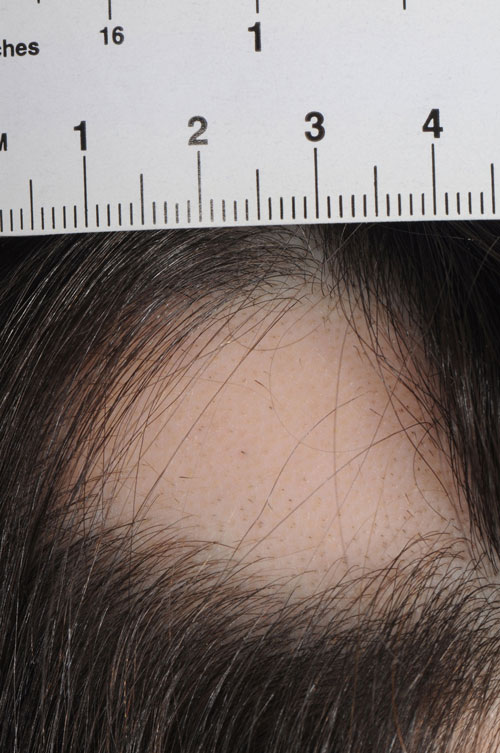
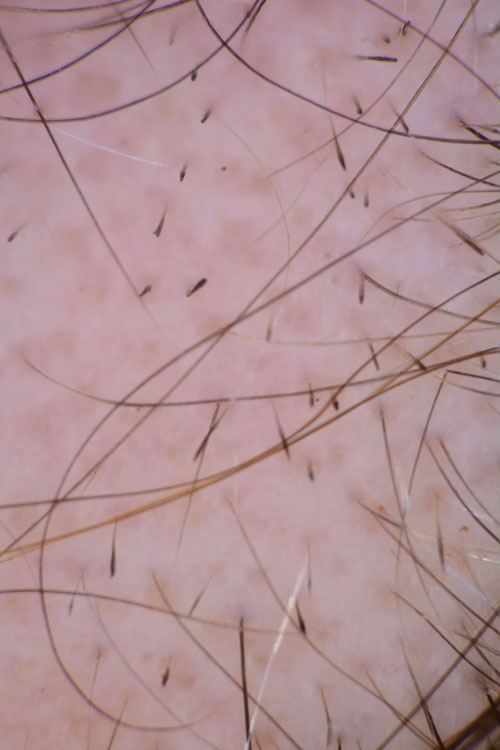
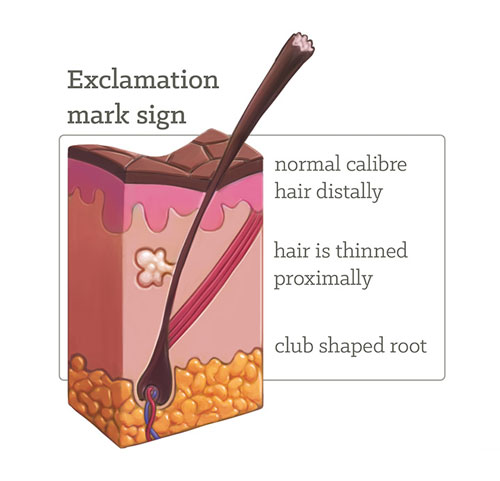
It is characterised by silky smooth patches of hairless skin, see figure 1, and the presence of peripheral exclamation mark hairs is pathognomonic, see figures 2 and 3. These are broken hairs, a few millimetres in length, that are thinner at the base than the tip. Involvement of the eyebrows and eyelashes together with pitting and longitudinal ridging of the nails are additional helpful diagnostic clues.
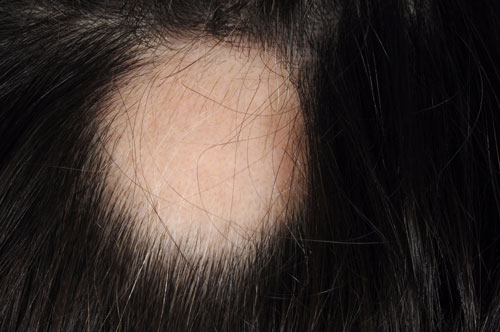
In 80% of affected individuals there is spontaneous regrowth within a year,4 but further episodes of hair loss are common. Initially when hairs regrow they are fine and non-pigmented, see figure 4, but gradually they acquire their normal calibre and colour, although they may remain permanently depigmented.
For mild to moderate alopecia areata that is not adversely affecting quality of life, no treatment may be the best option. Very potent topical steroids, such as 0.05% clobetasol propionate foam, shampoo or scalp application twice daily for 12 weeks may be considered, and for small areas of scalp or eyebrow hair loss intralesional corticosteroid injections with triamcinolone acetonide are often effective. The main limitation is patient discomfort. There is little evidence to support the use of topical minoxidil, but a trial is a reasonable and safe option. Treatments that may be tried in secondary care include PUVA, topical immunotherapy (diphencyprone) and topical dithranol.5
Tinea capitis
Children are most likely to be affected by tinea capitis. It typically presents with a round patch of hair loss associated with scaly erythema of the scalp that may fluoresce under Wood’s light depending on the fungal species. Accompanying lymphadenopathy is often present. Skin scrapings taken from the active border of the inflamed patch and a pulled hair sample sent for microscopy and fungal culture will confirm the diagnosis.
In its most severe form, tinea capitis causes a boggy inflammatory mass called a kerion, which may heal with scarring and subsequent permanent localised alopecia.
It should be treated with a four-week course of oral terbinafine for Trichophyton species and an eight-week course of griseofulvin for Microsporum species. Oral itraconazole for four weeks is second-line therapy. Treatment should be accompanied by ketoconazole shampoo twice weekly and a topical antiseptic preparation (benzalkonium chloride).
Traction alopecia
Traction alopecia is a form of unintentional hair loss associated with specific social, cultural and cosmetic hair practices. Individuals, mainly women, who wear wigs, tight braids and use curlers are at risk. Eliminating the source of traction on the hair often cures the problem and hair growth returns to normal. Rarely, chronic traction can lead to folliculitis and subsequent scarring that can result in permanent hair loss in the affected area.
Trichotillomania
Trichotillomania is a compulsive disorder that involves repeated hair plucking, resulting in broken-off hairs that feel prickly when an examining finger is passed over them. It is most commonly seen in children, where it tends to have a self-limiting course. When it persists into adulthood it may become intractable and a scarring alopecia may result. Referral to psychiatry or clinical psychology services may help.
Scarring focal alopecia
There are numerous types of scarring (cicatricial) alopecia including central centrifugal cicatricial alopecia, folliculitis decalvans, dissecting cellulitis and acne keloidalis nuchae. However, the two most commonly identified patterns among Caucasians are frontal fibrosing alopecia, a form of follicular lichen planus, and chronic cutaneous lupus erythematosus.
Frontal fibrosing alopecia
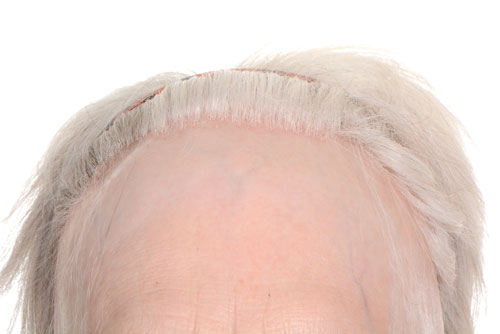
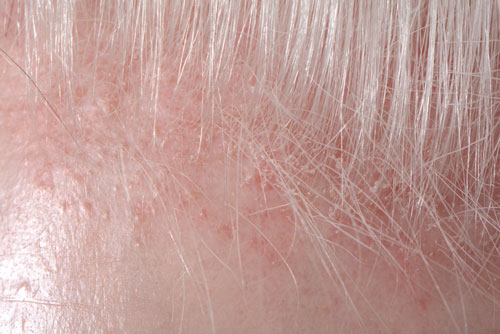
Frontal fibrosing alopecia typically occurs in postmenopausal women. It was once considered rare, but in the past 20 years has been increasingly recognised. Recession of the frontal hairline is the cardinal feature leaving smooth scarred skin, see figure 5, and on close inspection there is loss of the follicular orifices, perifollicular erythema and hyperkeratosis at the marginal hairline, see figure 6.
A variety of treatments have been advocated including topical and intralesional corticosteroids, hydroxychloroquine, tetracyclines and finasteride, but there is no convincing evidence that any of them are entirely effective.6
Chronic cutaneous (discoid) lupus erythematosus
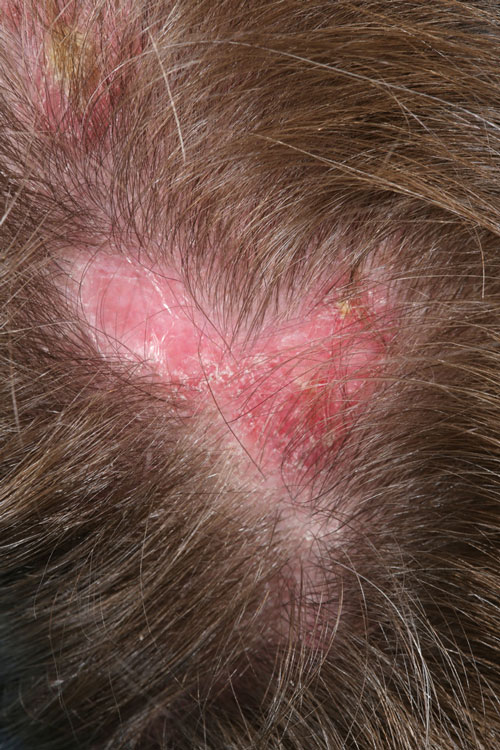
This form of lupus erythematosus results in a scarring alopecia, and usually presents with itchy patches of hair loss on the scalp and face, associated with erythema, scaling and follicular plugging as the primary features. Inflammatory activity is most pronounced in the centre of the area of alopecia, see figure 7. Ultimately, large areas of hair loss may develop. There is a small long-term risk of squamous cell carcinoma arising in lesions of chronic cutaneous lupus erythematosus. The incidence is estimated to range from 2.3% to 3.3%.7 Some cases burn out after one to two years, but others continue to progress for many years.
Cutaneous lupus is worsened by exposure to ultraviolet radiation, and so photoprotection with a hat or high SPF sunscreen is important.
Potent topical corticosteroids, intralesional triamcinolone and systemic prednisolone may halt disease progression. Hydroxychloroquine 200-400 mg/day is frequently effective, producing remission within three months in the majority of cases. Oral retinoids such as acitretin are as effective as antimalarial treatment in randomised controlled trials.7
Diffuse alopecia
Telogen effluvium
In telogen effluvium an increased number of hairs enter the telogen (resting) phase of the hair cycle from the anagen (growing) phase and are subsequently shed three months later. It is normal to shed around 100 hairs every day, but in telogen effluvium this rate significantly increases and 30-50% of scalp and body hair can be lost.8
It may be precipitated by severe illness, injury, surgery, psychological stress, extreme dieting, childbirth and drugs. Drugs that may cause this condition include: antidepressants, antithyroid agents, hormonal preparations (e.g. oral contraceptive pills, HRT, androgens), anticonvulsants, anticoagulants, beta-blockers,
ACE inhibitors and lithium.4 No cause is found in a third of cases.
Patients may report an increased number of hairs in their hairbrush or in the shower and thinning of the hair in their scalp, axillary and pubic areas.
A careful history may reveal a precipitating event three months prior to onset. On examination there is generalised hair loss with a positive hair pull test, see box 1, indicating active hair shedding, especially at the vertex and scalp margin. Telogen effluvium is managed by removing any underlying stressor or correcting any precipitating medical conditions.
Androgenetic alopecia
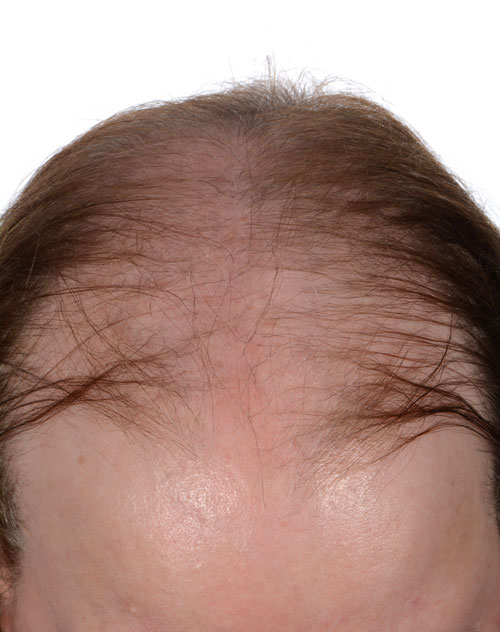
Androgenetic alopecia is the most common form of alopecia and has a typical male and female pattern. Women present with hair thinning over the central area of the scalp and widening of the midline parting but with preservation of the frontal hairline, see figure 8. Most will have normal androgen levels but if there is a history of abnormal menses, infertility, hirsutism, unresponsive cystic acne, virilisation or galactorrhoea then a targeted endocrine work-up for hyperandrogenism should be done. Iron deficiency and thyroid disease should be considered as these conditions can contribute to hair thinning or generalised hair loss. Treatment with minoxidil 2% can be tried, but has limited efficacy. Where there is a hyperandrogenic state, endocrinological assessment will be necessary.
In male pattern hair loss the androgen-sensitive follicles are affected, starting with bitemporal recession, spreading to thinning of the vertex and frontal regions in a classic M-shaped pattern. Men with lower levels of dihydrotestosterone tend to have less hair loss.
Topical minoxidil (2% and 5%) and oral finasteride are potential treatments. The patient should be warned of possible side effects including decreased libido, impotence and ejaculation disorders with finasteride. Starting treatment early can help maximise success and patients can hope to see results after 3-6 months, although dense regrowth is unlikely. Hair transplant can be effective but is not available on the NHS.
Diagnosis
In primary care the first step is to establish whether hair loss is focal or diffuse and if focal whether it is scarring or non scarring. It is usually possible to establish the pattern of hair loss from a combination of the history and clinical examination.
Dermatoscopic examination and pull testing can be useful in confirming the diagnosis. If hair loss is accompanied by scaling or significant inflammation it is important to exclude infective causes by mycology and testing for bacteria. Histological examination with a skin biopsy is sometimes necessary.
Referral
Irrespective of the pattern, alopecia is often associated with negative psychological effects including low self-esteem, anxiety and depression.
It is important to address these issues with consideration of referral to psychology or psychiatry services. Referral for a hair piece or wig can make a big difference to the patient.
GPs should refer patients in the following circumstances:
• Extensive alopecia
• Scarring alopecia
• Diagnostic uncertainty
• The patient would like to consider a hair piece or wig
• Significant associated psychological distress.
Conclusion
Alopecia is a common and distressing condition with a significant psychological burden. Establishing the type of alopecia by recognising the pattern of hair loss (focal, diffuse, scarring and non scarring) is key to successful management.
REFERENCES
1 Price VH. Treatment of hair loss. N Engl J Med 1999;341(13):964-73
2 Delamere FM, Sladden MJ, Dobbins HM, Leonardi-Bee J. Interventions for alopecia areata. Cochrane Database Syst Rev 2008. Issue 2. Art No. CD004413
3 McDonagh AJG, Messenger AG. The pathogenesis of alopecia areata. Dermatol Clin 1996;14:661-70
4 MacLean KJ, Tidman M. Alopecia areata: more than skin deep. Practitioner 2013;257(1764):29-32
5 Messenger AG, McKillop J, Farrant P et al. British Association of Dermatologists' guidelines for the management of alopecia areata 2012. Br J Dermatol 2012;166(5):916-26
6 To D, Beecker J. Frontal fibrosing alopecia: Update and review of challenges and successes. J Cutan Med Surg 2017.Oct 1:1203475417736279 doi: 10.1177/1203475417736279. [Epub ahead of print]
7 Tao J, Zhang X, Guo N et al. Squamous cell carcinoma complicating discoid lupus erythematosus in Chinese patients: review of the literature, 1964-2010. J Am Acad Dermatol 2012;66(4):695-96
8 Harries MJ, Sinclair RD, Macdonald-Hull S et al. Management of primary cicatricial alopecias: options for treatment. Br J Dermatol 2008;159:1-22
9 Mounsey AL, Reed SW. Diagnosing and treating hair loss. Am Fam Physician 2009;80(4):356-62
ARTICLE IN PDF
 Download this article in PDF format
CLICK ON IMAGES
EXTERNAL WEBLINKS
British Association of Dermatologists
Leaflets on alopecia areata and intralesional steroid therapy
British Association of Dermatologists
Leaflets on alopecia areata and intralesional steroid therapy