SEARCH

Rees F, Doherty M. Aerobic exercise can improve sleep and pain in fibromyalgia. Practitioner 2017;261(1805):23-26
Aerobic exercise can improve sleep and pain in fibromyalgia
22 Jun 2017
AUTHORS
Dr Frances Rees PhD MRCP(UK), Consultant Rheumatologist, Nottingham NHS Treatment Centre, Nottingham, UK
Professor Michael Doherty MA MD FRCP, Professor of Rheumatology and Head of Academic Rheumatology, School of Medicine, University of Nottingham, Nottingham, UK
Article
Abstract
Fibromyalgia is a chronic condition characterised by regional pain at multiple sites, non-restorative sleep and fatigue. In the UK, it is a common cause of musculoskeletal pain and significant disability, affecting around 2% of the population. It has a strong female preponderance with a female to male ratio of 7:1. Both the prevalence and incidence of the condition increase with age, resulting in a maximum prevalence of around 8% in older women. However, fibromyalgia can occur at any age including adolescence. Sleep studies have confirmed that patients with fibromyalgia have reduced delta wave sleep, which is predominantly deep, non-REM, non-dreaming sleep. Short-term deprivation of delta, but not REM, sleep in healthy controls induces fibromyalgia-like symptoms which strongly suggests that non-restorative sleep is a central problem in fibromyalgia. Altered physiology of pain processing manifests as a lowered pain threshold with both peripheral and central pain sensitisation. Patients with fibromyalgia usually present with a history of musculoskeletal pain affecting all four quadrants of the body, and accompanied by difficulty getting off to sleep, waking up frequently during the night and waking up unrefreshed in the morning. They often experience fatigue, poor concentration and forgetfulness (fibromyalgia fog), early morning stiffness, subjective hand swelling, paraesthesia affecting all fingers, irritability and occasional weepiness. Self-help strategies are important. There is strong evidence of benefit from a slow graded increase in daily aerobic exercise which can increase delta sleep and restore descending pain inhibition mechanisms. Sleep hygiene should also be considered to promote delta sleep.
Article
Fibromyalgia is a chronic condition characterised by regional pain at multiple sites, non-restorative sleep and fatigue. The condition appears to be ubiquitous and is reported in a wide variety of racial and cultural settings worldwide. In the UK, it is a common cause of musculoskeletal pain and significant disability, affecting around 2% of the population.
It has a strong female preponderance with a female to male ratio of 7:1.1 Both the prevalence and incidence of the condition increase with age, resulting in a maximum prevalence of around 8% in older women. However, fibromyalgia can occur at any age, including adolescence. As well as age and female gender a wide variety of life events that all associate with psychological distress, for example marital disharmony, divorce, traumatic injury or assault, low income and self-reported childhood abuse also increase risk.
Other recognised risk factors and associations include poor education, anxiety and depression, somatisation (a trait or state of paying undue negative attention to common bodily complaints), and childhood hospitalisation.
Patients with fibromyalgia are also more likely to have other chronic painful diseases, 20% of patients with rheumatic disease also have fibromyalgia. A positive family history in a first-degree relative confers an eight-fold increased risk.2
Fibromyalgia is commonly associated with medically unexplained symptoms in other systems and shows considerable overlap with, and similar risk factors to, other syndromes of functional disturbance such as irritable bowel syndrome, irritable bladder and tension headache, see table 1. This suggests that all these syndromes are different phenotypic presentations of the same underlying problem.3
Although no structural, inflammatory, metabolic or endocrine abnormality has been confirmed, patients with fibromyalgia have consistently been found to have two interrelated abnormalities, alterations in the physiology of sleep and physiology of pain processing. Sleep studies have confirmed that patients with fibromyalgia have reduced delta wave sleep, which is predominantly deep, non-REM, non-dreaming sleep.
Delta sleep is characterised electrophysiologically as deep, broad complexes synchronised through many regions of the brain. Most delta sleep occurs in the first few hours of sleep and is believed to be largely responsible for sleep restoration.
Those with fibromyalgia have difficulty getting into delta sleep and obtain reduced amounts during the night. Furthermore, short-term deprivation of delta sleep (but not REM sleep) in healthy controls induces fibromyalgia-like symptoms which strongly suggests that non-restorative sleep is a central problem in fibromyalgia.4
Altered physiology of pain processing manifests as a lowered pain threshold with both peripheral and central pain sensitisation.5 The lowered peripheral pain threshold results in more firing of peripheral pain neurones and amplification or wind-up of ascending messages at the spinal cord and higher levels. The impairment of descending pain inhibition pathways involves changes in the hypothalamic-pituitary axis, with a reduction, and altered diurnal variation, in cortisol and dexamethasone, and a reduction in endogenous opioids.
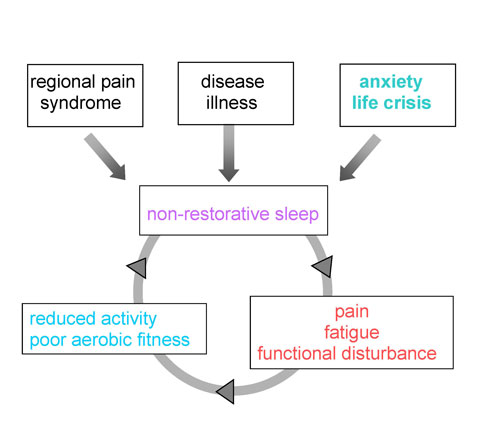
All these changes result in patients experiencing more pain than normal in response to any peripheral pain stimulus (evident on functional neurophysiological imaging) and also experiencing pain from sensory stimuli that normally are not painful (i.e. allodynia). It appears likely that the alteration in pain physiology comes first, but increased pain experience can also interfere with sleep so it is possible that a vicious cycle of non-restorative sleep, pain, reduced activity, further sleep disturbance and chronic pain can become established, see figure 1.
Clinical features
Patients with fibromyalgia usually present with a history of musculoskeletal pain that has affected all four quadrants of the body and accompanying sleep disturbance. Patients often describe their condition as feeling tired all the time with pain all over. At presentation, current pain in just one region or several regions may dominate the clinical picture, but the pain tends to move from region to region and over a period of a few months all four quadrants will have been affected.
Pain is characteristically diffuse in each region (e.g. all around the knee) as opposed to being well localised. Such diffuse regional pain is a common first clinical clue both to fibromyalgia or referred pain from a proximal site. However, rubbing improves referred pain but makes fibromyalgia pain worse. Patients with fibromyalgia usually report increased difficulty getting off to sleep, waking up frequently during the night and waking up unrefreshed in the morning.
They often experience fatigue, poor concentration and forgetfulness (fibromyalgia fog), early morning stiffness, subjective hand swelling, paraesthesia affecting all fingers, irritability and occasional weepiness. Low pressure cold damp weather often makes symptoms considerably worse.
There often appears to be a disproportionate disability compared with the symptoms and it is associated with high levels of distress. The pain is characteristically unresponsive to conventional analgesics, and physical therapy may make it worse.
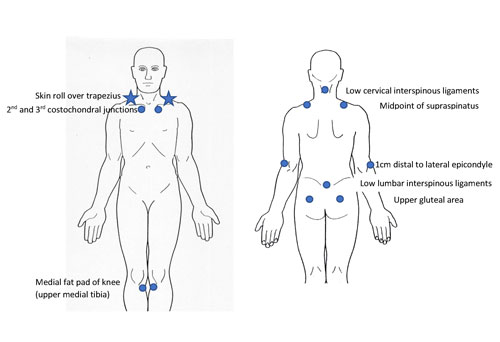
On examination, the patient shows a wince and withdrawal response to mechanical pressure (index finger, sufficient just to blanch the finger tip) applied to selected natural tender sites in all four body quadrants, see figure 2. However, in the presence of a characteristic history such hyperalgesia tender site findings are no longer required to make the diagnosis.6
Other reported clinical findings are exaggerated dermatographism and a heightened flare-wheal response to topical capsaicin. Although fibromyalgia causes regional pain and tenderness it does not cause any signs of inflammation or structural damage. However, it is common, especially in older people, to have other comorbidities such as osteoarthritis, and fibromyalgia is also more common in patients with other musculoskeletal conditions such as rheumatoid arthritis or lupus. Therefore, a full history is required for appropriate interpretation of the physical findings and to determine whether one or more diagnosis is present.
Diagnosis and differential diagnosis
Fibromyalgia is a clinical diagnosis and there are no required confirmatory tests. However, investigations are useful to identify or rule out comorbid conditions that may be difficult to diagnose clinically but which might contribute to one or more of the symptoms e.g. anaemia or hypothyroidism causing fatigue, see table 2. Although these listed conditions can cause pain in multiple regions and fatigue they are not associated with a widespread reduction in pain threshold – that is specific for fibromyalgia.
Once the diagnosis has been made clinically and screening investigations have been undertaken there is no need for further investigations. This reassures patients that there is no sinister cause for their symptoms and helps them to accept the diagnosis.
A positive diagnosis of fibromyalgia can reduce use of healthcare services and reassures patients.7 Fibromyalgia can be diagnosed and managed in primary care. Factors associated with poorer prognosis are: female sex; older age; leaving school at a young age; high tender point count; high levels of fatigue; and having symptoms in other systems (e.g. irritable bowel).8
Fibromyalgia shows a spectrum of severity. It differs from a diagnosis of chronic fatigue syndrome by the presence of widespread pain though often there is overlap between all the conditions shown in table 1 the individual labels often being assigned according to which symptom is predominant.
Management
Management should take the form of a graduated approach with the aim of reducing symptoms and improving health-related quality of life. European guidelines recommend focusing first on non-pharmacological modalities9 taking into account availability, cost, safety issues and patient preference.
It is important to acknowledge the reality of the symptoms and the distress caused to the patient and to offer an explanation regarding sleep disturbance and altered pain physiology with a no blame causation.
Patients, and close family members, should be provided with information (including written material) about the condition, for example education leaflets such as those available through Arthritis Research UK, see Useful information box.
Explore if there are any psychosocial stressors and sublimated anxieties which are contributing and might be addressed. It is important to reassure the individual that there is no causative underlying damage and that movement, although painful, will not cause harm and will actually be of benefit. The patient should be involved in decision making to define problems and set realistic goals.
Self-help strategies are important. The main management strategy with the strongest evidence is aerobic exercise.10 This increases delta sleep and can restore descending pain inhibition mechanisms. A slow graded increase in daily aerobic exercise, small amounts often, that is tailored to the patient’s ability and interests is important. Goals need to be achievable and activities paced appropriately. Some regions offer fibromyalgia management programmes.
Sleep hygiene should be considered to promote delta sleep. Patients should ensure that the hour before bedtime is relaxing and not stimulating, for example by avoiding caffeinated drinks or use of electronic devices with backlit screens. Any underlying pain generators, for example osteoarthritis, should be treated.
Amitriptyline is the only widely available drug that can increase delta sleep and 25-75 mg at night can be useful to help improve sleep quality. However, some patients may not be able to tolerate the side effects such as dry mouth or a hangover effect.9 Where there is intolerance, duloxetine or pregabalin may be tried.
Where depression co-exists an SSRI may be useful e.g. fluoxetine 20 mg daily. Often standard analgesic medication is unhelpful. If not effective, these medications should be stopped. Cognitive behaviour therapy can be helpful but has limited availability.
Patients with fibromyalgia managed in the community have a better outcome than those diagnosed in secondary care.8,9 There are a number of national and local patient support groups which people with fibromyalgia may find helpful, such as Fibromyalgia Action UK, see Useful information box, below. These groups can provide information and a useful support network following diagnosis.
Conclusions
Fibromyalgia is a common condition and the symptoms can be disabling. Although there is no cure, appropriate management can often greatly improve symptoms, functioning and quality of life. Management should be tailored to the individual, but should be reassuring, offering a full explanation, encouraging aerobic exercise and providing strategies to improve sleep.
REFERENCES
1 Wolfe F, Ross K, Anderson J et al. The prevalence and characteristics of fibromyalgia in the general population. Arthritis Rheum 1995;38(1):19-28
2 Queiroz LP. Worldwide epidemiology of fibromyalgia. Curr Pain Headache Rep 2013;17(8):356
3 Aaron LA, Buchwald D. A review of the evidence for overlap among unexplained clinical conditions. Ann Intern Med 2001;134(9 Pt2):868-81
4 Lentz MJ, Landis CA, Rothermel J, Shaver JL. Effects of selective slow wave sleep disruption on musculoskeletal pain and fatigue in middle aged women. J Rheumatol 1999;26(7):1586-92
5 Staud R. Biology and therapy of fibromyalgia: pain in fibromyalgia syndrome. Arthritis Res Ther 2006;8(3):208 Published online 2006 Apr 24. doi: 10.1186/ar1950
6 Wolfe F, Clauw DJ, Fitzcharles MA et al. The American College of Rheumatology preliminary diagnostic criteria for fibromyalgia and measurement of symptom severity. Arthritis Care Res 2010;62(5):600-10
7 Choy E, Perrot S, Leon T et al. A patient survey of the impact of fibromyalgia and the journey to diagnosis. BMC Health Serv Res 2010;10:102.(doi):10.1186/472-6963-10-102
8 MacFarlane GJ, Thomas E, Papageorgiou AC et al. The natural history of chronic pain in the community: a better prognosis than in the clinic? J Rheumatol 1996;23(9):1617-20
9 Ledingham J, Doherty S, Doherty M. Primary fibromyalgia syndrome — an outcome study. Br J Rheumatol 1993;32(2):139-42
10 Macfarlane GJ, Kronisch C, Dean LE et al. EULAR revised recommendations for the management of fibromyalgia. Ann Rheum Dis 2017;76(2):318-28
ARTICLE IN PDF
 Download this article in PDF format