SEARCH

Evans J, Negoescu A. Early referral improves long-term outcomes in rheumatoid arthritis. Practitioner 2017;261(1804):21-25
Early referral improves long-term outcomes in rheumatoid arthritis
23 May 2017
AUTHORS
Dr Jobie Evans BMBS MRCP, Rheumatology SpR
Dr Andra Negoescu Consultant Rheumatologist, Rheumatology Department, Addenbrooke’s Hospital, Cambridge, UK
Article
Abstract
Rheumatoid arthritis (RA) is a common, chronic systemic inflammatory disease of unclear aetiology leading to synovial hypertrophy and joint inflammation. It typically presents with symmetrical polyarthritis of small joints of the hands or feet, but can also involve larger joints, and have associated extra-articular manifestations. Diagnosis is based on duration of symptoms, joint distribution, level of inflammatory markers and autoantibodies i.e. rheumatoid factor (RhF) and anti-cyclic citrullinated peptide (CCP) antibodies. The presence of synovitis or effusion, either clinical or subclinical, seen on ultrasound or MRI, is essential for diagnosis. RA can sometimes present with a large joint monoarthritis or oligoarthritis. Although this is an atypical presentation, a diagnosis can be made in the presence of suggestive serology and/or histology. In cases presenting with monoarthritis, careful assessment for differential diagnoses is needed, particularly in the elderly population where other conditions such as gout, calcium pyrophosphate deposition disease and osteoarthritis are common. Early referral of patients with suspected synovitis via the rapid access early inflammatory arthritis clinic results in significant improvements in long-term outcomes. Hence it is important to consider early referral for individuals with synovitis, particularly if this is affecting small joints.
Article
Rheumatoid arthritis (RA) affects around 690,000 people, 1% of the population, in the UK.1 It is a chronic systemic inflammatory disease of unclear aetiology. An external trigger such as smoking, infection, or trauma which initiates an autoimmune reaction, leading to synovial hypertrophy and chronic joint inflammation, is thought to occur in genetically susceptible individuals.
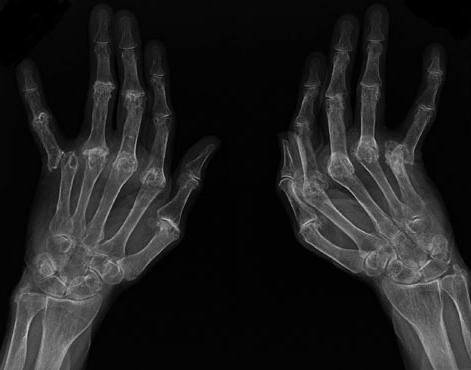
The inflammatory process is driven in part by malfunction of the immune system causing an up-regulation of cytokines (including tumour necrosis factor-alpha (TNF-α) and interleukin-6 (IL-6), which contribute to damage of the subchondral bone and articular cartilage.2 Joint deformities, disability and bone erosions result from chronic joint inflammation, see figure 1.
Presentation and diagnosis
RA typically presents with symmetrical polyarthritis involving the small joints of the hands or feet. It can also involve larger joints and have associated extra-articular manifestations.3
RA can be diagnosed using the ACR/EULAR 2010 criteria, see table 1. The score is based on duration of symptoms, joint distribution, level of inflammatory markers and autoantibodies i.e. rheumatoid factor (RhF) and anti-cyclic citrullinated peptide (CCP) antibodies. A score of 6 or more is required to fulfill the criteria for a definite diagnosis of RA. The presence of synovitis or effusion, either clinical or subclinical – seen on ultrasound or MRI, is essential for diagnosis.
As RA primarily affects the small joints, the scoring system is weighted in favour of these joints.
However, RA can sometimes present with a large joint monoathritis or oligoarthritis, and although this is an atypical presentation, a diagnosis can be made in the presence of suggestive serology and/or histology (if a synovial biopsy is performed).
In cases presenting with monoarthritis, careful assessment for differential diagnoses is needed, particularly in the elderly population, where other conditions such as gout, calcium pyrophosphate deposition disease (CPPD, previously called pseudogout), and osteoarthritis are common.
Autoantibodies
RhF has a relatively low specificity and can be found at low titre levels in other autoimmune rheumatological conditions (such as systemic lupus erythematosus, Sjögren’s syndrome), infective disorders (tuberculosis, hepatitis, bacterial endocarditis), non-autoimmune conditions (osteoarthritis), and malignancies.
RhF can also be found in healthy individuals, in up to 15-20% of the general population, and the prevalence increases with age. A positive RhF does not equate to a diagnosis of RA.
Anti-CCP antibodies are much more specific for RA with a specificity of 95-98% and sensitivity of 70-80%, particularly at high titres (> 3 times the upper limit of normal).4
The presence and titre of RhF and anti-CCP antibodies correlate with more progressive, erosive joint disease, and with development of extra-articular manifestations.5
Individuals with positive autoimmune serology for RhF and/or anti-CCP antibodies may present with symptoms of arthralgia without synovitis for months to years before the onset of RA. These individuals are considered at higher risk of developing RA compared with the general population.
High BMI, smoking and the presence of the periodontal bacterium Porphyromonas gingivalis have been shown to maintain high levels of specific autoantibodies in the blood stream hence current recommendations include weight optimisation, smoking cessation and good dental hygiene, including regular flossing.
In these predisposed individuals, the risks and potential benefits of using disease modifying antirheumatic drugs (DMARDs) need to be weighed carefully. Generally monitoring and lifestyle advice is all that is required until the onset of synovitis.
Plain radiographs of the hands and feet are unlikely to reveal evidence of erosions early in the disease, but can be useful in ruling out other diagnoses such as polyarticular CPPD, and inflammatory/erosive osteoarthritis, particularly in the elderly population.
Referral
Early referral of patients with suspected synovitis to specialist care, via the rapid access early inflammatory arthritis clinic, results in significant improvements in long-term outcomes for these patients. Hence it is important to consider early referral for individuals with suspected synovitis, particularly if this is affecting small joints. However, if there is no rapid access clinic available locally then GPs should make it clear in their referral letter that they are referring a patient with suspected inflammatory arthritis so that the patient can be appropriately triaged.
Routine blood tests, along with a basic autoimmune screen (ANA, RhF, anti-CCP antibodies) and plain radiographs are valuable in supporting the diagnosis, and excluding other possible causes of joint pain and swelling.
Treatment and monitoring
Introduction of DMARD therapy within three months of symptom onset,6 and a ‘treat to target’ approach (using the DAS28 score6 to optimise treatment, with the target being either remission or low disease activity) has been shown to improve disease control and reduce radiological progression of disease.7 Combination DMARD therapy including methotrexate is the first-line approach for newly diagnosed RA. Methotrexate should be used first line in all patients diagnosed with RA, unless contraindicated or not tolerated.
At initial onset of symptoms, NSAIDs or COX-2 inhibitors may be used for symptom relief. NSAID treatment in this context is only advised as a short-term bridging therapy until the patient is reviewed by a specialist. When considering NSAID treatment for the elderly, naproxen is generally considered the safest option from a cardiovascular perspective. A short course of oral, intramuscular or intra-articular corticosteroids can be offered for the rapid control of inflammation following diagnosis. Ideally, corticosteroid treatment should be deferred until review in the specialist clinic to prevent masking of clinical features but can be offered earlier following discussion with the specialist team.
Disease activity is monitored using the validated DAS28 tool, which is a composite score calculated using the number of tender joints and swollen joints, evaluation of global health by the patient (scale 0-100) and ESR/CRP level. This defines disease activity as high (DAS28 > 5.1); moderate (DAS28 3.2-5.1); low (DAS28 2.6-3.1) or in remission (DAS28 < 2.6).
In patients with stable disease on DMARD therapy, doses should be cautiously reduced to levels that maintain disease control.
Biologic/biosimilar therapies target specific molecules involved in the RA inflammatory pathway.7 Currently in the UK, they are used for treating severe RA (DAS28 > 5.1), after failure of, or intolerance to, combination therapy with two traditional DMARDs.9,10 They are usually given in combination with methotrexate (where tolerated), but can also be prescribed as monotherapy in selected cases. The dose, frequency and mode of action of the biologic drugs currently used in the treatment of RA can be found in table 2.
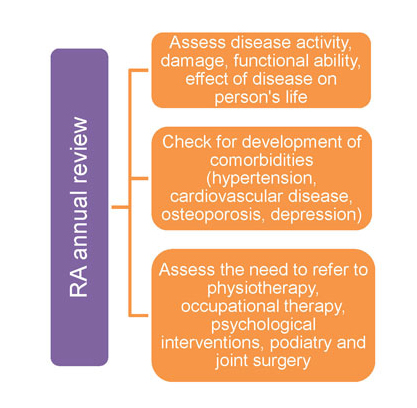
Monitoring the safety and efficacy of biologic therapy involves regular follow-up in the specialist clinic with assessment of the DAS28 score, and regular blood monitoring. An annual review should be offered to all patients with RA, and several aspects of the disease need to be taken into consideration, see figure 2.
In addition to symptoms, other aspects of the disease need to be considered and addressed when seeing a patient with RA. These include bone and cardiovascular health, mood, impact on daily life, ability to work, and function.
RA in the elderly
Assessing RA activity in the elderly population can be challenging. Older patients often have comorbidities that can contribute to musculoskeletal pain and functional decline including osteoarthritis, crystal arthropathies and neuropathic pain related to diabetes.
Inflammatory pain is characterised by prolonged early morning stiffness (> 30 minutes) with symptoms worsening after rest and improving with activity. Conversely, patients with degenerative joint disease or long-standing erosive RA complain of mechanical pain, with worsening after activity and towards the end of the day, and improving with rest.
Although it is important to try to ascertain the cause of the pain and functional impairment, as this has implications for management, this may not always be straightforward. In fact, in patients with comorbidities, pain is often multifactorial. Imaging modalities such as ultrasound and MRI can be useful in demonstrating subclinical synovitis and increased vascularity in active RA.
In addition, elderly patients with degenerative joint disease are more susceptible to developing crystal arthropathies (gout and CPPD), which can present with symmetrical polyarthritis that can mimic an RA flare.
Sometimes elderly patients, particularly those with comorbidities who are on multiple drugs, have difficulty tolerating the side effects of DMARD or biologic therapies, or these may be contraindicated or deemed to be too risky. In these patients treatment with low-dose, long-term corticosteroids (prednisolone 7.5 mg daily and below) may be appropriate and can be considered on an individual basis.
However, age alone is never a contraindication to DMARD and biologic therapy where indicated by disease activity.
Conclusion
Early recognition and referral has been shown to improve long-term outcomes significantly for patients with RA.
Although RA remains a clinical diagnosis, imaging modalities sometimes have value particularly in detecting subclinical synovitis in patients with inflammatory symptoms but no obvious synovitis on examination.
Early intensive intervention with combination DMARDs (ideally in the first three months from diagnosis) ensures a window of opportunity for preventing long-term damage and disability.
Where the patient is intolerant, has contraindications, or has failed to respond to conventional DMARDs, biologic therapies should be used with appropriate monitoring for safety and efficacy.
REFERENCES
1 National Rheumatoid Arthritis Society www.nras.org.uk (accessed 10th May 2017)
2 Watts R, Clunie G, Hall F, Marshall T. Oxford Desk Reference: Rheumatology. Oxford University Press. Oxford. 2009
3 Turesson C, O’Fallon WM, Crowson CS et al. Extra-articular disease manifestations in rheumatoid arthritis: incidence trends and risk factors over 46 years. Ann Rheum Dis 2003;62(8):722
4 Niewold TB, Harrison MJ, Paget SA. Anti-CCP antibody testing as a diagnostic and prognostic tool in rheumatoid arthritis. QJM 2007;100(4):193-201
5 Avouac J, Gossec L, Dougados M. Diagnostic and predictive value of anti-cyclic citrulinated protein antibodies in rheumatoid arthritis: a systematic literature review. Ann Rheum Dis 2006;65(7):845-51
6 National Institute for Health and Care Excellence. CG79. Rheumatoid arthritis in adults: management. NICE. London. 2009
7 Wells G, Becker JC, Teng J et al. Validation of the disease activity score 28 (DAS 28) and European League Against Rheumatism response criteria based on C-reactive protein against disease progression in patients with rheumatoid arthritis, and comparison with the DAS28 based on erythrocyte sedimentation rate. Ann Rheum Dis 2009;68(6):954-60
8 Landewé RB, Boers M, Verhoeven AC et al. COBRA combination therapy in patients with early rheumatoid arthritis: long-term structural benefits of a brief intervention. Arthritis Rheum 2002;46(2):347-56
9 National Institute for Health and Care Excellence. TA375. Adalimumab, etanercept, infliximab, certolizumab pegol, golimumab, tocilizumab and abatacept for rheumatoid arthritis not previously treated with DMARDs or after conventional DMARDs only have failed. NICE. London. 2016 www.nice.org.uk/guidance/ta375
10 National Institute for Health and Care Excellence. TA415. Certolizumab pegol for treating rheumatoid arthritis after inadequate response to a TNF-alpha inhibitor. NICE. London. 2016 www.nice.org.uk/guidance/ta415
ARTICLE IN PDF
 Download this article in PDF format
PRESET SEARCHES
PubMed
NICE evidence search
EXTERNAL WEBLINKS
National Rheumatoid Arthritis Society
www.nras.org.uk
Arthritis Research UK
NICE TA375 (2016)
Adalimumab, etanercept, infliximab, certolizumab pegol, golimumab, tocilizumab and abatacept for rheumatoid arthritis not previously treated with DMARDs or after conventional DMARDs only have failed. www.nice.org.uk/guidance/ta375
NICE TA415 (2016)
Certolizumab pegol for treating rheumatoid arthritis after inadequate response to a TNF-alpha inhibitor.