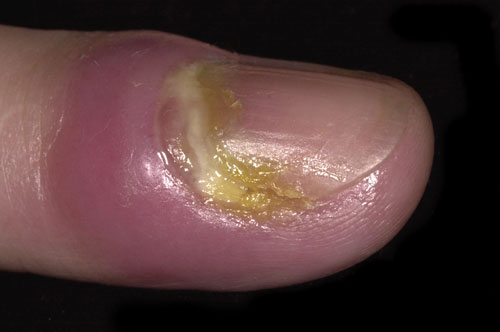
Acute paronychia
Paronychia is an infection of the nail bed. The acute form is almost always caused by Staphylococcus aureus infection and may occur as a result of trauma or picking or biting the nails. Although the infection, which enters via the side of the nail, is usually localised it may spread to the entire digit. The condition is often very painful as pus collects beneath, and adjacent to, the nail. Incision and drainage is often required and will bring about immediate relief from pain. Oral antibiotics, soaking in salt water and analgesia can also be helpful.
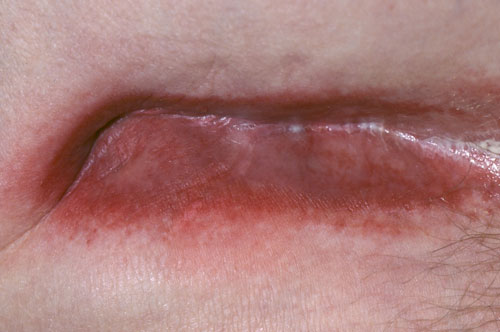
Intertrigo
Intertrigo is inflammation occurring between two adjacent areas of skin. It is usually caused by a yeast, fungal or bacterial infection. Commonly affected areas are under the breasts, in the axillae or the inner thighs and under abdominal aprons in the obese. A build-up of sweat and chafing will exacerbate the problem. In extreme untreated cases ulceration may develop. The condition occurs more frequently in the obese, the elderly and in patients with diabetes. It is important to try to keep the area dry. Zinc oxide or nappy rash creams can be applied. Hydrocortisone should be used to treat the inflammation. Any associated infection can be treated with antibiotic or antifungal preparations, as appropriate. In this case, the intertrigo occurred at the site of an abdominal scar.
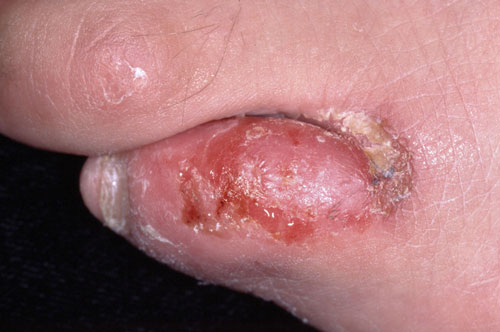
Tinea pedis
Known as athlete’s foot this fungal infection is commonly acquired from communal changing rooms. The toe webs are affected producing peeling, erythema and scaling. The distribution is usually asymmetrical predominantly affecting the spaces between the fourth and fifth toes. When only the toe webs are affected the other cause is intertrigo related to tight-fitting shoes and sweating. Taking a scraping for mycology will give a definitive diagnosis if in doubt. Topical antifungals are the treatment of choice, though in some cases oral treatment may be required especially if the area affected is extensive.
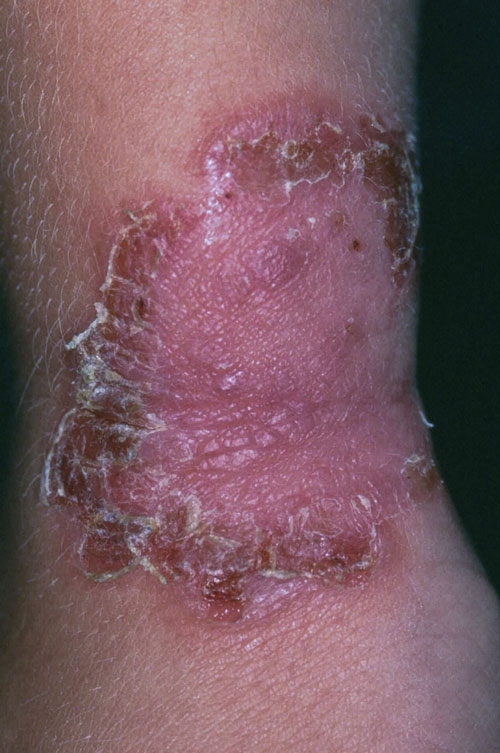
Bullous impetigo
Impetigo is a contagious infection of the epidermis caused by either staphylococcal or streptococcal infection. Affected skin typically has a yellow crust and associated erythema. There are two forms: non bullous and bullous. The latter accounts for 30% of cases. It starts with a bulla which looks similar to a burn and can occur in normal skin, unlike the non-bullous form which develops in previously traumatised skin. The blistering is caused by a toxin produced by Staphylococcus aureus which is almost exclusively the causative organism in the bullous type. An oral antibiotic such as flucloxacillin is usually required.
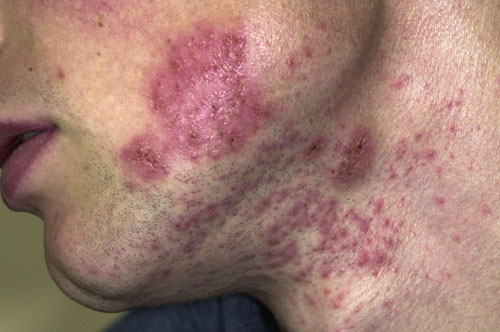
Folliculitis
Folliculitis is inflammation or infection of the superficial hair follicle as opposed to furuncles which are deep infections of the hair follicle. When folliculitis occurs as a result of infection the causative organism is usually Staphylococcus aureus which produces a small pustule with surrounding erythema. Folliculitis is more common in atopic patients who regularly use topical steroids. It may result from the use of thick greasy emollients which can plug follicles leading to inflammation. The treatment depends on the severity of the infection. In mild cases antibiotic creams may be adequate, in more severe cases oral antibiotics may be needed. When folliculitis is related to emollient use patients should be advised to apply the emollients in one direction, medially to distally, in the same way that they would stroke an animal.
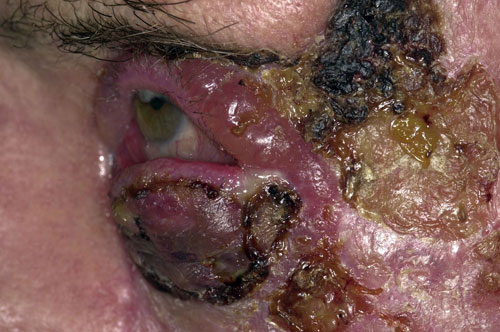
Necrotising fasciitis
Necrotising fasciitis is a severe infection which spreads rapidly through soft tissue and may be fatal. The common causative organisms are group A beta-haemolytic streptococci, although multiple organisms in combination may be responsible. The infection may arise as a complication of medical conditions or procedures such as cardiac catheterisation, vein sclerotherapy, or diagnostic laparoscopy. It develops rapidly and once a diagnosis has been made urgent treatment is essential. Treatment includes antibiotics, hyperbaric oxygen, and surgical debridement of all affected tissue. Both sepsis and renal failure are possible complications and the mortality rate is around 25%.
 Download this article in PDF format