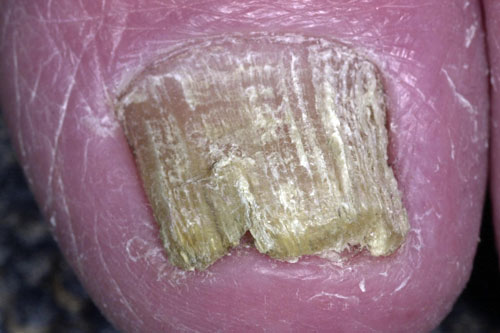
Acrodermatitis continua of Hallopeau
This chronic recurrent condition causes pustulation of the nail folds, nail beds and distal fingers and toes leading to dystrophy and eventual nail loss. It may occur as a distinct entity or in association with other conditions such as chronic plaque psoriasis, palmoplantar pustulosis, generalised pustular psoriasis or psoriatic arthropathy. Treatment can be difficult, but in this case the patient responded well to methotrexate.
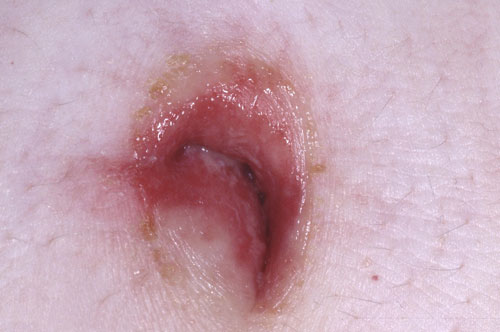
Umbilical fistula
When this patient presented with an inflamed and painful umbilicus it was felt that this was a simple infection. A swab was taken and she was treated with oral antibiotics. Although there was a slight improvement the discharge continued. The swab showed the presence of Staphylococcus aureus which was sensitive to the antibiotics given. A topical antibiotic was then prescribed but again this failed to settle the discharge. Eventually she was referred to a local surgeon. Exploration under general anaesthesia revealed a very deep fistula which was repaired, and the redness and discharge settled.
Inguinoscrotal appendicitis
This man’s right-sided inguinoscrotal hernia had been present for a number of years. When it became acutely painful, it was thought that the hernia may have become strangulated. He was admitted urgently and surgery undertaken. To the surprise of the surgeon an inflamed appendix was found within the scrotum. The appendix had not perforated and was removed. At the same time an attempt was made to repair the hernia. This was the first case of its type that the surgeon had seen.
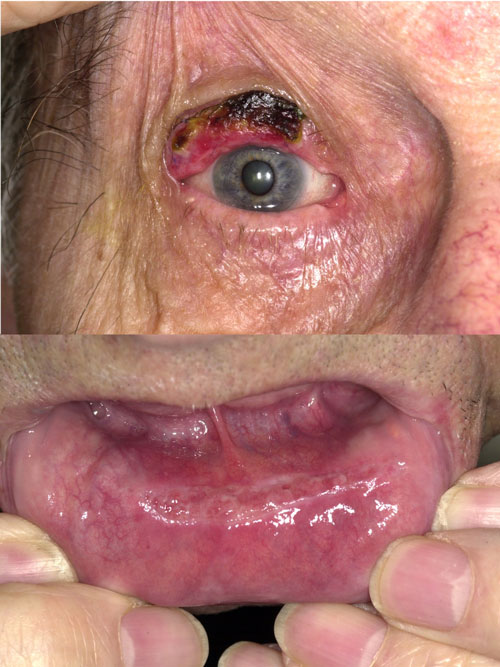
Upper lid entropion
The patient shown here had a long history of sore eyes caused by entropion of the upper eyelids affecting both eyes. Despite repeated plucking of the lashes by an optician the eyes remained sore and it was felt that he was at risk of corneal scarring. Eventually the problem was cured by grafting a strip of mucosa from the inner lower lip onto the lid lifting the lashes away from the eye.
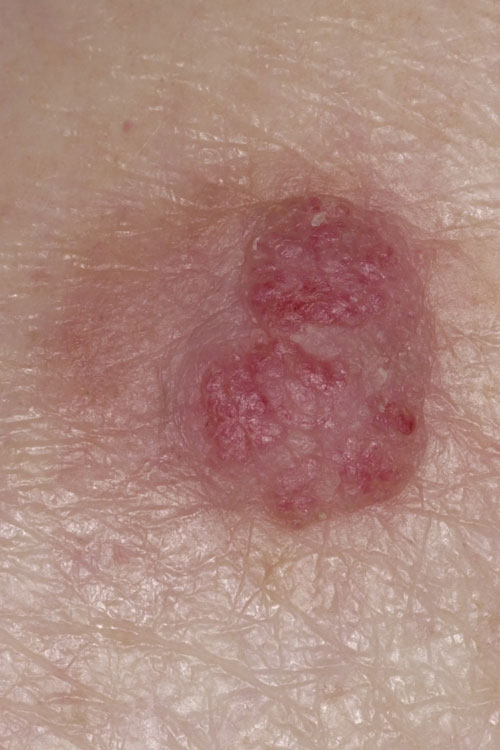
Clear cell acanthoma
Clear cell acanthomas are rare benign skin tumours that arise from the epithelium, usually in middle to older age. They generally present as solitary lesions on the lower legs, although cases of multiple acanthomas have been reported. The lesions are slightly elevated and dome shaped. They vary in colour from pink to brown and range from 3 to 20 mm in diameter. Both sexes are equally affected. Clear cell acanthomas have a distinctive dermoscopic appearance with characteristic blood vessels which helps diagnosis. Treatment is not usually required, but excision of the lesions can be undertaken.
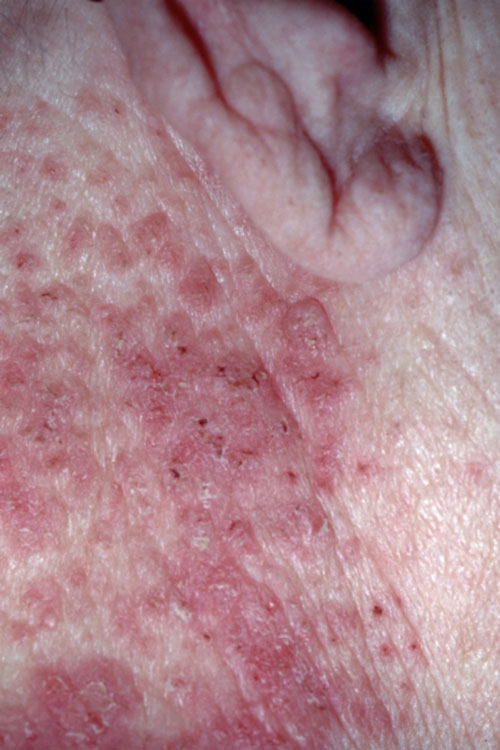
Darier’s disease
Darier’s disease occurs as a result of an abnormality of keratinisation. It is inherited in an autosomal dominant fashion and the abnormal gene has been identified as ATP2A2. The condition usually first becomes evident in late childhood or adolescence with characteristic brown follicular keratotic papules. These occur over the face, neck, chest, back, axillae and groin. The nails may also be involved with longitudinal pink or white bands and V-shaped notches at the free edges. If the diagnosis is in doubt a skin biopsy can be helpful. In mild cases, treatment with emollients along with sun protection may be all that is required. In more severe cases, the treatment of choice is topical or oral retinoids.
 Download this article in PDF format