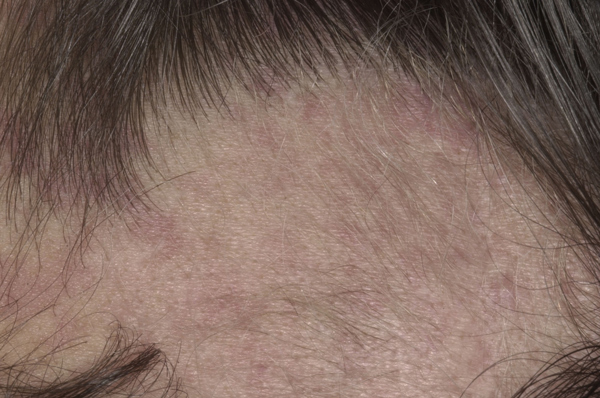
Alopecia mucinosa
Also known as follicular mucinosis, alopecia mucinosa most commonly affects the neck, scalp and face. A build-up of mucin in the hair follicles and sebaceous glands leads to epithelial reticular degeneration and hair loss. Alopecia mucinosa can be divided into three types.
The primary acute form occurs in young people and primary chronic in older people. The secondary form can be associated with benign disease e.g. lichen simplex chronicus and lupus, or malignant disease e.g. Kaposi's sarcoma, Hodgkin's disease and mycosis fungoides, or the use of drugs such as adalimumab. Treatments include steroids, PUVA and radiotherapy but are not very effective.
Pseudopelade
Pseudopelade of Brocq is a form of cicatricial alopecia which looks like alopecia areata. Considered by some to be a distinct clinical entity, others feel it is a clinical variant or end stage of various forms of cicatricial alopecia. It presents as discrete asymptomatic areas of hair loss usually over the vertex and parietal areas of the scalp. Affected skin is often atrophic and hypopigmented with a porcelain white appearance. Affected areas have irregular borders compared with the round lesions seen in alopecia areata. It is slowly progressive with alternating periods of accelerated loss and remission. Treatment is difficult but the condition usually remits spontaneously with time. Treatments include topical or intralesional steroids, hydroxychloroquine, isotretinoin and mycophenolate.
Female pattern baldness
The cause of female pattern baldness is not clearly understood but is thought to be a combination of aging, hormonal variations and inherited traits. The hair tends to thin on the crown first with a widening of the centre parting. Unlike male pattern baldness, there is not usually any frontal recession and the condition rarely results in total hair loss although the loss is usually permanent. In some cases, excess testosterone will underlie the hair loss so androgen levels should be checked. If there is diagnostic doubt a biopsy can be helpful. Drug therapy includes topical minoxidil, which will usually promote new hair growth in about 25% of women, but only works while it is used, or spironolactone which is used where the cause is an androgen excess. Other treatments include transplants, weaves and wigs.
Androgenic baldness
Androgenic baldness is the most common type of hair loss in men, and occurs as a result of the conversion of terminal hairs to indeterminate and then vellus hairs over time. Eventually the hair stops growing but the follicle remains viable suggesting that reversibility is possible. Scarring or an abnormal scalp should raise suspicion of other causes.
A biopsy can be helpful if there is doubt. Currently two treatments are licensed, topical minoxidil and oral finasteride, both of which will usually result in regrowth, but only while the medication is continued. Although mainly a cosmetic problem, studies have suggested an association between androgenic baldness and ischaemic heart disease and also with benign prostatic hyperplasia.
Trichotillomania
Trichotillomania is a primary psychiatric disorder which results in hair loss secondary to repetitive hair manipulation by the patient. Patients are usually referred to a dermatologist in the first instance to rule out other diagnoses. The history can often be misleading with patients not admitting their actions so a high index of suspicion for the diagnosis is required. No medication has been approved to treat this condition and cognitive behaviour therapy is the mainstay of treatment.
See also special report on alopecia areata
 Download this article in PDF format