Malignant melanoma
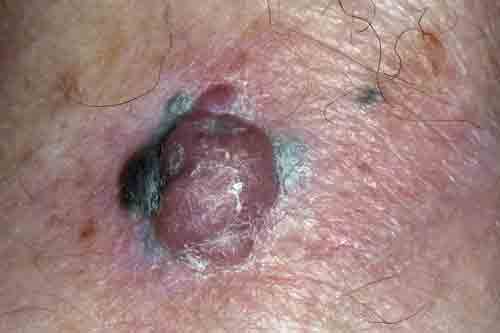
One of the main aetiological factors in the development of malignant melanoma is exposure to ultraviolet light, with intermittent exposure and burning of more significance than regular exposure and tanning. However, not all melanomas occur in areas exposed to sunlight. Acral melanomas, which are more common in skin types 5 and 6, are found on the palms of the hands and soles of the feet. Other melanomas can be found in the eye and the buccal cavity where ultraviolet light exposure is very low.
If a melanoma is suspected an urgent referral to secondary care under the current two-week wait rule should be undertaken. Urgent excision gives the best chance of a cure.
Solar lentigenes
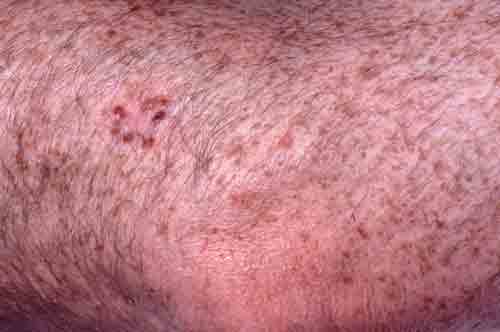
One of the first signs of ultraviolet damage to the skin is the development of solar lentigenes which appear on sun-exposed areas as a mass of small light or dark macules ranging from
1 mm to 1 cm in diameter. In childhood lentigenes may develop on unexposed areas and are termed simple lentigenes. Solar lentigenes develop in later life and when they occur on the backs of the hands are often referred to as liver spots although they have no relation to liver disease. Lentigenes and freckles differ in that the former, unlike the latter, have an increased number of melanocytes. Treatment is not usually necessary but unsightly lesions may improve with daily application of tretinoin cream.
Basal cell carcinoma
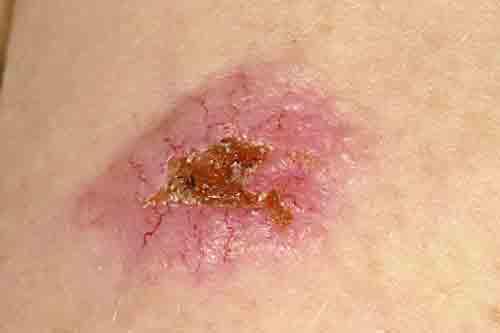
Basal cell carcinomas (BCCs) are very common especially on sun-exposed areas of the body. Although they are low risk and rarely fatal, if left untreated they can spread and be very disfiguring. The current high incidence is the result of increased sun exposure in the affected population over the past 50 years or so, brought about by a rise in foreign travel. Treatment varies depending on the type, size and location of the lesions. The nodular forms are usually excised either by standard excision or, if the lesions are in difficult locations or are recurrent, by Mohs surgery. Other treatments include photodynamic therapy and topical chemotherapy which works well for superficial BCCs.
Actinic keratosis
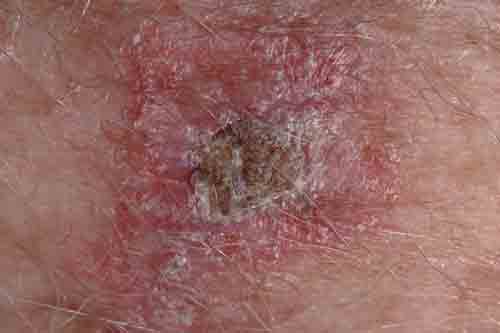
Actinic keratoses are discrete, rough-surfaced lesions caused by damage to the skin by UV light. They are more commonly found on sun-exposed areas such as the hands, forearms, forehead, face and especially areas of male pattern baldness. They can be premalignant but the percentage of lesions which become cancerous is relatively low. Even when there has been a lot of sun exposure at an early age actinic keratoses take many years to develop and unlike melanomas are rarely seen in young people. Patients need to be informed about how to protect their skin from further damage ideally by wearing hats and using a high sun protection factor sunscreen. This advice needs to be followed not only when abroad but also during everyday activities such as gardening and golf. Treatment options include cryotherapy, topical non-steroidal gels, topical chemotherapy and excision.
Vitiligo
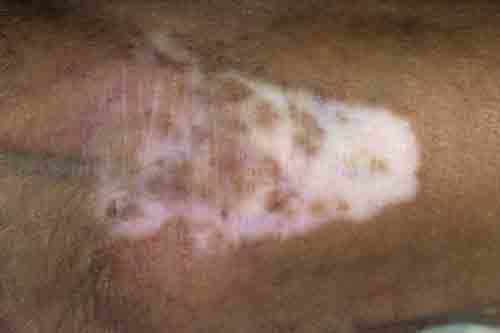
When conditions such as vitiligo cause depigmentation of the skin the resulting appearance can be very distressing for patients especially those with Fitzpatrick skin types 4, 5 and 6. Camouflage makeup can markedly improve the appearance, but it is important to explain to patients that the dark area will still develop increased pigment in response to ultraviolet light whereas the lighter areas will not. Ultraviolet protection with sunscreen and covering up with suitable clothing should always be recommended. The hypopigmented areas have lost their natural protection from ultraviolet light and so, in theory, are more at risk of developing malignant lesions such as squamous cell carcinoma.
PUVA
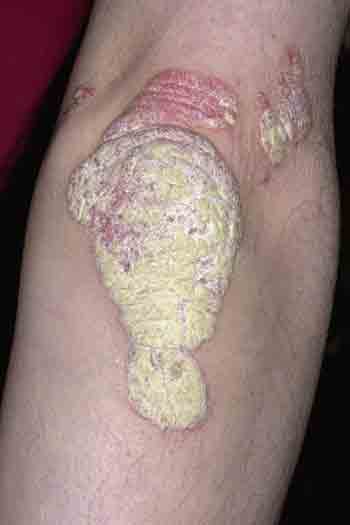
Although ultraviolet light can be very harmful to human skin, its effects can also be used therapeutically. PUVA, the combination of topical or oral psoralens and UVA, is used to treat conditions such as psoriasis (shown here), eczema, vitiligo (see above) and systemic lupus erythematosus. The use of such regimens can increase the risk of developing skin malignancy and as such the amount of radiation received by the skin is carefully controlled and limited.
 Download this article in PDF format