SEARCH

O’Grady EE, Power DM. Ulnar nerve injury on removal of a contraceptive implant. Practitioner 2016;260(1799):21-24
Ulnar nerve injury on removal of a contraceptive implant
15 Dec 2016
AUTHORS
Dr Eva E O’Grady MB BCh BAO MCh MRCSI, Hand Surgery Research Fellow
Mr Dominic M Power MA MB BChir (Cantab) FRCS (Tr&Orth) MFSEM, Consultant Hand and Peripheral Nerve Surgeon, Queen Elizabeth Hospital, Birmingham, UK
Article
Abstract
The close proximity of contraceptive implant placement to the course of the ulnar nerve can result in injury. Several factors have been implicated in this complication including: low BMI, erroneous placement of the implant, implantation over the brachial groove, and migration of the implant from its original insertion. Clinicians should familiarise themselves with the vulnerable neurovascular structures in the area and refer promptly to a specialist if any neurological symptoms develop during placement or removal of these devices. The prognosis following nerve injury is related to the anatomical site, pathophysiological depth of injury and delay between injury and treatment. Minor injury (neurapraxia) results from ischaemia or oedema within the nerve. In more severe injuries there is axonal damage resulting in Wallerian degeneration. The axonal damage affects all nerve fibre subtypes and as a result there is usually neuropathic pain and loss of autonomic sudomotor and vasomotor function in the cutaneous territory of the affected nerve. Loss of these autonomic supplies results in disruption of function of sweat glands and blood flow regulation which manifests as dry erythematous skin. High-grade nerve injury with axonal degeneration should be suspected when there is neuropathic pain, autonomic dysfunction and a positive Tinel’s sign (pain in the territory of the nerve elicited by gently tapping over the site of suspected injury). The British Orthopaedic Association recommends prompt referral for specialist assessment when there is motor or sensory dysfunction in the territory of a nerve following an intervention in proximity to the nerve. Early recognition and intervention may prevent further degeneration and improve outcomes.
Article
Iatrogenic nerve injury is common and accounts for 11% of referrals to our regional peripheral nerve injury service. While the majority of these injuries occur in the operating theatre they can also occur during minor surgical procedures, venous or arterial cannulation, subcutaneous or intramuscular injection or as a side effect of patient positioning in ICU or theatre.
As there is not a high index of suspicion of nerve injury in these cases the diagnosis may be missed leading to later specialist referral and worse patient outcomes.
Case report
A 30-year-old lady was referred to the West Midlands Regional Peripheral Nerve Injury Service with reduced sensation and weakness in her left hand. The symptoms started after removal of a contraceptive implant from the inner aspect of her left upper arm by her GP. She reported having a sharp pain that travelled down her arm at the time of removal of the implant and persistent pain and tenderness over her surgical site.
On examination in the clinic she had dry skin over the ulnar aspect of her left hand and reduced sensation over the ulnar hand, ring and small finger. She also had reduced power in finger flexion of her small finger and in abduction and adduction of all her fingers. She had an intensely positive Tinel’s sign (pain in the territory of the nerve elicited by gently tapping over the site of suspected injury) over her scar on her medial upper arm where her implant had been removed. Neurophysiology confirmed a degenerative axonopathy of the ulnar nerve.
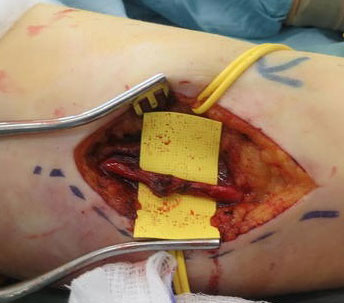
On surgical exploration of the ulnar nerve in the upper arm she was observed to have a partial injury of the ulnar nerve with a neuroma in continuity. The neuroma was resected and the nerve was repaired (see figure 1).
Following nerve repair she had severe neuropathic pain in the distribution of the ulnar nerve and a poorly progressive Tinel’s sign indicative of poor neural regeneration.
Further exploration at eight months identified persistent neuroma at the site of surgery and so microscopic neurolysis was performed to resect the neuroma and preserve intact fascicles. The 2 cm residual nerve gap was reconstructed using processed nerve allograft. Allograft reconstruction of a nerve gap is an alternative to autologous sensory sural nerve graft reconstruction and avoids the morbidity of donor nerve harvest. At last review there was evidence of advancing Tinel’s sign and reinnervation of the flexor carpi ulnaris and ulnar innervated flexor digitorum profundus. Further sensory and motor recovery is anticipated in the next 12 months.
Discussion
Contraceptive implant injury
Contraceptive implant placement and removal is a minor procedure that is frequently performed in primary care. Recommendations from the manufacturer advise placement of the implant subcutaneously in the medial upper arm 8-10 cm proximal to the medial epicondyle, as seen in the explanatory diagram in figure 2.1 They emphasise that practitioners should avoid the intermuscular sulcus during implant placement.
In the vast majority of cases this placement is without complication, however, its close proximity to the course of the ulnar nerve has resulted in multiple reported cases of ulnar nerve injury.
Several factors have been implicated in this complication including:
• Erroneous, more distal placement of the implant2
• Implantation over the brachial groove3
• A thin subcutaneous layer in patients with a low BMI4
• Migration of the implant from its original insertion5
All reports in the literature recommend that clinicians should familiarise themselves with vulnerable neurovascular structures in the area and refer promptly to a specialist
if any neurological symptoms develop during placement or removal of these devices. This advice is also applicable to the wider range of iatrogenic nerve injuries.
Other iatrogenic injuries
As well as the ulnar nerve in the medial upper arm there are several other major peripheral nerves whose superficial course renders them vulnerable to injury during minor procedures, cannulation and injection.
The spinal accessory nerve, which crosses the posterior triangle of the neck, may be injured during lymph node biopsy. One paper reports this injury occurring in up to 10% of all lymph node biopsy procedures in the neck.6
Simple venepuncture or cannulation has been implicated in injury of nerves in the upper arm, including the lateral cutaneous nerve as it crosses the antecubital fossa7 and the superficial branch of the radial nerve as it passes the wrist in close association with the cephalic vein.8, 9
A population study of iatrogenic nerve injuries in New Zealand identified venepuncture and cannulation as the second and third most common causes respectively.10
In the lower limb the sciatic nerve is vulnerable to injury during intramuscular injection, and a review published in 2010 identified these injuries as a persistent and global problem.11
Pathophysiology and diagnosis of nerve injury
The prognosis following a nerve injury is related to the anatomical site, the pathophysiological depth of injury and the delay between injury and treatment. For a mixed motor and sensory nerve the loss of distal function will present as anaesthesia or hypoaesthesia with motor weakness or paralysis dependent on whether the lesion is complete or partial.
Minor injury is termed physiological conduction block or neurapraxia and results from ischaemia or oedema within the nerve with segmental disruption of myelin sheaths, (see figure 3, and box 1). In such injuries there is no axonal damage and no Wallerian degeneration. Myelinated fibres are affected more than unmyelinated fibres and generally
there is preservation of some slow pain (C fibre function), deep pressure and autonomic function including sweating in the territory of the nerve. Neurophysiological assessment of the distal nerve demonstrates normal conduction.
In more severe injuries there is axonal damage resulting in Wallerian degeneration. The axonal damage affects all nerve fibre subtypes and as a result there is usually neuropathic pain and loss of autonomic sudomotor and vasomotor function in the cutaneous territory of the affected nerve. Loss of these autonomic supplies results in disruption of function of sweat glands and blood flow regulation respectively which manifests as dry erythematous skin.
The neurophysiology will demonstrate absent distal motor and sensory conduction velocities if the lesion is complete and electromyography sampling will demonstrate fibrillation potentials from the denervated muscle fibres.
The recovery potential depends on whether there is physical continuity of the nerve and the extent of internal derangement.
The hallmarks of a degenerative nerve lesion are neuropathic pain, dry red skin and a Tinel’s sign. If the Tinel’s sign is non-progressive on sequential clinical examination then either a neurotmesis (nerve transection) or neuroma in continuity should be suspected and the nerve should be explored.
Management of iatrogenic nerve injury
The British Orthopaedic Association Standards for Trauma (BOAST-5) guidelines recommend prompt referral for specialist assessment when there is motor or sensory dysfunction in the territory of a nerve following an intervention in proximity to the nerve.12
A high grade nerve injury with axonal degeneration should be suspected when there is neuropathic pain, autonomic dysfunction and a positive Tinel’s sign at the site of injury.
Early recognition and intervention may prevent further degeneration and improve outcomes. Careful clinical examination is usually sufficient to make a diagnosis and neurophysiological investigations, while confirming the severity of a lesion, are not essential and should not delay referral.
REFERENCES
1 Summary of Product Characteristics: Nexplanon 68mg implant for subdermal use. Electronic Medicines Compendium. 2016 [cited 14/11/2016] www.medicines.org.uk/emc/medicine/23824
2 Smith JM, Conwit RA, Blumenthal PD. Ulnar nerve injury associated with removal of Norplant implants. Contraception 1998;57(2):99-101
3 Sarma SP, Hatcher RP. Neurovascular injury during removal of levonorgestrel implants. Am J Obstet Gynecol 1995;172(1 Pt 1):120-1
4 Osman N, Dinh A, Dubert T, Goubier JN. A new cause for iatrogenic lesion of the ulnar nerve at the arm: contraceptive hormonal implant. Report of two cases. Chir Main 2005;24(3-4):181-83
5 Vidin E, Garbin O, Rodriguez B et al. Removal of etonogestrel contraceptive implants in the operating theater: report on 28 cases. Contraception 2007;76(1):35-39
6 Bostrom D, Dahlin LB. Iatrogenic injury to the accessory nerve. Scand J Plast Reconstr Surg Hand Surg 2007;41(2):82-87
7 Stevens RJ, Mahadevan V, Moss AL. Injury to the lateral cutaneous nerve of forearm after venous cannulation:
a case report and literature review. Clin Anat 2012;25(5): 659-62
8 So E, Sanders GM, Au TK, Hung CT. Radial nerve injury after intravenous cannulation at the wrist - a case report. Ann Acad Med Singapore 1999;28(2):288-89
9 Boeson MB, Hranchook A, Stoller J. Peripheral nerve injury from intravenous cannulation: a case report. AANA J 2000;68(1):53-57
10 Moore AE, Zhang J, Stringer MD. Iatrogenic nerve injury in a national no-fault compensation scheme: an observational cohort study. Int J Clin Pract 2012;66(4): 409-16
11 Mishra P, Stringer MD. Sciatic nerve injury from intramuscular injection: a persistent and global problem. Int J Clin Prac 2010;64(11):1573-79
12 British Orthopaedic Association. British Orthopaedic Association Standards for Trauma (BOAST). BOAST 5 - Peripheral Nerve Injury. www.boa.ac.uk
ARTICLE IN PDF
 Download this article in PDF format
PRESET SEARCHES
PubMed
Ulnar nerve injury contraceptive implant
Immediate CPD prompts
These handy templates*, associated with all articles, prompt drafting of personal learning, reflection and planning.
Save your record straight into your personal development folder on your device or cloud storage system.
*Adobe fillable PDFs. Adobe reader needed for iPad
Comment or question
If you, or your peer group, would like to comment on an article or have a question for the authors, write to:
Editor
Case report submissions
Do you have an interesting case that you would like to share with other readers?
Your article would need to be around 1,500 words long, include a brief review of the literature to put the case in context, and be fully referenced in the Vancouver style.
Submissions for consideration for publication should be sent to: [email protected]
EXTERNAL WEBLINKS
British Orthopaedic Association
Guidelines for management of nerve injury
The Birmingham Hand Unit at Queen Elizabeth Hospital