SEARCH

Henderson AH, Hallam M-J, Saha R, Nduka C. A case of persistent hemifacial weakness. Practitioner 2013;257 (1763): 29-32
A case of persistent hemifacial weakness
25 Jul 2013
AUTHORS
Mr Arthur H Henderson MRCS DOHNS, Senior House Officer ENT, Queen Alexandra Hospital, Portsmouth Hospitals NHS Trust, Portsmouth, UK
Mr Marc-James Hallam MRCS, Specialist Registrar Plastic Surgery, St George’s Hospital, London, UK
Dr Romi Saha PhD FRCP Consultant Neurologist, Hurstwood Park Neurological Centre, Brighton and Sussex Universities Hospitals NHS Trust, Haywards Heath, UK
Mr Charles Nduka MA(Oxon) MD FRCS FRCS(Plas), Consultant Plastic Surgeon, Queen Victoria Hospital Foundation NHS Trust, East Grinstead, UK
Article
Hemifacial weakness, or palsy, results from disruption of communication between cortical motor centres and the facial musculature along the course of the facial nerve. Facial palsy is not an uncommon presentation in primary care and can present both diagnostic challenges as well as physical and psychosocial problems for patients.
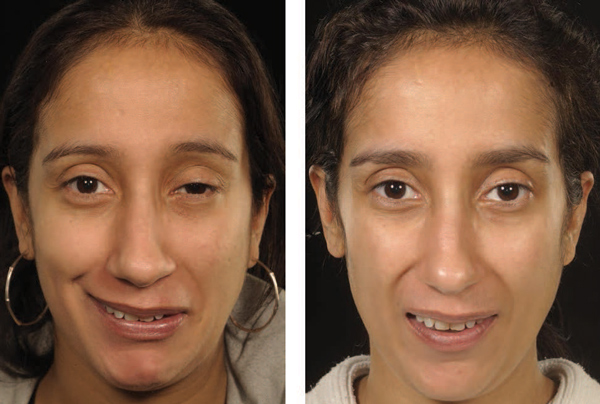
Our patient, see box 1, highlights a typical presentation of Bell’s palsy — sudden onset, mild otalgia, altered facial sensation and/or taste, with no obvious prodrome.1 A lower motor neurone palsy of unknown aetiology, more prevalent during pregnancy and in those with a family history,2 it represents over half of hemifacial weakness cases in primary care. However, as a diagnosis of exclusion, there are a number of key clinical features of more sinister diagnoses that must be considered see table 1.
Acute hemifacial weakness secondary to isolated facial nerve palsy must be differentiated from acute cerebrovascular accident (CVA). The latter results in sparing of the brow musculature due to the bilateral innervation of the frontalis. Bell’s palsy is also not associated with the other corporeal neurological deficits of CVA. Altered facial sensation and mild otalgia are common in Bell’s palsy, however severe pain is suggestive of Ramsay Hunt syndrome, with pain frequently present before the emergence of vesicles. Ramsay Hunt syndrome may also be associated with sudden onset vestibulocochlear nerve involvement (tinnitus, vertigo, and sensorineural hearing loss) as well as intraoral pain.3 Recent facial or head trauma and surgery should also be excluded in causation.
Facial palsy secondary to tumours of the head and neck is generally of slow, progressive onset and is almost always preceded by other symptoms. Specifically, tumours of the cerebellopontine angle e.g. acoustic neuromas, present with tinnitus and hearing loss, and parotid tumours with a mass.4
Middle and external ear infections do not cause facial palsy in isolation. Significant otitis externa in a patient with diabetes may predate the development of facial palsy, as would progressive hearing loss and the foul persistent discharge of cholesteatoma. Facial palsy is seen in persistent acute otitis media however it is a rare complication.
Facial palsy may also be associated with systemic disease such as sarcoidosis or HIV and should be considered within the spectrum of concurrent symptoms and medical history. The exception is that of Lyme neuroborreliosis where facial palsy is occasionally the sole presenting symptom.5
Referral
Acute Bell’s palsy can be managed successfully in primary care. Current research still demonstrates benefit in the expeditious use of steroids (e.g. 50 mg prednisolone once daily within 72 hours of onset for ten days). However no clear added benefit from the use of antiviral therapy has been shown.1
In the assessment of acute facial palsy examination should include the cranial nerves, ear, parotid, neck and oral cavity. It is essential for both GPs and specialists to grade the extent of weakness early to determine prognosis and direct treatment, see table 2.
The following patients should be referred:
• Cases with lagophthalmos require eye protection (patching and artificial tears); ophthalmological opinion is required if the weakness persists beyond a few days or ocular damage is suspected
• In Ramsay Hunt syndrome, which typically presents with severe pain and a rash on the ipsilateral ear or intraorally, antivirals both expedite recovery and improve outcome.3 The usual dose is aciclovir 400 mg five times daily for ten days. Referral to specialist care is indicated in immunocompromised patients, those with significant pain, and where intraoral vesicles prohibit oral intake
• Palsy secondary to trauma or surgery should be referred immediately as surgical exploration is often required
• A parotid mass with facial palsy implies malignant change and must be referred within the two-week wait pathway
• A history of progressive hearing loss and tinnitus with palsy also requires urgent referral to neuro-otology for assessment of cerebellopontine angle tumours
• All cases of facial palsy associated with infective otological symptoms should be discussed with ENT
Management
If an organic cause is excluded, reassurance and advice are critical when managing facial weakness. Prognosis is dependent upon causation.
Bell’s palsy results in full recovery in around 70% of patients,1 partial paralysis is prognostically favourable. Recovery is usually rapid (within three weeks) but can take up to 12 months. There is recurrence in around 10% of cases.2 The longer the duration of paralysis in Bell’s palsy the poorer the recovery. Episodes occurring during pregnancy have a slightly worse outcome.
If no recovery is observed after six weeks, a referral to an ENT or neurology department is appropriate as exclusion of a space-occupying lesion is important.
Recovery in Ramsay Hunt syndrome is less complete with only 60% returning to House-Brackmann grade I or II. Incomplete palsy resulting from trauma or surgery usually resolves completely. However, recovery following complete traumatic palsy has a more variable outcome.
Preoperative weakness associated with tumours is often irreversible because compromised nerve is sacrificed where resection is necessary. However, postoperative impairment frequently recovers after resolution of transient oedema.
More complex than acute management is the long-term therapy of patients with facial nerve palsy. Weakness is not the only symptom requiring therapeutic intervention. Varying degrees of palsy also affect salivation, dental care, speech, eating, eye closure, and responsive facial animation.
Facial palsy is commonly associated with symptoms of anxiety and/or depression, often poorly correlated with the degree of weakness, and frequently overlooked.6 Thus, a multidisciplinary assessment to rehabilitate and manage the functional and aesthetic as well as the psychological aspects is essential (see table 3). Facial therapists formulate strategies to aid symptom optimisation, including neuromuscular training and physiotherapy that may aid those patients with chronic symptoms.7
Selected patients may also then benefit from a range of reconstructive surgical treatments.
Conclusion
Acute facial weakness frequently presents a diagnostic dilemma in general practice. If in doubt, patients should be discussed with secondary care. However, most can be managed successfully in primary care with the likelihood of a good recovery.
Facial palsy is not just a cosmetic problem, but rather a condition associated with long-term functional and psychological sequelae for which a range of effective treatment options are available. Advice and support is essential. Charities and support groups are invaluable in the education of patients and their families (see Useful information box, below).
REFERENCES
1 Gronseth GS, Paduga R. Evidence-based guideline update: Steroids and antivirals for Bell’s palsy. Report of the Guideline Development Subcommittee of the American Academy of Neurology. Neurology 2012; 79(22):2209-13
2 Oosterveer DM, Benit CP, deSchryver E. Differential diagnosis of recurrent or bilateral peripheral facial palsy.
J Laryngol Otol 2012;126:833-836
3 Ryu EW, Lee H, Lee SY et al. Clinical manifestations and prognosis of patients with Ramsay Hunt syndrome. Am J Otolaryngol 2012;33(3): 313-8
4 Stodulski D, Mikaszewski B, Stankiewicz C. Signs and symptoms of parotid gland carcinoma and their prognostic value. Int J Oral Maxillofac Surg 2012;41(7): 801-6
5 Broekhuijsen-van Henten DM, Braun KP, Wolfs TF. Clinical presentation of childhood neuroborreliosis; neurological examination may be normal. Arch Dis Child 2010 Nov; 95(11):910-4. Epub 2010 Jun 28
6 Walker DT, Hallam MJ, Ni Mhurchadha S et al. The psychosocial impact of facial palsy: our experience in one hundred and twenty six patients. Clin Otolaryngol 2012;37(6:474-7.doi:10.1111/coa.12026
7 Teixeira LJ, Valbuza JS, Prado GF. Physical therapy for Bell’s palsy (idiopathic facial paralysis) Cochrane Database Syst Rev 2011 Dec 7;(12) CD006283
ARTICLE IN PDF
 Download this article in PDF format