SEARCH

Bhupal HK. Ramsay Hunt syndrome presenting in primary care. Practitioner 2010;254 (1727):33-35
Ramsay Hunt syndrome presenting in primary care
22 Mar 2010
AUTHORS
Dr Hardeep K. Bhupal MBBS, MRCGP, MRCP (UK), DRCOG
GP, Hillingdon, Middlesex
Article
Ramsay Hunt syndrome is a lower motor neurone weakness of the seventh (facial)cranial nerve caused by reactivation of the herpes zoster virus.
It was first described by James Ramsay Hunt (1874 - 1937), an American neurologist. The virus infects the geniculate ganglion of the nerve causing facial weakness. The onset of a motor neuropathy thereby makes it inherently different from the more typical presentation of shingles, which predominantly causes a sensory neuropathy. A vesicular erythematous rash on, or around, the pinna (zoster oticus) may be present.
Epidemiology
Herpes zoster, or shingles, occurs through reactivation of the varicella zoster virus, which also causes chickenpox. After the initial infection the virus remains within the sensory ganglia and with increasing age has a propensity to reactivate and present as herpes zoster. Hence herpes zoster and Ramsay Hunt syndrome are seen as diseases of older people.
It is believed that approximately 20-30% of individuals will be affected by herpes zoster during their lives.1,2 However, Ramsay Hunt syndrome is a rare disease, affecting fewer than 1 in 1,500 people in the United States. Vulnerability to reactivation occurs as a result of immunosenescence, and a gradual decline in cellular and possibly humoral immunity.3
Patients who are immunocompromised are at greater risk of developing herpes zoster and reactivation can result in a more severe widespread presentation.
Case report
A 70-year-old woman presented to her GP with a two-day history of left ear pain and no further symptoms. She was immunocompetent and apart from lisinopril for her hypertension was not on any other medication.
On examination, there was mild erythema around the left ear canal, however, there were no other obvious abnormalities. Otitis externa was suspected so she was prescribed a course of oral antibiotics and advised to come in should she develop any further symptoms.
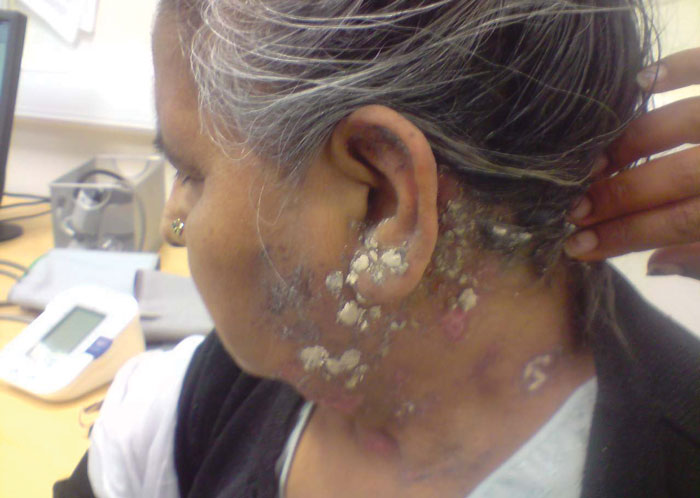
Three days later she was seen by another GP. She had developed a vesicular, erythematous rash extending from the external meatus, to involve the post-auricular area, and also down the mandible, see figure 2. The diagnosis at this stage appeared clear, the patient had developed varicella zoster. She was started on aciclovir with a plan to review over the next few days.
However, two days later the patient presented with left-sided facial weakness and was seen by yet another GP. A diagnosis of Ramsay Hunt syndrome was made.
The patient was advised to continue her aciclovir. At review three days later, most of the active lesions had regressed. She was prescribed oral prednisolone and amitriptyline along with paracetamol and codeine phosphate for pain relief.
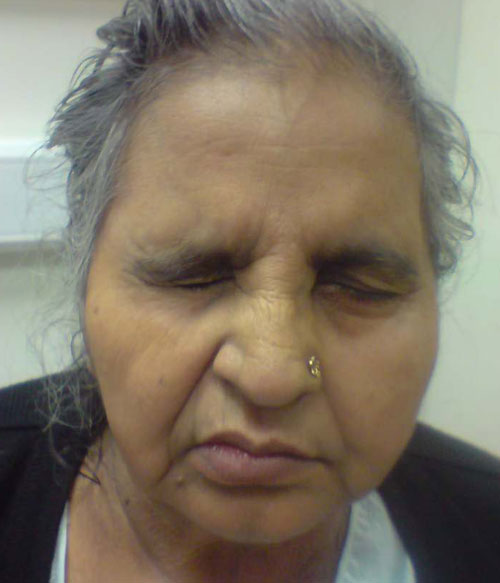
Her corneal reflex and ability to close her left eye fully were preserved, see figure 3. She was followed up regularly over the next two weeks. The lower motor neurone facial weakness of the seventh cranial nerve resolved and her skin lesions regressed.
Symptoms and signs
Pain
The pain can be subjective in nature and severity but has commonly been described as a dull background ache with acute exacerbations. Post-herpetic neuralgia is a well known complication and can result in typical features associated with neuropathic pain.
The pain around the ear may also be associated with headaches and a general malaise along with allodynia (pain at the site provoked by innocuous stimuli). Patients may also report a numbness or tingling sensation around the area.
Ipsilateral auditory manifestations can occur and these include: tinnitus, deafness, hyperacusis (due to paralysis of the branch of the facial nerve supplying the stapedius) and a sensation of aural fullness.
Additional symptoms include nausea, vomiting, vertigo and a change in taste perception.
Rash
Early presentations may mimic otitis externa, as was the case in this patient. The locality of the rash is variable, and common sites include: the auditory canal, in and around the pinna; the palate; and occasionally the anterior two thirds of the tongue. It commonly presents as an erythematous vesicular rash, with the vesicles coalescing to form bullous lesions, resolution usually takes 10 to 14 days. However, complete resolution can take 2-4 weeks and may be complicated by superimposed bacterial infection.
The presence of pain and allodynia, without the onset of a rash, is indicative of the condition zoster sine herpete.
Ipsilateral facial weakness
This can cause significant alarm and is often a major factor in the patient seeking immediate medical attention.
It characteristically involves the lower motor neurone fibres of the seventh (facial) cranial nerve.
Preservation of the motor function of the forehead muscles is characteristic and can be assessed by asking the patient to raise his or her eyebrows.
If the patient is able to furrow the forehead muscles then the upper motor neurones have been spared and the lesion is exclusive to the lower motor neurone fibres.
In 12% of patients presenting with lower motor neurone facial weakness the cause is Ramsay Hunt syndrome.4 Other causes include Bell's palsy, trauma to the facial nerve, parotid gland tumours and cerebrovascular events.
Severe eruptions can result in significant ophthalmological complications. Thus the cornea, along with the corneal reflex, and the patient's ability to close the eye completely should be fully assessed. Severe eruptions are an indication for an urgent ophthalmological opinion as there is higher risk of ocular complications.5
Differential diagnoses are listed in table 1.
Diagnosis
Within the general practice setting the diagnosis remains clinical. The presence of severe eruptions or significant complications such as ocular involvement or severe cellulitis may warrant acute admission.
Diagnosis can be confirmed by obtaining scrapings from the lesions and direct immunofluorescence staining of the varicella zoster virus. Polymerase chain reaction is also an effective way of confirming the diagnosis and may play a role in those individuals who present early without typical features, or in those who present with zoster sine herpete or in whom the diagnosis remains ambiguous.8,9
Management
Antivirals
A recent review concluded that management of Ramsay Hunt syndrome remains controversial with a lack of evidence to support the use of antivirals.10 However, a retrospective study, published in 1997, showed a significant improvement in outcomes in patients treated with antiviral medication within 72 hours of the onset of symptoms. Complete recovery occurred in 75% of patients treated within 72 hours compared with 30% of patients treated within 7 days of the onset of symptoms.11
A prospective study, in 2001, concluded that aciclovir improved treatment outcome.12 Several randomised, placebo-controlled trials have also found this.13-16
Although there is no clear guidance on recommended dosing regimens, trials commonly used 800 mg aciclovir orally 5 times a day for 7-10 days. This appears to be the recommended dosing regimen in the UK with the preferred duration of treatment being 7 days.17 There is no evidence to suggest increased benefit of using intravenous aciclovir over oral aciclovir.11 Although most benefit is obtained if antivirals are prescribed within the first 72 hours, all patients should be assessed individually and those at high risk of developing post-herpetic neuralgia (over 50 years of age, severe eruptions and prodromal symptoms) should be prescribed antiviral medication.
Corticosteroids
Large controlled trials have concluded that adjuvant corticosteroid therapy resulted in improved and quicker healing of cutaneous lesions and improved relief of neuralgic symptoms.17,18 Trials have used a regimen of oral prednisolone
1 mg/kg daily for 5 days followed by tapering the dose.12 An alternative regimen of 60 mg of oral prednisolone daily for 5 days followed by tapering has been proposed.19
Care should be taken in prescribing steroids in patients with comorbidity such as diabetes mellitus, hypertension, osteoporosis and associated metabolic disorders.
Adjuvant therapy
Oral analgesics, lubricating eye drops, eye patches and taping down of the eyelid can also play an important role in management.
Post-herpetic neuralgia: Pain persisting for three months after the onset of symptoms is termed post-herpetic neuralgia. It is more commonly seen in older patients and treatment may include amitriptyline and neuroleptics such as gabapentin. Topical capsaicin and lidocaine patches have also been shown to be of benefit.20,21
Prognosis
Advanced age, diabetes mellitus and hypertension appear to be significant poor prognostic features with patients more likely to suffer complications.22 With regards to facial paralysis, 66% of patients with untreated partial loss of nerve function at onset regain complete function, in contrast to 10% of patients recovering completely when presenting with complete loss of nerve function.23
Conclusion
Ramsay Hunt syndrome can present with vague and non-specific symptoms, especially during early onset of the disease. A high index of suspicion and frequent follow up are imperative for early diagnosis. There is clear evidence to support the use of early antiviral therapy along with oral corticosteroid use. Early and appropriate intervention has resulted in significant improvement in treatment and complication outcomes.
REFERENCES
1 Yawn BP, Saddier P, Wollan PC et al. A population-based study of the incidence and complication rates of herpes zoster before zoster vaccine introduction. Mayo Clin Proc 2007;82:1341-1349 [correction appears in Mayo Clin Proc 2008;83:255]
2 Harpaz R, Ortega-Sanchez IR, Seward JF. Prevention of herpes zoster: recommendations of the Advisory Committee on Immunization Practices (ACIP). MMWR Recomm Rep 2008;57(RR-5):1-30,CE2-4. Available at: www.cdc.gov/mmwr/preview/mmwrhtmle
3 Burke BL, Steele RW, Beard OW et al. Immune responses to varicella zoster in the aged. Arch Intern Med 1982;142:291-293
4 Robillard RB, Hilsinger RL Jr, Adour KK. Ramsay Hunt facial paralysis: clinical analyses of 185 patients. Otolaryngol Head Neck Surg 1986;95(3 Pt 1):292-7
5 Nithyanandam S, Dabir S, Stephen J et al. Eruption severity and characteristics in herpes zoster ophthalmicus: correlation with visual outcome, ocular complications and postherpetic neuralgia. Int J Dermatol 2009; 48(5)484-7
6 Agius AM, Pickles JM, Burch KL. A prospective study of otitis externa. Clin Otolaryngol 1992;17:150-4
7 Insinga RP, Itzler RF, Pellissier JM et al. The incidence of herpes zoster in a United States administrative database. J Gen Intern Med 2005;20:748-753
8 Dobec M, Bossart W, Kaeppeli F et al. Serology and serum DNA detection in shingles. Swiss Med Wkly 2008;138:47-51
9 Engelmann I, Petzold DR, Kosinska A et al. Rapid quantitative PCR assays for the simultaneous detection of herpes simplex virus, varicella zoster virus, cytomegalovirus, Epstein-Barr virus, and human herpesvirus 6 DNA in blood and other clinical specimens J Med Virol 2008;80:467-477 [correction appears in J Med Virol 2008;80:1505;2008;80:2177]
10 Uscategui T, Doree C, Chamberlain IJ et al. Antiviral therapy for Ramsay Hunt syndrome (herpes zoster oticus with facial palsy) in adults. Cochrane Database of Systematic Reviews 2008, Issue 4. Art. No.: C006851.DOI:10.1002/14651858.CD006851.pub2
11 Murakami S, Hato N, Horiuchi J, et al. Treatment of Ramsay Hunt syndrome with acyclovir-prednisone: significance of early diagnosis and treatment. Ann Neurol 1997;41:353-7
12 Kinishi M, Amatsu M, Mohri M et al. Acyclovir improves recovery rate of facial nerve palsy in Ramsay Hunt syndrome. Auris Nasus Larynx 2001;28:223-6
13 Huff JC, Bean B, Balfour HH Jr et al. Therapy of herpes zoster with oral acyclovir. Am J Med 1988;85(2A):84-89
14 McKendrick MW, McGill JI, White JE et al. Oral acyclovir in acute herpes zoster. Br Med J 1986;293(6561):1529-1532
15 Morton P, Thomson AN. Oral acyclovir in the treatment of herpes zoster in general practice. N Z Med J 1989;102(863):93-95
16 Wood MJ, Kay R, Dworkin RH et al. Oral acyclovir therapy accelerates pain resolution in patients with herpes zoster: a meta-analysis of placebo-controlled trials. Clin Infect Dis 1996;22(2):341-347
17 Wood MJ, Johnson RW, McKendrick MW et al. A randomized trial of acyclovir for 7 days or 21 days with and without prednisolone for treatment of acute herpes zoster. N Engl J Med 1994;330(13):896-900
18 Whitley RJ, Weiss H, Gnann J Jr et al. National Institute of Allergy and Infectious Diseases Collaborative Antiviral Study Group. Acyclovir with and without prednisone for the treatment of herpes zoster: a randomized, placebo-controlled trial. Ann Intern Med 1996;125(5):376-383
19 Whitley, RJ.Discussant. A 70-Year-old woman with shingles, review of herpes zoster. JAMA 2009;302(1):73-80
20 Bernstein JE, Korman NJ, Bickers DR et al. Topical capsaicin treatment of chronic postherpetic neuralgia. J Am Acad Dermatol 1989;21(2 pt 1):265-270
21 Rowbotham MC, Davies PS, Verkempinck C et al. Lidocaine patch: double-blind controlled study of a new treatment method for post-herpetic neuralgia. Pain 1996;65(1):39-44
22 Yeo SW, Lee DH, Jun BC, et al. Analysis of prognostic factors in Bell's palsy and Ramsay Hunt syndrome. Auris Nasus Larynx 2006 Oct 18
23 Devriese PP, Moesker WH. The natural history of facial paralysis in herpes zoster. Clin Otolaryngol 1988;13:289-98
USEFUL INFORMATION
ARTICLE IN PDF
 Download this article in PDF format
CLICK ON IMAGES