SEARCH

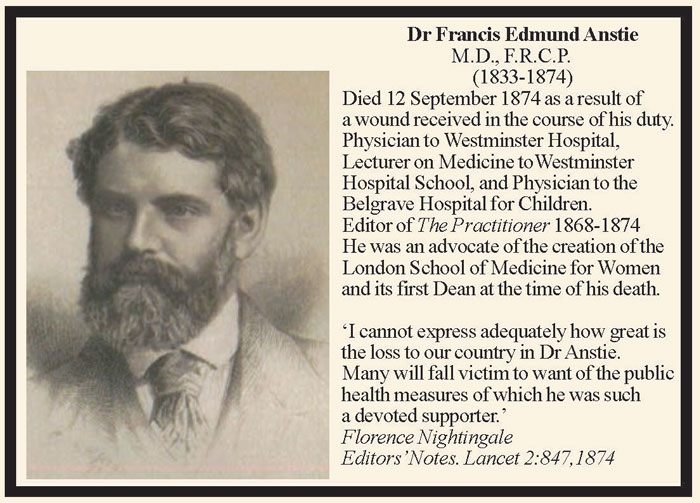
150 years ago:Dr Anstie’s death and his last teaching in sanitary work. Practitioner November/December 2022;266(1863):32-33
150 years ago: Dr Anstie’s death and his last teaching in sanitary work
20 Dec 2022
Article
Dr Anstie, during the examination of a septic corpse from the Royal Victoria Patriotic Asylum for Girls, received the puncture which killed him at the age of 41 years. The day after the puncture the writer of this article had a long conversation with him on the state of things which Dr Anstie had observed at this asylum. He made no reference to the wound he had received, and which must then have been beginning to work out its fatal consequences; and the writer left him impressed with the enthusiasm with which he had entered upon a difficult task.
It seems due to him, in the pages of The Practitioner, and in this section of it on Public Health, to reproduce in substance what he then said; and his death, a related consequence of the neglect against which he protested, gives a melancholy interest to this his last teaching in sanitary work.
Royal Victoria Patriotic Asylum for Girls
Dr Anstie first described the kind of sickness which was proving fatal among the children in this south London asylum for orphan daughters of soldiers, sailors and marines who had died in service.
Its most obvious post-mortem sign was peritonitis, and the chief symptoms observed during life were explicable by this change found after death. He had, in fact, to deal with a local outbreak of peritonitis among children above the age of infancy, a form of the disease apparently unknown, and, at least so far as he had then been able to make out, unrecorded in medical literature.
Provisionally, he regarded the peritonitis as an indication of a septicaemic state of the system. In the direction suggested by this line of thought, he was casting about for a clue to the outbreak by examining the ordinary sanitary conditions under which the children in the asylum lived.
He had first, after a general survey, given attention to the water supply; and here a state of things had been discovered which led him to suppose that other conditions of grave sanitary mismanagement would be disclosed on further investigation.
Dr Anstie found that water, supplied by one of the water companies south of the Thames, was first received into a tank, in which was placed a charcoal filter, after passing which it flowed into other tanks, and was then distributed to the various parts of the building. In other words, notwithstanding the filtration of the water by the water company in the first place, arrangements had been made at the asylum for a second more efficient filtration of the water, through charcoal, before its use.
This provision would have been excellent and thoughtful, if it had been other than an egregious sham. For Dr Anstie found the filter loaded with filth, and at the bottom of the filtration tank, and of the other tanks, a large quantity of excessively foul sludge. That is to say, the means adopted to purify the water had been converted into a means of fouling it.
In the then state of the filter, water passing through would necessarily carry along with it some of the filthy matter deposited in it.
It was obvious that neither the state of the tanks nor of the filter had been looked to for a long time, and that there was no supervision deserving of the name over this important part of the arrangements of the asylum.
The absence of all proper supervision over the water supply of the asylum (and over other important sanitary provisions) was, Dr Anstie observed, an illustration of a defect of management which prevailed to an untold extent in great schools and other public institutions, not even excluding hospitals, which was productive of much evil.
The defect was a want of true responsibility on the part of the managing body for the sanitary welfare of the persons under their charge, and a consequent laxity in the sanitary administration of the institution.This sooner or later leads to distressing and not infrequently fatal outbreaks of disease.
Dr Anstie looked at institutions like the Patriotic Asylum, in which the thoughtful original structural provision for the health of its inmates is suffered to go seriously wrong. The evil in these cases depends upon the fact that the sanitary care of the institution is dealt with as an incidental matter, requiring only dilettante care. It was rarely held necessary to inquire systematically into the state of the particular arrangements for the water supply and for the sewerage, with all the mechanical fittings connected therewith, until a breakdown occurs or the occurrence of sickness among the inmates.
The managing body does not undertake this duty itself, and does not fix the duty definitely on a responsible officer. It inquires vaguely as to sanitary arrangements when it meets; makes vague, superficial inspections; its officers catch the trick of vagueness and superficiality from their masters; there are neither minute examinations at regular intervals nor specific reports, and everybody drifts into a seventh heaven of self-complacent ignorance of the actual state of things, until aroused by an outbreak of mischief which it was the special object of the sanitary arrangements of the place to prevent, and which they would have prevented had they been kept in reasonable order as originally designed.
Another institution
In another such institution discussed by Dr Anstie the sewerage arrangements had been designed by an architect competent and painstaking in such matters, and carried out under his supervision. His final suggestion to the managing body was to appoint a competent man to look weekly to all the mechanical fittings of the water-closets, and generally to the state of the sewers, and to make one officer definitely responsible for the proper working of the sewerage and water supply.
The managing body found a competent man but thought they should most benefit the institution by refusing to pay £15 a year and by looking after the sanitary arrangements themselves.
Thus everything with regard to sewerage and water supply was left to chance care. Occasionally there was a stopped drain or some such trifling break-down, and the readiest jobbing builder was called in to rectify it.
Four or five years later, the medical officer of the institution complained of foul smells, but he was curtly told that he had
‘an imaginative nose’. The inmates and those in charge of them supported the medical officer’s statement, but they were told that the smells only came from their own ‘dirty habits.’
Then a dropping case or two or erysipelas occurred, and diarrhoea became common among the inmates but the managing body had confidence in the original plan of sewerage, and refused to listen to the advice of their medical officer or call in the architect for a survey.
Finally, enteric fever appeared in the institution, and an imminent danger of public exposure came with it. Then the architect and original builder were sent for and the sewerage arrangements looked at.
The findings were that the mechanism of every water-closet was more or less out of order; the drains had been interfered with at various points by the jobbing builders under direction of individual members of the managing body; traps had been put down promiscuously where they ought not to have been; drains directed into old long-disused cesspools; levels disturbed, and the whole system of drains transferred into a ramified cesspool.
As Dr Anstie put it, the managing bodies of these institutions had played with their responsibility as to the sanitary arrangements with the results described.
The lesson he had proposed to teach in these pages, from this instance and that of the Patriotic Asylum, was this: ‘The necessity for a clearer insight among managing bodies as to the nature of the responsibility resting upon them respecting the sanitary management of the institutions under their care; and for fixing a more definite responsibility as to the sanitary arrangements upon the officers, or some of them.’
ARTICLE IN PDF
 Download this article in PDF format