SEARCH

A hundred years ago. Difficult dislocations. Practitioner 2016;260 (1792):29
Difficult dislocations
25 Apr 2016
AUTHORS
Written 100 years ago by W. Paulson, L.R.C.P. & S.
Article
DISLOCATIONS, even rare ones, have a knack of cropping up in general practice. One of the most unmanageable and disastrous is undoubtedly congenital dislocation of the hip. Failures gall me, as I suppose they do most people, and the verdict, “Nothing can be done,” always, I fear, arouses my obstinacy.
Dislocations of the hip
A particularly distressing failure, in the earlier years of my work, was the sight of a good looking youth sitting, from his hips upwards, like an image of Buddha. I shared the responsibility with several hospitals and specialists, but the result of our efforts was negative. The much trumpeted operations of a few years ago apparently only inflicted suffering, and left the unfortunate victims in a worse state than before.
A short time ago, I came across a case of this kind, and, watching the child, I perceived that, by placing her feet together and spreading her knees widely apart, she produced the forward dislocation quite easily and painlessly. Ordinarily, I think the dislocation is either directly forwards or backwards. If forwards, the child places its feet together and abducts the thighs, there is little to restrain it, and the result is certain. In case the head escapes backwards, I think it is somewhat easier to deal with.
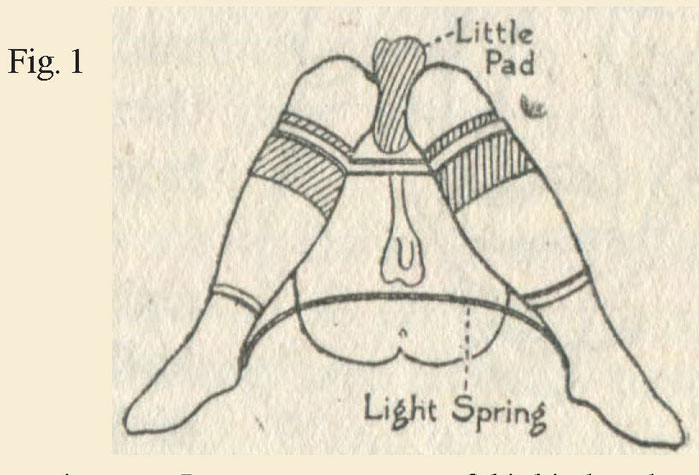
After watching the child previously mentioned and carefully considering the question, I devised the plan as shown in Fig. 1 to defeat the manoeuvre. The knees are shackled together and the feet kept wide apart.
With young children (and, of course, treatment should be as early as possible), I think a silk handkerchief, divided into two triangular bandages and looped in a figure of eight above and below the knee, would suffice, the ends being tied together, and only one removed at a time.The feet should be kept apart by a light, nickelled-steel spring, fitted to warm and comfortable boots. It is impossible to extend the legs under these circumstances.
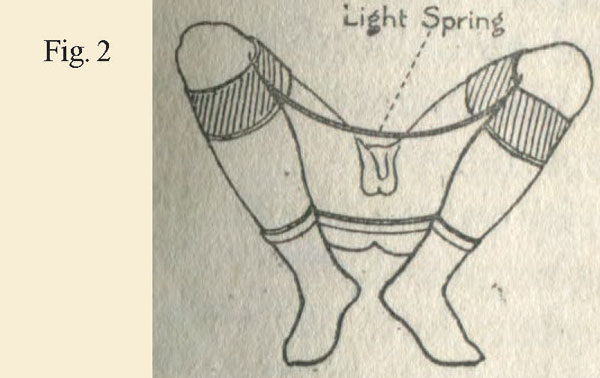
As regards dislocation backwards, tucking one knee under the other and spreading the feet accomplishes the luxation only too promptly. Spreading the knees, and shackling the ankles, as illustrated in Fig. 2, entirely prevents this occurring. Both methods allow of a sufficiently moderate movement for comfort, and the freest possible access for washing, powdering, and tending the baby. A somewhat narrow crib, and a horseshoe rubber cushion, would also afford support to the hip joint. Both positions are inelegant, but so natural and comfortable to babies that they may be maintained for any length of time.
When there is practically no acetabulum, I fear the case is hopeless.
Dislocation of the thumb
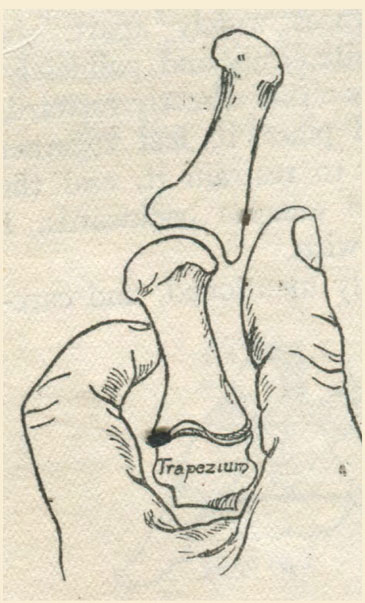
Another dislocation is notoriously troublesome – that of the thumb at the metacarpo-phalangeal joint. The following little manipulation, which I first practised many years ago, and which has never failed to reduce it, is well worth trying before resorting to the usual anaesthetic.
Suppose it is the left thumb. Place your left hand over the back of the patient’s left, press your index finger firmly between his metacarpal and hand to steady it, then flex his thumb to release it from short flexors.
Turn it outwards at almost a right angle, press firmly, with the ball of your left thumb, on the dislocated end of his phalanx, following it up as you elevate sharply, with your right hand. In this way, reduction is easily and quickly accomplished, sliding smoothly over the convex head.
ARTICLE IN PDF
 Download this article in PDF format