SEARCH

Tidman MJ. Improving the management of atopic eczema in primary care. Practitioner 2012; 256 (1750):21-23
Improving the management of atopic eczema in primary care
25 Apr 2012
AUTHORS
Dr Michael J. Tidman MD FRCP (Edin) FRCP (Lond)
Consultant Dermatologist, Department of Dermatology, Royal Infirmary of Edinburgh
Article
Atopic eczema is a very common, pruritic, inflammatory condition of the skin, the cause of which is complex and still not fully understood. There appears to be a genetic deficiency of the barrier function of the epidermis making the skin excessively permeable and susceptible to damage by environmental factors. Although generally considered a childhood ailment, 38% of patients with atopic eczema in the UK are adults.1
Not only is there a very substantial cost to the NHS in treating atopic eczema2 but, depending on disease severity, the condition often has a very significant detrimental effect on the quality of life of affected individuals and their families as a result of pruritus-induced sleep disturbance and impairment of concentration, cosmetic appearance, and the time and money spent on treatment. Atopic eczema can adversely affect a child’s emotional and social development and cause psychological problems; later in life it may cause relationship and occupational difficulties.3,4
The majority of care for atopic eczema is, quite rightly, undertaken by the primary healthcare team. However, despite the availability of national evidence-based guidelines such as those produced by NICE5 and SIGN,6 standards of care in the community setting can vary, and there is still a tendency to undertreat and not follow up and monitor some patients with atopic eczema adequately. Moreover, patients are not always given adequate information to help them understand and manage their condition, see below. However, atopic eczema is not always easy to manage. It is a multifaceted condition, and more often than not the reasons for flaring cannot be identified.
Diagnosis
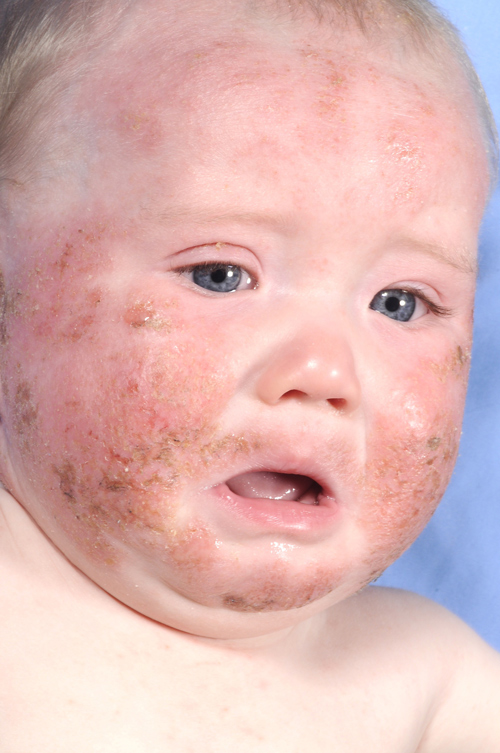
The diagnosis of uncomplicated atopic eczema (see figure 1) is usually straightforward and is based on clinical history and visual assessment. Laboratory tests are not helpful. The best validated diagnostic criteria were produced by a UK Working Party7 (see table 1) and are included in the SIGN guidelines.6
However, atopic eczema may be complicated by secondary infection, particularly staphylococcal and streptococcal, and herpes simplex virus may cause extensive cold sore formation (eczema herpeticum), which is very uncomfortable and potentially dangerous.
Furthermore, atopic eczema may coexist with other dermatological disorders, such as scabies, superficial fungus infection and contact dermatitis (irritant and allergic): if these conditions pass undiagnosed, the treatment of atopic eczema will be compromised.
Patient information
There is no doubt that a well informed patient or carer will find it easier to cope with the management of atopic eczema.
Written information, in the form of patient information leaflets about atopic eczema, eczema herpeticum and topical corticosteroids, is available from the British Association of Dermatologists (www.bad.org.uk), and patients and their carers have been included as targeted users of the SIGN guideline (www.sign.ac.uk). The British Skin Foundation and the National Eczema Society are also useful sources.
Ideally, patients or carers should receive a full explanation of how to use topical treatments and a demonstration of how to apply dressings, if applicable.
They should be educated about the diagnosis of infection and have the opportunity to discuss any concerns regarding potential side effects.
Therapeutic options
Historically, the management of atopic eczema has relied heavily on clinical consensus and the preferences of individual clinicians, whereas guidelines such as those produced by NICE and SIGN are based on contemporaneous evidence.
A number of the traditional therapeutic options to manage atopic eczema are unsupported by evidence derived from unbiased measures, and therefore have low profiles in these evidence-based guidelines. The treatment options available in primary care are listed in table 2.
Emollient therapy
Emollients are the mainstay for treating atopic eczema. They soften the skin, help restore the impaired barrier function of the epidermis, reduce the itch of dry skin, increase the efficacy of topical corticosteroids and have a steroid-sparing effect.6
Patient preference should be respected, the application technique explained, warnings about the flammability of greasy preparations given, and adequate amounts prescribed.6
They should be applied liberally and frequently, enough to keep the skin silky smooth, and their use continued during periods of treatment with topical corticosteroids.
Topical corticosteroid therapy
The SIGN guideline for atopic eczema made the novel recommendation that topical corticosteroids need be applied, initially, just once daily.6 This should have the benefit of reducing prescribing costs, improving patient compliance and minimising the potential risks of local and systemic side effects.
SIGN also recommends that consideration be given to maintenance therapy (with topical corticosteroid applied twice weekly to eczema-prone areas during remissions, in addition to daily emollients) as a safe means of reducing the frequency of flaring.
There is no good evidence base to assist in the selection of steroid potency, although both the NICE and SIGN guidelines make recommendations based on age and body region.
SIGN recommends as good practice that atopic eczema patients for whom intermittent courses of topical corticosteroids are being prescribed should be reviewed every three to six months (depending on steroid potency and site of application) to ascertain response and to assess their skin for potentially reversible atrophic changes.
Topical calcineurin inhibitors
The topical calcineurin inhibitors tacrolimus and pimecrolimus are non-steroidal immunomodulating agents, and should be considered, in patients two years and older, for the acute treatment of moderate and severe atopic eczema that has not been controlled by topical corticosteroids
or if there is a serious risk of important adverse effects from further corticosteroid use.6 Long-term maintenance therapy with tacrolimus ointment, applied twice weekly, has been shown to reduce flaring.
Because the long-term safety of the topical calcineurin inhibitors has not yet been established, they are licensed as second-line treatments for atopic eczema, and both NICE and the Scottish Medicines Consortium have restricted their initiation to doctors with a special interest and experience in treating atopic eczema, which may include GPs.
Paste dressings and wet wraps
There is very little evidence base for the use of occlusive dressings in the management of atopic eczema in primary care, but consensus clinical opinion is that paste dressings in particular can be very effective by providing a physical barrier to scratching, improving retention of emollient, and being soothing and intrinsically anti-inflammatory.
Antimicrobial measures
The evidence base for the effectiveness of antimicrobial measures, including antiseptics, topical and oral antibiotics, in the management of atopic eczema
is poor. Oral antibiotics are not recommended in the routine treatment of non-infected atopic eczema, but their short-term use in infected atopic eczema is encouraged.6 Staphylococcal carriage should be excluded in the patient and family members when there is recurrent infection.6
Antihistamines
There is insufficient evidence on which to base a recommendation for the use of antihistamines in atopic eczema, but SIGN encourages the short-term night-time use of a sedating antihistamine in atopic eczema complicated by sleep disturbance.6
Investigation for allergies
Food allergy and intolerance (IgE- and non-IgE-mediated) is common in patients with atopic eczema, and may cause a variety of symptoms, but its relevance to the generation and maintenance of cutaneous inflammation in atopic eczema remains unclear and controversial.
IgE-mediated sensitisation can be demonstrated by the presence of circulating specific IgE and by skin prick testing. However, the multifactorial nature of the inflammation in atopic eczema may obscure a causal relationship between food ingestion and cutaneous symptoms, as assessed by a food diary or an elimination diet. Dietary exclusion is not recommended in the management of atopic eczema in the absence of a confirmed food allergy.6
In view of the difficulties involved in teasing out the relevance of dietary factors in atopic eczema, it is reasonable to consider referral of children with moderate to severe atopic eczema and adults with severe disease to an allergy specialist if they do not respond satisfactorily to standard topical medication.
Explanation should be given to patients and carers that food allergy, if demonstrated, is unlikely to be the sole cause of their atopic eczema.
If a contact allergy, which is an entirely different immunological mechanism from food allergy, is suspected to be complicating atopic eczema, referral to a dermatologist should be made for consideration of patch testing.
Referral
Although the majority of patients with atopic eczema are managed in primary care, referral for specialist care and investigation should be considered in the following situations:6
• Clinical suspicion of eczema herpeticum (in which case an emergency referral to a dermatologist or paediatrician should be made)
• Uncertainty about the diagnosis
• Poor control of the condition or lack of response to appropriate topical medication
• Psychological upset or sleep problems
• Recurrent secondary infection
• Reasonable suspicion of food allergy (in which case the referral should be to an allergist or a paediatrician with a special interest in allergy)
• Reasonable suspicion of contact allergy (in which case the referral should be to a dermatologist)
Conclusion
Experience shows that the majority of children and adults with atopic eczema can be managed very satisfactorily in general practice.
Ready access to a primary healthcare team that is informed and enthusiastic will contribute significantly towards reducing the emotional and economic burden of the condition, and obviate the need to consider secondary care options such as phototherapy or systemic immunosuppression.
Evidence-based guidelines should act as catalysts for generating new data for those aspects of atopic eczema management where an evidence base is currently lacking.
REFERENCES
1 Herd RM, Tidman MJ, Prescott RJ et al. Prevalence of atopic eczema in the community: the Lothian atopic dermatitis study. Br J Dermatol 1996;135:18-19
2 Herd RM, Tidman MJ, Prescott RJ et al. The cost of atopic eczema. Br J Dermatol 1996;135:20-3
3 Barnetson R, Rogers M. Childhood atopic eczema. BMJ 2002;324:1376-9
4 Absolon C, Cottrell D, Eldridge S et al. Psychological disturbance in atopic eczema: the extent of the problem in school-aged children. Br J Dermatol 1997;137:241-5
5 National Institute for Health and Clinical Excellence. CG57. Atopic eczema in children: management of atopic eczema in children from birth up to the age of 12 years. NICE. London. 2007
6 Scottish Intercollegiate Guidelines Network. SIGN 125. Management of atopic eczema in primary care. SIGN. Edinburgh. 2011
7 Williams H, Burney PG, Hay RJ et al. The UK Working Party’s Diagnostic Criteria for Atopic Dermatitis. I. Derivation of a minimum set of discriminators for atopic dermatitis. Br J Dermatol 1994;131(3):383-96
ARTICLE IN PDF
 Download this article in PDF format
EXTERNAL WEBLINKS
PubMed
NICE Evidence
UK Primary Care Dermatology Society
Guidance
Eczema: asteatotic eczema (syn. xerotic eczema, eczema craquele)
Eczema: atopic eczema
Eczema: contact allergic dermatitis (including latex and rubber allergy)
Eczema: discoid (syn. nummular) eczema
Eczema: eczema herpeticum
Eczema: gravitational eczema
Eczema: hand (and foot) eczema
Eczema: napkin eczema