SEARCH

Day A, Hollamby S, Girling J. Have a high index of suspicion for ectopic pregnancy. Practitioner Mar 2020;264(1835):15-18
Have a high index of suspicion for ectopic pregnancy
24 Mar 2020
AUTHORS
Ms Andrea Day MBBS MRCOG, Locum Consultant Obstetrician and Gynaecologist
Ms Suzanne Hollamby MBBS FRCOG, Consultant Gynaecologist
Ms Joanna Girling MA MRCP FRCOG Consultant Obstetrician and Gynaecologist
West Middlesex University Hospital, Chelsea and Westminster NHS Foundation Trust, London, UK
Competing interests: None
Article
Ectopic pregnancy is estimated to occur in 1-2% of all pregnancies and continues to be the leading cause of maternal mortality in early pregnancy. Most ectopic pregnancies are located within the fallopian tube and carry a risk of tubal rupture and intra-abdominal bleeding. Clinical diagnosis alone is inaccurate in ectopic pregnancy. A history of a previous ectopic pregnancy is the strongest recognised risk factor, with a recurrence rate of at least 10% for women with one previous ectopic pregnancy, and 25% for those with two or more. A meta-analysis also found a strong association with previous tubal surgery, documented tubal pathology and in utero diethylstilbestrol exposure. Conception using assisted reproductive technology, smoking and age have also been found to be contributing factors. However, many women have no risk factors.Women with ectopic pregnancy can present in a wide variety of ways, from acute collapse following rupture to asymptomatic and unaware that they are pregnant. Symptoms may include vaginal bleeding and abdominal pain. There may also be non-specific symptoms such as Gl and urinary symptoms, rectal pressure, dizziness, shoulder tip pain, fainting or syncope. A full history should be taken and physical examination should include pulse and blood pressure, abdominal and pelvic examination. Patients may have generalised or localised abdominal tenderness, guarding or rebound. Pelvic examination may be normal but adnexal tenderness or cervical excitation is a cause for concern. However, women with ectopic pregnancy may have no abnormal findings.
In the UK, ectopic pregnancy is estimated to occur in 1-2% of all pregnancies and continues to be the leading cause of maternal mortality in early pregnancy. When evaluated in women who experience symptoms such as abdominal pain and vaginal bleeding, the prevalence can be as high as 16%.1
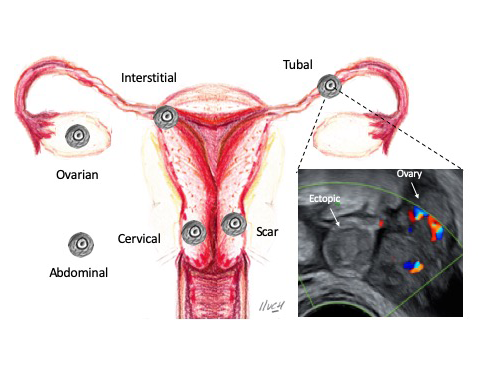
The majority of ectopic pregnancies are located within the fallopian tube and carry a risk of tubal rupture and intra-abdominal bleeding.2
Clinical diagnosis alone is inaccurate in ectopic pregnancy and represents a diagnostic challenge in primary care.3,4 We will review the diagnosis and management of tubal ectopic pregnancy looking at the recommendations in the updated NICE guideline (NG126) published in 2019.5 Non-tubal ectopic pregnancy and heterotopic pregnancy (in which there are two pregnancies in different sites, usually one intrauterine and one ectopic) need individual consideration and are outside the scope of this article.
Risk factors
Although a range of risk factors have been reported in the literature, many women diagnosed with an ectopic pregnancy have no risk factors.5,6
A history of a previous ectopic pregnancy is the strongest recognised risk factor with a recurrence rate of at least 10% for women with one previous ectopic pregnancy, and 25% for women with two or more.6,8 Conception using assisted reproductive technology,7,8 smoking and maternal age have also been found to be contributing factors.9
A meta-analysis that reviewed 36 studies suggested the following risk factors showed a strong association:7 previous ectopic pregnancy; previous tubal surgery; documented tubal pathology; in utero diethylstilbestrol exposure. A weak association was found for: previous genital infection; infertility; lifetime number of sexual partners > 1.
If women conceive with an intrauterine device in situ, the chance of having an ectopic pregnancy increases significantly, and has been reported to be as high as 53%.10,11
Presentation
Women with ectopic pregnancy can present in a wide variety of ways, ranging from acute collapse following rupture to asymptomatic and unaware that they are pregnant. Symptoms may include vaginal bleeding and abdominal pain, there may also be non-specific symptoms such as gastrointestinal and urinary symptoms, rectal pressure, dizziness, shoulder tip pain, fainting or syncope.5,13,14 This represents a broad clinical spectrum and as such, clinical diagnostic accuracy is poor.14,15
The importance of having a high index of suspicion is highlighted in the confidential enquiries into maternal deaths and morbidity. The report emphasises that a diagnosis of ectopic pregnancy should be considered (regardless of whether or not the patient is known to be pregnant) in all women of reproductive age who present in a state of shock and/or collapse with no obvious cause, or who present with acute abdominal or pelvic pain or gastrointestinal symptoms.16
A pregnancy test can potentially save a life and should be a priority, even using a catheter if this is needed to obtain a urine sample.16
Women who do not know they are pregnant and mistake vaginal bleeding due to ectopic pregnancy as menstruation are at particular risk, as often, they have an underlying ectopic pregnancy and present late. Consequently, if a woman reports a last menstrual period 2-3 weeks before a positive pregnancy test with continued light vaginal bleeding, urgent referral to an early pregnancy assessment unit (EPU) or out of hours services should be considered.
The other group that can result in a misdiagnosis is women with heavy vaginal bleeding who are thought to have had a miscarriage and are passing what is thought to be ‘pregnancy tissue’ but may in fact be a clot or decidual cast. These women need to be appropriately followed up with a urine pregnancy test (UPT) or ultrasound, as it is estimated that 5-7% of women who give a history suggestive of miscarriage, actually have an underlying ectopic pregnancy.17
Assessment
In primary care, a full history should be taken and physical examination carried out to decide the urgency of referral and also to rule out other causes. This should include pulse and blood pressure, abdominal and pelvic examination.
On abdominal examination, patients may have generalised or localised tenderness, guarding or rebound. Pelvic examination may be normal but adnexal tenderness or cervical excitation is a cause for concern and may represent peritoneal irritation by blood. However, women with ectopic pregnancy may have no abnormal findings.
In the EPU setting, a transvaginal ultrasound is the first-line investigation. A prospective study on women attending an EPU with a positive UPT, found that in 74% of women with a tubal ectopic pregnancy, the diagnosis was made on the initial scan.18
However, imaging is dependent on the skills of the operator and patient factors such as body mass index, uterine fibroids, adnexal pathology or ovarian hyperstimulation. As a result, in more challenging cases the ectopic pregnancy may not be visualised on a scan.
When a scan fails to identify the site of the pregnancy in a woman with a positive UPT, a provisional diagnosis of ‘pregnancy of unknown location (PUL)’ is made. This may occur because: the scan has been performed before it is possible to see a pregnancy (i.e. too early) or after the pregnancy tissue has been passed during a miscarriage; or the scan has failed to detect an ectopic pregnancy. In cases of PUL, a serum beta-hCG test (and progesterone in some units) is done and the results are interpreted taking the clinical picture into account.
Referral
Any patient who is haemodynamically unstable with signs of shock such as pallor, tachycardia or hypotension or in whom there is significant concern about degree of pain or bleeding should be transferred immediately to the nearest emergency department, alerting the out of hours gynaecology team as urgent surgical intervention may be indicated.
If the patient in whom an ectopic pregnancy is suspected is stable, the urgency of referral is dependent on the clinical situation. When and where the patient is referred will depend on EPU service availability and referral should usually be initiated the same day. While patients are waiting for an appointment or scan they should be advised that if they have worsening pain or develop dizziness, shoulder tip pain or any gastrointestinal symptoms, they should go to accident and emergency immediately.
Each hospital will have its own referral policies. The NICE recommendations on referral are shown in box 1.
Management
Ectopic pregnancy can be managed with surgical, medical or expectant management.
Immediate surgical treatment is advised for women in whom an ectopic pregnancy is suspected with any evidence of significant haemoperitoneum (bleeding in the abdominal cavity) and/or collapse.
Patients who are haemodynamically stable, can also have other treatment modality options depending on the site of the ectopic pregnancy, the symptoms, the presence of blood in the abdominal cavity and the serum hCG value (see figure 1).
Surgery
NICE recommends surgical management for tubal ectopic pregnancy in the following cases:5
• Significant pain
• A live ectopic
• An adnexal mass ≥ 35 mm
• hCG ≥ 5,000 IU/L
• Failed medical or expectant management
• The patient is unable to return for follow-up
Surgery should be performed laparoscopically. However, laparotomy can be performed in exceptional cases of acute collapse. A salpingectomy is recommended if the contralateral tube appears normal, and a salpingotomy is considered if the contralateral tube appears abnormal. A randomised controlled trial comparing the two surgical options reported fertility rates to be the same for both, and that women treated by salpingectomy had a lower ectopic recurrence rate.19 It is currently the preferred option in women whose tubes appear normal.
Women who undergo salpingotomy also have a risk of residual trophoblastic tissue, estimated to occur in up to 20% of these patients; they should have serum hCG measurements weekly until the result is negative. It is therefore recommended that salpingotomy should only be considered in women with evidence of contralateral tubal pathology in an attempt to improve the fertility rate in this group of women.20 Rhesus-negative women undergoing a surgical procedure for ectopic pregnancy should be given anti-D 250 IU intramuscularly which is usually arranged by the hospital prior to discharge.
Non-surgical management
Non-surgical management of tubal ectopic pregnancy includes medical treatment with systemic methotrexate, which is a folic acid antagonist that acts by inhibiting cell proliferation, or expectant management which has a reported success rate of 70% in those with a low hCG.21
NICE recommends these options should be considered in the following circumstances:
• The woman is clinically stable
• There is no significant pain
• The tubal ectopic pregnancy measures < 35 mm (with no fetal cardiac activity or signs of rupture)
• The woman is willing to return for regular follow-up
• Beta-hCG: < 5,000 IU/L for medical management; < 1,000 IU/L (or possibly up to 1,500 IU/L) for expectant management
Methotrexate is teratogenic and consequently an intrauterine pregnancy needs to be completely ruled out and contraception advised for three months thereafter. In clinical practice, this option is offered only after a confirmed ectopic is seen on a scan and an intrauterine pregnancy has been ruled out. In many cases, an hCG in 48 hours is required to rule out a possible intrauterine pregnancy. Normal liver and renal function need to be established prior to starting medical treatment.
Surgical intervention or a second dose may be required should the hCG plateau or increase, if pain worsens or there are any signs of intra-abdominal bleeding.
Evidence of hCG clearance is needed both in medical and expectant management to monitor success of these non-surgical options and occasionally, a second dose or laparoscopy is required.
Improving outcomes
A pregnancy loss has a significant psychological impact. A recent large study of women with early pregnancy loss (miscarriage or ectopic pregnancy) reported that nearly a third of women can suffer post-traumatic stress and a quarter experience moderate to severe anxiety a month after the event.22
Support and counselling are imperative and should include leaflets, web addresses and helpline numbers.
A follow-up appointment should be offered to all women after an early pregnancy loss5 and referral to a specialist should be offered to those with significant symptoms. Box 2 outlines other steps that can be taken to try to improve patient outcomes.
Conclusion
Abdominal pain and vaginal bleeding are common symptoms in early pregnancy. Most women with ectopic pregnancy present subacutely with mild symptoms. Occasionally, these women can display atypical symptoms such as diarrhoea, shoulder tip pain, dizziness or collapse due to peritoneal irritation and intra-abdominal bleeding. A high index of suspicion is needed to be able to offer patients all management options and reduce morbidity and mortality.
Early pregnancy loss has a significant psychological impact and improvements are needed for the follow-up of these patients.
REFERENCES
1 Murray H, Baakdah H, Bardell T, Tulandi T. Diagnosis and treatment of ectopic pregnancy. CMAJ 2005;173(8):905-12
2 Bouyer J, Coste J, Fernandez H et al. Sites of ectopic pregnancy: a 10 year population-based study of 1800 cases. Hum Reprod 2002;17(12):3224-30
3 Kadar N. Early recourse to laparoscopy in the management of suspected ectopic pregnancy. Accuracy and morbidity. J Reprod Med 1990;35(12):1153-56
4 Dart RG, Kaplan B, Varaklis K. Predictive value of history and physical examination in patients with suspected ectopic pregnancy. Ann Emerg Med 1999;33(3):283-90
5 National Institute for Health and Care Excellence. NG126. Ectopic pregnancy and miscarriage: diagnosis and initial management. NICE. London. 2019 www.nice.org.uk/guidance/ng126
6 Barnhart KT, Sammel MD, Gracia CR. Risk factors for ectopic pregnancy in women with symptomatic first-trimester pregnancies. Fertil Steril 2006;86(1):36-43
7 Ankum WM, Mol BWJ, Van der Veen F, Bossuyt PMM. Risk factors for ectopic pregnancy: a meta-analysis. Fertil Steril 1996;65(6):1093-99
8 Karaer A, Avsar FA, Batioglu S. Risk factors for ectopic pregnancy: A case-control study. Aust NZ J Obstet Gynaecol 2006;46(6):521-27
9 Bouyer J, Coste J, Shojaei T et al. Risk factors for ectopic pregnancy: A comprehensive analysis based on a large case-control, population-based study in France. Am J Epidemiol 2003;157(3):185-94
10 Backman T, Rauramo I, Huhtala S, Koskenvuo M. Pregnancy during the use of levonorgestrel intrauterine system. Am J Obstet Gynecol 2004;190(1):50-54
11 Xiong X, Buekens P, Wollast E. IUD use and the risk of ectopic pregnancy: A meta-analysis of case-control studies. Contraception 1995;52(1):23-34
12 Cleland K, Raymond E, Trussell J et al. Ectopic pregnancy and emergency contraceptive pills: a systematic review. Obstet Gynecol 2010;115(6):1263-66
13 Huchon C, Panel P, Kayem G et al. Is a standardized questionnaire useful for tubal rupture screening in patients with ectopic pregnancy? Acad Emerg Med 2012;19(1):24-30
14 Crochet JR, Bastian LA, Chireau MV. Does this woman have an ectopic pregnancy? The rational clinical examination systematic review. JAMA 2013;309(16):1722-29
15 Weckstein LN. Clinical diagnosis of ectopic pregnancy. Clin Obstet Gynecol 1987;30(1):236-44
16 Knight M, Brunch K, Tuffnell D et al. Saving lives, improving mother’s care report, Lessons learned to inform maternity care from the UK and Ireland Confidential Enquiries into Maternal Deaths and Morbidity 2015-17. 2019
17 Condous G, Okaro E, Khalid A, Bourne T. Do we need to follow up complete miscarriages with serum human chorionic gonadotrophin levels? BJOG 2005;112(6):827-29
18 Kirk E, Papageorghiou AT, Condous G et al. The diagnostic effectiveness of an initial transvaginal scan in detecting ectopic pregnancy. Hum Reprod 2007;22(11):2824-28
19 Mol F, van Mello NM, Strandell A et al. Salpingotomy versus salpingectomy in women with tubal pregnancy (ESEP study): an open-label, multicentre, randomised controlled trial. Lancet 2014;383(9927):1483-89
20 Mol BWJ, Matthijsse HC, Tinga DJ et al. Fertility after conservative and radical surgery for tubal pregnancy. Hum Reprod 1998;13(7):1804-89
21 Elson J, Tailor A, Banerjee S et al. Expectant management of tubal ectopic pregnancy: Prediction of successful outcome using decision tree analysis. Ultrasound Obstet Gynecol 2004;23(6):552-56
22 Farren J, Jalmbrant M, Falconieri N et al. Posttraumatic stress, anxiety and depression following miscarriage and ectopic pregnancy: a multicenter, prospective, cohort study. Am J Obstet Gynecol Published 13 December 2019. Epub ahead of print
 Download this article in PDF format