SEARCH

Craig MC, Sadler C, Panay N. Diagnosis and management of premenstrual syndrome. Practitioner Mar 2019;263(1824):15-19
Diagnosis and management of premenstrual syndrome
25 Mar 2019
AUTHORS
Dr Michael C Craig BSc(Hons) MBBS PhD FRCOG FRCPsych, Reader in Reproductive and Neurodevelopmental Psychiatry, Institute of Psychiatry, Psychology and Neuroscience, King’s College London and National Female Hormone Clinic, Maudsley Hospital, London, UK
Dr Carrie Sadler BMBS DRCOG DCH, Associate Specialist in Reproductive Health, Derbyshire Integrated Sexual Health Service, Derby, UK
Mr Nick Panay BSc FRCOG MFSRH, Consultant Gynaecologist, Menopause and PMS Centre, Queen Charlotte’s and Chelsea Hospital, and Chelsea and Westminster Hospital, London, UK
Competing interests
Dr Michael Craig has no competing interests. Dr Carrie Sadler has acted in an advisory capacity for Pfizer, Consilient, Gedeon Richter and HFA Healthcare Products, has given talks organised by Bayer, Astellas and Consilient and is a coil trainer for Bayer. Mr Nick Panay has lectured and acted in an advisory capacity for Abbott, Bayer, Besins, Consilient, Fotona, Meda, Mithra, MSD, Mylan, Novo Nordisk, Pfizer, Secur, Shionogi and Theramex.
Article
Abstract
The term premenstrual syndrome (PMS) refers to a constellation of mood and physical symptoms that occur during the luteal phase of the menstrual cycle. The National Association for Premenstrual Syndrome suggests that: ‘If PMS symptoms affect personal and/or social and/or professional quality of life then this should be regarded as being clinically significant PMS.’ Some women give a clear history of onset during the luteal phase of the menstrual cycle, with improvement taking place within a few days after the onset of menses. However, other women present with fluctuating symptoms without making a connection with their menstrual cycle. There are no diagnostic tests for PMS; diagnosis is dependent on the history. Diagnosis of PMS is complicated by a number of conditions with overlapping symptoms. The most common conditions that overlap are anxiety and mood disorders, where the symptoms are present all month long. However, differentiation of these, and other, conditions can be very difficult if the physician relies solely on retrospective symptoms, as recall can be unreliable. Therefore, it is considered best practice to use a symptom diary. Women with confirmed PMS who fail to respond to first-line treatments should be referred to secondary care.
The term Premenstrual syndrome (PMS) refers to a constellation of mood and physical symptoms that occur during the luteal phase of the menstrual cycle. Various approaches have been taken to define the syndrome, arising predominantly from the fields of psychiatry and gynaecology (see box 1 and table 1).
The main factor that separates these definitions is the severity of the symptoms required for a diagnosis. However, the National Association for Premenstrual Syndrome suggests that: ‘If PMS symptoms affect personal and/or social and/or professional quality of life then this should be regarded as being clinically significant PMS, warranting prompt diagnosis, appropriate recognition, psychological support and evidence-based medical care. Some cases of PMS will also qualify for a premenstrual dysphoric disorder (PMDD) diagnosis, but in non-PMDD cases of severe PMS, symptoms may have an equally, or even more, serious impact on the sufferer’.
Presentation
Women can present to primary care with any of the mood and physical symptoms that occur within the spectrum of PMS. Some women give a clear history of onset during the luteal phase of the menstrual cycle, with improvement taking place within a few days after the onset of menses.
However, other women present with fluctuating symptoms without making a connection with their menstrual cycle, and some make a connection where this does not exist. There are no tests for PMS (e.g. blood tests) and diagnosis is dependent on the history.
Diagnosis
Diagnosis of PMS is complicated by a number of conditions with overlapping symptoms. These include generalised anxiety disorder, mood disorders (e.g. bipolar disorder, major depressive disorder, dysthymia), dysmenorrhoea, iatrogenic use of hormonal treatments (e.g. the contraceptive pill), substance misuse, borderline personality disorder, chronic fatigue syndrome, irritable bowel syndrome, and thyroid disease (e.g. hypothyroidism or hyperthyroidism).
The most common conditions that overlap are anxiety and mood disorders, where the symptoms are present all month long. However, differentiation of these, and other, conditions can be very difficult if the physician relies solely on retrospective symptoms, as recall can be unreliable. Therefore, it is considered best practice for PMS symptoms to be prospectively recorded by patients using a symptom diary, e.g. the Daily Record of Severity of Problems (DRSP),1 see figure 2, for a period of not less than two months. From a practical perspective, some women may find it easier to use app diaries such as Clue and PreMentricS.
Management
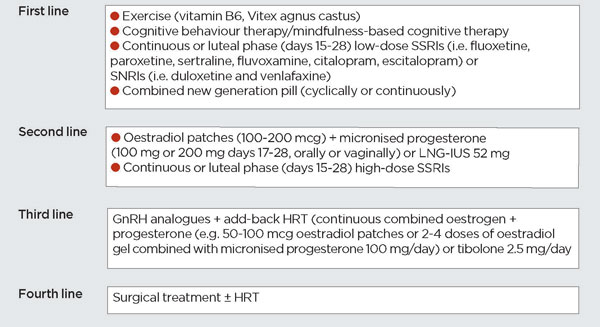
PMS treatment should be considered within a biopsychosocial model. Adopting healthy lifestyle choices, such as regular exercise, is likely to have a beneficial effect on many core PMS symptoms and should be a first-line treatment, see figure 1.
Most treatments for PMS are not licensed for this purpose. However, the Royal College of Obstetricians and Gynaecologists has published evidence-based guidelines for the management of PMS (Green-top Guideline No. 48).4 The options available are summarised below:
Psychological therapy
There is evidence from randomised controlled trials to support the use of mindfulness-based cognitive therapy5 and cognitive behaviour therapy (CBT)6 in the treatment of PMS. Where possible women with severe PMS should be routinely considered for psychological therapy. While resources mean this is often not possible, recent studies have supported delivery of CBT in groups, and remotely using internet-based CBT7 which may increase availability in the longer term.
Pharmacological therapy
Studies support the use of continuous and luteal phase dosing of selective serotonin reuptake inhibitors (SSRIs)8 and suggest that they should be considered as one of the first-line pharmacological interventions.
There is also evidence to support the use of serotonin-noradrenaline reuptake inhibitors (SNRIs).
As with many medications prescribed to women of reproductive age, it is best to discuss the possible, although unproven, association between SSRI/SNRI use and congenital malformations if taken during pregnancy. However, a recent study suggests that SSRI/SNRI exposure during the first trimester is driven by yet to be determined confounding factors.9 Further, regardless of causation, the absolute risk for septal heart defects is extremely low.10 In addition, women with PMS are likely to discontinue treatment soon after the first missed period, rather than later in the first trimester, and therefore any putative risk may be further diminished. However, women on continuous or higher-dose treatment should be advised of the risk of discontinuation symptoms if they abruptly stop their treatment.
Hormonal therapies
Progesterone: Treating PMS with progesterone or progestogens is not supported by current evidenced-based studies.11,12 However, progesterone pessaries or suppositories (e.g. Cyclogest 200-800 mg days 12–14 until the onset of menstruation) remain a licensed treatment for PMS.
The combined oral contraceptive pill (COCP): Studies suggest that the COCP should be considered as a first-line pharmacological intervention when treating some women with PMS.
This can be prescribed cyclically, but some women benefit from continuous (i.e. back-to-back) regimens.
Currently, the strongest evidence supports the use of new (third) generation COCP preparations.
While it has been suggested that drospirenone-containing COCPs with a shortened hormone-free interval may be particularly effective, the evidence to support this is limited.13
It is also important for clinicians to be aware of the reported association between hormonal contraceptives and increased risk of depression in some women14 and to remain mindful of the risk of venous thrombotic events associated with the COCP in certain women.
Percutaneous oestradiol: Continuous percutaneous bioidentical oestradiol in the form of implants (e.g. 50 mg implant) or transdermal preparations (e.g. 100 mcg patch twice each week or 1 mg gel twice each day) have been reported to be effective in the treatment of physical and psychological symptoms of severe PMS. The dose of oestrogen prescribed is usually enough to suppress ovulation but the contraceptive efficacy is unclear and additional contraceptive measures should be taken.
In women with a uterus it is important to combine continuous oestradiol with cyclical progesterone or progestogens to avoid endometrial hyperplasia. Progestogenic opposition with oral micronised bioidentical progesterone (e.g. Utrogestan 200 mg days 17-28)
is recommended as first line as it is probably less likely to cause PMS-like symptoms than other progestogens (e.g. norethisterone acetate).
Vaginal administration of progestogens can be used in women with a poor tolerance of oral treatment (e.g. Utrogestan 200 mg or Cyclogest 200 mg pessaries on days 17-28). Intrauterine administration using a levonorgestrel intrauterine system (LNG-IUS) can also be considered (e.g. Mirena 52 mg). An advantage of this approach is that it provides contraception where needed.
Lower doses/duration of progesterone or the smaller Jaydess 13.5 mg LNG-IUS are being used off label in some specialist centres for women with severe progestogen/progesterone intolerance with ultrasound monitoring of the endometrium. While vaginal and intrauterine approaches can mitigate the reintroduction of PMS-like symptoms, they can still lead to adverse effects in some progestogen-intolerant women, requiring them to be stopped.
Gonadotropin-releasing hormone agonists (GnRHa): In women with severe PMS symptoms GnRHa can be used as a diagnostic tool (e.g. when diagnosis remains unclear after two months of DRSP charting) and/or to treat symptoms when other approaches have failed.
The mechanism of action of GnRHa is to suppress all ovarian steroid production. This approach can lead to a profound improvement of symptoms in some patients with PMS. However, other women are unable to tolerate the effects of ‘medical menopause’. Further, due to their effects on bone mineral density (BMD) women, need to be given advice about conservative methods that reduce BMD loss (e.g. exercise, diet and stopping smoking).
Add-back hormone therapy (i.e. continuous combined HRT or tibolone) should also be considered either from the outset or certainly when treatment extends beyond six months and an annual DEXA scan is recommended for women receiving long-term treatment.
Hysterectomy and oophorectomy
In women with gynaecological comorbidities that require hysterectomy, and/or severe PMS where the above approaches have been unsuccessful, hysterectomy with bilateral oophorectomy offers an effective and permanent method of ovulation suppression.
This approach is particularly beneficial for women with progesterone intolerance, as it permits oestrogen replacement without the need for progestogenic opposition. Prior to this approach a preoperative trial of GnRHa is recommended to test the likelihood of success and tolerance to hormonal (i.e. oestrogen ± testosterone) add-back.
Exercise and complementary therapies
There have been studies into various therapies including: physical (exercise, reflexology and acupuncture); vitamins (e.g. B6 and D); minerals
(e.g. magnesium and calcium); and herbs (Vitex agnus castus, St John’s wort, Ginkgo biloba, saffron, evening primrose oil, and curcumin). Support for these treatment options is limited by small sample sizes, variability in the definition of PMS applied and the high placebo response reported in PMS.
The evidence currently available lends greatest support for exercise and Vitex agnus castus but variability in quality and content of Vitex preparations means that no specific product can be recommended.
Referral
Women with confirmed PMS who fail to respond to first-line treatments should be referred to secondary care.
The ideal multidisciplinary service includes gynaecologists and psychiatrists with a special interest in PMS, and access to other professionals including clinical psychologists/counsellors, dietitians and neurologists.
At present there is only one specialist NHS tertiary referral service that has this complement of professionals, see Useful information box, right. While it is hoped that this type of multidisciplinary clinic will eventually increase in number, in the meantime, it is likely that GPs will continue to coordinate treatment through referral to specific professionals depending on the individual needs of the patient. This may, for example, involve referral to a gynaecologist with a special interest in PMS in cases where consideration of more complex hormonal manipulation is needed (e.g. GnRHa), and to a psychiatrist/clinical psychologist in more severe cases where comorbid mental health symptoms dominate the clinical picture.
REFERENCES
1 Endicott J, Nee J, Harrison W. Daily Record of Severity of Problems (DRSP): reliability and validity. Arch Womens Ment Health 2006;9(1):41-9
2 American Psychiatric Association. Diagnostic and Statistical Manual of Mental Disorders. American Psychiatric Association. 5th ed. Washington, DC. 2013
3 Nevatte T, O'Brien PM, Backstrom T et al. ISPMD consensus on the management of premenstrual disorders. Arch Womens Ment Health 2013;16(4):279-91
4 Green LJ, O’Brien PMS, Panay N, Craig M. Management of premenstrual syndrome - on behalf of the Royal College of Obstetricians and Gynaecologists. Green-top Guideline No. 48. BJOG 2017;124(3):e73-e105
5 Panahi F, Faramarzi M. The effects of mindfulness-based cognitive therapy on depression and anxiety in women with premenstrual syndrome. Depress Res Treat 2016;2016:9816481
6 Hunter MS, Ussher JM, Browne SJ et al. A randomized comparison of psychological (cognitive behavior therapy), medical (fluoxetine) and combined treatment for women with premenstrual dysphoric disorder. J Psychosom Obstet Gynaecol 2002;23(3):193-99
7 Weise C, Kaiser G, Janda C et al. Internet-based cognitive-behavioural intervention for women with premenstrual dysphoric disorder: A randomized controlled trial. Psychother Psychosom 2019;88(1):16-29
8 Marjoribanks J, Brown J, O'Brien PM, Wyatt K. Selective serotonin reuptake inhibitors for premenstrual syndrome. Cochrane Database Syst Rev 2013(6):CD001396
9 Furu K, Kieler H, Haglund B et al. Selective serotonin reuptake inhibitors and venlafaxine in early pregnancy and risk of birth defects: population based cohort study and sibling design. BMJ 2015;350:h1798
10 Pedersen LH, Henriksen TB, Vestergaard M et al. Selective serotonin reuptake inhibitors in pregnancy and congenital malformations: population based cohort study. BMJ 2009;339:b3569
11 Wyatt K, Dimmock P, Jones P et al. Efficacy of progesterone and progestogens in management of premenstrual syndrome: systematic review. BMJ 2001;323(7316):776-80
12 Ford O, Lethaby A, Roberts H, Mol BW. Progesterone for premenstrual syndrome. Cochrane Database Syst Rev 2012(3):CD003415
13 Lopez LM, Kaptein AA, Helmerhorst FM. Oral contraceptives containing drospirenone for premenstrual syndrome. Cochrane Database Syst Rev 2012 Feb 15;(2): CD006586
14 Skovlund CW, Mørch LS, Kessing LV, Lidegaard O. Association of hormonal contraception with depression. JAMA Psychiatry 2016;73(11):1154-62
ARTICLE IN PDF
 Download this article in PDF format
EXTERNAL WEBLINKS
RCOG guideline
Premenstrual syndrome, management (Green-top Guideline No.48)