SEARCH

Hull AM, Curran SA. Be vigilant for post-traumatic stress reactions. Practitioner 2016; 260(1793):19-23
Be vigilant for post-traumatic stress reactions
23 May 2016
AUTHORS
Dr Alastair M Hull MD FRCPsych Consultant Psychiatrist in Psychotherapy, Multidisciplinary Adult Psychotherapy Service (MAPS) & Veterans First Point Tayside, Perth Royal Infirmary, Perth UK. Honorary Senior Clinical Lecturer, Institute of Medical Sciences, University of Dundee, Dundee, UK
Dr Stephen A Curran MB BCh BAO MRCPsych Consultant Psychiatrist, Perth CMHT Cairnwell, Perth Royal Infirmary, Perth, UK
Article
Most people experience at least one potentially traumatic event (PTE) during their life.1 Many will develop only transient distress and not a psychological illness. Some individuals will experience a PTE but show little or no distress at all. This article will focus on those individuals who develop a post-traumatic reaction, such as post-traumatic stress disorder (PTSD).
GPs work in settings where trauma survivors attend for both physical and psychological reasons and thus are well placed to identify and respond to all the needs of the individual patient.
No PTE will cause post-traumatic psychopathology in everyone who experiences it;2 instead there is a complex interaction of vulnerability factors and resilience. Even the most inherently horrific event does not lead invariably to the development of a psychological disorder,3 while an individual with sufficient vulnerability may develop PTSD after what appears to be an event of low magnitude.
A major disaster or suffering major burns are readily identifiable as severe PTEs but so too are more commonplace events such as motor vehicle accidents (MVAs), assaults, workplace trauma or critical illness. PTEs can also affect those witnessing or confronted by the event, often referred to as the ripple effect.4
The PTE is an important risk factor for the development of PTSD but post-trauma factors such as lack of social support and life stresses have been found to be more influential,5 see table 1.
Whether an event is traumatic or not is determined by the perception of the individual, not by that of the clinician. Even under the most extreme circumstances many individuals do not develop PTSD.
PTEs can be categorised as type 1 and type 2 trauma.6 Type 1 trauma involves single, sudden events, well defined and more public trauma (e.g. MVAs), across all ages. Type 2 trauma includes multiple, serial trauma frequently occurring over protracted periods and committed covertly by person(s) close to the individual who is often a child (e.g. neglect, abuse). Abduction, being taken hostage or prolonged combat exposure are also type 2 trauma. It is clear that the PTEs experienced by children are largely in their immediate social environment, and that such families often have other risk factors.
Occurrence, course and duration of PTSD
Psychological reactions to trauma, such as PTSD, are clinically important and common with a lifetime prevalence in community samples of between 1.9% and 8.8%. A large general population survey of adults in England found a current prevalence of 3%.7 The 12-month prevalence for Northern Ireland was 5.1% and lifetime prevalence 8.8%, with two-fifths of cases linked to ‘the troubles’.8
The natural history of PTSD is not simply recovery; time is not always a great healer. A range of trajectories has been identified.9 Trajectories include transient distress, relapse/remitting, chronic dysfunction and delayed dysfunction. Up to 60% of patients recover from acute PTSD within three months, but for some there will be no remission by six years.10 Those patients who access treatment have a shorter duration of symptoms10 but it is not always those most needing help who access it.
Comorbidity
Nearly 60% of men and more than 40% of women with PTSD meet criteria for three or more other psychiatric diagnoses.10 Comorbidity includes: depression, anxiety disorders such as generalised anxiety disorder or panic disorder, specific phobias and alcohol or substance use disorders; all of which can be independent outcomes after trauma. Clearly it is important to detect all comorbidities. While the relationship between depression and PTSD is complex, they regularly co-occur and depression may be a factor in suicide risk.11
Aetiology and prognostic factors
While some traumatic events seem so dreadful that they will predispose to high rates of post-traumatic reactions individuals can be remarkably resilient and not all survivors will develop an illness. The exact weighting of aetiological factors is not known and the outcome after trauma is the result of a complex interaction between features of the trauma, the patient, and their circumstances, see table 1.
It is the patient’s perception that is important and predictive, both in relation to threat to life and seriousness of injury. It is not clear whether risk factors are additive, as many will cluster and some will predispose to others.
Also previous trauma may potentially either ‘sensitise’ or ‘inoculate’ the individual depending upon their view of that event and their ability to cope with it (e.g. whether they felt powerless or powerful).
Presentation
Clinically, normal and abnormal reactions to trauma lie on a continuum distinguished by the intensity and duration of the reaction, and the degree of difficulty the individual has with day to day functioning. Common early normal reactions to trauma include numbness and denial, fear, depression, anger, guilt, impaired sleep, perceptual changes and flashbacks.12 The majority of patients can be reassured that their reactions are normal.
Adverse psychological reactions to traumatic experience can range from acute stress reaction/disorder, grief reactions, adjustment disorder or brief psychotic disorders, to a variety of chronic disorders such as complex PTSD, eating disorders, dissociative or somatisation disorders or those noted under comorbidity. Recently, both the DSM and ICD classification systems have been involved in overlapping reviews, with DSM publishing the fifth edition (DSM-5) in 2013 and the 11th revision of the ICD due to be published in 2018, though proposals for the latter have been published and are under discussion they are not yet in clinical use; ICD-10 remains in use for now. In the revision of the ICD classification system13 (ICD-11) two sibling diagnoses are proposed: PTSD and complex PTSD.13 The core symptoms of PTSD remain the same in each system though different emphasis is given; the symptoms according to DSM-5 are included in
table 3. One justifiable criticism of arranging the symptoms into criterion clusters is the myriad combinations of symptoms which can achieve the minimum diagnostic criteria. The criteria for, and management of, complex PTSD is beyond the scope of this article but will be covered in a later article.
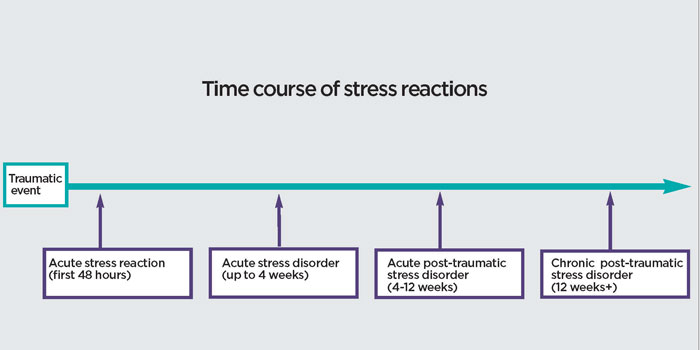
For approximately one-third of people experiencing a PTE the likely outcome will either be PTSD alone or with comorbidity. While the characteristic symptoms of PTSD can be present earlier the diagnosis requires the persistence of symptoms for one month. PTSD usually has an early onset with many patients improving quickly.
If symptoms are present at three months they are likely to persist for much longer.
Comorbidity and symptom overlap with depression or anxiety means that PTSD can be missed in primary care; considering the role of a PTE may help improve detection. Patients with PTSD avoid thinking or talking about the PTE so may not volunteer this information. There is no single diagnostic test for PTSD and assessment must be conducted sensitively as putting traumatic experience into words is difficult and/or dysregulating, see table 2, opposite.
Assessment
The early response of clinicians/carers
to individuals after PTEs is likely to influence subsequent adjustment.
GPs should not underestimate their supporting role alongside family, friends or faith group leaders. It is also important to assess the impact upon the patient’s partner and family.
There is no single diagnostic test for PTSD so clinicians are reliant on self-reporting and good clinical interview skills. Guidance on assessing an individual post-trauma is provided in table 2, below.
The diagnosis of PTSD differs from most psychiatric disorders as it includes an aetiological factor, the stressor, the PTE, as a core criterion.
The individual must have been exposed to, witnessed or learnt about a PTE occurring to someone they are close to, with emphasis placed upon the individual’s subjective experience.
The core symptoms of PTSD are listed in table 3, p22. In addition, the symptoms must be present for one month and cause functional impairment.
There are several self-report measures that may be of benefit in the assessment of patients following trauma. Questionnaires are generally acceptable to patients and may increase recognition of the disorder by clinicians less familiar with PTSD, however they are not diagnostic and do not replace a diagnostic interview. Perhaps ideal for screening in general practice is the Trauma Screening Questionnaire (TSQ), a free 10-item validated scale providing good specificity.14 The Impact of Events Scale-Revised Version15 (IES-R) is another commonly used scale; again not diagnostic but useful in a similar fashion to the use of questionnaires for the detection and follow-up of depressive symptoms in general practice.
A diagnostic interview tool such as CAPS-5,16 which is available free, would be considered a gold standard. However, it takes approximately 45 minutes to complete.
Referral
It can be difficult to distinguish the early reactions of resilient individuals who
are experiencing temporary distress, from others who have an acute or
a developing longer-term disorder.
The majority of individuals will not require treatment and expert opinion supports the adoption of the principle of watchful waiting rather than treatment during the initial four weeks.17
A small minority of individuals may exhibit extreme reactions indicative of mental disorder and require earlier or urgent psychiatric assessment and intervention. Treatment should also be considered where there is a lack of recovery at four weeks; the rule of thumb is early diagnosis and intervention.17 Sufficient social support is crucial with collective resilience in a family similar to the unit cohesion utilised and built upon in the military.
Those with pre-existing mental illness who experience trauma might benefit from review, support and liaison with their mental health team.
Because of the lack of empirical evidence experts recommend the use of medication only for symptomatic relief, or where access to therapy is limited,
or when patients either decline psychotherapeutic intervention or are unable to engage in it.18
Currently, for acute stress disorder short-term trauma-focused cognitive behaviour therapy (TF-CBT) has the most support,19 though accessing psychological therapy in that timescale may be challenging. The need to bear witness will be discussed in a later paper.
Providing the right information at the right time will be helpful but the patient should not be overloaded with this. It is important to target interventions to those needing help and thereby not intervene in cases who are adjusting appropriately.
Treatment options include referral to mental health specialists (though some patients will resist such a referral),
and the prescription of medication if psychological intervention is declined
or if depression is readily apparent.
The very resilience which allows
an individual to survive trauma
(e.g. self-reliance) may mean they are less likely to access treatment.
Proactive review of response to treatment initiated in primary care is often required (because of avoidance or loss of trust in authority figures) with referral to specialists if needed.
Urgent referral is necessary if the PTSD is severe or there are suicidal thoughts (common), homicidal thoughts or comorbid conditions.
There are specialist services for discrete trauma populations in different areas of the UK, see Useful information box, p23. This includes but will not be limited to, services for: refugees in key areas, blue light services personnel, former military personnel and intensive care follow-up clinics. It is important to note that former military personnel are entitled to priority NHS treatment.
Management
Patients often have unrealistic expectations of treatment: it will not wipe the slate clean; they will not so much bounce back but bounce forward as a new normality is constructed.
Psychological therapies
The NICE guidelines on PTSD17 recommend that all patients should be offered trauma-focused psychological interventions, with the greatest evidence base for TF-CBT and eye movement desensitisation and reprocessing (EMDR). There has been a paucity of studies comparing effectiveness of psychological and pharmacological treatment or indeed a combination thereof, 20 making definitive conclusions difficult. The BAP guidelines20 also highlight pragmatic considerations such as service availability and patient choice. Generalising from studies showing efficacy to clinical effectiveness necessitates consideration of the differing challenges of acute, chronic, complex or comorbid PTSD; taking the clinician beyond helpful guidelines and toward referral for specialist opinion.
TF-CBT also offers some clinically important effects for depression and anxiety symptoms.21 The evidence is not as strong for EMDR, but still significant. There was also some evidence for group CBT and for guided self-help therapies for sub-syndromal PTSD. The use of internet or computer-based therapies may offer new ways of delivering therapy.22
The effect sizes for psychological treatments are greater than for medication but this difference may in part be methodological artefact and direct empirical comparisons need to be conducted. Psychotherapy studies do not report adverse effects, and it would be wrong to consider a therapy as either neutral or positive; the wrong therapy or therapist at the wrong time may be psychonoxious. Emergent psychotherapies will be discussed in a subsequent article.
Pharmacological treatments
NICE describes medication as a second-line approach and states that it should be considered where psychotherapy is contraindicated (e.g. because of an ongoing threat), when the patient declines psychotherapy, where no psychotherapy is available or, when psychotherapy has not been effective, and when there is a suicide risk.
The usual medication of choice is an SSRI. The NICE guidelines17 recommend paroxetine or mirtazapine for general use (i.e. by GPs) or amitriptyline or phenelzine by specialists. They are also recommended when there is significant comorbid depression. A more recent meta-analysis23 supported the use of fluoxetine, paroxetine, sertraline and venlafaxine and to a lesser extent amitriptyline, mirtazapine, and phenelzine. There is also mounting evidence for prazosin, an alpha-1 adrenoceptor antagonist, for general PTSD symptoms and specifically nightmares.24
Some individuals will manage psychotherapy only after successful pharmacotherapy. Evidence suggests the atypical antipsychotic olanzapine (but not risperidone) may act adjunctively with antidepressants.25, 26
Cautions with medication include sexual side effects and sedative effects. The use of benzodiazepines is common but no studies support their use; some suggesting a detrimental effect.27
Monitoring and follow-up
Patient preference is important in determining monitoring and follow-up; having been injured once patients can be very sensitive to any perceived secondary wounding, especially by services.
Where management is shared with secondary care there should be clear agreement about monitoring and follow-up.17 As many PTSD patients suffer from disabling anxiety they can avoid engaging in treatment and assertive follow-up may be necessary. With avoidance a core symptom, the assumption that all is well if the patient does not present will often need to be reversed. It may be illuminating to check that the patient’s stated secondary care plan of treatment matches what they report receiving. Transitions in treatment
(of therapy, medication, therapist, or discharge) can be difficult. Risks, including suicidality and homicidality need to be assessed and reviewed.
The loss of trust in authority or authority figures may impact on engagement
if an authoritarian stance is taken.
Conclusion
There is certainly no uniform or singular experience of trauma and there is compelling evidence that traumatic experience triggers a psychological response and for some, PTSD.
The holistic care of patients necessitates that the management of their psychological problems should not be seen as less important than the treatment of their physical injuries resulting from the trauma.
REFERENCES
1 Ogle CM, Rubin DC, Berntse D et al. The frequency and impact of exposure to potentially traumatic events over the life course. Clin Psychol Sci 2013;1:426-34
2 Alexander DA. Psychological reactions to trauma. In I Greaves, K Porter, J Ryan. Eds. Trauma Care Manual pp 277-86. Arnold. London. 2000
3 Dyregrov A, Gupta L, Gjestad R et al. Trauma exposure and psychological reactions to genocide among Rwandan children. J Traum Stress 2000;13(1):3-21
4 Raphael B. When Disaster Strikes. How Individuals and Communities Cope with Catastrophe. Basic Books. New York. 1986
5 Brewin CR, Andrews B, Valentine JD. Meta-analysis of risk factors for post-traumatic stress disorder in trauma-exposed adults. J Consult Clin Psychol 2000;68(5):748-766
6 Terr LC. Childhood Traumas: An outline and overview. Am J Psych 1991;148(1):10-20
7 McManus S, Meltzer H, Brugha T et al. Adult psychiatric morbidity in England in 2007: results of a household survey. The NHS Information Centre for Health and Social Care, 2009. http://www.ic.nhs.uk/webfiles/publications/mental%20healt/other%20mental%20health%20publications/Adult%20psychiatric%20morbidit%2007/APMS%2007%20%28FINAL%29%20Standard.pdf.
8 Ferry F, Bolton D, Bunting B et al. The economic impact of post traumatic stress disorder in Northern Ireland:
A report on the direct and indirect health economic costs of PTSD and the specific impact of conflict in Northern Ireland. 2011. available at www.nictt.org
9 Norris FH, Tray M, Galea S. Looking for resilience: understanding the longitudinal trajectories of responses to stress. Social Sci Med 2009;68:2190-2198
10 Kessler RC, Sonnega A, Bromet E et al. Post-traumatic stress disorder in the national comorbidity survey. Arch Gen Psych 1995;52(12):1048-1060
11 Krysinska K, Lester D. Post-traumatic stress disorder and suicide risk: a systematic review. Arch Suicide Res 2010;14:1-23
12 Alexander DA. Human reactions to trauma: their features and management. In: Pre-hospital medicine: The principles and practice of immediate care. Eds. I Greaves, K Porter. Arnold. London. 1999
13 Cloitre M, Garvert D, Brewin C et al. Evidence for proposed ICD-11 PTSD and complex PTSD: A latent profile analysis. EJPT 2013; 4: 20706 http://dx.doi.org/10.3402/ ejpt.v4i0.20706
14 Brewin CR, Rose S, Andrews B et al. Brief screening instrument for post traumatic stress disorder. Br J Psych 2002;181:158-162
15 Marmer CR, Weiss DS. The Impact of Event Scale-Revised. In Assessing Psychological Trauma and PTSD. Eds. JP Wilson, TM Keane. The Guilford Press. New York. 1997
16 Weathers FW, Blake DD, Schnurr PP et al. The Clinician-Administered PTSD Scale for DSM-5 (CAPS-5). 2013
17 National Institute for Health and Care Excellence. CG26. Post-traumatic Stress Disorder: The management of PTSD in adults and children in primary and secondary care. NICE. London. 2005
18 Forbes D, Creamer M, Wade D. Psychological support and recovery in the aftermath of natural disaster. Int Psych 2012:9(1):15-17
19 Bryant RA, Sackville T, Dang ST et al. Treating acute stress disorder: an evaluation of cognitive behavior therapy and supportive counseling techniques. Am J Psychiatry 1999:156(11):1780-1786
20 Baldwin DS, Anderson IM, Nutt DJ et al. Evidence-based pharmacological treatment of anxiety disorders, post-traumatic stress disorder and obsessive-compulsive disorder: A revision of the 2005 guidelines from the British Association of Psychopharmacology. J Psychopharm 2014:1-37
21 Bisson JI. Pharmacological treatment of post-traumatic stress disorder. Adv Psych Treat 2007;13:119-126
22 Litz BT, Engel CC, Bryant RA et al. A randomized, controlled roof-of-concept trial of an internet-based, therapist-assisted self-management treatment for post-traumatic stress disorder. Am J Psych 2007;164:1676-1683
23 Hoskins M, Pearce J, Bethell A et al. Pharmacotherapy for post-traumatic stress disorder: systematic review and meta-analysis. Br J Psych 2015;206:93-100
24 Bisson JI, Cosgrove S, Lewis C, Roberts NP. Post-traumatic Stress Disorder. BMJ 2015: 351:h6161
25 Stein MB, Kline NA, Matloff JC. Adjunctive olanzapine for SSRI-resistant combat-related PTSD: A double-blind, placebo-controlled study. Am J Psych 2002;159:1777-79
26 Krystal JH, Rosenheck RA, Cramer JA et al. Adjunctive risperidone treatment for antidepressant-resistant symptoms of chronic military service-related PTSD: a randomised trial. JAMA 2011:306:493-502
27 Murphy G, Nkansa E. Benzodiazepines for the treatment of post traumatic stress disorder: a review of the clinical effectiveness and guidelines. Health Technology Inquiry Service, Canadian Agency for Drugs and Technologies in Health. 2009
ARTICLE IN PDF
 Download this article in PDF format
PRESET SEARCHES
PubMed
Post traumatic stress syndrome
Post traumatic stress syndrome review
NICE evidence search
EXTERNAL WEBLINKS
UK Psychological Trauma Society
British Association for Behavioural and Cognitive Psychotherapies
Former Service Personnel (Veterans)
Many areas/health boards now have a lead practitioner or Forces Champion