SEARCH

Potter C, McGuinness B, Passmore P. Diagnosing mild cognitive impairment can prove challenging. Practitioner May 2021;265(1848):11-14
Diagnosing mild cognitive impairment can prove challenging
25 May 2021
AUTHORS
Dr Claire Potter MB BCh BAO MRCPsych, ST6 Dual General Adult and Old Age Psychiatry, Irish Clinical Academic Training (ICAT) Fellow
Dr Bernadette McGuinness MB BCh MD PhD FRCP FRCPI, Clinical Senior Lecturer
Professor Peter Passmore BSc MB BCh MD FRCP(Lond, Glas) FRCPI, Professor of Ageing and Geriatric Medicine
Centre of Public Health, Queen’s University Belfast, Belfast, UK
Competing interests: Professor Peter Passmore has received honoraria and travel grants from Pfizer, Eisai, Shire, Johnson & Johnson and Nutricia. The other authors have no competing interests.
Article
Mild cognitive impairment (MCI) is a heterogeneous clinical syndrome defined as evidence of cognitive decline which is greater than expected for an individual’s age and educational level but which does not significantly impact on activities of daily living. Around 6% of those over the age of 60 are thought to have MCI. Approximately 5-15% of individuals with MCI develop dementia each year and around 50% remain stable after five years of follow-up. Risk factors associated with dementia are also linked to MCI risk, and the strongest of them are increasing age, family history, the APOE e4 gene and cardiovascular risk factors. The challenge for clinicians is to distinguish between normal cognition, cognitive decline normal for ageing, subjective cognitive decline, delirium, MCI and dementia. The history should focus on the onset and progression of symptoms. An acute or fluctuating course suggests delirium or another potentially reversible cause. It is important to identify any recent physical illnesses, medication changes or stressful life events. Risk factors for MCI and dementia should be recorded together with the level of social support or requirement for carers. To meet the diagnostic criteria for MCI there must be evidence of cognitive decline but maintained activities of daily living and so an assessment of both is required. In primary care cognitive screening tools such as the GPCOG are widely used but it is important to be aware that a normal score does not rule out cognitive impairment or dementia. A full physical examination, including neurological examination, and screening blood tests are required to identify any reversible causes.
Mild cognitive impairment (MCI) is a heterogeneous clinical syndrome describing evidence of cognitive decline greater than expected for an individual’s age or educational level but not to a degree that significantly impacts on activities of daily living.1
Around 6% of those over the age of 60 are thought to have MCI. However, there can be a significant range in incidence and prevalence rates with some studies reporting MCI in up to 20% of over 65s due to variation in diagnostic criteria and assessment tools used.2,3
As dementia research has advanced, particularly in the area of biomarker discovery and functional neuroimaging, conditions such as Alzheimer’s disease are now felt to have a long preclinical phase of several years to decades with MCI considered by some to be on the continuum to disease.4,5 However, in support of the argument against the continuum theory a proportion of those individuals with MCI will remain stable with little further cognitive decline and never meet the clinical threshold for a dementia diagnosis and some may find that their cognitive function improves.6
Approximately 5-15% of individuals with MCI develop dementia each year and around 50% remain stable after five years of follow-up.7
A challenge for clinicians is being able to distinguish between normal cognition, cognitive decline normal for ageing, subjective cognitive decline, temporary changes to cognition as seen in delirium, cognitive decline in MCI and possible dementia as their prognosis and treatments differ, see table 1.
As individuals get older there is an age associated, non-pathological decline in cognitive functioning termed normal cognitive ageing.8 In contrast, dementia syndromes caused by conditions such as Alzheimer’s disease, vascular dementia, Lewy body dementia, frontotemporal dementia and Parkinson’s disease are a pathological, progressive, neurodegenerative process and not a normal process of ageing.9 This results in a large spectrum of symptoms between these two clinical domains, where MCI is often diagnosed when other conditions are excluded.
Further challenges in the assessment of individuals with MCI and the dementia spectrum are the slow, insidious onset of symptoms in most cases, often going undiagnosed for some time or reported first by the individual’s family or carers.10
Cognitive domains and MCI subtypes
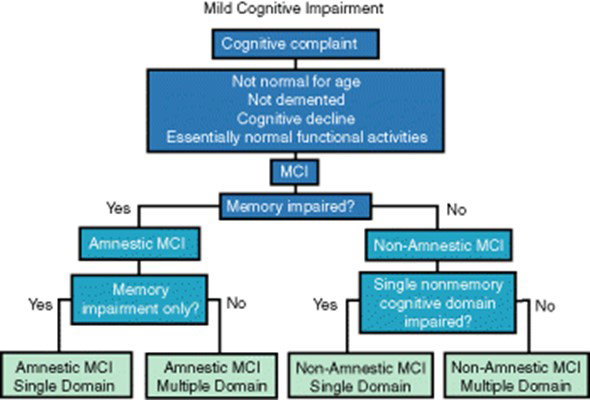
Individuals presenting with MCI may report problems with short-term memory or recall (categorised as amnestic MCI) but there may be deficits apparent in other (non-amnestic MCI) or multiple cognitive domains. There have been a range of attempts to reach a consensus on MCI diagnosis both in clinical practice and research.7
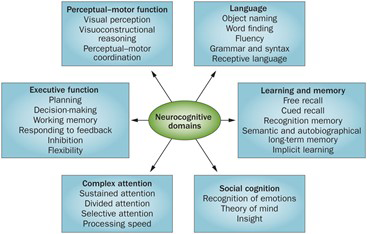
Figure 1 describes the six cognitive domains recorded in the DSM-5.11 The flowchart, see figure 2 can be used to aid recognition of the MCI subtypes.12 It is important not only to ask individuals about problems pertaining to their memory but also to address these other domains as well.
Risk factors
In keeping with the ‘syndrome’ definition of MCI, the underlying causes and risk factors vary significantly and are not yet fully understood. Complex and overlapping comorbidities, including increased frailty in older age, can make assessment of cognitive impairment or decline in activities of daily living a challenge.
As described above, in a proportion of individuals presenting with MCI their symptoms could represent an emerging dementia process and so the risk factors associated with dementia are also linked to MCI risk. Increasing age, strong family history, the APOE e4 gene and cardiovascular risk factors are the strongest risk factors. The SPRINT trial found that intensive BP treatment in hypertensive adults aged 50 years and over significantly reduced the risk of incident MCI over five years of follow-up.13
Cognitive impairment could also be secondary to a range of medical or psychological conditions and MCI can be misdiagnosed in these cases if a careful history and assessment are not completed.
Medical causes
Delirium describes an acute, fluctuating disturbance in attention and awareness which may feature additional disturbance in cognition. Causes of delirium can be multifactorial with older age, infection, hospitalisation especially following hip fracture or requiring ICU admission all shown to be risk factors.
Symptoms can take several weeks to resolve fully even after the offending insult has been addressed and should be considered in any new presentation of cognitive impairment after recent illness.
Repeated delirious episodes increase the risk of developing dementia and episodes of delirium can increase the risk of future delirious episodes inferring a cognitive vulnerability in these patients.14
In addition to delirium, other causes of potentially reversible cognitive impairment include:15
• Metabolic conditions: Hypo/hyperthyroidism, hypo/hyperparathyroidism, hypercalcaemia, Cushing’s disease, Addison’s disease, pituitary insufficiency, hypoglycaemia, vitamin deficiencies
(B1, B6, B12 and folate), chronic liver failure, chronic respiratory failure or sleep apnoea, chronic renal failure or Wilson’s disease
• Neuroinflammation/infection: meningitis, encephalitis, neurosyphilis, Lyme disease, sarcoidosis or vasculitis
• Neurosurgical conditions: subdural haematoma, normal pressure hydrocephalus, intracranial tumours or abscesses
• Other: medication side effects, particularly those with strong anticholinergic activity, alcohol misuse, drugs or toxins and epilepsy
Psychological causes
Depression, anxiety, loneliness, social isolation and/or prolonged grief reaction can all impact on cognitive functioning with attention often being the most common domain affected.
Assessment and Investigation
History
A thorough history and assessment can help differentiate between MCI and other potential causes of cognitive impairment. There should be particular focus on the onset and progression of symptoms, with acute or fluctuating courses indicating potentially reversible causes.
Association with onset of symptoms and any precipitating causes should be made such as cerebrovascular events, other recent physical illness, medication change or stressful life events.
Past medical history can identify cardiovascular risk and/or reversible causes. Family history of cognitive impairment or dementia and social history including level of educational attainment or previous occupation, smoking status, alcohol intake and level of social support or requirement for carers should be recorded.
A collateral history is important to corroborate the patient’s account and is useful to determine level of premorbid function or any associated behavioural change. Determining if there is any risk to the individual as a result of the cognitive impairment is important, e.g. driving, medication errors, level of social support, any episodes of wandering or problems in the kitchen such as leaving the oven on.
During interaction with the patient there may be clues to cognitive function on simple observation. Obvious dressing errors, stains on clothing, change in mobility, level of alertness or engagement, any obvious mood disorders, level of orientation, verbal fluency or problems with comprehension as well as any sensory impairment.
Assessment
To meet the diagnostic criteria there must be evidence of cognitive decline but maintained functioning in activities of daily living and so an assessment of both is required. Cognitive testing can cause some distress to patients so consider asking relatives or carers to sit outside and ensure the room is free from distractions and any sensory impairment has been addressed.
In the primary care setting cognitive screening tools such as the GPCOG,16 are widely used as they are brief and have a similar sensitivity to detecting dementia as the mini-mental state examination (MMSE).17 A score less than 5 on the patient section or less than 3 on the informant questionnaire of the GPCOG indicates cognitive impairment but a normal score does not rule out cognitive impairment or dementia.18
Additional cognitive assessment tools such as the Addenbrooke’s Cognitive Examination Revised (ACE-R) are useful to differentiate deficits in the different cognitive domains, particularly in non-amnestic MCI presentations.19
Functional assessment could include the basic activities of daily living (BADL) or instrumental activities of daily living (IADL) questionnaires.20,21
A full physical examination including neurological examination is required to help rule out potentially reversible causes as described above.
Additional investigations
Blood tests should be completed as part of initial investigations to help rule out potential reversible causes, see table 2.
Depending on availability and access to services, neuroimaging is also indicated, most commonly a CT brain scan mainly to rule out major structural abnormalities or vascular events.
Management
There is currently no UK national guidance for MCI. There are also no medications approved for the treatment of MCI. Drugs used in the treatment of Alzheimer’s disease have been investigated but have not demonstrated any improvement in cognitive function in MCI.22
As the causes are multiple and include a range of medical and lifestyle factors the best evidence appears to be for a multidomain approach.
The FINGER trial was a double blind randomised controlled trial in community settings in Finland.
It investigated the effects of a multidomain approach targeting cardiovascular risk factors, diet, exercise and cognitive training in older people at increased risk of dementia.23
Inclusion criteria were CAIDE (Cardiovascular Risk Factors, Ageing and Incidence of Dementia) dementia risk score of at least 6 points and cognition at mean level or slightly lower than expected for age. A total of 1,260 participants aged 60-77 years were randomised to the intervention group (n = 631) or control group (n = 629).
In the intervention group cognitive benefits, quality of life and physical function were better maintained over the two-year follow-up period although the effect size was small. The study has now been expanded to other countries with longer follow-up planned.
Referral and follow-up
Where there is concern about future dementia risk or diagnostic uncertainty it may be useful to make a referral to a specialist memory clinic which may be run by neurology, geriatric or psychiatry of old age specialist teams. These teams may have access to additional structural or functional neuroimaging such as fluorodeoxyglucose positron emission computed tomography (FDG-PET) or blood or CSF based biomarkers in accordance with NICE early dementia recommendations. The use of these investigations tends to be assessed on an individual basis where diagnosis is uncertain and Alzheimer’s disease suspected.7,24
If MCI is diagnosed some memory clinics will discharge the patient back to primary care or offer a six month or annual review to monitor cognition with assertive management of risk factors, as mentioned above.
Programmes provided by organisations such as Age UK, see Useful information box below, can offer some practical tips to help individuals overcome some of the challenges their cognitive impairment creates, e.g. by the use of adaptive technology.
Specialist community nurses, social workers or occupational health practitioners may also provide additional support but access to these services and referral criteria can vary significantly.
REFERENCES
1 Gauthier S, Reisberg B, Zaudig M et al. Mild cognitive impairment. Lancet 2006;367(9518):1262-70
2 Ward A, Arrighi HM, Michels S, Cedarbaum JM. Mild cognitive impairment: disparity of incidence and prevalence estimates. Alzheimer's Dement 2012;8(1):14-21
3 Sachdev PS, Lipnicki DM, Kochan NA et al. The prevalence of mild cognitive impairment in diverse geographical and ethnocultural regions: the COSMIC collaboration. PloS One 2015;10(11):e0142388
4 Sperling RA, Aisen PS, Beckett LA et al. Toward defining the preclinical stages of Alzheimer’s disease: Recommendations from the National Institute on Aging-Alzheimer's Association workgroups on diagnostic guidelines for Alzheimer's disease. Alzheimer's Dement 2011;7(3):280-92
5 Petersen RC, Smith GE, Waring SC et al. Mild cognitive impairment: clinical characterization and outcome. Arch Neurol 1999;56(3):303-08
6 Hu C, Yu D, Sun X et al. The prevalence and progression of mild cognitive impairment among clinic and community populations: a systematic review and meta-analysis. Int Psychogeriatr 2017;29(10):1595
7 Dunne RA, Aarsland D, O’Brien JT et al. Mild cognitive impairment: the Manchester consensus. Age Ageing 2021;50(1):72-80
8 Deary IJ, Corley J, Gow AJ et al. Age-associated cognitive decline. Br Med Bull 2009;92(1):135-52
9 Yu L, Boyle PA, Leurgans S et al. Disentangling the effects of age and APOE on neuropathology and late life cognitive decline. Neurobiol Aging 2014;35(4):819-26
10 Lang L, Clifford A, Wei L et al. Prevalence and determinants of undetected dementia in the community: a systematic literature review and a meta-analysis. BMJ Open 2017;7:e011146
11 Sachdev PS, Blacker D, Blazer DG et al. Classifying neurocognitive disorders: the DSM-5 approach. Nature Rev Neurol 2014;10(11):634-42
12 Petersen RC. Mild cognitive impairment as a diagnostic entity. J Intern Med 2004;256(3):183-94
13 Williamson JD, Pajewski NM, Auchus AP et al. The SPRINT MIND Investigators for the SPRINT Research Group. Effect of intensive vs standard blood pressure control on probable dementia. A randomized clinical trial. JAMA 2019;321:553-61
14 Davis DH, Muniz Terrera G, Keage H et al. Delirium is a strong risk factor for dementia in the oldest-old: a population-based cohort study. Brain 2012;135(9):2809-16
15 Tripathi M, Vibha D. Reversible dementias. Ind J Psychiatry 2009;51(Suppl1):S52
16 Brodaty H, Pond D, Kemp NM et al. The GPCOG: a new screening test for dementia designed for general practice. J Am Geriatr Soc 2002;50(3):530-34
17 Brodaty H, Connors MH, Loy C et al. Screening for dementia in primary care: a comparison of the GPCOG and the MMSE. Dementia Geriatric Cog Disord 2016;42(5-6): 323-30
18 National Institute for Health and Care Excellence. NG97. Dementia: assessment, management and support for people living with dementia and their carers. NICE. London. 2018
19 Mioshi E, Dawson K, Mitchell J et al. The Addenbrooke’s Cognitive Examination Revised (ACE‐R): a brief cognitive test battery for dementia screening. Int J Geriatric Psychiatry 2006;21(11):1078-85
20 Mahoney FI, Barthel DW. Functional evaluation: the Barthel Index: a simple index of independence useful in scoring improvement in the rehabilitation of the chronically ill. Maryland State Med J 1965;14:61-65
21 Lawton M, Brody EM. Assessment of older people: self-maintaining and instrumental activities of daily living. Nursing Res 1970;19(3):278
22 Russ TC, Morling JR. Cholinesterase inhibitors for mild cognitive impairment. Cochrane Database Syst Rev 2012(9):CD009132
23 Ngandu T, Lehtisalo J, Solomon A et al. A 2 year multidomain intervention of diet, exercise, cognitive training, and vascular risk monitoring versus control to prevent cognitive decline in at-risk elderly people (FINGER): a randomised controlled trial. Lancet 2015;385(9984):2255-63
24 Brys M, Pirraglia E, Rich K et al. Prediction and longitudinal study of CSF biomarkers in mild cognitive impairment. Neurobiol Aging 2009;30(5):682-90
 Download this article in PDF format