SEARCH

Grant N, Stobie B. Diagnosis and treatment of obsessive compulsive disorder. Practitioner May 2020;264(1837):17-21
Diagnosis and treatment of obsessive compulsive disorder
25 May 2020
AUTHORS
Dr Nina Grant BSc (Hons) MSc DClinPsy PhD, Postdoctoral Researcher
Dr Blake Stobie BA (Hons) MA (ClinPsych) C Psychol PhD, Head of Service
Centre for Anxiety Disorders and Trauma, South London & Maudsley NHS Foundation Trust, London, UK
Competing interests: None
Article
Obsessive compulsive disorder (OCD) consists of obsessions (repetitive, intrusive thoughts, urges, impulses or doubts) and compulsions (ritualistic, deliberate behaviours performed in response to obsessions). As well as contamination and safety fears, many patients experience distressing thoughts of causing harm. Sexual obsessions are common, including thoughts regarding sexual orientation, aggressive sexual behaviour or child molestation. Typical compulsions include checking, washing, ruminating, and counting. The point prevalence of OCD in the UK is 1.3%. The age of onset differs between the sexes: men typically experience first symptoms in late adolescence, and women in their early twenties. Young children often present with intrusive thoughts about their caregivers dying, and adolescents with sexual or religious intrusions. Perinatal OCD can present in the absence of a previous OCD diagnosis and often involves thoughts about harming the baby. It is important to distinguish intrusive thoughts indicative of OCD from delusional beliefs (generally held with conviction) which might be a sign of postpartum psychosis. Up to 90% of patients with OCD will meet criteria for another psychiatric disorder in their lifetime, with the most common being other anxiety disorders, major depressive disorder and substance use disorders. Patients with OCD are at increased risk of suicidal thoughts, and therefore a risk assessment should be carried out. Patients with OCD are very unlikely to act on their intrusive thoughts but there may be secondary risk to others due to the compulsions.
Obsessive compulsive disorder (OCD) is a relatively common syndrome, which can be chronic and disabling.1
It consists of obsessions (repetitive, intrusive thoughts, urges, impulses or doubts) and compulsions (ritualistic, deliberate behaviours performed in response to obsessions). Obsessions are thoughts, whereas compulsions can be overt (e.g. checking) or covert behaviours (e.g. ruminating).
As well as contamination and safety fears, many patients experience distressing thoughts of causing harm. Sexual obsessions are common, including thoughts regarding sexual orientation, aggressive sexual behaviour or child molestation.2 Typical compulsions include checking, washing, ruminating, and counting, among others.
The point prevalence of OCD in the UK was 1.3% in the most recent National Psychiatric Morbidity Survey.3 However, many people will experience both obsessive thoughts and/or compulsive behaviours without meeting diagnostic criteria for OCD or any other mental health disorder.4 Age of onset differs between the sexes, with men typically experiencing first symptoms in late adolescence, and women in their early twenties.5
OCD is associated with a particularly high degree of impairment, relative to both healthy individuals and other anxiety disorders.6 It affects social and occupational functioning, is associated with higher rates of unemployment, lower income, and negatively impacts on work and relationships.6
Presentation
Accurate recognition in primary care can be difficult because of significant symptom heterogeneity: e.g. fear of harming self or others (which may manifest in checking, reassurance-seeking or avoidance) among other compulsions, symmetry obsessions (ordering and counting compulsions), fear of contamination (washing, cleaning and avoidance), distressing violent or sexual thoughts (avoidance and rumination).7 OCD may be best explained as a dimensional disorder which has a cluster of symptoms across broad areas including: order and symmetry, causing harm, and contamination.8
Many patients present with shame or fear regarding their intrusive thoughts.9 Secondary symptoms, such as dermatological complaints, may be reported as the primary problem.
Patients often delay seeking help, and only a small percentage of primary care patients may report the problem as OCD.10 A treatment delay of more than two years is associated with poorer treatment outcomes.11
OCD symptom patterns are similar in children, adolescents, and adults. Childhood prevalence rates are estimated at 1-2%.12 However, boys are more likely than girls to develop OCD in childhood,13 and younger age is associated with less insight.12 Young children often present with intrusive thoughts about their caregivers dying, and adolescents with sexual or religious intrusions. Children with OCD may present with school avoidance and disrupted social relationships.14
Perinatal OCD can present in the absence of a previous OCD diagnosis.15 It is very common for new parents to have intrusive thoughts, including thoughts about harming their baby. These are rarely indicative of either OCD or postpartum psychosis. However, some new parents will experience a new onset, or a relapse, of OCD.
Distinguishing intrusive thoughts indicative of OCD (generally characterised by doubts about distressing intrusions), and delusional beliefs (generally held with conviction) which might be a sign of postpartum psychosis, has important consequences for parental and infant wellbeing.15
Assessment
The screening questions in box 1 can prompt assessment of patients presenting with possible OCD. Time constraints within GP consultations may preclude routinely asking every anxious or depressed patient who does not self-report OCD all the screening questions. In these cases, the first question ‘do you currently spend a significant amount of time compulsively repeating actions or worrying that something bad might happen?’ can be asked before deciding whether to ask the remaining screening questions.
Box 2 shows the DSM-5 diagnostic criteria, which includes reference to the level of impairment experienced by the patient.16 Although most people experience intrusions, the key to an OCD diagnosis is the frequency, distress and time taken up by intrusions, and responses to them.
Patients can often be fearful of acting on intrusions, particularly those involving antisocial, sexual or violent thoughts. Careful assessment of these thoughts is necessary to identify whether they are unwanted intrusions, or an indication of risk to others i.e. not OCD. In most cases, patients will be clear that they have never acted, and never will act, on the thoughts. It is only in very severe cases that patients may express serious doubts about this.
Patients with suspected OCD may be at increased risk of deliberate self-harm and suicidal thoughts, and therefore a risk assessment should be carried out.17 Patients with OCD are extremely unlikely to act on their intrusive thoughts.14
Of greater relevance is risk of harm to self, and secondary risk to others due to the compulsions. For example, a new mother with intrusive thoughts of harming her baby may respond by avoiding the baby.
Common comorbidities
Up to 90% of patients with OCD will meet criteria for another psychiatric disorder in their lifetime, with the most common being other anxiety disorders, major depressive disorder and substance use disorders.18 Patients with comorbidities tend to have more severe OCD symptoms, and lower quality of life.1 Patients with depression, anxiety disorders, alcohol or substance misuse, body dysmorphic disorder and eating disorders are at higher risk of OCD.17
Some patients with other mental health diagnoses may present with symptoms similar to OCD, such as eating disorders (preoccupation with thoughts about eating, shape and weight as well as altered eating behaviours); generalised anxiety disorder (broader, excessive and uncontrollable worrying), and autistic spectrum disorders.
Those with addictive gambling behaviours may also demonstrate obsessive thoughts and behaviours, along with distress. People with a diagnosis of obsessive compulsive personality disorder may report a preference for performing tasks in a particular way, which may cause conflict with others e.g. excessive perfectionism.
OCD is distinct from, but related to, three other disorders, namely hoarding disorder, body dysmorphic disorder and trichotillomania. While these disorders may appear similar by virtue of the repetitive behaviours they entail, the underlying motivation behind these behaviours differentiate them from each other. For example, someone with trichotillomania may compulsively remove body hairs, in the absence of a feared consequence if they fail to do so.
Patients with body dysmorphic disorder may engage in repeated or extreme checking behaviours and reassurance seeking, fearing negative evaluation by self or others. A perceived responsibility for causing or failing to prevent harm is the motivating factor which differentiates OCD from the repetitive behaviours evidenced in these other conditions mentioned above.
Management
The two evidence-based treatments for OCD are cognitive behaviour therapy (CBT) and medication.
Stepped care treatment
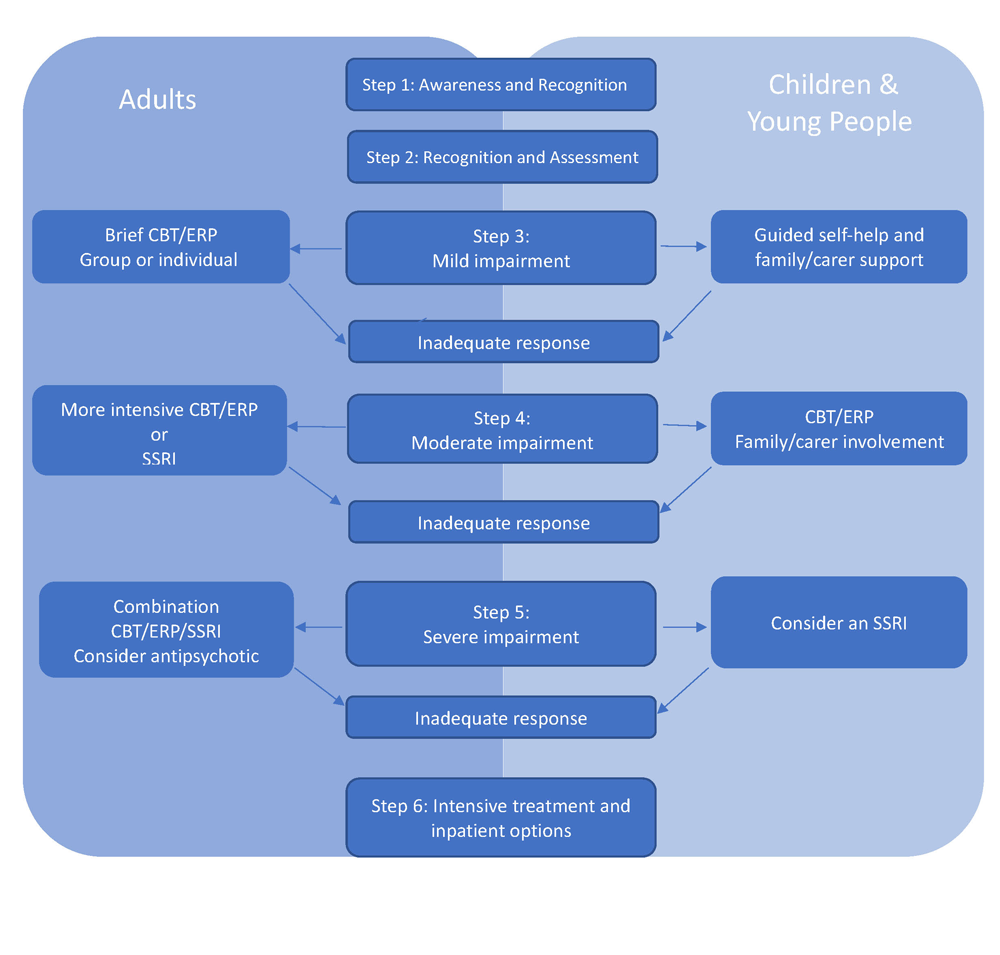
Treatment for OCD following a stepped care model is shown in figure 1.
Step 1 (awareness and recognition) and step 2 (recognition and assessment) in primary care inform decisions about when to refer patients. Steps 3-5 will usually be provided in primary care by the GP, and via an Increasing Access to Psychological Therapies (IAPT) service.
Patients will begin treatment at the step most appropriate for them, so that if their presentation is severe they can begin at step 5, or if they do not respond they can be stepped-up. Where patients have not responded at steps 3-5, and the OCD is severe and having a significant impact, patients may be referred for outpatient, residential or inpatient treatment at specialist treatment clinics (see box 3).
Referrals to these specialist centres will usually be made by local mental health teams. Should the OCD persist, NHS England commissions a nationally funded treatment service for patients with treatment resistant OCD. To be eligible for treatment under this service, patients will have to have failed to maintain gains from at least two past courses of CBT, as well as two trials of SSRIs at adequate dosage, including augmentation of at least one of the SSRI trials (see box 3; clinics marked * offer this top tier treatment).
The British Association for Psychopharmacology guideline19 states that drug and psychological approaches have broadly similar efficacy in acute treatment i.e. patients should be offered a choice. For those with more severe OCD e.g. at step 5, NICE suggests combination treatment i.e. CBT including exposure and response prevention (ERP) which involves facing the feared stimulus while resisting compulsions, plus an SSRI.17
Cognitive behaviour therapy
The most effective psychological therapy for OCD is CBT, which incorporates ERP. Step 3 usually consists of up to 10 hours with a psychological therapist, and patients with mild functional impairment who do not respond to this initial treatment may then need to receive more intensive psychological therapies.
Therapist-assisted exposure (vs exposure prescribed as homework), imaginal exposure paired with actual exposure (i.e. picturing the contamination on a door handle while touching it), and home-based treatment (where indicated), are all associated with better outcomes.7
Medication
SSRIs should be considered for patients with OCD with moderate or severe impairment.17 Although individual patients may respond better to one SSRI than to another, there is no convincing evidence that any one SSRI is more effective in comparison with others.20,21 Higher SSRI doses may be associated with better outcomes22 although this needs to be weighed against the risk of side effects.
If the patient does not show significant improvement, consider switching SSRIs17 and if that is ineffective, clomipramine may be considered. The relative efficacy of clomipramine for OCD must be weighed against its side-effect profile and the potential effect on cardiac function.20 There is good evidence for the efficacy of SSRIs in children and young people12 but the increased risk of suicidal ideation, and deliberate self-harm must be closely monitored. Pharmacotherapy can also be of benefit with perinatal OCD, but the risk profile, as well as potential implications for breastfeeding, will also need to be considered.23
Where two different SSRI trials have not led to treatment response, augmentation with a low-dose antipsychotic medication may be considered, and there is some evidence that this may be effective.22 However, these medications are associated with side effects such as endocrine and metabolic dysregulation, and weight gain, even with second-generation antipsychotics, and high relapse rates on discontinuation.24
NICE recommends that benzodiazepines are not prescribed for those with anxiety disorders, including OCD, because of reduced tolerance over time and the potential for dependence.25
It is common for patients with OCD to worry that taking medication may cause them to act on their intrusions.26 Patients may therefore agree to a medication trial but may avoid initiating it; they may also not take medications as prescribed for fear of side effects. Awareness of these issues, along with empathetic reassurance, monitoring and follow-up may improve compliance.
Referral
Decisions about urgency and referral pathways can be guided by: previous treatment, severity, and risk assessment. For patients who have not benefited from previous treatments but are stable, consider a non-urgent referral to a specialist clinic, which may offer inpatient or residential care (see box 3).
Referrals for treatment may be urgent where the patient is actively suicidal or displaying other potentially self-injurious behaviours e.g. disordered eating or food or liquid restriction because of concerns about contamination, poor insight or overvalued ideation.
Some of the specialist clinics in box 3 prioritise perinatal parents with OCD. If patients are housebound by their OCD or unable to travel, residential or inpatient treatment may be required. In urgent cases, GPs should also consider referral to local mental health teams, particularly as there may be a waiting list for treatment, if the patient is in crisis or requires additional support, and as the referral to tertiary services may need to be made by the patient’s mental health team.
Treatment response and follow-up
Approximately 20% of patients treated with SSRIs or CBT recover completely, and a further 20-40% of patients will have a significant reduction in symptoms but remain symptomatic.27 However, not all patients will be offered or accept treatment, and of those that do, a subset of approximately 30-40% will report small, minimal or no improvement at follow-up.21 These patients are likely to present with chronic symptoms that fluctuate but seldom remit completely.28
Discontinuation of medication is associated with high rates of relapse.22,24 Where drug treatment is reintroduced, the effectiveness of the medication may be reduced.24 NICE guidelines recommend that when a patient has improved with medication this should be continued for at least 12 months, and in some cases an even longer period.17
GPs are well placed to provide reassurance about how common intrusive thoughts are and can signpost patients to relevant third sector organisations. Ongoing GP follow-up can also help patients to access services, address medication issues, and improve overall levels of functioning.
New treatment approaches
Current research is investigating the potential effectiveness of novel treatments including deep brain stimulation,29 use of smartphone technology23 and alternative medication strategies.30
Increasing the intensity of psychological treatments, such as longer appointment times over consecutive days, has been shown to be effective in both adolescent and perinatal OCD.31,32 More intensively delivered psychological treatments may be better for patients with comorbid depression, but this type of treatment delivery is not routinely available outside specialist clinics.
Treatment fidelity is important in both pharmacotherapy and psychological therapies. Some treatment resistant patients may be showing a lack of response to psychological therapies which did not contain core components of CBT/ERP.33 Of particular relevance is the implicit need for both patient and therapist to tolerate high levels of distress caused by exposure to feared stimuli: psychological treatment which lacks exposure will generally be less effective.
REFERENCES
1 Huppert JD, Simpson HB, Nissenson KJ et al. Quality of life and functional impairment in obsessive-compulsive disorder: a comparison of patients with and without comorbidity, patients in remission, and healthy controls. Depression Anxiety 2009;26(1):39-45
2 Williams MT, Farris SG. Sexual orientation obsessions in obsessive-compulsive disorder: Prevalence and correlates. Psychiatry Res 2011;187(1-2):156-59
3 McManus S, Bebbington P, Jenkins R, Brugha T. Mental health and wellbeing in England: Adult Psychiatric Morbidity Survey 2014. A survey carried out for NHS Digital by NatCen Social Research and the Department of Health Sciences, University of Leicester. 2016
4 Fullana MA, Mataix-Cols D, Caspi A et al. Obsessions and compulsions in the community: prevalence, interference, help-seeking, developmental stability, and co-occurring psychiatric conditions. Am J Psychiatry 2009;166:329-36
5 Veale D, Roberts A. Obsessive-compulsive disorder. BMJ 2014;348:g2183
6 Torres AR, Prince MJ, Bebbington PE et al. Obsessive-compulsive disorder: prevalence, comorbidity, impact, and help-seeking in the British National Psychiatric Morbidity Survey of 2000. Am J Psychiatry 2006;163(11):1978-85
7 Abramowitz JS, Brigidi BD, Roche KR. Cognitive-behavioral therapy for obsessive-compulsive disorder: A review of the treatment literature. Res Soc Work Pract 2001;11(3):357-72
8 Mataix-Cols D, Conceição do Rosario-Campos M, Leckman JF. A multidimensional model of obsessive-compulsive disorder. Am J Psychiatry 2005;162:228-38
9 García-Soriano G, Rufer M, Delsignore A, Weidt S. Factors associated with non-treatment or delayed treatment seeking in OCD sufferers: a review of the literature. Psychiatry Res 2014;220(1-2):1-10
10 Belloch A, del Valle G, Morillo C et al. To seek advice or not to seek advice about the problem: the help-seeking dilemma for obsessive-compulsive disorder. Soc Psychiatry Psychiatr Epidemiol 2009;44(4):257
11 Dell’Osso B, Altamura A, Mundo E et al. Diagnosis and treatment of obsessive‐compulsive disorder and related disorders. Int J Clin Pract 2007;61(1):98-104
12 Kalra SK, Swedo SE. Children with obsessive-compulsive disorder: are they just “little adults”? J Clin Invest 2009;119(4):737-46
13 Leonard HL, Lenane MC, Swedo SE et al. Tics and Tourette's disorder: a 2- to 7-year follow-up of 54 obsessive-compulsive children. Am J Psychiatry 1992;149(9):1244-51
14 Veale D, Freeston M, Krebs G et al. Risk assessment and management in obsessive–compulsive disorder. Adv Psychiatr Treat 2009;15(5):332-43
15 Challacombe FL, Wroe AL. A hidden problem: consequences of the misdiagnosis of perinatal obsessive-compulsive disorder. Br J Gen Pract 2013;63(610):275-76
16 American Psychiatric Association. Diagnostic and Statistical Manual of Mental Disorders. 5th ed. Washington, DC. USA. 2013
17 National Institute for Health and Care Excellence. CG31. Obsessive-compulsive disorder and body dysmorphic disorder: treatment. NICE. London. 2005 www.nice.org.uk/guidance/cg31
18 Fenske JN, Schwenk TL. Obsessive compulsive disorder: diagnosis and management. Am Fam Physician 2009;80(3):239-45
19 Baldwin DS, Anderson IM, Nutt D J et al. Evidence-based pharmacological treatment of anxiety disorders, post-traumatic stress disorder and obsessive-compulsive disorder: A revision of the 2005 guidelines from the British Association for Psychopharmacology. Psychopharmacol 2014;28(5):403-39
20 Schruers K, Koning K, Luermans J et al. Obsessive-compulsive disorder: a critical review of therapeutic perspectives. Acta Psych Scand 2005;111(4):261-71
21 Rasmussen SA, Eisen JL. Treatment strategies for chronic and refractory obsessive-compulsive disorder. J Clin Psychiatry 1997;58(suppl 13), 9-13
22 Fineberg NA, Brown A, Reghunandanan S, Pampaloni I. Evidence-based pharmacotherapy of obsessive-compulsive disorder. Int J Neuropsychopharmacol 2012;15(8):1173-91
23 Roncero M, Belloch A, Doron G. A novel approach to challenging OCD related beliefs using a mobile-app: An exploratory study. J Behav Ther Exp Psychiatry 2018;59:157-60
24 Maina G, Albert U, Bogetto F. Relapses after discontinuation of drug associated with increased resistance to treatment in obsessive-compulsive disorder. Int Clin Psychopharmacol 2001;16(1):33-38
25 National Institute for Health and Care Excellence. QS53. Anxiety disorders. NICE. London. 2014 www.nice.org.uk/guidance/qs53
26 Mancebo MC, Pinto A, Rasmussen SA, Eisen JL. Development of the treatment adherence survey-patient version (TAS-P) for OCD. J Anxiety Disord 2008;22(1):32-43
27 Goodman WK, McDougle CJ, Barr LC, Aronson SC. Biological approaches to treatment-resistant obsessive compulsive disorder. J Clin Psychiatry 1993.54.Suppl:16-26
28 Steketee G, Eisen J, Dyck I et al. Predictors of course in obsessive compulsive disorder. Psychiatry Res 1999;89(3):229-38
29 Kohl S, Schönherr DM, Luigjes J et al. Deep brain stimulation for treatment-refractory obsessive compulsive disorder: a systematic review. BMC Psychiatry 2014;14(1):214
30 Dougherty DD, Brennan BP, Stewart SE et al. Neuroscientifically informed formulation and treatment planning for patients with obsessive-compulsive disorder: a review. JAMA Psychiatry 2018;75(10):1081-87
31 Whiteside SP, Brown AM, Abramowitz JS. Five-day intensive treatment for adolescent OCD: A case series. J Anxiety Disord 2008;22(3):495-504
32 Challacombe F, Salkovskis P, Woolgar M et al. A pilot randomized controlled trial of time-intensive cognitive-behaviour therapy for postpartum obsessive-compulsive disorder: effects on maternal symptoms, mother-infant interactions and attachment. Psychol Med 2017;47(8): 1478-88
33 Stobie B, Taylor T, Quigley A et al. Contents may vary: A pilot study of treatment histories of OCD patients. Behav Cogn Psychother 2007;35(3):273-82
Further reading
Challacombe F, Oldfield V, Salkovskis P. Break free from OCD. Penguin. London. 2011
Veale D, Willson R. Overcoming obsessive compulsive disorder. Robinson. London. 2009
ARTICLE IN PDF
 Download this article in PDF format