SEARCH

Patel D, Gaillard EA. Optimising the management of children with cystic fibrosis. Practitioner February 2022;266(1855):17-21
Optimising the management of children with cystic fibrosis
24 Feb 2022
AUTHORS
Dr Deepa Patel MB ChB MRCPCH, Paediatric Respiratory Registrar
Dr Erol A Gaillard PhD MRCPCH, Associate Professor in Child Health and Honorary Consultant in Paediatric Respiratory Medicine
University of Leicester, Department of Respiratory Sciences, Leicester NIHR Biomedical Research Centre and Department of Paediatric Respiratory Medicine, Leicester Children’s Hospital, University Hospitals Leicester, Leicester, UK
Article
Cystic fibrosis (CF) is an autosomal recessive disorder resulting from two disease-causing mutations in the cystic fibrosis transmembrane regulator (CFTR) gene located on chromosome 7. CFTR is a chloride and bicarbonate channel found in sweat glands and the epithelial cells of the respiratory and digestive tracts. CF is the most common life-limiting genetic disorder in the UK, diagnosed in one in every 2,500 babies. The median age of death in the UK has been rising steadily and is 36 years. Most deaths in young people are the result of rapidly progressing lung disease. CF lung disease is characterised by acute and chronic bacterial and fungal infection. In conjunction with the resulting airway inflammation, this leads to the gradual loss of healthy lung architecture, bronchiectasis, accelerated decline in respiratory function, and ultimately respiratory failure. Viscous pancreatic exocrine secretions, resulting from altered ion transport processes similar to those occurring in the airways, block the pancreatic duct leading to exocrine pancreatic failure and fat malabsorption. This results in faltering growth and is frequently the first clinical sign of the condition. Autodigestion of the pancreas leads to endocrine pancreatic failure in more than half of CF patients over time. Approximately 10% of children with CF present with meconium ileus in the neonatal period and require urgent bowel surgery. Physiotherapy, mucoactive agents, antibiotics and nutrition continue to be mainstays of treatment. Use of CFTR modulators has resulted in a step change in CF management, improved lung function and will help to improve survival. CFTR modulator therapy targets the underlying CFTR defect.
Cystic fibrosis (CF) is the most common life-limiting genetic disorder in the UK, with 1 in 2,500 babies diagnosed with the condition.1
The median age of death for CF patients has been rising and is 36 years according to the latest UK Cystic Fibrosis Registry (2020) data.1 Most deaths in young people are the result of rapidly progressing lung disease caused by chronic respiratory infections and the associated airway inflammation.
Pathophysiology
CF is an autosomal recessive disorder resulting from two disease-causing mutations in the cystic fibrosis transmembrane regulator (CFTR) gene located on chromosome 7.2 To date, more than 2,000 mutations have been identified.3
CFTR is a chloride and bicarbonate channel found in sweat glands and the epithelial cells of the respiratory and digestive tracts. Ion transport systems in the airway epithelium control the movement of salt and water across airway epithelial cell membranes.4
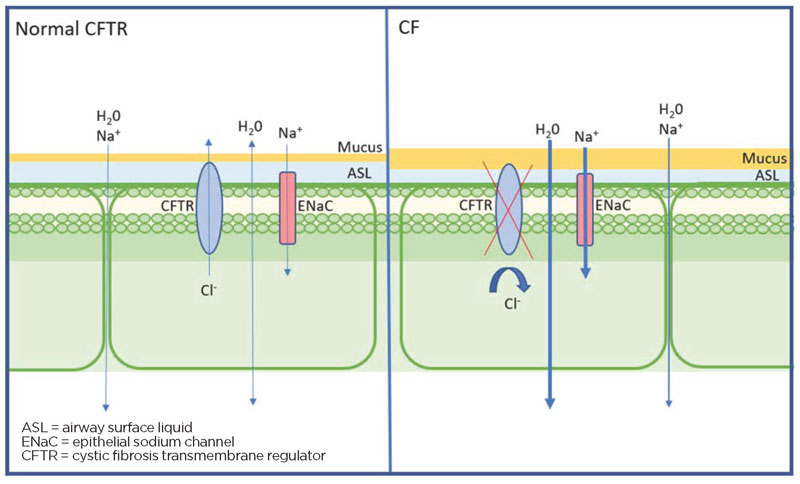
This process regulates the airway surface liquid, which is critical for the effective mucociliary clearance of the airways.5 Chloride hyposecretion of CFTR is compounded by sodium hyperabsorption by a separate channel, the epithelial sodium channel (ENaC). Airway ion transport systems are shown in figure 1.
Normally functioning CFTR allows efflux of chloride into the airway lumen and also inhibits sodium absorption from the airway surface liquid.
Water passively follows due to an electrochemical gradient and hydrates the airway surface liquid. In the presence of an abnormal CFTR, less chloride passes into the lumen and the ENaC-mediated sodium absorption is not inhibited. Therefore, there is less sodium and chloride within the airway lumen and the airway surface liquid volume is depleted. The reduced volume results in abnormal airway mucus6 and impaired mucociliary clearance. This creates an environment for chronic infection and inflammation.7 The clinical features in CF lungs result from the accumulation of viscous mucus.8
Multisystem disease
CF affects multiple organs, see table 1. However, lung and digestive system disease are the most prominent features.
Respiratory system
CF lung disease is characterised by acute and chronic bacterial and fungal infection. In conjunction with the resulting airway inflammation this leads to the gradual loss of healthy lung architecture, bronchiectasis, accelerated decline in respiratory function, and ultimately respiratory failure. Lung transplantation is then often the only therapeutic option.
The most common bacteria causing respiratory infections are Staphylococcus aureus and Haemophilus influenzae in early life, followed by infection and chronic airway colonisation with Pseudomonas aeruginosa in teenagers and young adults.1 Chronic pseudomonal infection is associated with reduced lung function. Infections are treated with prolonged courses of targeted oral and intravenous antibiotics and frequently prophylactic oral and inhaled antibiotics. Regular daily airway clearance with physiotherapy is a cornerstone of CF treatment.
Gastrointestinal system
Viscous pancreatic exocrine secretions, resulting from altered ion transport processes similar to those occurring in the airways, block the pancreatic duct leading to exocrine pancreatic failure and fat malabsorption. This results in faltering growth and is frequently the first clinical sign of the condition. This is why gastroenterologists were often leading the care of CF patients in the past9 when little was known about the condition. Approximately 10% of children with CF present with meconium ileus in the neonatal period and require urgent bowel surgery.
Autodigestion of the pancreas leads to endocrine pancreatic failure in more than half of CF patients over time, an entity known as CF-related diabetes, treated with insulin but rarely resulting in diabetic ketoacidosis.
The treatment for exocrine pancreatic failure is enzyme replacement therapy with pancrelipase directed by the CF dietitian.
CF outcomes depend on several factors including the class of CFTR mutations which will affect the severity of the disease, nutritional status, prompt treatment of any respiratory infection with a prolonged course (usually 2 weeks) of appropriate oral or intravenous antibiotics and adherence to CF treatments.
Diagnosis
The UK national CF newborn screening programme has been in operation since October 2007. Immunoreactive trypsinogen (IRT) is measured from a blood spot taken on a Guthrie card on day 5 of life. IRT is a pancreatic enzyme precursor and raised levels are found when there is blockage of the pancreatic ducts.
If the baseline IRT is raised on day 5 then a repeat test will be performed on day 28 and if this is raised the blood spot sample can be analysed for the four common mutations found in the UK. Positive screen results are sent to the local specialist centre. Where only one mutation is found an extended mutation screen is carried out.
A diagnosis of CF is confirmed if two disease-causing mutations are identified, but a sweat test is also performed in the majority of patients as this is a gold standard test. Where two disease-causing mutations are not identified, a sweat test is useful in confirming a diagnosis of CF. A sweat test involves collecting sweat through the skin and measuring chloride levels; ≥ 60 mmol/L is diagnostic.
A late diagnosis is now uncommon. However, a small but significant proportion of children with CF (5%) are missed by the screening programme.
It is important therefore to remain vigilant.10 CF should be considered in children with the clinical features highlighted in table 1, in particular those with chronic wet cough, faltering growth and a family history. These children should be referred to a paediatrician urgently for an assessment and a sweat test.
Management
The management of CF is detailed in full in the NICE guidelines.11 Both the NICE guidelines and the Cystic Fibrosis Trust12 highlight the role of the specialist multidisciplinary team (MDT).
Management strategies aim to improve outcomes for patients with CF in the following ways.
• Preserving lung function
• Slowing progression of lung disease
• Identifying and treating infection promptly
• Improving quality of life
• Improving survival rates
A specialist CF MDT based at one of the UK tertiary CF centres will coordinate the care of a child with CF. The team consists of doctors and nurses trained in CF care, specialist physiotherapists and dietitians, a pharmacist, psychologist and sometimes a social worker.
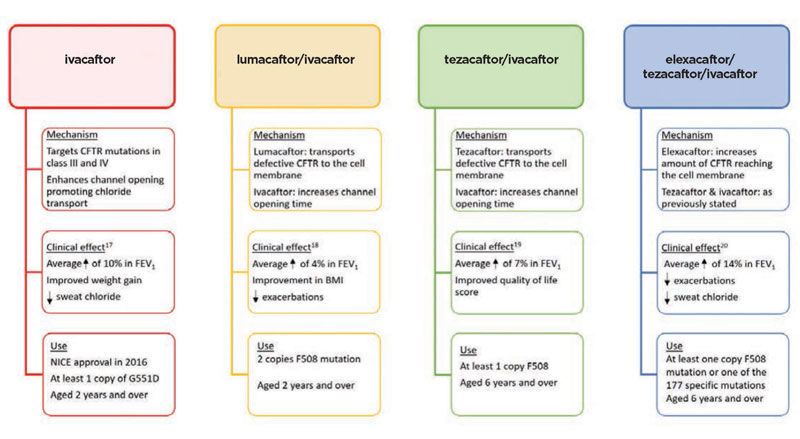
Regular physiotherapy, improved nutritional care and the aggressive use of antimicrobial agents delivered by a specialist MDT have been the mainstays of treatment contributing to improved outcomes. However, the recent discovery of small molecules affecting CFTR function such as the potentiator ivacaftor and the correctors lumacaftor, tezacaftor and elexacaftor has led to a significant change in CF management by addressing the underlying protein defect. CFTR modulators have resulted in a step change in CF management, improved lung function and will help to improve survival, see figure 2.
Physiotherapy
An effective, individualised airway clearance technique is implemented to aid clearance of mucus from the airways and prevent infections.13 This should be carried out daily during periods of stability and increased further during pulmonary exacerbations.
Mucoactive agents
Dornase alfa (recombinant human deoxyribonuclease) is offered to children aged five years and older who have clinical evidence of lung disease. This is administered as a nebulised treatment to reduce mucus viscosity and aid clearance of secretions.
Evidence shows improvement in FEV1 and reduction in pulmonary exacerbations in comparison with placebo.14 If there is a suboptimal response or intolerance to this, hypertonic sodium chloride can be added or used instead.
Antibiotics
Flucloxacillin prophylaxis may be offered from diagnosis until the age of three to prevent staphylococcus infection. After three years of age the decision to continue, and choice of, antibiotic prophylaxis will be at the discretion of the CF MDT.
Antibiotic choice for a positive respiratory culture or for symptoms of pulmonary exacerbation will also be guided by the MDT. Choice of antimicrobial, duration of treatment and mode of delivery are based on clinical status, the type of bacteria and advice from the microbiologist.
Nutrition
Pancreatic insufficiency is diagnosed by the faecal elastase test. Patients with pancreatic insufficiency will require pancreatic enzyme replacement therapy from diagnosis. Response to this is monitored by symptoms and signs of malabsorption.
There is strong evidence that poor nutritional status in CF is associated with worse lung function.15 Optimising nutrition through calculating energy intake is vital and this may be supplemented by calorie-dense food/ supplements or enteral tube feeding.
CFTR modulator therapy
There are five classes of CFTR mutations, some of which result in more severe disease (classes I, II and III) compared with others (classes IV and V). Mutations that result in misfolded protein (approximately 90% of mutations) act as targets for small molecule drugs which partially restore CFTR function and result in significant clinical improvement.
• Class I: Mutation results in a shortened CFTR protein resulting in complete loss of CFTR function
• Class II: The most common mutation affecting up to 90% of diagnosed individuals is the F508 deletion.16
The mutation prevents the CFTR protein from reaching the cell surface membrane and results in complete loss of CFTR function
• Class III: Gating mutation where CFTR is present in the cell membrane but the chloride channel is unable to open and/or close at the correct time for ion transport
• Class IV: CFTR present in the membrane but chloride is unable to move in and out of the channel
• Class V: Normal CFTR protein but reduced amounts present at the membrane
CFTR modulator therapy targets the underlying CFTR defect. The modulators to treat individual patients are chosen based on the patient’s CFTR mutation profile. For approximately 10% of CF patients there are currently no licensed CFTR modulators available. Simplified, modulators bind to abnormal CFTR and alter the structure of CFTR resulting in the restoration or augmentation of CFTR function. Currently there are four CFTR modulators licensed for patients based on their mutations (see figure 2 p19). There are variations in clinical response with a minority of patients not responding to modulator therapy.
Psychosocial management
Psychosocial management involves assessment and monitoring of the child’s psychosocial needs and the needs of their family. Assessment of mental health, quality of life, barriers to treatment adherence, the child’s behaviour and impact on schooling is essential.
Follow-up
Patients will be reviewed regularly, usually 2 to 3 monthly by the MDT but caregivers usually have rapid access to their specialist team.
Reviews are more frequent when children are younger, building up to 3-6 monthly follow-up visits as adults.
In addition, all children undergo a comprehensive annual review assessment which aims to monitor their symptoms and signs of complications.
Primary care
GPs can implement measures to help families in a variety of ways.
It is important to bear in mind that 5% of children may have been missed by newborn screening, particularly when children present with chronic wet cough or faltering growth.
Children with CF who have a pulmonary exacerbation (new cough) usually need 2 weeks of broad-spectrum antibiotics. Choice of antimicrobial will be guided by specialists but most children will have a predetermined back-up antibiotic.
Patients and families face a high treatment burden and frequent trips to hospital. GPs can help by providing prompt support for routine prescriptions such as pancrelipase and salt supplements including salt solution.
The specialist CF centre will liaise with the GP and provide guidance on medications which may be unlicensed or unfamiliar. Routine medications often require a minimum of one month’s supply, but may be longer for some e.g. pancrelipase. Often extra capsules are needed to be used in school and for other family members involved in the care of the child such as grandparents.
Families can face difficulties with the diagnosis and treatment burden.
GPs play a vital role in supporting family members. They are the first port of call for non-CF health related problems and routine immunisation including annual flu vaccinations for patients and their family members/carers.
When patients with CF reach adulthood GPs may need to arrange referral for problems relating to fertility and pregnancy or for genetic counselling. Liaison with the MDT is crucial in managing home intravenous antibiotics and end of life care.
Conclusion
CF is the most commonly inherited multisystem disease in the UK. CF has a considerable impact on the quality of life of children affected, their caregivers and also their siblings. Integrated care provided by primary care and specialist teams is key to improving outcomes in CF.
Early recognition of the clinical features and complications, targeted chest management and addressing psychosocial barriers to treatment in CF is pivotal.
Novel CFTR modulator treatments are now available which partially restore CFTR function and result in significant clinical improvement.
Competing interests: Dr Deepa Patel has received grants from Gilead Sciences, outside the submitted work. Dr Erol Gaillard has undertaken consultancy work for Boehringer Ingelheim and Anaxsys, the fees were paid to the institution (The University of Leicester). He has also received research grants from Circassia and Gilead Sciences, both for investigator led research, and grants from Chiesi Ltd, and from Medimmune for research collaboration; all outside the submitted work
REFERENCES
1 Cystic Fibrosis Trust. UK Cystic Fibrosis Registry 2020 Annual Data Report. 2021. www.cysticfibrosis.org.uk/sites/default/files/2021-12/CF_Annual%20Report%202020_V8.pdf [Last accessed 6 Jan 2022]
2 Rowe SM, Miller S, Sorscher EJ. Cystic fibrosis. N Engl J Med 2005;352(19):1992-2001
3 Cystic fibrosis centre at the hospital for sick children in Toronto. Cystic fibrosis mutation database. 2010. Updated 2011. www.genet.sickkids.on.ca/cftr [Last accessed 6 Jan 2022]
4 Moore PJ, Tarran R. The epithelial sodium channel (ENaC) as a therapeutic target for cystic fibrosis lung disease. Expert Opin Ther Targets 2018;22(8):687-701
5 Gaillard EA, Kota P, Gentzsch M et al. Regulation of the epithelial Na+ channel and airway surface liquid volume by serine proteases. Pflugers Arch 2010;460(1):1-17
6 Boucher RC. Airway surface dehydration in cystic fibrosis: pathogenesis and therapy. Annu Rev Med 2007;58:157-70
7 Knowles MR, Boucher RC. Mucus clearance as a primary innate defense mechanism for mammalian airways. J Clin Invest 2002;109(5):571-77
8 Knowles MR, Durie PR. What is cystic fibrosis? N Engl J Med 2002;347(6):439-42
9 Ooi CY, Durie PR. Cystic fibrosis from the gastroenterologist's perspective. Nat Rev Gastroenterol Hepatol 2016;13(3):175-85
10 Rock MJ, Levy H, Zaleski C, Farrell PM. Factors accounting for a missed diagnosis of cystic fibrosis after newborn screening. Pediatr Pulmonol 2011;46(12):1166-74
11 National Institute for Health and Care Excellence. NG78. Cystic fibrosis: diagnosis and management. NICE. London. 2017. Updated October 2021 www.nice.org.uk/guidance/ng78 [Last accessed 6 Jan 2022]
12 Cystic Fibrosis Trust. Standards for the clinical care of children and adults with cystic fibrosis in the UK, second edition 2011. www.cysticfibrosis.org.uk/sites/default/files/2020-12/Cystic%20Fibrosis%20Trust%20Standards%20of%20care.pdf [Last accessed 6 Jan 2022]
13 Warnock L, Gates A. Chest physiotherapy compared to no chest physiotherapy for cystic fibrosis. Cochrane Database Syst Rev 2015;2015(12):CD0014011
14 Yang C, Chilvers M, Montgomery M, Nolan SJ. Dornase alfa for cystic fibrosis. Cochrane Database Syst Rev 2016;4:CD001127
15 Sharma R, Florea VG, Bolger AP et al. Wasting as an independent predictor of mortality in patients with cystic fibrosis. Thorax 2001;56(10):746-50
16 Riordan JR, Rommens JM, Kerem B et al. Identification of the cystic fibrosis gene: cloning and characterization of complementary DNA. Science 1989;245:1066-73
17 Ramsey BW, Davies J, McElvaney NG et al. A CFTR potentiator in patients with cystic fibrosis and the G551D mutation. N Engl J Med 2011;365:1663-72
18 Elborn JS, Ramsey BW, Boyle MP et al. VX-809 TRAFFIC and TRANSPORT study groups. Efficacy and safety of lumacaftor/ivacaftor combination therapy in patients with cystic fibrosis homozygous for Phe508del CFTR by pulmonary function subgroup: a pooled analysis. Lancet Resp Med 2016;4(8):617-26
19 Rowe SM, Daines C, Ringshausen FC et al. Tezacaftor-Ivacaftor in residual-function heterozygotes with cystic fibrosis. N Engl J Med 2017;377:2024-35
20 Middleton PG, Mall MA, Dřevínek P et al. Elexacaftor-tezacaftor-ivacaftor for cystic fibrosis with a single Phe508del allele. N Engl J Med 2019;381:1809-19
ARTICLE IN PDF
 Download this article in PDF format
EXTERNAL WEBLINKS
Information and support for cystic fibrosis patients and resources for healthcare professionals are provided by the above organisations in the UK and USA respectively
UK Cystic Fibrosis Medical Association (UKCFMA)
The UKCFMA represents doctors in the UK who deliver clinical care to people with CF.