SEARCH

Josephides E, Gala A, Chowdhury S. GPs have key role in managing men with testicular cancer. Practitioner 2014;258 (1770):19-23
GPs have key role in managing men with testicular cancer
22 Apr 2014
AUTHORS
Dr Eleni Josephides MBBS BSc MRCP, Clinical Fellow
Ms Aleksandra Gala, Medical Student
Dr Simon Chowdhury MA MBBS MRCP PhD, Consultant Medical Oncologist, Department of Oncology, Guy's and St Thomas' NHS Foundation Trust, London, UK
Article
In the UK, testicular cancer accounts for only 1% of all malignancies in males.1 It is, however, the most frequently occurring solid tumour in men between the ages of 15 and 34 years.2 In recent decades, the incidence of testicular cancer has increased and the lifetime risk for a man in the UK is now one in 190.1 This article will refer only to testicular germ cell tumours (GCTs), these account for 95% of testicular cancer seen in young men.
Testicular GCTs are classified into two main types: pure seminomas and non-seminomas (also called non-seminomatous germ cell tumours (NSGCTs). They are managed in different ways and have different prognoses.
NSGCTs include histological subtypes such as embryonal carcinoma, choriocarcinoma, yolk sac tumour and teratoma. Mixed GCTs are common and contain two or more of these subtypes. NSGCTs are more clinically aggressive than seminomas so those patients who have both seminoma and non-seminoma components are managed according to NSGCT guidelines.
Nowadays, testicular tumours have excellent cure rates, even in patients with metastases, as they are extremely sensitive to chemotherapy and radiotherapy. Five-year survival, which effectively represents long-term disease specific survival because it does not fall much beyond this point, is now 97.2%.3
Early diagnosis is, however, very important as treatment is more successful, less intensive and long-term health consequences can be minimised.
Presentation
Testicular cancer usually presents with a unilateral painless lump in the body of the testis. Occasionally, patients complain of a dull ache or heaviness in the scrotum. The swelling may suddenly increase in size or become painful and can mimic epididymo-orchitis or cause a hydrocoele.
Much less commonly, testicular cancer presents with symptoms from metastases. Pain in the back, groin and lower abdomen can be caused by retroperitoneal lymphadenopathy. Cough, breathlessness and difficulty in swallowing can be caused by lung metastases.
Some testicular GCTs produce human chorionic gonadotrophin (HCG) which can cause gynaecomastia and breast tenderness. In < 5% cases, germ cell tumours may originate extra-gonadally in the retroperitoneum or mediastinum with no evidence of a testicular primary.
Self-examination
Early diagnosis of testicular cancer is very important. It is recommended that men, particularly those with risk factors, see below, undertake monthly testicular self-examination. Men should be taught that the best time to check their testicles is during, or right after, a warm bath or shower when the scrotal skin is relaxed. A normal testicle should feel firm and smooth, but not hard. 4
In a study of 740 unselected men attending a genitourinary medicine clinic, 79.2% had previously carried out testicular self-examination. The most common reason stated for not performing testicular self-examination was: ‘I don’t really know what to look for.’ Men previously taught testicular self-examination were 11.5 times more likely to examine their testicles than those who had not been taught.5
Risk factors
Unilateral cryptorchidism is associated with an increased risk of testicular cancer in both testes, even after orchidoplexy, but is more common on the ipsilateral side with a relative risk of 6.33.6 In addition, having a contralateral testicular cancer increases the risk of developing a metachronous tumour (i.e. another primary testicular cancer occurring at a different time), by about 12 fold.7
The incidence of GCTs varies greatly worldwide. The highest rates of testicular cancer are reported in industrialised countries, particularly Western and Northern Europe and New Zealand/Australia. It is more common in white men than Afro-Caribbean or Asian men.
For example, Western Europe reports age standardised rates (ASRs) of 7.8 per 100,000, while West Africa reports ASRs of 0.2 per 100,000.1 Additionally, the risk of testicular cancer is higher in males with testicular atrophy or dysgenesis.
The risk is 59% higher in subfertile men (without cryptorchidism)8 and up to 79% higher in males with HIV infection.9 Around 1-3% of patients have a positive family history of testicular cancer.10
Examination and investigations
The diagnosis of testicular cancer is suspected on physical examination when a solid testicular mass or nodule may be palpated. General physical examination should also be carried out to rule out an abdominal mass or lymphadenopathy.
NICE guidelines state that any patient with a swelling or mass in the body of the testis should be referred urgently for further investigation.11 They also state that an urgent ultrasound should be considered in men with a scrotal mass that does not transilluminate and/or when the body of the testis cannot be distinguished. Patients with suspected testicular cancer should be referred to a urologist under the two week suspected cancer referral pathway.
Tumour markers for testicular cancer include alpha-fetoprotein (AFP), βHCG and lactate dehydrogenase (LDH). Patients with NSGCTs may have an elevated AFP and βHCG but about a third are negative for markers.12 AFP is not secreted by pure seminomas and only 10-20% of patients with a pure seminoma have elevated serum βHCG. If AFP is significantly elevated in a tumour diagnosed as a seminoma based on histology, it is reclassified as NSGCT.13
Serum LDH may be raised in all germ cell tumours and can correlate with burden of disease but it is much less specific than AFP and βHCG.
As these tumour markers are not recommended for screening or diagnosis in testicular cancer, their role in primary care is limited.
Confirming diagnosis
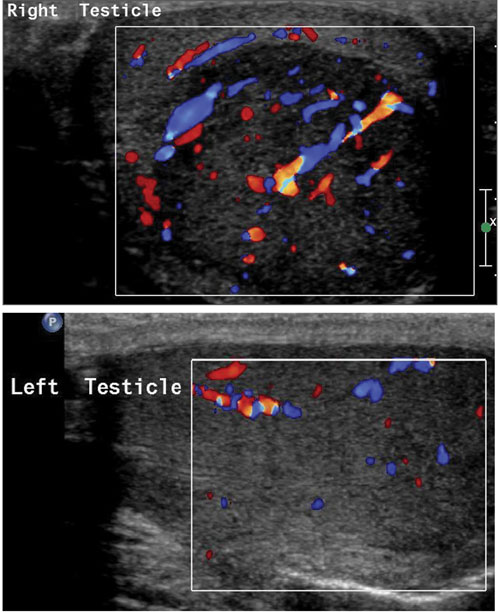
Bilateral scrotal ultrasound, which has a sensitivity of almost 100% in diagnosing testicular cancer, should be performed to confirm the diagnosis, see figure 1. Histological analysis of the testicular mass occurs only after it has been removed by inguinal orchidectomy.
A biopsy through the scrotum and scrotal orchidectomies are avoided as they carry an increased risk of local recurrence and inguinal node metastases.2
Treatment
Treatment options for men with testicular cancer include surgery, chemotherapy, radiotherapy, or a combination of the above, depending on the histology, presence of tumour markers and radiological staging.
Orchidectomy is the first step in treating testicular cancer. Serum tumour markers should be measured before orchidectomy and five to seven days later. Staging, see table 1 below, is usually undertaken after orchidectomy and helps determine prognosis and treatment. It requires a CT of the thorax, abdomen and pelvis but additional imaging may be performed depending on the patient’s symptoms. More than 70% of patients are diagnosed with stage l disease at presentation.14
Raised serum tumour marker levels should fall after orchidectomy so patients with clinical stage l disease whose tumour marker levels fail to normalise after orchidectomy are presumed to have metastatic disease, even if their CT scan appears normal. These patients are categorised as clinical stage lS and should be treated with chemotherapy.2
Risk categories for patients with metastatic germ cell tumours post-orchidectomy have been established by the International Germ Cell Cancer Collaborative Group for seminoma and non-seminoma based on clinically independent prognostic features, see table 2. 15
Seminoma
An algorithm for the management of seminomas is shown in figure 2.
The recommended management post-orchidectomy for stage l seminoma is surveillance.
One cycle of adjuvant carboplatin chemotherapy may be advised if risk factors for recurrence are present.14
A recent study identified predictive factors for relapse including:
• Invasion of blood or lymphatic vessels
• Tumour size > 4 cm
• Serum HCG > 200IU/L16
Adjuvant carboplatin reduces the relapse rate from 15-20% to around 5%. Patients who relapse while on surveillance are very likely to be cured by chemotherapy, with an overall cancer specific survival rate > 99%.17
Metastatic seminoma
The standard treatment for stage IIA/B seminoma is retroperitoneal radiotherapy but this area has become controversial and concerns exist about its efficacy and the risk
of radiotherapy-related induction of secondary cancers. Chemotherapy is an alternative to radiotherapy and a recent study has suggested that it may be associated with a lower relapse rate.18 The most commonly used regimen is three cycles of bleomycin, etoposide and cisplatin (BEP).
For advanced seminomas (IIC and III), the standard treatment is chemotherapy. Three cycles of BEP are given for patients in the good prognosis group and four cycles for those in the intermediate prognosis group. 14
Non-seminoma
An algorithm for the management of non-seminomas is shown in figure 3.
Stage 1 NSGCT patients are divided into low or high risk depending on the presence of vascular invasion.
The five-year relapse rate is 20% for low-risk patients and 40-50% for high-risk patients.
For low-risk patients, surveillance is recommended unless the patient is unwilling or unsuitable, in which case, adjuvant chemotherapy or nerve sparing retroperitoneal lymph node dissection are treatment options. Adjuvant chemotherapy with two cycles of BEP should be recommended for high-risk patients. 14
Metastatic non-seminoma
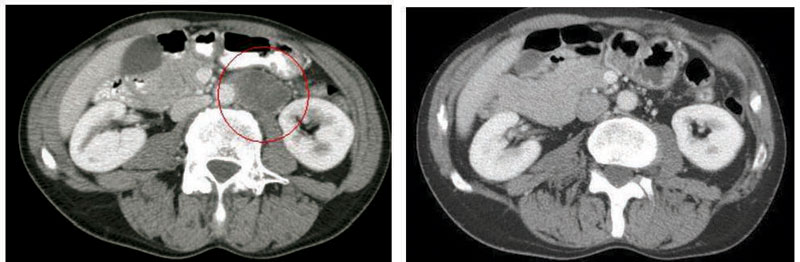
The primary treatment of choice in metastatic NSGCT is BEP chemotherapy, three cycles for patients in the good prognosis group and four cycles for those in the intermediate or poor prognosis groups. 14 Overall survival in the good, intermediate and poor prognosis groups is 94%, 83% and 71%, respectively.19 Figure 4, shows CT scans in a 51-year-old man before and after successful treatment with chemotherapy for metastatic NSGCT.
All patients are placed on a long-term follow-up schedule after treatment which aims to detect relapse and to monitor the contralateral testis as well as monitoring the side effects of treatment, see below.
Monitoring survivors
Testicular cancer is a curable cancer predominantly affecting young men, so the need to identify and manage long-term health consequences in survivors is very important.
Some patients become hypogonadal after orchidectomy and require testosterone replacement.
Others will experience chronic side effects from chemotherapy which may be permanent. These include hearing loss, peripheral neuropathy, Reynaud’s phenomenon, renal impairment and ototoxicity (hearing loss and tinnitus). In most patients, there is recovery of spermatogenesis two years after completion of chemotherapy20 but in all patients, sperm banking should be offered before chemotherapy. Bleomycin may cause lung toxicity because it has the potential to cause pulmonary fibrosis.
The risk of developing a secondary malignancy is increased in patients treated for testicular cancer. In a study of 40,576 testicular cancer survivors, those who survived at least ten years had significantly increased risks of secondary solid cancers. This risk was associated with the following treatment modalities:
• Radiotherapy alone, relative risk (RR) 2.0 (95% CI:1.9-2.2)
• Chemotherapy alone, RR 1.8 (95% CI:1.3-2.5)
• Radiotherapy + chemotherapy, RR 2.9 (95% CI:1.9-4.2) 21
Men who have been treated for testicular cancer with infradiaphragmatic radiotherapy or chemotherapy also have an increased incidence of cardiovascular disease and metabolic syndrome.22 Patients should be screened for cardiovascular risk factors, given advice on healthy lifestyle choices and advised not to smoke.
A large study in Norway found significantly increased levels of anxiety which was associated with younger age, peripheral neuropathy, fear of relapse, economic concerns, alcohol abuse, sexual difficulties, and a history of treatment for mental health problems in long-term survivors of testicular cancer, compared with men in the general population.23
Chemotherapy has revolutionised the treatment of testicular cancer and is one of the great success stories of modern oncology. Early diagnosis remains important to maximise cure rates and reduce the need for intensive treatment. GPs can help to educate young male patients about the risk and how to perform self-examination.
Early referral to a urologist, if a tumour is suspected, can result in early diagnosis, more effective and less intensive treatment with fewer long-term health consequences.
REFERENCES
1 Cancer Research UK. Testicular cancer incidence statistics 2011. www.cancerresearchuk.org/cancer-info/cancerstats/types/testis/incidence/
2 Motzer RJ, Agarwal N, Beard C et al. NCCN clinical practice guidelines in oncology: testicular cancer. J Natl Compr Canc Netw 2009;7(6):672-93
3 Cancer Research UK - Testicular cancer survival statistics 2013. www.cancerresearchuk.org/ cancer-info/cancerstats/types/testis/survival/
4 Macmillan Cancer Information - Symptoms of testicular cancer 2012 www.macmillan.org.uk/Cancerinformation/Cancertypes/Testes/Symptomsdiagnosis/Symptoms.aspx
5 Kennett A, Shaw JW, Woolley PD. Testicular self-examination amongst genitourinary medicine clinic attendees. Int J STD AIDS.2014 Feb 10 [Epub ahead of print]
6 Akre O, Pettersson A, Richiardi L. Risk of contralateral testicular cancer among men with unilaterally undescended testis: a meta analysis. Int J Cancer 2009;124(3):687-9
7 Fosså SD, Chen J, Schonfeld SJ et al. Risk of contralateral testicular cancer: a population-based study of 29,515 U.S. men. J Natl Cancer Inst 2005;97(14):1056-66
8 Peng X, Zeng X, Peng S et al. The association risk of male subfertility and testicular cancer: a systematic review. PLoS One 2009;4(5):e5591
9 Yousif L, Hammer GP, Blettner M, Zeeb H. Testicular cancer and viral infections: a systematic literature review and meta-analysis. J Med Virol 2013;85(12):2165-75
10 McGlynn KA, Cook MB. Etiologic factors in testicular germ-cell tumors. Future Oncol 2009;5(9):1389-402
11 National Institute for Health and Clinical Excellence. CG27. Referral guidelines for suspected cancer. NICE. London. 2005
12 Gilligan TD, Seidenfeld J, Basch EM et al. American Society of Clinical Oncology Clinical Practice Guideline on uses of serum tumor markers in adult males with germ cell tumors. J Clin Oncol 2010;28(20):3388-404
13 Ehrlich Y, Beck SD, Foster RS et al. Serum tumor markers in testicular cancer. Urol Oncol 2013;31(1):17-23
14 Albers P, Albrecht W, Algaba F et al. EAU guidelines on testicular cancer: 2011 update. Eur Urol 2011;60(2):304-19
15 International Germ Cell Consensus Classification: a prognostic factor-based staging system for metastatic germ cell cancers. International Germ Cell Cancer Collaborative Group. J Clin Oncol 1997;15(2):594-603
16 American Society of Clinical Oncology (ASCO) - Daily News - Post-Surgery Surveillance Adequate for Patients with Stage I Seminoma. 2013 http://am.asco.org/post-surgery-surveillance-adequate-patients-stage-i-seminoma
17 Mead GM, Fossa SD, Oliver RT et al. Randomized trials in 2466 patients with stage I seminoma: patterns of relapse and follow-up. J Natl Cancer Inst 2011;103(3):241-9
18 Tandstad T, Smaaland R, Solberg A et al. Management of seminomatous testicular cancer: a binational prospective population-based study from the Swedish Norwegian testicular cancer study group. J Clin Oncol 2011;29(6):719-25
19 van Dijk MR, Steyerberg EW, Habbema JD. Survival of non-seminomatous germ cell cancer patients according to the IGCC classification: An update based on meta-analysis. Eur J Cancer 2006;42(7):820-6
20 Suzuki K, Yumura Y, Ogawa T et al. Regeneration of spermatogenesis after testicular cancer chemotherapy. Urol Int 2013;91(4):445-50
21 Travis LB, Fosså SD, Schonfeld SJ et al. Second cancers among 40,576 testicular cancer patients: focus on long-term survivors. J Natl Cancer Inst 2005;97(18):1354-65
22 Haugnes HS, Bosl GJ, Boer H et al. Long-term and late effects of germ cell testicular cancer treatment and implications for follow-up. J Clin Oncol 2012;30(30): 3752-63
23 Dahl AA, Haaland CF, Mykletun A et al. Study of anxiety disorder and depression in long-term survivors of testicular cancer. J Clin Oncol 2005;23(10):2389-95
ARTICLE IN PDF
 Download this article in PDF format
CLICK ON IMAGES
PRESET SEARCHES
Immediate CPD prompts
These handy templates* prompt immediate drafting of personal learning, reflection and planning. Save your record straight into your personal development folder on your device or Cloud storage system.
*Adobe reader needed for iPad
EXTERNAL WEBLINKS
For patients
Cancer Research UK
Macmillan Cancer Support
For healthcare professionals
European Association of Urology
US National Cancer Institute
PDQ® (Physician Data Query) is NCI's cancer database of peer-reviewed, regularly updated evidence-based, referenced summaries
Men
Testicular screening
Penile
UK Risk Assessment Tools
QCancer
Qcancer men
UK Early diagnosis programmes
UK NCAT
Macmillan - early diagnosis
PubMed
Diagnosis testicular cancer
Primary care testicular cancer - review