SEARCH

Practitioner 2011; 255 (1739): 21-23
Managing patients with acute urinary retention
18 Apr 2011
AUTHORS
Dr Shanggar Kuppusamy MB BS MSurg FRCS
Honorary Fellow, Bristol Urological Institute, Southmead Hospital, Bristol
Senior Lecturer, Division of Urology, Department of Surgery, University of Malaya, Kuala Lumpur, Malaysia
Mr David GillattMB ChB ChM FRCS
Consultant Urologist and Director, Bristol Urological Institute, Southmead Hospital, Bristol
Article
Acute urinary retention (AUR) is a common urological emergency. AUR is defined as the sudden inability to pass urine.1 The patient presents with a history of reducing urinary output, which may have stopped for hours before seeking medical attention. This is associated with lower abdominal distension. Although painful acute urinary retention is more common, the occurrence of painless retention should also be kept in mind as this usually indicates an acute on chronic retention or a neurological cause.
Although the immediate problem can be relieved by successful catheterisation of the bladder, the dilemma is always in deciding what to do next. The causes, and hence the subsequent management, can vary widely. Urological advice may or may not be available at the time of presentation, and increasing numbers of patients are seen initially by GPs.
Causes
Women
Retention in women is relatively rare. Generally, once the underlying problem is identified and treated, successful voiding is achieved in the majority of cases.2 There may not always be an identifiable cause and a trial without catheter (TWOC) in these conditions can yield good results.
Common causes in women include:
- neurological problems
- infection such as urethritis, vulvovaginitis
- inflammation postpartum
- gynaecological such as uterine fibroids
- post-surgery e.g. following trans-vaginal tape (TVT) or spinal surgery
- constipation
Men
AUR is more than ten times more common in men than women.3 AUR in men tends to occur in the elderly and the risk of AUR is higher in men > 70 years. Those in this age group have a 10% risk of developing AUR over a five-year period.4 A large cohort study5 reported that the incidence of AUR is actually low in the general male population of 45 years or older. The incidence of AUR in the general male population was only 2.2 per 1,000 man-years (95% CI: 2.0-2.4) and an increasing incidence was noted with increasing age.5 However, in almost 50% of AUR patients with benign prostatic hyperplasia/lower urinary tract symptoms (BPH/LUTS), AUR was their first symptom.
The causes of AUR in men can be divided into precipitated (induced by an event) or occurring spontaneously. These can be further divided according to the mechanism i.e. obstructive, neurological and myogenic. Table 1, above, shows potential causes of AUR and mechanisms of obstruction.1,3,4,6
Spontaneous AUR is caused by progression of BPH leading to a mechanical obstruction of the bladder outlet. It is the most common cause of AUR.
Presentation and assessment
The typical presentation of AUR is a patient complaining of sudden inability to urinate associated with progressive abdominal distension which is usually painful. The pain increases in intensity with increasing distension of the bladder. A thorough history and examination of the patient enables a clinical diagnosis of AUR to be made and the probable cause to be identified.
The history should include prior LUTS (although the patient may not have noticed any symptoms before), drug intake, alcohol intake, previous surgery/instrumentation, neurological problems, constipation and recurrent urinary tract infections.
An abdominal examination should reveal a distended bladder which can be confirmed by a dull percussion note. A digital rectal examination is vital to gain information on prostatic enlargement (either benign or malignant), faecal load in rectum, anal tone and presence of other masses.
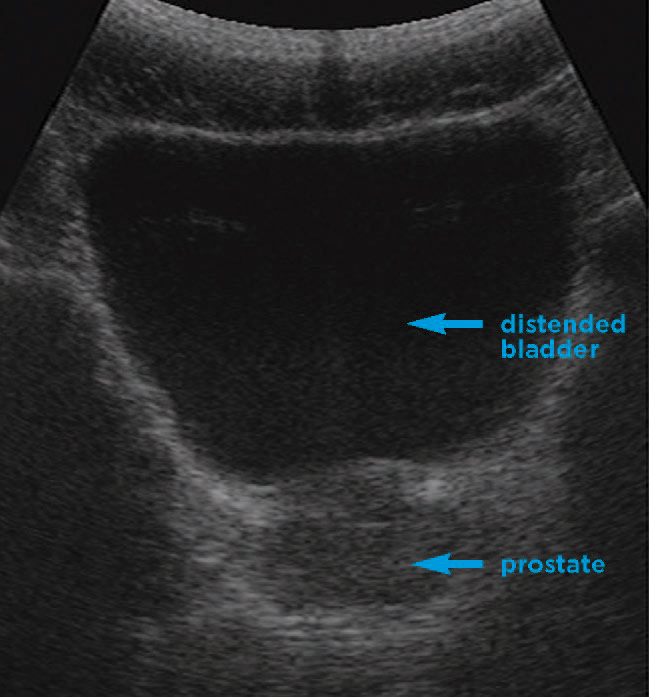
If an ultrasound machine is available, a quick scan of the suprapubic region can confirm the diagnosis. Although ultrasound is not necessary to diagnose AUR, it can be used to measure bladder volume to differentiate between AUR and acute on chronic retention especially when the patient does not have any pain associated with the retention. A bladder volume on ultrasound of < 1L suggests AUR rather than chronic urinary retention (CUR).
Several investigations are necessary when dealing with AUR. Urinalysis and culture should be carried out on a sample obtained after catheterisation to rule out infection.
Renal function should be assessed specifically looking at urea, electrolytes and creatinine to see if there has been damage to the upper tracts. This is more common in CUR. Ultrasound of the urinary system may not be necessary unless the patient has abnormal renal function.
It is better not to perform a PSA test in this situation as it will invariably be raised due to distension of the bladder and catheter insertion.7
Management
A patient suffering from AUR needs urgent catheterisation to decompress the bladder as they will usually be in severe pain. The patient may be seen in A&E or in the community by a GP.
Catheter insertion technique must be sound in order to prevent long-term damage to the urethra. A smaller sized catheter can be used for a stricture or a larger one if a case of BPH is suspected. If catheter insertion fails then a urological consultation is required for insertion of a suprapubic catheter (SPC).
Urethral catheterisation is still the preferred route and the SPC is reserved for urethral catheter failure even among urologists.8
Although SPC insertion is a more complex procedure, there have been suggestions that it has advantages as a primary catheterisation method for AUR with regards to comfort, sexual function and risk of infection.9
Once the bladder is decompressed, it is important to quantify the volume of urine that is drained within 15-20 minutes as this will indicate the residual urine. A volume < 1L indicates that the patient has a better chance of a successful TWOC as compared with a volume >1L. Sudden decompression of the bladder can also give rise to haematuria but this usually resolves within a couple of days without the need for further intervention or investigation.
A decision needs to be made about whether the patient should be admitted. Admission is essential if the patient:
- is unwell with urosepsis
- has abnormal renal function needing further investigation and fluid monitoring (risk of diuresis)
- has acute neurological problems
- is unable to take care of the catheter
However, if none of these features is apparent then the patient can go home and be cared for in the community. Many patients may find the presence of a catheter socially unacceptable and may prefer to stay in hospital until it is removed.
Trial without catheter
TWOC needs to be planned and the ideal time to do this is within 2-3 days so that the patient can pass urine naturally. TWOC is successful in up to 40% of patients when all precipitating causes such as UTI, constipation and any precipitating drugs have been identified and the situation resolved.
Residual urine of
In cases where the AUR is secondary to BPH, administration of an alpha-blocker e.g. alfuzosin 10 mg or tamsulosin 400 µg daily for up to 3 days post-catheterisation significantly increases the chance of TWOC. These drugs inhibit the alpha-adrenergic activity at the bladder neck to relieve the outlet obstruction. Subsequent alpha-blocker therapy plays an important role in improving the urinary symptoms, reducing or preventing another episode of AUR and may reduce the need for surgical intervention.8, 10
Failure of TWOC in a BPH patient will lead to possible surgical intervention in the form of a transurethral resection of the prostate (TURP) which has its own complications. A single episode of AUR used to be an indication for TURP, however with the advent of newer and more efficacious drugs such as alpha-blockers and
5α-reductase inhibitors e.g. finasteride and dutasteride, the risk of AUR recurring can be reduced or prevented.6 This can result in avoidance of surgery or at least postponement to an elective setting.
Reducing episodes of AUR
GPs have an important role in preventing or reducing the number of episodes of AUR. It may not be possible to predict the occurrence of precipitated AUR in the community as the causes are quite diverse. However, the progression of BPH is one of the most common causes of AUR, and AUR may be the first presentation of BPH/LUTS.
Unfortunately, many elderly men do not seek, or delay seeking, medical advice for their symptoms as they tend to attribute these symptoms to advancing age.
Identifying risk factors for AUR (see table 2, above) and referring high-risk patients to a urologist, especially for assessment of prostatic volume and flow rate, and early treatment with alpha-blockers and 5α-reductase inhibitors can improve symptoms as well as reduce the incidence of AUR.6, 10
Conclusion
GPs can play a major role in identifying patients who need assessment for BPH/LUTS and starting early treatment with pharmacotherapy. Health education should address the importance of compliance with medication and patients should be followed up to reduce the risk of AUR and surgical intervention. Urological intervention may only be required in cases where specialised assessment or treatment is needed and in patients where catheter insertion has failed during an episode of AUR.
REFERENCES
1 Kaplan S, Wein A, Staskin R et al. Urinary retention and post void residual urine in men: separating truth from tradition. J Urol 2008;180:47-54
2 Ahmad I, Krishna NS, Small DR et al. Aetiology and management of acute female urinary retention. Br J Med Surg Urol 2009;2:27-33
3 Choong S, Emberton M. Acute urinary retention. BJU Int 2000;85:186-201
4 Fitzpatrick J, Kirby R. Management of acute urinary retention. BJU Int 2006;97(Suppl 2):16-20
5 Verhamme KMC, Dieleman JP, van Wijk MAM et al. Low incidence of acute urinary retention in the general male population: The Triumph Project. Eur Urol 2005;47:494-498
6 Kalejaiye O, Speakman MJ. Management of acute and chronic retention in men. Eur Urol 2009;8(Suppl):523-529
7 Aliasgari M, Soleimani M, Hosseini Moghaddam SM. The effect of acute urinary retention on serum prostate-specific antigen level. Urol J 2005;2:89-92
8 Emberton M, Fitzpatrick J. The Reten-World survey of the management of acute urinary retention: preliminary results. BJU Int 2008;101(Suppl 3):27-32
9 Abrams P, Gaches C, Green N. Role of suprapubic catheterisation in retention of urine. J R Soc Med 1980;73:845-8
10 McNeill SA. The role of alpha-blockers in the management of acute urinary retention caused by benign prostatic obstruction. Eur Urol 2004;45:325-332
USEFUL INFORMATION
ARTICLE IN PDF
 Download this article in PDF format
EXTERNAL WEBLINKS
Nice Evidence
PubMed
For healthcare professionals and patients