SEARCH

Saghir R, Saghir N, Challacombe B. Managing bothersome LUTS. Practitioner April 2020;264(1836):17-21
Managing bothersome LUTS
23 Apr 2020
AUTHORS
Dr Reyan Saghir BSc (Hons) MBBS, Foundation Year Doctor, King’s College, London, UK
Mr Noman Saghir BSc (Hons) MBChB MRCS PGCert HR, Core Surgical Trainee, Wythenshawe Hospital, Manchester, UK
Mr Ben Challacombe MS FRCS (Urol), Consultant Urological Surgeon, The Urology Centre, Guy’s Hospital, London, UK
Competing interests: None
Article
Lower urinary tract symptoms (LUTS) in men can arise from the bladder, bladder neck, urethral sphincter, urethra or prostate. Global prevalence rates range from 50 to 75% in men over 50 to 80% in men over 70. LUTS can be classified into two major categories: storage or irritative symptoms and obstruction or voiding symptoms. Benign prostatic hyperplasia (BPH) is the most common cause of LUTS. By 80 years of age almost 90% of men have developed BPH at varying symptomatic levels. Specific LUTS associated with prostate enlargement include: urgency, intermittency, incomplete emptying, weak stream and nocturia. A full abdominal examination should be performed incorporating assessment for acute retention. The examination should include the external genitalia and a DRE to help assess prostate size, nodularity indicative of malignancy, rectal sphincter tone and perianal sensation. Blood tests should include a full blood count, renal function, glucose and HbA1c (if diabetes is suspected), and PSA (if prostate cancer is suspected). Urinalysis should be performed for blood, glucose, protein, leucocytes and nitrite followed by microscopy, culture and sensitivity if a UTI is suspected. If the patient’s symptoms and examination findings are suspicious of cancer then an urgent two week wait referral should be made to urology. Other reasons for referral include: complicated LUTS with recurrent or persistent UTI, retention, renal impairment, stress incontinence or bothersome LUTS not resolved by conservative or drug management.
Lower urinary tract symptoms (LUTS) in men can be defined by clinical symptoms arising from the bladder, bladder neck, urethral sphincter, urethra or prostate. LUTS are a growing concern among the aging population. Global prevalence rates range from 50 to 75% among men 50 years of age and older to 80% among men 70 years of age and older.1 However, LUTS should not be normalised as part of the ‘aging process’. LUTS can have a detrimental effect on quality of life. Early recognition and diagnosis will help improve the quality of life of these men.
Presentation
A European study investigating the reasons for consultation in 4,979 newly diagnosed LUTS patients showed that 77% attended because of the ‘bothersomeness’ of their symptoms, with this rate increasing to 89% (n = 435) for UK patients. Other reasons for consultation included: a fear of developing prostate cancer (15%), attendance via the prostate cancer screening programme (3%) or because of concerns raised by family or friends (1%).2
In a population-based study men with LUTS were nearly twice as likely to have elevated symptoms of depression.3
LUTS can be classified into two major categories, storage/irritative symptoms or disturbances due to obstruction or voiding difficulties as shown in table 1. Storage LUTS include: increased frequency of urination, nocturia, increased urgency followed by urge incontinence. Symptoms related to voiding include: weak stream, split stream, hesitancy, intermittency, straining, incomplete voiding, urinary retention, and postmicturition dribbling.
Detailed questioning and assessment may be needed to elicit the aetiology of the symptoms identified.3
Pathophysiology and aetiology
Bladder outlet obstruction
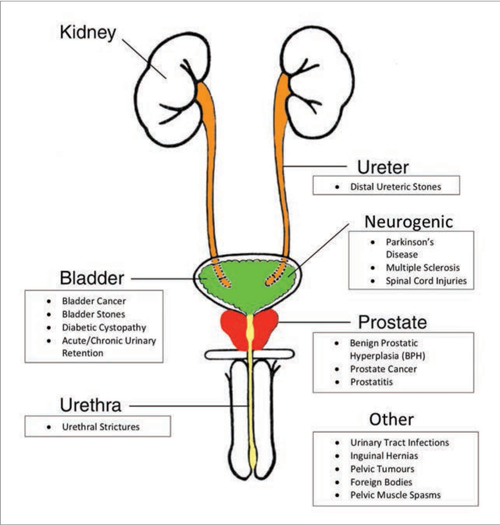
The pathophysiology of LUTS is multifactorial as shown in figure 1. Benign prostatic hyperplasia (BPH) which causes bladder outlet obstruction affecting the flow of urine is the most common cause of LUTS.
In BPH there is a non-malignant proliferation of smooth muscle and epithelial cells. It is estimated that by 80 years of age almost 90% of men have developed BPH at varying symptomatic levels.4 Specific LUTS associated with prostatic enlargement include: urgency, intermittency, incomplete emptying, weak stream and nocturia.
Prostatitis can also manifest with similar symptoms and although there is considerable overlap between the two conditions, the presence of pain may make prostatitis the more likely diagnosis.5 Recently worsening LUTS, over months rather than years, may also indicate prostate cancer, particularly if accompanied by progressive constitutional symptoms, such as weight loss and fatigue requiring further investigation to confirm diagnosis.
Other less common causes of bladder outlet obstruction include: bladder stones and bladder cancer, pelvic tumours, urethral scarring from infections or trauma causing urethral strictures, foreign bodies, pelvic muscle spasms and inguinal hernias.
Detrusor muscle activity
Most overactivity of the detrusor muscle is idiopathic with no underlying cause identified. Neurogenic causes of LUTS caused by dysfunction of the bladder detrusor muscle can lead to both underactivity and overactivity.
One of the most common causes of detrusor muscle dysfunction is diabetic cystopathy. It is thought that poor glycaemic control leads to ischaemia and free radical development causing neuronal and detrusor muscle damage, leading to symptoms such as increased frequency, nocturia, hesitancy and intermittency.
Neurological disorders affecting detrusor muscle activity include multiple sclerosis with 90% having some urinary symptoms including frequency, urgency and urge incontinence as part of the condition. Storage LUTS are most common with increased frequency, urgency and urge incontinence.6 In Parkinson’s disease detrusor overactivity may manifest in some patients and underactivity in others.7 Spinal cord injuries may produce voiding symptoms and herniated intervertebral discs can also cause LUTS. Cauda equina may cause irreversible loss of bladder and urethral sphincter functions.8
Management of LUTS in patients with neurological conditions is outside the scope of this article.
Examination and assessment
History
Questioning should address all potential voiding and storage symptoms. It is important to enquire about fluid intake, medical history in particular previous surgery, and neurological conditions or diabetes which can cause LUTS, previous urinary tract infections (UTIs) and sexually transmitted infections.
Drug history should cover diuretics, and caffeine intake, herbal remedies and in particular ketamine abuse, if suspected, which may cause significant storage LUTS.9
Constitutional symptoms indicative of cancer should be enquired about. Previous lower urinary tract structural abnormalities should be noted.
The International Prostate Symptom Score (I-PSS), see figure 2, can be very useful to track progression of LUTS over multiple consultations.
Physical examination
A full abdominal examination should be performed assessing for acute urinary retention, by percussion, with accompanying pain during deep suprapubic palpation. The external genitalia and hernial orifices should be examined, with consent, and ideally in the presence of a chaperone. A digital rectal examination (DRE) is extremely important to help assess prostate size, nodularity indicative of malignancy, rectal sphincter tone and perianal sensation. However, be wary as even smooth small prostates can still have underlying anterior malignancies, as you are only feeling the posterior aspect of the prostate and further investigation is warranted in the presence of symptoms.
Neurological examination is also important to perform in LUTS patients if the history is suggestive or there are associated comorbidities. Examination should include assessing tone, strength, reflexes and sensations both peripherally and centrally.
Investigations and referral
A PSA test and renal function blood tests should be performed if not done recently. Urinalysis should be performed for blood, glucose, protein, leucocytes and nitrite followed by microscopy, culture and sensitivity (MC&S) if a UTI is suspected and blood glucose and HbA1c levels for suspected diabetes.
A two-week wait referral should be made if the prostate feels malignant on DRE or if the PSA level is above the age-specific reference range according to NICE. 10 Other reasons for referral may include complicated LUTS with recurrent or persistent UTI, retention, renal impairment, stress urinary incontinence or if the patient has bothersome LUTS not resolved by conservative or drug management. Following urological referral, a formal symptom assessment (I-PSS), frequency/volume chart, flow test and residual volume measurement and ultrasound will usually be carried out. Some patients will require cystoscopy if they present with: recurrent infections, sterile pyuria, haematuria, profound symptoms or pain. MRI imaging can be used for investigation of prostate cancer and urodynamics will be performed for complex or neurological LUTS. Pad tests may also be used to help identify degrees of urinary incontinence.11
Management
Lifestyle interventions
Initially management options should involve conservative lifestyle adjustments. Patients should aim to consume 1.5 to 2L of fluid per day, with a reduction in consumption of alcohol, caffeinated and fizzy drinks in particular to avoid bladder irritation. Diuretics should be avoided with the focus on bladder retraining strategies and pelvic floor exercises if symptoms include frequency, urge and incontinence.
Patients should try to avoid becoming constipated as enlargement of the bowels will have a compressive effect on the bladder. Men should avoid heavy lifting, and if overweight lose weight.12
In smokers, smoking cessation is also recommended.
Medical and surgical treatment
In BPH, the mainstay of treatment is alpha blockers to relax the bladder neck and ease urination and/or 5-alpha reductase inhibitors to reduce/reverse the prostate growth. NICE recommends consideration of combination treatment for men with prostates estimated to be > 30 g.13 Some men with a mixture of voiding and storage LUTS will benefit from a combination of an alpha blocker and an anticholinergic tablet. This can be prescribed as the combination formulation of solifenacin and tamsulosin. However, if symptomatic relief is not achieved and LUTS remain bothersome then minimally invasive surgical procedures such as transurethral resection of the prostate (TURP) or Holmium laser enucleation of the prostate (HoLEP) for larger glands may be used.13 There are a number of more minimally invasive treatments emerging such as PVP-GreenLight laser ablation, UroLift, Rezum and prostate artery embolisation. These techniques usually have a better initial side-effect profile but are not as definitive or durable as TURP or HoLEP.
Acute bacterial prostatitis requires antibiotics and analgesia.14 However, in chronic prostatitis alpha blockers can play a role. As well as alpha blockers, NSAIDs and occasionally tadalafil and laxatives can be of use if chronic pelvic pain syndrome develops.
Stones and structural abnormalities
Distal ureteric stones can be painful due to peristaltic spasms causing frequency and a feeling of incomplete emptying. Treatment options depend on the size of the stone following ureteric imaging (non-contrast spiral CT). Stones less than 4 mm will pass spontaneously but larger ones require ureteroscopy and laser fragmentation or ultrasound guided shockwave lithotripsy.
Bladder stones mostly formed by urinary retention are treated by cystolitholapaxy. However, although the stone can be destroyed the underlying problem of poor bladder emptying may remain and stones recur. Thus formal bladder outflow surgery to the prostate is often recommended. For urethral strictures a formal dilatation or urethrotomy or a formal urethroplasty may be needed.15
Incontinence
Incontinence is generally due to stress or urge or a mixture of both and can be initially managed with lifestyle changes (avoiding caffeine, alcohol, and restricting fluids) and temporary measures such as pads, catheters or collection devices. Medical and surgical approaches are available in urology if these approaches are not successful.
Stress incontinence is due to weakness of the pelvic floor and sphincter muscle commonly starting after childbirth in women and after surgery in both sexes. With stress incontinence stress activities such as jumping or coughing can increase intra-abdominal pressure causing leakage beyond the patient’s control. Medical treatment such as the antidepressant duloxetine to help relax urethral muscle is not particularly effective and thus surgical treatment may be indicated such as sling surgery whereby an autologous graft or prosthetic sling is made to wrap around the urethral bulb or in rarer cases an artificial sphincter.
Urge incontinence is due to a sudden involuntary contraction of the bladder wall creating an unstoppable urge to urinate. Classical antimuscarinics such as solifenacin and detrusitol, or mirabegron, a selective beta-3 adrenoreceptor agonist, help relax the bladder smooth muscle allowing the bladder to fill with urine more fully thereby reducing urge incontinence episodes. Due to an association with prolonged use of antimuscarinics and dementia in the elderly, mirabegron or trospium (which does not cross the blood brain barrier) are the preferred options in this group.
Other options for persistent urge incontinence include botulinum toxin (Botox) injections to the bladder mucosa or sacral/posterior tibial nerve stimulation. These approaches may help control detrusor and pelvic floor muscles respectively. Overflow incontinence, which often occurs at night, is almost pathognomonic for chronic urinary retention. Here the detrusor muscle of the bladder wall is weaker and leads to incomplete emptying and swelling of the bladder. This can only be treated using an intermittent or permanent indwelling catheter (depending on the severity and age of the patient) and then a TURP or equivalent if indicated.16
In patients with diabetes ensuring good glycaemic control is paramount.
Complications
Acute urinary retention (AUR) is a medical emergency commonly seen in BPH patients, where obstruction of the urinary tract suddenly impedes the ability to pass urine. This is treated by urgent catheter insertion and drainage
and a subsequent trial of voiding helped by an alpha blocker or definitive bladder outflow surgery. In some men insidious chronic urinary retention can develop in the longer term potentially leading to detrusor failure and chronic kidney disease. In such cases the urinary tracts must be imaged for hydronephrosis and eGFR and serum creatinine measured, but only by treating the underlying bladder outlet obstruction can the chronic retention be resolved.17
Other common complications include UTIs which can be very troublesome and can become complicated by functional abnormalities of the genitourinary system such as prostate hyperplasia, catheter insertion and urolithiasis. Where the bladder is unable to empty fully, the residual urinary volume can act as a culture medium for bacterial growth and UTIs develop. Symptoms may be mild with increased frequency and urgency to severe with frank haematuria. Following a urine dipstick and subsequent MC&S antibiotics should be commenced. However, if systemically unwell, patients can be at risk of developing urosepsis needing urgent hospital admission.17
Conclusion
LUTS are an increasing problem among the aging population. Symptoms are often bothersome and in many cases disabling leading to detrimental effects on the patient’s quality of life.
The impact on the patient’s quality of life can be easily overlooked leading to depression. An assessment of the impact of LUTS on the patient’s mental health should be also be carried out.3
Taking a careful history, followed by appropriate examination and investigations are key to diagnosing the underlying cause of LUTS and enabling effective management. A range of novel medical and surgical treatments have emerged to improve outcomes, prevent progression of symptoms and improve quality of life.
REFERENCES
1 Egan KB. The epidemiology of benign prostatic hyperplasia associated with lower urinary tract symptoms: prevalence and incident rates. Urologic Clinics 2016;43(3):289-97
2 Hutchison A, Farmer R, Chapple C et al. Characteristics of patients presenting with LUTS/BPH in six European countries. Eur Urol 2006;50:555-62
3 Coyne KS, Wein AJ, Tubaro A et al. The burden of lower urinary tract symptoms: evaluating the effect of LUTS on health-related quality of life, anxiety and depression: EpiLUTS. BJU Int 2009;103 Suppl 3:4-11
4 Lepor H. Pathophysiology of lower urinary tract symptoms in the aging male population. Rev Urol 2005;7 Suppl 7:S3-S11
5 Nickel JC. The overlapping lower urinary tract symptoms of benign prostatic hyperplasia and prostatitis. Curr Opin Urol 2006;16(1):5-10
6 Haensch CA, Jorg J. Autonomic dysfunction in multiple sclerosis. J Neurol 2006;253 Suppl 1:I3-9
7 Araki I, Kitahara M, Oida T, Kuno S. Voiding dysfunction and Parkinson's disease: urodynamic abnormalities and urinary symptoms. J Urol 2000;164(5):1640-43
8 Miyazato M, Yoshimura N, Chancellor MB. The other bladder syndrome: underactive bladder. Rev Urol 2013;15(1):11-22
9 Chu PS, Ma WK, Wong SC et al. The destruction of the lower urinary tract by ketamine abuse: a new syndrome? BJU Int 2008;102(11):1616-22
10 National Institute for Health and Care Excellence. NG12. Suspected cancer: recognition and referral. NICE. London. 2015 Updated July 2017
11 National Institute for Health and Care Excellence. Lower urinary tract symptoms in men overview. NICE Pathways 2019:1-13 https://pathways.nice.org.uk/pathways/lower-urinary-tract-symptoms-in-men
12 Yeh HC, Liu CC, Lee YC. Associations of the lower urinary tract symptoms with the lifestyle, prostate volume, and the metabolic syndrome in the elderly males. Aging Male 2012;15(3):166-72
13 National Institute for Health and Care Excellence. CG97. Lower urinary tract symptoms in men: management. NICE. London. 2010 Updated June 2015
14 Coker TJ, Dierfeldt DM. Acute bacterial prostatitis: Diagnosis and management. Am Fam Physician 2016;93(2):114-20
15 Ali M, Hashem A, Helmy TE et al. Shock wave lithotripsy versus endoscopic cystolitholapaxy in the management of patients presenting with calcular acute urinary retention: a randomised controlled trial. World J Urol 2019;37(5):879-84
16 Chung E, Katz DJ, Love C. Adult male stress and urge urinary incontinence - A review of pathophysiology and treatment strategies for voiding dysfunction in men. Aust Fam Physician 2017;46(9):661-66
17 Speakman MJ, Cheng X. Management of the complications of BPH/BOO. Indian J Urol 2014;30(2):20
 Download this article in PDF format