SEARCH

Betts TR. Improving identification and treatment of atrial fibrillation. Practitioner 2012;256 (1756): 27-31
Improving identification and treatment of atrial fibrillation
12 Dec 2012
AUTHORS
Dr Tim R Betts MB ChB MD FRCP, Consultant Cardiologist and Electrophysiologist, Oxford Heart Centre, John Radcliffe Hospital, Oxford, UK
Article
Atrial fibrillation is the most common sustained cardiac arrhythmia. The oft quoted incidence of 1-1.7% of the population, based on the presence of atrial fibrillation on 12 lead screening ECGs, misses all those with paroxysmal episodes in a normal rhythm at the time of screening. One in 40 of the over 45s, 1 in 20 of the over 65s, 1 in 10 of the over 75s and 1 in 5 of the over 85s will have paroxysmal, persistent or permanent atrial fibrillation.
Paroxysmal atrial fibrillation episodes self-terminate. Persistent atrial fibrillation will not stop spontaneously but sinus rhythm may be restored with treatment and permanent atrial fibrillation occurs when all attempts to restore sinus rhythm have been abandoned.
The natural history is for paroxysmal episodes to increase until they become persistent, although many patients develop persistent atrial fibrillation from the outset.
Detecting atrial fibrillation
Although many individuals will have idiopathic atrial fibrillation with otherwise healthy hearts and no comorbidities, its development is associated with a number of common risk factors, see table 1.
On rare occasions an obvious and reversible precipitating or provoking cause may be identified, such as thyrotoxicosis, pneumonia or high alcohol intake. In reality, however, most patients have an underlying tendency to atrial fibrillation which is influenced by, but not entirely due to, environmental and lifestyle factors. It is very rare for abstinence from stress, caffeine or alcohol to abolish attacks.
Diagnosing and detecting atrial fibrillation can be challenging as the spectrum ranges from the asymptomatic individual in persistent arrhythmia to the patient with highly symptomatic but short-lived palpitations. Between 25 and 30% of patients will have no symptoms and present coincidentally through health checks, preoperative assessments and occasionally through screening pulse checks or ECGs.
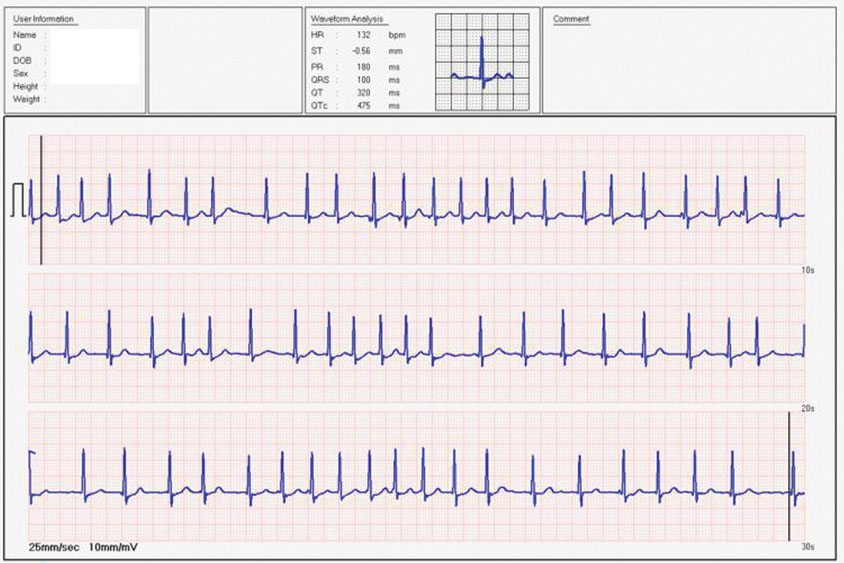
If an irregular pulse is detected on physical examination it should be followed by a 12 lead ECG. For people with intermittent symptoms potentially due to atrial fibrillation, documentation of the ECG during episodes requires appropriate use of monitoring equipment that will result in a high yield, see table 2. This usually requires a prolonged period of monitoring, see figure 1.
Every patient with a diagnosis of atrial fibrillation should have a physical examination to assess blood pressure and look for signs of valve disease and heart failure. It is routine to check thyroid function.
Referral
Although many patients can be successfully managed in primary care, NICE recommends transthoracic echocardiography in all younger patients (i.e. < 60 years), if a cardioversion and rhythm control strategy is contemplated, to look for suspected structural heart disease and stroke risk stratification (if no other risk factors are already present) and thus the possible need for oral anticoagulation.1
In addition, there are subgroups who would benefit from seeing a cardiologist, ideally one with an interest in arrhythmias, see table 3.
Consequences of atrial fibrillation
The consequences of atrial fibrillation can be divided into three separate areas, each of which should be assessed independently.
Thromboembolic stroke
Atrial fibrillation results in the loss of normal atrial contraction as well as influencing clotting factors. This may lead to the development of left atrial thrombus, most commonly in the left atrial appendage. The risk of systemic thromboembolism and stroke is increased five-fold, irrespective of whether the atrial fibrillation is paroxysmal, persistent or permanent and 35% of atrial fibrillation patients will have a stroke in their lifetime. Atrial fibrillation strokes are larger, more disabling and have a higher mortality rate than those with other causes.
Although recorded episodes that last seconds rather than minutes or hours may be lower risk, they may also be an indicator that longer episodes could occur at other times and therefore risk stratification should still be undertaken and anticoagulation used if appropriate.
The risk of stroke can be estimated using the CHADS2 score, see box 1a, opposite.2 Although now widely in use, approximately 25% of patients have a score of 1, placing them in an intermediate category for which aspirin is often inappropriately prescribed (see below). To overcome this, the more sophisticated CHA2DS2- Vasc score was devised, see box 1b, opposite.3 These scoring systems can be used to identify patients who will derive a net benefit from oral anticoagulation. The CHADS2 scoring system can be integrated into practice electronic patient records using the GRASP AF toolkit to identify patients suitable for oral anticoagulation and facilitate audit.4
Oral anticoagulation lowers the risk of ischaemic stroke by 60-70%.
The HAS-BLED scoring system has been developed to assess the risk of bleeding with warfarin.5 A score of 3 or more indicates high risk and the risks may then begin to outweigh the benefits. It should be noted that falls are not a risk factor in the HAS-BLED scoring system. Although often used as a reason to withhold anticoagulants, it has been calculated that it takes nearly 300 falls per annum before the benefits of warfarin outweigh the risks.6
Symptoms
Although 25-30% of patients are truly asymptomatic, for many the irregular, often rapid pulse may result in palpitations, exertional breathlessness, dizziness and chest pain. For others the loss of atrial contractility may cause symptoms of fatigue, breathlessness and reduced exercise capacity. The symptoms from atrial fibrillation can often be difficult to distinguish from the side effects of the drugs used in treatment.
Understanding the contribution of ventricular rate and atrial contractility helps determine the most appropriate treatment strategy.
Tachycardia cardiomyopathy Approximately 5% of individuals will have persistent atrial fibrillation with a rapid ventricular rate but very few symptoms. If the ventricles race away faster than 100 bpm for days or weeks on end a tachycardia cardiomyopathy can develop and patients eventually present with signs and symptoms of heart failure. Fortunately, this left ventricular dysfunction is reversible once the rate is brought under control and ideally sinus rhythm is restored.
Management
Stroke prevention
Aspirin is no longer a recommended option for thromboembolic stroke prevention in atrial fibrillation. It is now recognised that it does not prevent left atrial thrombus formation and is not without risk. In the BAFTA trial the incidence of serious bleeding with aspirin was identical to that with warfarin in the over 80s, yet it did not offer nearly as much protection against stroke.7 Patients aged < 60 years with lone AF have a stroke rate estimated to be 1.3% over 15 years which is not reduced with aspirin.
The choice now is between oral anticoagulation and nothing.
Oral anticoagulation is the recommendation for all patients with a CHADS2 score or CHA2DS2-Vasc score of 1 or more. Patients with scores of 0 do not require any therapy. If patients with stable coronary artery disease start warfarin for atrial fibrillation they can stop aspirin as there is no benefit from the combination (warfarin protects against vascular events too) but there is an increased bleeding risk.
The combination of aspirin and clopidogrel increases the bleeding risk significantly but is not as effective as oral anticoagulation and should not be seen as an alternative.
Warfarin is the established oral anticoagulant. It does require regular INR monitoring, however in stable patients this may be as infrequent as once every two months. Point of care finger-prick testing avoids the need for venepuncture and some patients purchase machines and self-manage their warfarin dose.
New oral anticoagulants have now been developed in an attempt to overcome the many challenges of warfarin use including labile INRs, the need for frequent blood tests, multiple interactions with other drugs and a high rate of patient non-compliance and treatment cessation.
Two drugs, dabigatran and rivaroxaban (see table 4) have recently been approved by NICE for the prevention of stroke in atrial fibrillation for patients with a CHADS2 score of 1 or more.8,9 A third agent, apixaban, is under review. The potential advantages include predictable and stable anticoagulant effects avoiding the need for regular blood test monitoring and fewer interactions with other medications.
Challenges remain however – neither dabigatran nor rivaroxaban have antidotes; there are side effects (such as dyspepsia with dabigatran) that lead to discontinuation in 5-11% per annum; the safety in the very elderly is not known as they represent only a minority of trial participants; and their excretion is affected by renal function.
For those with a CHADS2 score ≥ 1 the option of percutaneous left atrial appendage occlusion has been shown in the PROTECT-AF trial to be as effective as warfarin at reducing, stroke.10 This minimally invasive procedure, performed through a femoral vein puncture, seals off the source of the left atrial thrombus and can be performed using a short course of antiplatelet therapy. As a new therapy it is likely to be most suited to those with a high stroke risk (CHADS2 score > 2) and absolute contraindications(e.g. previous intracerebral bleed).
Symptoms
When the majority of symptoms (i.e. palpitations, breathlessness and dizzy spells) result from a rapid ventricular rate, AV nodal blocking drugs such as beta-blockers (e.g. bisoprolol 2.5–10 mg od) or long-acting calcium channel blockers (e.g. diltiazem 180-300 mg od) are preferred. Digoxin may slow the rate at rest but its effects are negated by exertion and it is often ineffective as a sole agent.
The target for effective rate control should be a resting heart rate < 95-100 bpm and abolition of symptoms. In the less active, elderly patient this can often be achieved without the need for high doses of medication.
If drugs are ineffective or poorly tolerated, an alternative option is simple catheter ablation of the atrioventricular node to create complete heart block combined with insertion of a permanent pacemaker. This option is less attractive for younger individuals as it renders them pacemaker-dependent for life.
Unfortunately many people, particularly those who lead active lifestyles, suffer symptoms from the loss of atrial contractility even with good ventricular rate control. Rhythm control can be far more challenging to achieve.
Persistent atrial fibrillation may be treated with DC cardioversion. However, relapse rates are high, with 70% back in atrial fibrillation at 12 months. Even with the use of amiodarone, 50% will be back in atrial fibrillation at 12 months. Cardioversion, however, is a simple and safe procedure and can be used repeatedly if the intervals between persistent attacks are long. It can also be useful to determine whether atrial fibrillation is contributing to symptoms (do patients feel better when in sinus rhythm and can they tell when atrial fibrillation returns?) and thus select candidates for catheter ablation.
Paroxysmal episodes may be prevented with antiarrhythmic drugs including sotalol, flecainide and more recently dronedarone, see table 5, below. Although they may reduce the frequency and duration of attacks and delay the progression to persistent atrial fibrillation, it is rare to find an individual in which they work well and have no side effects. Some patients with infrequent episodes that last for many hours may use a ‘pill in the pocket’ approach with a single 200-300 mg dose of flecainide taken at the onset of the attack to try and hasten the return to normal rhythm.
Pill in the pocket beta-blockers (such as bisoprolol 5 mg once only) may help reduce symptoms by slowing the ventricular rate but will not increase the likelihood of sinus rhythm returning.
Catheter ablation (pulmonary vein isolation)
The recognition that the pulmonary veins are a source of electrical triggers that initiate and perpetuate atrial fibrillation episodes has led to a huge growth in pulmonary vein isolation ablation. This procedure is performed through femoral vein needle punctures, takes 2-3 hours and involves an overnight stay in hospital. The success rates are 85-90% for paroxysmal and 80-85% for persistent atrial fibrillation patients, although for 30-50% at least two ablation procedures are required.
The risks associated with ablation include a 3-5% chance of cardiac tamponade or femoral aneurysm, a 0.5% risk of stroke and a 0.15% risk of death. For that reason, ablation is usually only offered to highly symptomatic individuals who have failed drug therapy, have few comorbidities and are under the age of 80.11
As neither drug therapy, cardioversion nor ablation therapy can guarantee that atrial fibrillation is cured, particularly as there may be silent, asymptomatic episodes, the abolition of symptoms does not mean that the stroke risk is reduced. At present none of the rhythm control therapies can be used as a reason to avoid oral anticoagulation and should be employed purely to address symptoms.
Atrial flutter
Common flutter is an atrial arrhythmia with electrical short circuit rotating around the tricuspid valve causing the atria to flutter at 300 bpm, creating the classic saw-tooth baseline on the ECG. Two to one filtering at the atrioventricular node means the ventricles often beat at a regular rate of 150 bpm although higher degrees of filtering will result in a slower and sometimes more irregular rate.
Flutter carries the same thromboembolic stroke risk as fibrillation and the same rules should be applied. The rhythm tends to be even more challenging to control with rate or rhythm drug therapy, however, it is easily treated with catheter ablation, usually as a day case under light sedation with minimal risk and a success rate that should reach 100%.
Conclusions
Treatment for atrial fibrillation has come a long way over the past five years with the introduction of simple systemic thromboembolism risk stratification schemes, the introduction of new oral anticoagulants and percutaneous appendage occlusion to reduce stroke risk and the evolution of catheter ablation procedures to treat selected symptomatic patients. Despite this progress there are still challenges in identifying patients, particularly those who are asymptomatic.
REFERENCES
1 National Institute for Health and Clinical Excellence. CG36. The management of atrial fibrillation. NICE. London. 2006
2 Gage BF, Waterman AD, Shannon W et al. Validation of clinical classification schemes for predicting stroke: results from the National Registry of Atrial Fibrillation. JAMA 2001;285(22):2864-2870
3 Lip GY, Nieuwlaat R, Pisters R et al. Refining clinical risk stratification for predicting stroke and thromboembolism in atrial fibrillation using a novel risk factor-based approach: the Euro Heart Survey on atrial fibrillation. Chest 2010; 137(2):263-72
4 Guidance on Risk Assessment and Stroke Prevention for Atrial Fibrillation (GRASP-AF) http://www.improvement.nhs.uk/graspaf/
5 Pisters R, Lane DA, Nieuwlaat R et al. A novel user-friendly score (HAS-BLED) to assess one-year risk of major bleeding in atrial fibrillation patients: The Euro Heart Survey. Chest 2010; 138(5):1093-100
6 Man-Son-Hing M, Nichol G, Lau A, Laupacis A. Choosing antithrombotic therapy for elderly patients with atrial fibrillation who are at risk for falls. Arch Intern Med 1999;159:677-85
7 Mant J, Hobbs FD, Fletcher K et al. Warfarin versus aspirin for stroke prevention in an elderly community population with atrial fibrillation (the Birmingham Atrial Fibrillation Treatment of the Aged Study, BAFTA): a randomised controlled trial. Lancet 2007;370 (9586): 493-503
8 National Institute for Health and Clinical Excellence. TA249. Dabigatran etexilate for the prevention of stroke and systemic embolism in atrial fibrillation NICE. London. 2012
9 National Institute for Health and Clinical Excellence. TA256. Rivaroxaban for the prevention of stroke and systemic embolism in people with atrial fibrillation. NICE. London. 2012
10 Holmes DR, Reddy VY, Turi ZG et al. PROTECT AF Investigators. Percutaneous closure of the left atrial appendage versus warfarin therapy for prevention of stroke in patients with atrial fibrillation: a randomised non-inferiority trial. Lancet 2009;374(9689):534-42
11 National Institute for Health and Clinical Excellence. IPG168. Percutaneous radiofrequency catheter ablation for atrial fibrillation. NICE. London. 2006
USEFUL INFORMATION
Information and support for clinicians and patients
Atrial Fibrillation Association
www.atrialfibrillation.org.uk/
Arrhythmia Alliance
www.arrhythmiaalliance.org.uk/
 Download this article in PDF format